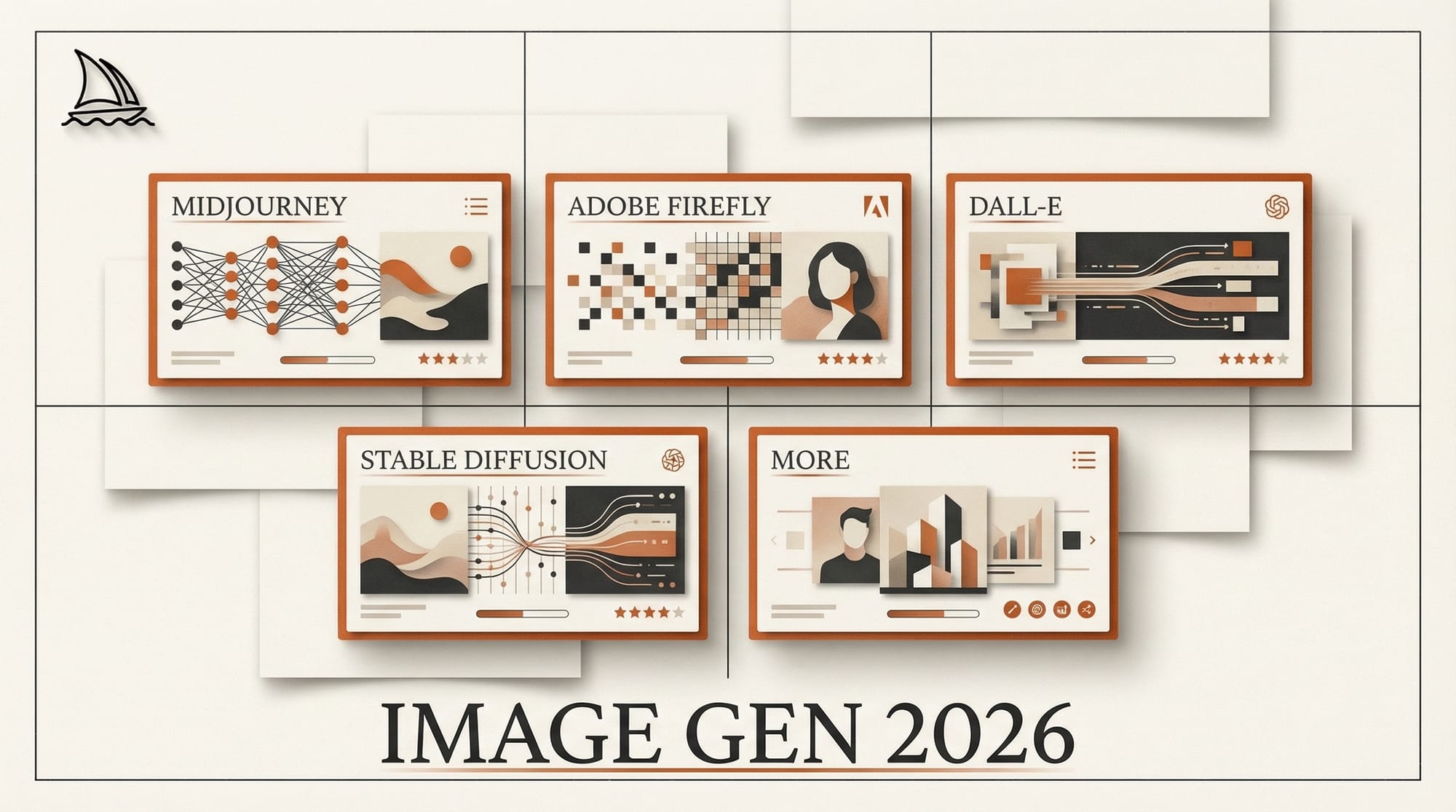
In September 2026, OpenAI's GPT Image 2.5 and GPT Image 2 lead AI image generation on both public leaderboards, followed by Microsoft's MAI-Image-2.6, Reve 2.1, xAI's Grok Imagine Image 2.0, Meta's Muse Image and Google's Nano Banana 2. On the Arena text-to-image leaderboard of September 24, 2026, GPT Image 2 scores 1383 and two preliminary GPT Image 2.5 entries score 1401 and 1424, while Midjourney V8.2 does not appear at all. Price and workflow still decide the right pick: FLUX.2 [pro] costs $0.03 per image through its API, and Nano Banana 2 costs $0.067. Here are the 10 best AI image generators for creative professionals, ranked by overall value, with prices checked on each vendor's own page on September 27, 2026.
| Tool | Current model | Price | Free option | Best for | Arena score |
|---|---|---|---|---|---|
| Midjourney | V8.2 | $10-120/mo | No | Artistic style | Not listed |
| OpenAI GPT Image | GPT Image 2.5 Sunburst and Flare; GPT Image 2 | API $0.006-0.211 per 1K image (GPT Image 2, low to high); ChatGPT Plus $20/mo | Yes (ChatGPT Free, with limits) | Overall quality, precise edits | 1383 (GPT Image 2); 1401-1424 (2.5, preliminary) |
| Adobe Firefly | Firefly Image Model 5 | $9.99-199.99/mo | Yes (daily limits) | Commercial safety | Not listed |
| Open weights | Qwen-Image-2512, HiDream-O1-Image, FLUX.2 [klein] 4B | Free to self-host | Yes | Local control | 1125 / 1116 / 1030 |
| FLUX.2 (Black Forest Labs) | FLUX.2 [pro], [flex], [max] | API from $0.03 per image | [klein] 4B open weights | API value | 1154 [pro]; 1162 [max] |
| Ideogram | Ideogram 4.0 | $20-60/mo; API $0.03-0.10 per image | Yes (limited) | Editable text, print designs | 1205 (4.0 Quality) |
| Leonardo AI | Lucid Origin, Phoenix | $12-60/mo | Yes (150 tokens/day) | Game and concept art | 1013 (Lucid Origin) |
| Nano Banana 2, Nano Banana Pro | API $0.067 (Nano Banana 2, 1K) to $0.24 (Pro, 4K) per image | Yes (Gemini app) | Google users, search-grounded images | 1261 (Nano Banana 2); 1247 (Pro) | |
| Reve | Reve 2.1 | Free, $7.99-19.99/mo | Yes | Layout control, native 4K | 1302 |
| Playground | GPT Image 2, Nano Banana Pro, Seedream | Free, $15-45/mo | Yes (10 images per 3 hours) | Beginners, design templates | Not listed |
1. Midjourney V8.2: Best for Artistic Style
Price: $10/mo (Basic), $30/mo (Standard), $60/mo (Pro), $120/mo (Mega); 20% off yearly | Free Tier: No | Best For: Illustration, concept art, stylized imagery
Midjourney remains the default recommendation for creators who want consistently beautiful output without touching a terminal. V8.2 became the default model on July 24, 2026, focused on bolder aesthetics, fewer low-quality results and Personalization that reads your taste more accurately. On August 27, 2026 Midjourney opened testing of a V8.2 edit model that edits images from instructions, takes up to four image references and handles inpainting and outpainting. V8.1, the default from June 10 to July 23, renders standard jobs about 4-5 times faster than earlier versions and adds native 2K HD images. The Standard plan at $30 a month includes unlimited Relax mode images. Midjourney's V8 models are not listed on the Arena or Artificial Analysis leaderboards, and Midjourney says it does not provide an API, so its quality cannot be compared by score. Our V8.2 deep dive covers the changes.
- Unlimited Relax mode images from the $30 Standard plan
- Strongest aesthetic consistency, with Personalization and style references
- New edit model with instruction edits and up to 4 image references
- No free tier
- Companies with more than $1 million in yearly revenue must buy Pro or Mega
- No API, and automating the service is prohibited
2. GPT Image 2.5: Best Overall Quality and Editing
Price: API $30 per 1M image output tokens (GPT Image 2.5 and GPT Image 2); ChatGPT Go $8/mo, Plus $20/mo, Pro $100/mo | Free Tier: Yes (ChatGPT Free, with image limits) | Best For: Precise edits, complex prompts, text in images
OpenAI holds the top of both public leaderboards. GPT Image 2 (snapshot dated April 21, 2026) scores 1383 on Arena, and OpenAI's image generation guide now recommends two GPT Image 2.5 models for new work: Sunburst "for workflows where editing precision matters most" and Flare for fast everyday generation. Both add xhigh and max quality settings and custom sizes up to 3840 pixels on the long edge, with anything above 2560x1440 marked experimental. OpenAI released GPT Image 2.5 on September 8, 2026, and it is retiring older models from the API: gpt-image-1 on October 23, 2026 and gpt-image-1.5 on December 1, 2026. API pricing is by token: $30 per million image output tokens for GPT Image 2.5 and GPT Image 2, so the cost per image depends on size and quality. OpenAI's own table puts a 1024x1024 GPT Image 2 image at $0.006 (low), $0.053 (medium) or $0.211 (high). In ChatGPT, the free plan includes image creation with separate usage limits; Go ($8 a month) adds more image creation, Plus ($20) adds image creation with Thinking, and Pro ($100) makes it unlimited within abuse guardrails. DALL-E 3 left the API on May 12, 2026; see our migration guide.
- Highest Arena scores of any released image model family
- Two tuned variants: Sunburst for precise edits, Flare for speed
- Up to 4K custom sizes and transparent backgrounds in the API
- Token pricing makes per-image cost harder to predict
- No local deployment option
- Resolutions above 2560x1440 are still experimental
3. Adobe Firefly: Best for Commercial Safety
Price: $9.99/mo (Standard), $19.99/mo (Pro), $49.99/mo (Pro Plus), $199.99/mo (Premium) | Free Tier: Yes (daily free generations) | Best For: Commercial projects that need IP clarity, Creative Cloud users
Adobe Firefly remains the safest choice for commercial work. Adobe says outputs from its own Firefly models "are safe for commercial use," and eligible enterprise customers can receive IP indemnification for select Firefly outputs. Firefly Image Model 5 has been generally available since March 19, 2026. On Adobe's plans page, Standard costs $9.99 a month for 2,000 generative credits and Pro $19.99 for 4,000; Pro Plus ($49.99, 10,000 credits) and Premium ($199.99, 50,000 credits) are 30% off for the first year in an offer that ends October 21, 2026. Every paid plan includes unlimited standard image and vector generations. Firefly also runs partner models such as Nano Banana, and Adobe states that you are responsible for checking partner-model output, so the commercial-safety promise covers Adobe's own models. Photoshop users should read our AI Assisted Editor and Firefly Image 5 breakdown.
- Adobe states its own models' outputs are safe for commercial use
- Unlimited standard image generations on every paid plan
- Deep Photoshop and Creative Cloud integration
- IP indemnification only for eligible enterprise customers
- Partner-model outputs are your responsibility
- Not listed on Arena, so quality cannot be compared by score
4. Open Weights (Qwen-Image, HiDream-O1, FLUX.2 [klein]): Best for Local Control
Price: Free to download and run | Free Tier: Yes (open weights) | Best For: Custom pipelines, LoRA training, private or offline work
Stable Diffusion 3.5 is no longer the local default: Stability AI has not released a newer image model, and SD 3.5 Large sits near the bottom of Arena at 938. The strongest open-weight models whose licenses allow commercial use are Alibaba's Qwen-Image-2512 (Apache 2.0, Arena 1125), HiDream-O1-Image (MIT, 1116) and Black Forest Labs' FLUX.2 [klein] 4B (Apache 2.0, 1030), which BFL positions for real-time, high-volume generation. Higher-scoring open models restrict commercial use: Qwen-Image-2.1 (September 2026, 1228 preliminary) ships under the Qwen Research License for non-commercial use, Ideogram 4 (1205) weights need a paid license for commercial self-hosting, and FLUX.2 [dev] (1146) and [klein] 9B use the FLUX Non-Commercial License. Read the license on the model card before you ship client work.
- No per-image cost and full control over the pipeline
- Private, offline generation with LoRA fine-tuning
- Apache 2.0 and MIT options for commercial work
- Requires a capable GPU and technical setup
- The best-scoring open models are non-commercial
- Quality trails the closed leaders by 250+ Arena points
5. FLUX.2: Best API Quality-to-Price Ratio
Price: From $0.03 per image (FLUX.2 [pro]), $0.05 ([flex]), $0.07 ([max]) | Free Tier: FLUX.2 [klein] 4B weights are Apache 2.0 | Best For: Developer integrations, batch generation
Black Forest Labs replaced FLUX 1.1 with the FLUX.2 family: [pro] and [flex] launched on November 25, 2025, [max] on December 16, 2025, and the small [klein] 4B and 9B models on January 15, 2026. BFL's pricing is per megapixel, so a standard 1-megapixel image costs $0.03 on FLUX.2 [pro], $0.05 on [flex] and $0.07 on [max], the same in the API and the BFL Playground. On Arena, FLUX.2 [max] scores 1162 and [pro] 1154, below the leaders but at a fraction of their price. FLUX.2 [dev], a 32B open-weight model, is free for non-commercial use only. BFL announced FLUX 3 on July 23, 2026, but its model and pricing pages list only FLUX 3 Video and FLUX 3 Action so far, no FLUX 3 image model.
- $0.03 per 1-megapixel image on [pro], priced the same in the API and Playground
- [max] adds grounding search for current events and products
- [klein] 4B open weights under Apache 2.0
- No consumer subscription app; you pay per image through the API or BFL Playground
- Trails GPT Image, Nano Banana and Reve on Arena
- [dev] and [klein] 9B weights are non-commercial
6. Ideogram 4: Best for Editable Text and Print Designs
Price: $20/mo (Plus, $15 billed yearly), $60/mo (Pro, $42 billed yearly); API $0.03-0.10 per image | Free Tier: Yes (weekly slow credits for eligible accounts) | Best For: Logos, posters, designs with text
Ideogram built its name on legible text inside images and now wraps its models in design workflows such as editable text layers and print-on-demand. Ideogram 4, released on June 3, 2026, is its first model with downloadable weights: a 9.3B-parameter model published on GitHub and Hugging Face, free for non-commercial use, with a $300-a-month self-serve license for commercial self-hosting. In the app, Plus costs $20 a month for 1,000 priority credits and Pro $60 for 3,500, both with unlimited slow generations. Through the API, Ideogram 4.0 costs $0.03 (Turbo), $0.06 (Default) or $0.10 (Quality) per image, and 4.0 Quality scores 1205 on Arena. Pure text accuracy has moved on: in Arena's Text Rendering category of September 24, 2026, OpenAI's models lead and Ideogram 4.0 Quality ranks 18th at 1238. Our text rendering comparison covers the trade-offs for typography.
- Design tools built around text: editable text layers, print-on-demand workflows
- Weights available to run locally
- Free plan for testing
- Commercial self-hosting needs a $300/mo license
- Ranks 18th in Arena's Text Rendering category
- Smaller ecosystem of third-party tools
7. Leonardo AI: Best for Game and Concept Art
Price: $12/mo (Essential), $30/mo (Premium), $60/mo (Ultimate); up to 20% off yearly | Free Tier: Yes (150 tokens/day) | Best For: Game assets, character design, concept art
Leonardo AI targets game developers and concept artists with its own Lucid and Phoenix models, style presets and video tools in one subscription. The free plan gives 150 fast tokens a day, and creations on it are public. Premium at $30 a month adds unlimited relaxed image generation on selected models (Lucid Origin, Lucid Realism, Phoenix 1.0 and 0.9), and Ultimate at $60 adds unlimited relaxed video on selected models. Leonardo's API, which is moving to pay-as-you-go, also lists partner models such as GPT Image 2, Nano Banana Pro and Seedream 5.0 Pro. Its own Lucid Origin scores 1013 on Arena, so choose Leonardo for its workflow and presets rather than raw model quality.
- Free plan with 150 tokens a day
- Unlimited relaxed image generation from the $30 Premium plan
- Image, video and design tools in one subscription
- In-house models trail the leaders on Arena
- Token system can be confusing for new users
- Free plan creations are public
8. Google Nano Banana 2 and Nano Banana Pro: Best for Google Users
Price: API $0.067 per 1K image (Nano Banana 2), $0.134 per 1K or 2K image (Nano Banana Pro); Google AI Plus $4.99/mo, AI Pro $19.99/mo | Free Tier: Yes (Gemini app) | Best For: Gemini app users, search-grounded images, high-volume API work
Google's image models now carry the Nano Banana name. Nano Banana 2 (Gemini 3.1 Flash Image) is built for speed and efficiency and can ground images in Google Web and Image Search; Nano Banana Pro (Gemini 3 Pro Image) costs twice as much per 1K image. On Google's Gemini API pricing page, Nano Banana 2 costs $0.067 per 1K image and $0.151 per 4K image, Nano Banana Pro costs $0.134 per 1K or 2K image and $0.24 per 4K image, and Nano Banana 2 Lite costs $0.0336 per 1K image. Both became generally available on May 28, 2026. Google shut down the Imagen 4 models in the Gemini API on August 17, 2026, and the original Nano Banana (Gemini 2.5 Flash Image) shuts down on October 2, 2026. In the Gemini app, image generation and editing are included on the free plan, and Google AI Plus ($4.99 a month) and AI Pro ($19.99) subscribers can redo an image with Nano Banana Pro. On Arena, Nano Banana 2 with web search scores 1261 and Nano Banana Pro 1247 (ninth and fourteenth overall, tenth and twelfth for photorealism), so choose Google for access and price rather than top quality.
- Free image generation and editing in the Gemini app
- Three price points in the API, from $0.0336 per image (Lite)
- API grounding with Google Web and Image Search
- No free API tier for the image models
- Trails OpenAI, Microsoft, xAI and Reve on Arena
- The original Nano Banana API ends October 2, 2026, so older integrations must migrate
9. Reve 2.1: Best for Layout Control and 4K Output
Price: Free, $7.99/mo (Lite), $19.99/mo (Pro), $59/user/mo (Teams) | Free Tier: Yes | Best For: Editable layouts, text-heavy designs, print-size images
Reve 2.1, released on July 9, 2026, plans an image as a structured layout before rendering it, so you can change one element and re-render only that region instead of re-rolling the whole prompt. It renders at native 4K (16 megapixels), which suits print work without an upscale step, and extends text rendering to foreign scripts. Reve 2.1 scores 1302 on Arena, fifth overall on September 24, 2026. It is a closed model, not open weights: you use it in the Reve app or through the API Reve opened on July 14, 2026. OpenAI announced an investment in Reve on July 27, 2026.
- Native 4K (16 megapixel) output
- Edit individual regions of an image without regenerating it
- Free plan, with paid plans from $7.99 a month
- Closed model with no local option
- Smaller community and fewer tutorials than Midjourney
- Video generation only on the $19.99 Pro plan
10. Playground: Best for Beginners
Price: Free, $15/mo (Pro, $12 billed yearly), $45/mo (Pro Plus, $36 billed yearly) | Free Tier: Yes (up to 10 images every 3 hours) | Best For: Beginners, social graphics, logos and posters from templates
Playground has become an AI design studio: you start from templates for logos, t-shirts, stickers and posters, and it generates with GPT Image 2, Nano Banana Pro and Seedream rather than a model of its own. The free plan makes up to 10 images every 3 hours plus 3 generations a month on premium models, with commercial use. Pro at $15 a month raises that to 75 images every 3 hours and 150 model credits, and Pro Plus at $45 adds unlimited generations and 1,000 credits.
- Zero setup, with templates for common design jobs
- Top models from OpenAI, Google and ByteDance in one app
- Free plan includes commercial use
- No in-house model
- Premium model use is limited by credits
- Less control than the dedicated tools above
Also strong in September 2026
- Microsoft MAI-Image-2.6 scores 1335 on Arena, fourth overall and the highest model outside OpenAI. It entered public preview in Microsoft Foundry on September 4, 2026 at $38 per million image output tokens; Bing Image Creator currently offers the older MAI-Image-2.5-Flash free, with 15 fast creations a day. See our MAI-Image-2.5 comparison.
- xAI Grok Imagine Image 2.0, generally available since August 7, 2026 as Quality Mode on grok.com/imagine and in the Grok apps, scores 1301 on Arena. Its API costs $0.04 per image at 1K. See our Grok Imagine Image 2.0 breakdown.
- Meta Muse Image, launched July 7, 2026, is free for everyday creation in Meta AI and costs $0.01 per image through Meta's developer API; it scores 1276 on Arena. See our Muse Image coverage.
- ByteDance Seedream 5.0 Pro launched on July 8, 2026 as a multimodal image model with reasoning for design work. It costs $0.045 per image up to 2.61 megapixels on BytePlus ModelArk and scores 1256 on Arena. See our Seedream 5.0 Pro guide.
- Recraft V4.1, released May 14, 2026, targets design and vector work. Its API costs $0.035 per image ($0.007 for V4.1 Flash), and plans start at $12 a month; free plan images are public and not licensed for commercial use.
- Krea 2, Krea's first in-house model (May 12, 2026), is included on every Krea plan from Free; Pro costs $35 a month or $21 billed yearly.
Frequently asked questions
What is the best AI image generator for designers in 2026?
For stylized design output, Midjourney V8.2 is still the pick. For precise edits, complex prompts and text inside images, GPT Image 2.5 leads Arena's overall and Text Rendering boards, with MAI-Image-2.6, Grok Imagine Image 2.0 and Reve 2.1 next; Ideogram 4 adds editable text layers for design work, and Recraft V4.1 targets vector and brand assets. Adobe Firefly suits teams already on Creative Cloud who want output Adobe describes as commercially safe.
Which AI image generator is free to use in 2026?
ChatGPT Free, the Gemini app, Meta AI (Muse Image), Bing Image Creator and Adobe Firefly all let you create images at no cost, within daily or usage limits. Ideogram, Reve, Leonardo (150 tokens a day), Krea and Playground (up to 10 images every 3 hours) all have free plans, and open-weight models such as Qwen-Image-2512 and FLUX.2 [klein] 4B are free to run on your own GPU. Midjourney has no free plan. Free plans usually limit volume, make images public or exclude commercial use, as Recraft's does.
Which AI image generator has the best photorealism?
In Arena's Photorealistic and Cinematic Imagery category of September 24, 2026, OpenAI leads with GPT Image 2.5 (1432 and 1419, preliminary) and GPT Image 2 (1381), followed by Microsoft's MAI-Image-2.6 (1331), xAI's Grok Imagine Image 2.0 (1310) and Reve 2.1 (1305). For print resolution, Reve 2.1 renders natively at 16 megapixels. Midjourney V8.2 is not ranked there and remains the pick for stylized rather than strictly realistic output.
How fast are AI image generators in 2026?
Recraft says V4.1 Flash takes 1.3 seconds from prompt to image. Midjourney says V8.1 and V8.2 render standard jobs about 4-5 times faster than earlier versions. BFL positions FLUX.2 [klein] for real-time, high-volume work, and OpenAI recommends GPT Image 2.5 Flare for fast everyday generation, with the low quality setting for quick drafts.
Are AI image generators safe for commercial use?
Adobe says outputs from its own Firefly models are safe for commercial use, and eligible enterprise customers can get IP indemnification for select outputs; partner models inside Firefly are your responsibility. Midjourney allows commercial use on every paid plan, but companies with more than $1 million in yearly revenue must buy Pro or Mega. Recraft paid plans grant full ownership and commercial rights, while its free plan does not. For open weights, check the license: Qwen-Image-2512 and FLUX.2 [klein] 4B are Apache 2.0, while Ideogram 4, FLUX.2 [dev] and Qwen-Image-2.1 are non-commercial without a paid license. Avoid trademarked elements, recognizable people and copyrighted characters in commercial work whatever the tool.