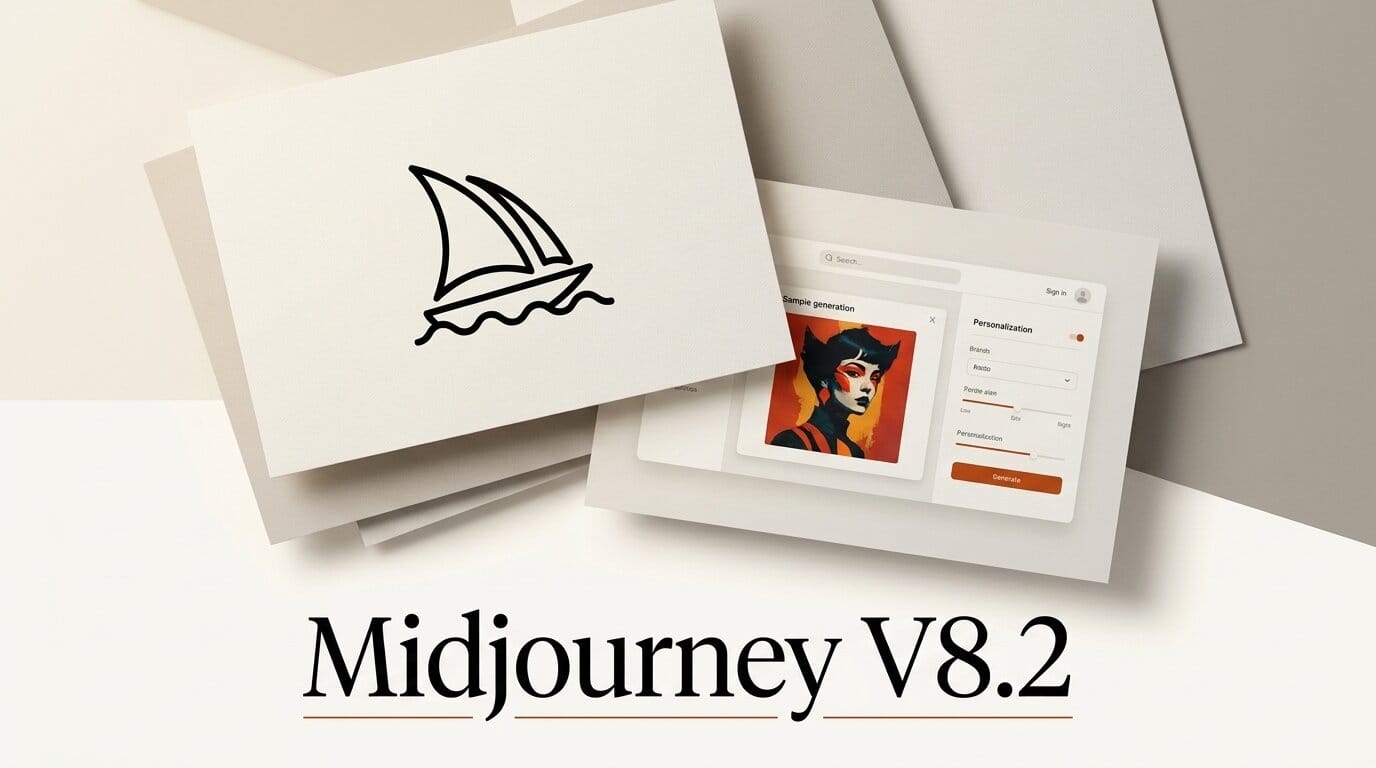
Midjourney released Version 8.2 on July 24, 2026, an update to its flagship text-to-image model focused on three things creators feel immediately: bolder aesthetics, a sharp drop in random low-quality results, and personalization that reads your taste far more accurately. It follows the V8.2 preview that opened on June 25 behind the --preview flag, and it lands roughly six weeks after V8.1 became the default model. If you generate images for thumbnails, ad concepts, moodboards, or client work, this is the release that changes what a default Midjourney prompt looks like. And as of August 27, 2026, V8.2 also has a native edit model in community testing, which brings instruction-based image editing to the same base model.
What Changed in Version 8.2
Midjourney frames V8.2 as an aesthetics and quality pass rather than a new architecture. In its own words, images "should be more creative, bold, sophisticated, edgy and fresh," and the "random situations where you'd get a low quality image should be dramatically reduced." That second point matters more than it sounds: the biggest tax on a production Midjourney workflow is re-rolling prompts until a usable frame appears. Fewer duds means fewer credits burned and less time culling a grid.
The other headline is personalization. V8.2 is designed to "understand your personal taste much better," especially for accounts with a large ratings history. Building a personalization profile for V8.2 now draws from a much larger and improved pool of images, so the model has more signal to match your style. This is a continuation of the same trajectory that made V8.1 the default in June, where personalization and draft-mode speed were the core selling points.
What Midjourney did not change is as telling as what it did. There is no pricing shift tied to the release, no new subscription tier, and no reset of prompt syntax, so existing prompt libraries and sref codes keep working. The company is treating V8.2 as a drop-in quality upgrade to a model creators already build production pipelines around, which lowers the switching cost to effectively zero. That continuity is deliberate: an aesthetics update only pays off if people actually adopt it, and adoption stalls when a new version forces you to relearn your prompts or rebuild your presets from scratch.
Version 8.1 vs Version 8.2: What Is Different
Here is how the current default compares to the July 24 release across the dimensions that affect a real workflow.
| Dimension | V8.1 (June default) | V8.2 (July 24 release) |
|---|---|---|
| Aesthetic direction | Refined, photoreal-leaning | Bolder, edgier, more sophisticated |
| Low-quality frequency | Occasional random misfires | Dramatically reduced |
| Personalization | Ratings-driven profiles | Larger image pool, better taste matching |
| Draft mode with random styles | Introduced with sref random | Carries forward, faster exploration |
| Availability | Default model | Preview since June 25, release July 24 |
The practical takeaway: V8.1 is the safe, predictable baseline, while V8.2 pushes style harder and cleans up the failure cases. For a deeper feature breakdown of the preview build, the write-up on what the V8.2 flag ships tracks the changes that landed during the preview window, and the Midjourney overview gives context on how the version cadence has accelerated in 2026.
How to Try Midjourney V8.2
You do not need to wait for a rollout to test the new model against your own prompts. The fastest path to an apples-to-apples comparison:
- Pick a proven prompt. Choose one you already know produces good V8.1 results, so any difference you see comes from the model, not the prompt.
- Append the version flag. Add the V8.2 selector (or
--previewduring the preview window) to run the same prompt through the new model. - Run it in Draft Mode with random styles. Draft Mode combined with sref random lets you sweep the style space quickly and cheaply before committing credits to upscales.
- Rebuild your personalization profile. Because V8.2 draws from a larger image pool, spend ten minutes rating pairs so the model learns your taste on the new base.
- Compare grids side by side. Judge on hit rate (how many usable frames per grid), not just the single best image.
The preview-era guidance in the V8.2 flag walkthrough covers the draft-mode and sref-random mechanics in more depth if you want to go further.
What This Enables for Creators
The combination of a lower dud rate and stronger personalization changes the economics of a Midjourney session. When fewer frames come back unusable, you spend fewer fast-hours and fewer reroll cycles to reach a final image, which directly lowers the cost per delivered asset. For anyone producing volume (blog thumbnails, social variations, ad concepts, storyboards) the "dramatically reduced" low-quality claim is the line that touches your budget.
Better personalization compounds that. A profile that genuinely learns your aesthetic means shorter prompts get closer to your intended look on the first try, so the model does more of the styling work and you do less prompt engineering. The early community reaction on Hacker News centered on exactly this shift toward taste-aware defaults rather than raw capability. For teams, the move is to standardize on one shared reference of what "on-brand" looks like and let personalization carry it across a project.
The V8.2 Edit Model: Instruction-Based Editing Arrives
On August 27, 2026, Midjourney began community testing of what it calls its first V8.2 image edit model, the image-to-image counterpart to the V8.2 base model covered above. Instead of generating from a text prompt alone, you hand the model an existing image and describe the change you want in plain language, and it edits the picture rather than starting over. This is the piece the V8 line had been missing: a native, instruction-driven editor that inherits V8.2's aesthetics and personalization.
The launch build covers four editing workflows in Midjourney's own words: editing images with instructions, generating images with other images (using up to four image references at once, which replaces the older omni-reference workflow), changing specific areas with inpainting or expanding the frame with outpainting, and carrying your personalization, moodboards, and srefs into an edit, though Midjourney notes moodboards and srefs may need extra prompt direction in this version. There is no separate version number for it: it is simply the V8.2 edit model, versioned with the base.
You can reach it two ways. On the web at midjourney.com or alpha.midjourney.com, drag an image into the prompt bar, click edit in the lightbox viewer, or upload through the edit tab. On Discord, append --edit url... to point the model at a source image. Midjourney is explicit that this is an early community test rather than a finished feature: in its words, "there's gonna be a lot of edge cases here," and it expects "a lot of fast-follow updates from here." Treat it as a preview to pressure-test on real edits, not a stable production tool yet.
How V8.2 Fits the Wider Image-Model Race
Midjourney is tuning for taste and reliability while rivals push architectural breadth. Open and multimodal models are racing on speed and format coverage: FLUX 3 folds image, video, and audio into one model, and Qwen-Image-Flash chases near-instant open generation. Midjourney's counter is a curated look and a personalization loop that competitors do not replicate, an advantage that reviews like the 2026 Midjourney update roundup keep returning to. V8.2 doubles down on that identity: it is not trying to be the everything-model, it is trying to be the one whose default output looks the most intentional.
Frequently Asked Questions
Is Midjourney V8.2 the default model now?
V8.1 became the default in June 2026, and V8.2 was released on July 24 after opening in preview on June 25. You can select V8.2 directly rather than waiting for it to be applied automatically to every prompt.
How is V8.2 different from V8.1?
V8.2 targets bolder, edgier, more sophisticated aesthetics, dramatically fewer low-quality results, and stronger personalization that draws on a larger pool of reference images to learn your taste.
Do I need to rebuild my personalization profile?
It helps. V8.2 builds profiles from a much larger and improved image pool, so re-rating images on the new base gives the model more accurate signal about your style.
Is V8.2 a new architecture or a tuning update?
Midjourney presents it as an aesthetics, quality, and personalization update rather than a ground-up new architecture, so prompt habits that work on V8.1 largely carry over.
What is the fastest way to compare V8.2 to V8.1?
Run a prompt you already trust through both models in Draft Mode, use random styles to sweep the style space cheaply, and judge on how many usable frames each grid returns rather than the single best image.
When did V8.2 become available?
The V8.2 preview opened on June 25, 2026 behind the preview flag, and the release was announced on July 24, 2026.
Can Midjourney V8.2 edit an existing image?
Yes. As of August 27, 2026, Midjourney is community-testing its first V8.2 edit model, which takes an existing image plus a natural-language instruction and supports up to four image references, inpainting, and outpainting. Use it on the web by dragging an image into the prompt bar, or on Discord with the --edit url... syntax. It is an early test build, so expect edge cases while Midjourney gathers feedback.