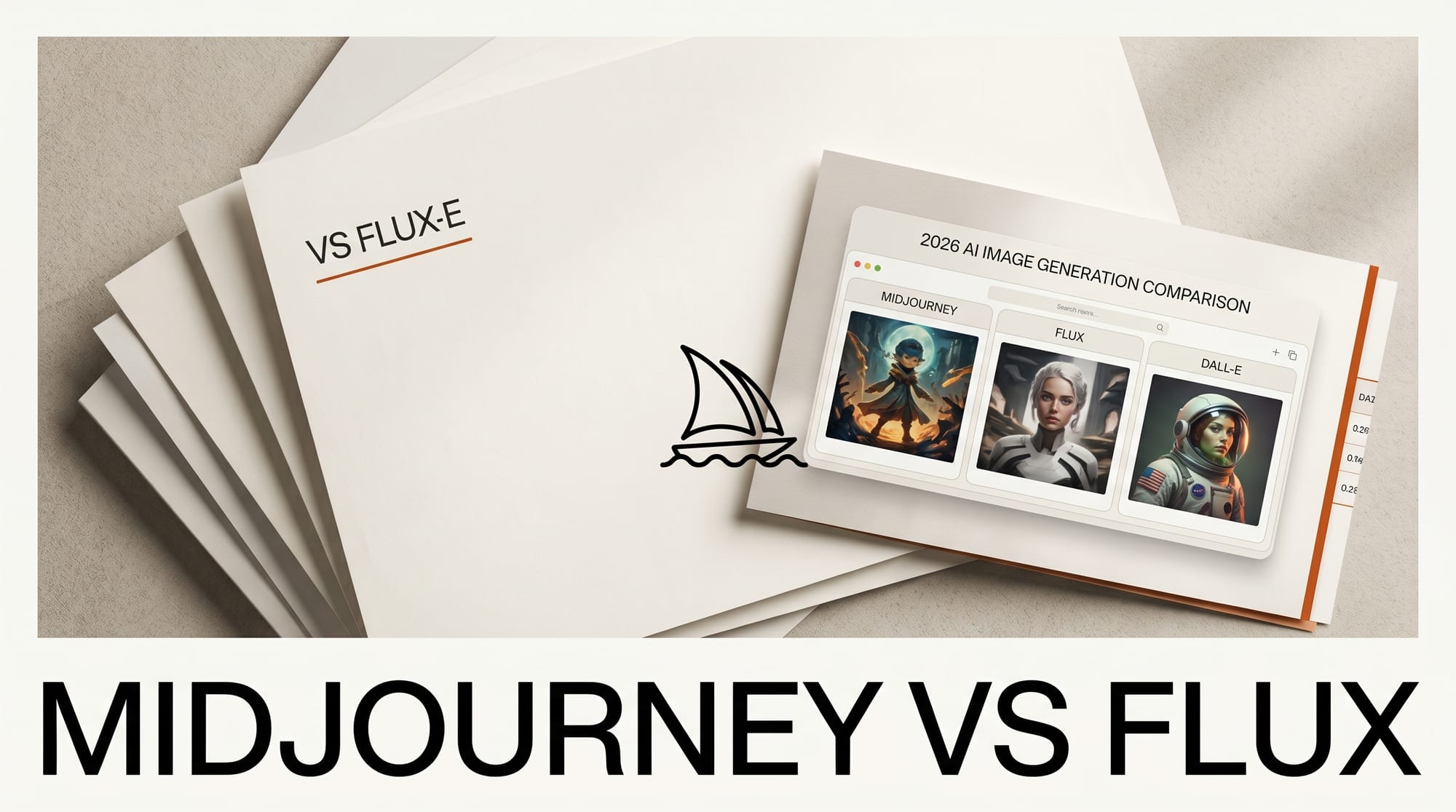
Midjourney, Flux, and OpenAI's GPT-Image-2 (formerly DALL-E) are the three most-debated AI image generators among working creators in 2026. Each one wins on different jobs, and choosing wrong costs subscription money and time. This is the head-to-head comparison: which one to use, when, and why -- based on real production work, not benchmark vibes.
The short answer is that no single model wins for every job. The longer answer is that most working designers in 2026 use two of these three together, and the choice depends on whether you prioritize aesthetic ceiling, in-image text, or open-weights flexibility.
TL;DR -- Which to use, when
- Pick Midjourney V8.1 if: aesthetic ceiling matters most, you produce design and editorial work, you want minimum prompt engineering for maximum visual quality.
- Pick GPT-Image-2 if: text rendering inside images matters, you produce posters or ads with typography, you want maximum instruction-following for complex prompts.
- Pick FLUX if: you need open-weights customization through LoRAs, you produce volume work and per-image cost matters, you want full local control over the generation pipeline.
- Most working designers run two of these three: Midjourney + FLUX (aesthetic + customization), Midjourney + GPT-Image-2 (aesthetic + text rendering), or FLUX + GPT-Image-2 (cost + text). All-three is overkill unless you ship at agency scale.
Quick comparison table
| Feature | Midjourney V8.1 | OpenAI GPT-Image-2 | FLUX (BFL) |
|---|---|---|---|
| Aesthetic ceiling | Highest | High | High (with LoRAs) |
| In-image text | Improving | Best | Decent |
| Instruction following | Improved (V8.1) | Best | High |
| Customization | Style refs, sref | Limited | Open weights, infinite LoRAs |
| Pricing | $10-60/mo | ChatGPT Plus + API | Free self-host, BFL API |
| Per-image cost | ~$0.02-0.10 | ~$0.04-0.08 | ~$0.001-0.02 (self-host) |
| Speed | 30-60s | 30-90s | 5-30s on 4090 |
| Commercial license | Yes (paid) | Yes (Plus+) | Apache (dev) / commercial license (pro) |
| API access | Yes (recent) | Yes | Yes (BFL or fal) |
| Native ComfyUI | No (third-party) | Yes (partner nodes) | Yes (first-class) |
Midjourney V8.1 -- Best for aesthetic ceiling
Midjourney V8.1 Alpha shipped 3x faster HD generation in 2026 alongside the aesthetic strengths Midjourney has held since V5. For working designers, Midjourney remains the highest-ceiling option for "make this look beautiful" prompts. The V8.1 release also closes the historical gap on prompt adherence -- earlier Midjourney versions interpreted prompts loosely, V8.1 follows them more literally without sacrificing aesthetic coherence.
Wins: Brand campaigns, magazine illustration, concept art, design moodboards, art-direction-friendly output, "looks-like-a-pro-took-it" feel.
Loses: In-image text (still improving but not best-in-class), precise multi-element instruction following, customization beyond style references and stylize parameters.
Pricing: Basic $10/mo, Standard $30/mo, Pro $60/mo. Commercial use requires a paid plan. The fastest tier is Pro for working creators.
OpenAI GPT-Image-2 -- Best for text and instruction following
OpenAI's GPT-Image-2 raised the bar on two specific capabilities. First, in-image text rendering -- typography in generated images is now accurate enough for posters, ads, and social cards without a separate compositing pass. Second, instruction following -- complex multi-element prompts ("a designer working at a wooden desk holding a coffee cup with the text 'BRIEFING' on it, late afternoon light") render correctly first try where Midjourney and earlier DALL-E typically required iteration.
GPT-Image-2 reached commercial creators through three paths: ChatGPT Plus and Pro rollout, the earlier preview showcasing text capabilities, and the fal API at 4K commercial-use pricing. ComfyUI integration through native partner nodes brought the model into the open-source workflow ecosystem.
Wins: Posters and ads with typography, social cards with text, complex multi-element scenes, signage and product mockups with labels, instruction-following across long prompts.
Loses: Aesthetic ceiling on pure-art prompts (Midjourney still wins), customization (no LoRA equivalent), per-image cost at high volume.
Pricing: ChatGPT Plus ($20/mo) gives you GPT-Image-2 in chat. ChatGPT Pro ($200/mo) gives faster access. fal API gives pay-per-call commercial 4K access. For occasional designers, Plus is sufficient. For production volume, fal API is more economical.
FLUX -- Best for customization and open-weights flexibility
FLUX from Black Forest Labs is the de facto open-source standard for high-quality AI image generation in 2026. The 70-person team has shipped successive FLUX versions that consistently lead the open-weights field. FLUX dev is Apache-licensed for personal and commercial development. FLUX pro requires the BFL commercial license but is API-accessible for managed use.
What makes FLUX win for working designers in 2026 is the ecosystem. Thousands of community LoRAs for style customization on Civitai. MegaStyle's 1.4M-image style transfer dataset dramatically expanded what FLUX can produce stylistically. ComfyUI native integration as first-class -- FLUX is the default open-weights model that ships with ComfyUI in 2026.
Wins: Style customization through LoRAs, brand-specific tuning, volume work where per-image cost dominates, technical workflows requiring full pipeline control, on-prem deployment for IP-sensitive studios.
Loses: Setup cost (1-3 hours your first time with ComfyUI), zero-friction quality without prompt engineering (Midjourney still leads on the quick win), cutting-edge in-image text (GPT-Image-2 still leads).
Pricing: Free for self-hosted FLUX dev. BFL API: pay-per-call. fal API: pay-per-call. ComfyDeploy / RunComfy / Replicate: hosted ComfyUI environments at per-generation pricing for teams without local GPU.
Head-to-head: which wins for which job?
Brand campaign hero image
Winner: Midjourney V8.1. Aesthetic ceiling matters most for hero images. Midjourney's "make this look like a pro took it" quality is the lead for campaign work. Use FLUX with brand-tuned LoRAs as the second pass for variations.
Social card with typography (poster, ad, banner)
Winner: GPT-Image-2. Typography accuracy is the differentiator. Generate the base, route through GPT-Image-2 for text rendering, output. Midjourney's text rendering is improving but still inconsistent for production typography work.
High-volume editorial illustration
Winner: FLUX (with style LoRAs). When you need 50 stylistically consistent illustrations for an editorial article or 20 product variations for an e-commerce campaign, the per-image cost on Midjourney or GPT-Image-2 adds up. FLUX self-hosted approaches zero per-image cost after hardware is paid off, with style consistency through brand-specific LoRAs.
Concept art and moodboards
Winner: Midjourney V8.1. Same reason as hero campaign work -- aesthetic exploration where "make it beautiful" beats specifications.
Product mockups with labels
Winner: GPT-Image-2. In-image text accuracy. Generate the product mockup with brand label, ship without compositing pass.
Custom-style generation for a specific client
Winner: FLUX (with custom-trained LoRA). Train a LoRA on the client's existing visual library, generate matched-style new work. Neither Midjourney nor GPT-Image-2 supports this depth of customization.
Quick exploration and ideation
Winner: Midjourney V8.1. Fastest path to "good-enough" output for a moodboard or quick exploration. The friction of FLUX setup is wrong for occasional use.
How to combine these in a working pipeline
Three pattern stacks for working designers in 2026:
- Aesthetic + text: Midjourney V8.1 for hero shots, GPT-Image-2 for typography composites, Photoshop for finishing. Subscription cost: ~$50/mo.
- Aesthetic + customization: Midjourney V8.1 for exploration, FLUX in ComfyUI with brand LoRAs for production. Subscription cost: $10/mo + GPU hardware (one-time) + Civitai (free).
- Cost + text: FLUX in ComfyUI for volume, GPT-Image-2 via fal for typography. Per-image cost approaches zero for FLUX, ~$0.04-0.08 per text-heavy image via fal. Studio scale.
Whichever pipeline you choose, our AI image generation 2026 complete guide covers the full landscape including the secondary models (Imagen, Ideogram, Adobe Firefly) for use cases the big three don't dominate.
What's coming in late 2026
- Midjourney V9 likely: Midjourney's release cadence suggests V9 around late 2026. Expect further closing of the gap on text rendering and instruction following.
- GPT-Image-3: OpenAI typically iterates yearly; the next generation likely brings video-image cross-modality and even tighter instruction following.
- FLUX 2: BFL has signaled major architecture changes. The next FLUX generation likely introduces MoE (similar to Nucleus-Image's open-source MoE diffusion) and significantly higher quality at lower compute.
- Brand-tuned generation as differentiator: Adobe Firefly Foundry (Adobe + NVIDIA + WPP) and Stability Brand Studio represent the enterprise direction -- branded models trained on brand-owned IP. The big-three image models will likely follow.
Frequently asked questions
Which AI image generator wins in 2026: Midjourney, FLUX, or DALL-E?
It depends on the workload. Midjourney V8 wins for stylized design and aesthetic-driven creative work. FLUX 1.1 Pro wins for photorealism and commercial licensing flexibility. DALL-E (now GPT Image 2) wins for prompts requiring text inside images and multi-subject scene composition.
Is Midjourney better than DALL-E in 2026?
Midjourney V8 ranks higher on Artificial Analysis aesthetic ELO scores and produces more design-friendly output by default. DALL-E (GPT Image 2) handles text rendering inside images more reliably. For most design and creative work, Midjourney wins. For text-heavy outputs like posters or memes, GPT Image 2 wins.
Is FLUX better than Midjourney for commercial work?
FLUX 1.1 Pro offers clearer commercial licensing and self-hosting options that Midjourney does not. For agencies needing on-premises generation or custom fine-tuning, FLUX is the better choice. For one-off design output through a paid SaaS subscription, Midjourney's quality still leads.
How much does each cost in 2026?
Midjourney runs $10 to $96 per month depending on plan tier. FLUX 1.1 Pro is $0.04 per image via API or self-host with no per-image cost. GPT Image 2 access is included with ChatGPT Plus at $20 per month or via API at $0.04 per image.
Which AI image model is best for text inside images?
GPT Image 2 leads by a clear margin on rendering English text inside generated images, including stylized typography and accurate spelling. FLUX 1.1 Pro is second. Midjourney V8 still struggles with text fidelity, often producing garbled or misspelled output even for short phrases.