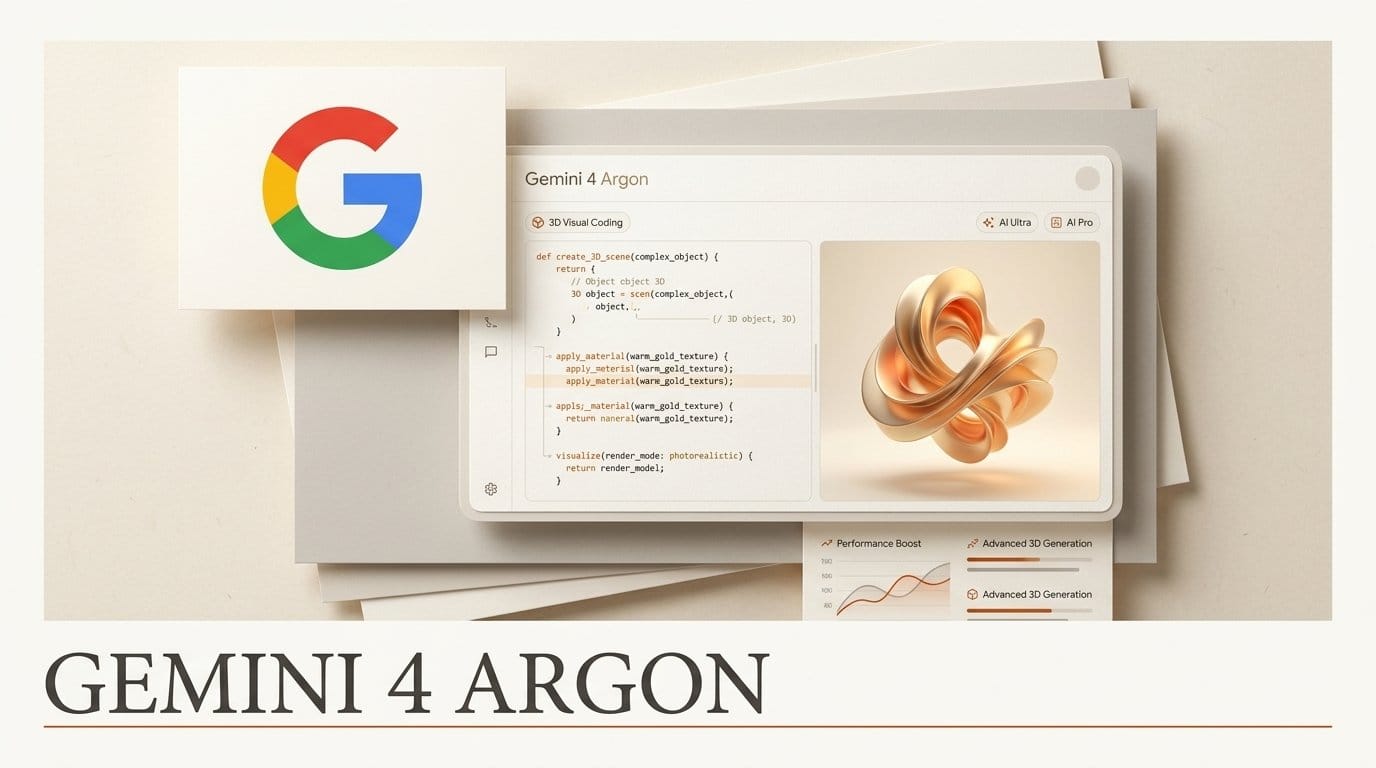
Google released Gemini 4 Argon to the public on October 13, 2026, two weeks after a preview limited to security teams. Google AI Ultra subscribers can use it today in the Gemini app, AI Mode in Search and Google Antigravity, and it is rolling out to Google AI Pro in select countries. Through the Gemini API it costs $2 per million input tokens and $10 per million output tokens until the end of November, then double that. In our own test, Argon built a 3D product scene in 36 seconds for about 4.5 cents.
What shipped
Argon is Google's new top model, announced by Google DeepMind's Koray Kavukcuoglu. Google first showed it on September 30, when only a small group of vetted cyber defenders could use it. Today it opens to everyone who pays.
- Gemini app and AI Mode: available to Google AI Ultra now; Google's AI plans page says it is rolling out to AI Pro subscribers in select countries.
- Google AI Studio and Antigravity: Ultra subscribers can try it in both.
- Gemini API: paid tier only. The pricing page says Argon is not on the free tier.
Google pitches it at hard, long jobs: big code projects, deep document analysis and multi-step agent work. Agents built on it pause and ask before an irreversible step. For creators, the useful part is what Google calls visual coding: Argon writes working 3D scenes for Three.js, Blender scripts and browser games, and Google published demo apps such as Wizard Chess 3D in AI Studio.
What changed from the previous version
Google gives no direct scores against earlier Gemini models in the launch post. It does claim first place on the Vals Index, an independent ranking across finance, coding, legal and tax tasks, and 87% on the ERQA spatial reasoning test. Google also says Argon follows style instructions better than earlier Gemini models and rarely takes shortcuts on coding tests.
The price is new too. The previous top model, Gemini 3.1 Pro, costs $2 in and $12 out per million tokens on the same pricing page. Argon costs less per output token until November 30, and more after it.
Our test: one 3D scene, two models
Original test, run on October 13, 2026. We gave Gemini 4 Argon and Gemini 3.1 Pro the same request a designer might type: build a single web page with a 3D sneaker on a round pedestal, soft studio light, a cream background, an orange accent, slow rotation and drag to look around. No 3D files allowed, so each model had to build the shoe from simple shapes in Three.js. We sent the prompt through the Gemini API, the engine behind AI Studio, then opened each page in a browser.
| Result | Gemini 4 Argon | Gemini 3.1 Pro |
|---|---|---|
| Time to finished page | 36 seconds | 52 seconds |
| Cost of this one scene | About 4.5 cents (about 9 cents from December) | About 8.5 cents |
| Opened without errors | Yes | Yes |
| What came out | Rounded sole, tongue, laces and heel loop on an orange-trimmed pedestal, plus a product title it added on its own | Stacked boxes and half cylinders, with the laces floating off the shoe |
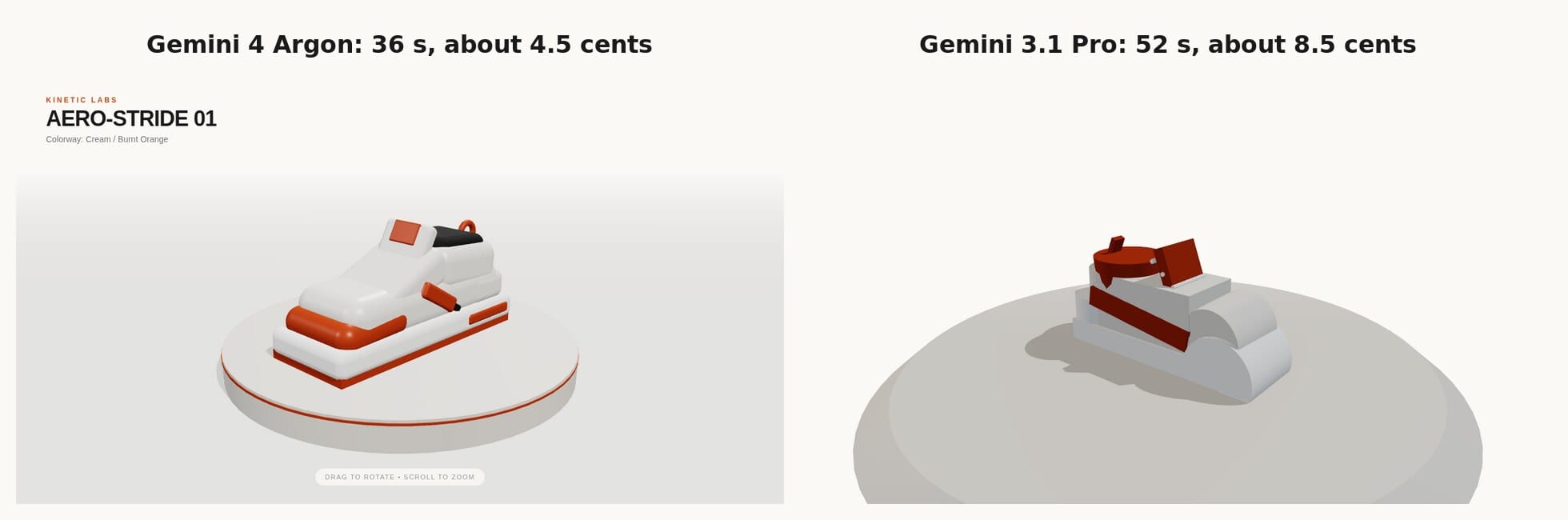
Neither shoe would pass for a real product render. Argon's reads as a chunky sneaker from most angles but has a boxy toe, and it spun very slowly. Still, Argon's page looked like a finished product page, with branding we did not ask for. Gemini 3.1 Pro spent most of its tokens on hidden reasoning, which is why it cost more and took longer. One run each, so treat this as a first look, not a benchmark.
What it means for your workflow
If you already pay for AI Ultra, Argon is worth trying today for anything where the AI has to build rather than describe: a 3D mockup for a pitch, a small browser game, a Blender script that sets up a scene, or an interactive page for a portfolio. Google's own Playground game maker points the same way.
If you use the API through a tool such as an app builder, the per-job price is small: our 3D scene came to a few cents. Lock in heavy use before November 30, when the output price doubles to $20 per million tokens. Repeated inputs, like a long style guide sent every time, are billed 95% cheaper when cached.
Argon does not replace Google's image or video models. The launch post says nothing about new image or video generation.
What is not known yet
Google has not said which countries get AI Pro access first, or how many Argon prompts a day each plan allows in the Gemini app. The 1 million token limit applies to input and output combined. The model card lists the safety testing, but not how Argon compares with rival models from OpenAI or Anthropic on creative work. We will grow this page into a full comparison once we have run those tests.