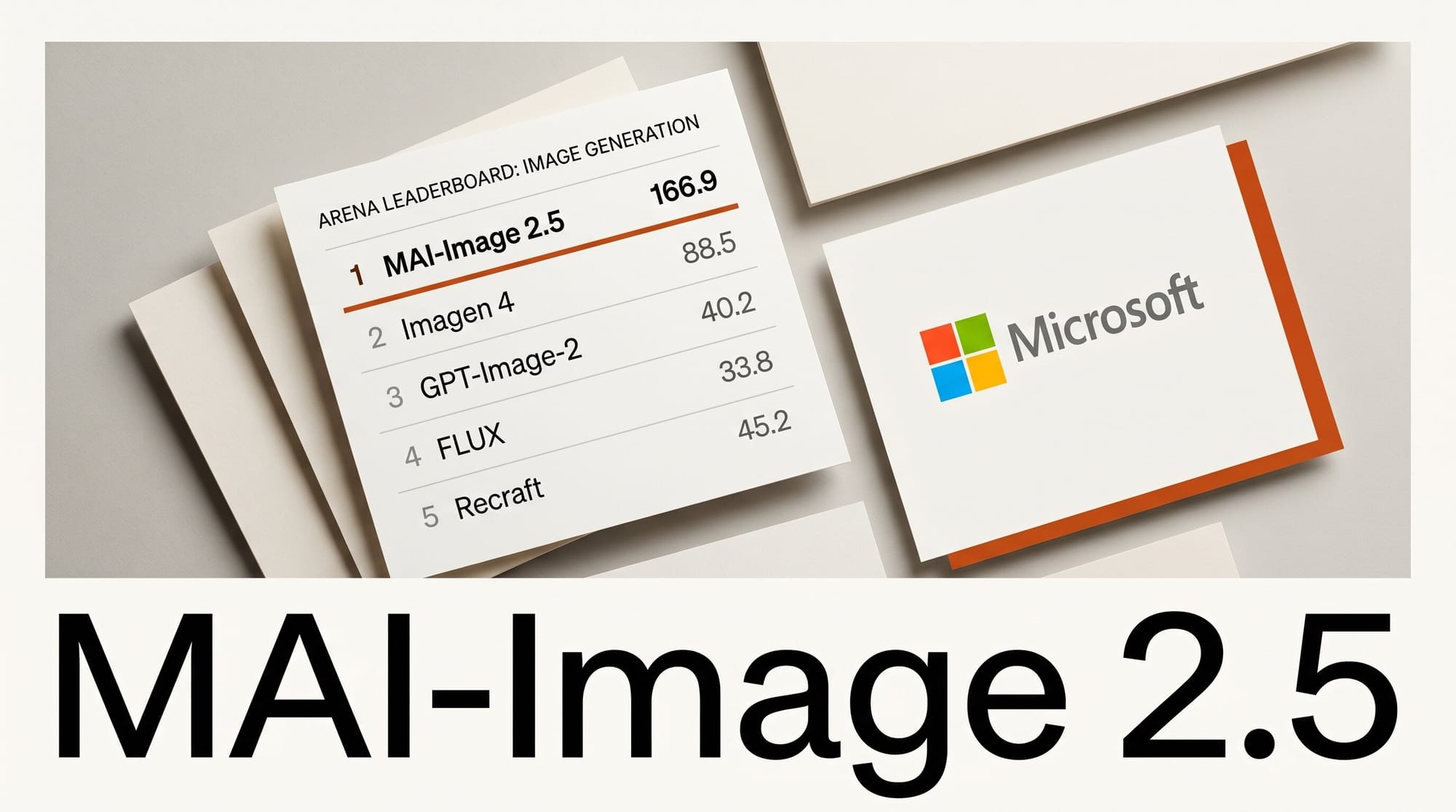
Microsoft's MAI-Image-2.5 debuted at No. 3 on the Arena text-to-image leaderboard on May 26, 2026, breaking a stretch where the top three slots had been split between Google's Imagen 4 family and OpenAI's GPT-Image-2 family. The model is the first MAI-line image generator to crack the top three on a public ELO leaderboard, and the first frontier-quality option that lives natively inside Microsoft's Copilot and Foundry surfaces. The short verdict: if you ship inside the Microsoft stack, MAI-Image-2.5 just became your default; for everyone else, the picture is more nuanced, and the choice still depends on text rendering, license posture, and how much you care about controllable style.
Quick Picks
Pick MAI-Image-2.5 if you live in Copilot, Microsoft Foundry, or Designer, need reliable on-image text, and want a single API for both editorial illustration and product mockups without paying a third-party premium.
Pick Imagen 4 Ultra if you are building inside Google's Gemini API or Vertex AI, want the strongest photographic realism on the leaderboard, and need batch generation that hooks into the rest of Google's media stack.
Pick GPT-Image-2 if you are already paying for ChatGPT Plus or the OpenAI API, want the broadest cultural style coverage, and need an image model that integrates with ChatGPT's conversational editing loop.
Pick FLUX.2 or Recraft V3 if you need controllable style transfer, brand-asset reuse, or commercial licensing terms that explicitly cover commercial distribution at scale.
Detailed Comparison
The five models in this comparison sit in the production tier of text-to-image generators as of late May 2026: MAI-Image-2.5, Imagen 4 Ultra, GPT-Image-2, FLUX.2 [max], and Recraft V3. The methodology here mirrors how a small studio actually decides which model to use. We weight five axes: on-image text rendering, multi-object layout coherence, stylized illustration, surface integration, and commercial-use posture. Arena ELO is referenced as a tiebreaker, not the primary signal, because ELO rewards generic prompts and underweights the specific creator workflows that drive revenue.
On-image text rendering
Text rendering is the single most expensive failure mode for diffusion models in commercial work. A product mockup with the wrong typography sends a designer back to Photoshop; a poster with garbled headline kerning is unusable. MAI-Image-2.5's release notes single out text rendering as a top-priority axis for the 2.5 generation, and the Arena leaderboard's text-heavy prompt subset is where the model has gained the most ground over its MAI-Image-2 predecessor. Imagen 4 Ultra remains the most reliable on long English headlines and Latin scripts but trails on non-Latin scripts. GPT-Image-2 is competitive on short slogans but has a known weak point on layout consistency when text and complex backgrounds collide. FLUX.2 has improved markedly but is still behind on multi-line text. Recraft V3 wins on structured layouts (posters, social cards) because of its dedicated text-as-vector pipeline; it loses on purely raster text.
Multi-object layout coherence
Layout coherence is the second axis Microsoft flagged in the 2.5 announcement. The benchmark is a scene with five or more distinct objects in defined spatial relationships, lit consistently. MAI-Image-2.5 lands a clean step above MAI-Image-2 on these prompts and is roughly on par with Imagen 4 Ultra. GPT-Image-2 still holds a slight edge on the hardest spatial prompts (relational language like "the cup is behind and to the left of the lamp"). FLUX.2 [max] is the dark horse here: its multi-reference control feature lets you pin two or three reference images per object, which produces the most photo-accurate compositions at the cost of slower iteration. Recraft V3 is not built for this prompt class and shouldn't be evaluated on it.
Stylized illustration and brand consistency
This axis is where the leaderboard order misleads. Recraft V3 dominates brand-consistent illustration because of its style-as-asset model, where you bake a style reference once and reuse it across hundreds of generations. MAI-Image-2.5 has caught up on first-shot stylized illustration quality and now feels closer to Recraft than its predecessor did, but it does not match Recraft's style-asset persistence. FLUX.2 [max] sits between the two, with its style-reference inputs producing the most photoreal results but with less consistency on illustrative styles. Imagen 4 Ultra and GPT-Image-2 both render stylized work cleanly on the first prompt but drift across a session, which is exactly the failure mode that kills brand work.
Surface integration
This is where MAI-Image-2.5 lands its most decisive win. Microsoft has confirmed the model will roll out to Copilot and Microsoft Foundry within two weeks of the leaderboard debut, which means any team already paying for Copilot Pro or Foundry can generate at their existing seat or tenant price without procuring a new model API. Imagen 4 Ultra has the equivalent story inside Google's stack via the Gemini API and Vertex AI; if your shop is in Workspace, Imagen 4 wins on integration. GPT-Image-2 ships inside ChatGPT Plus and the OpenAI API. FLUX.2 and Recraft are standalone services that integrate via REST APIs but live outside the major productivity suites.
Commercial-use posture and pricing
Microsoft has not disclosed API pricing for MAI-Image-2.5; for Foundry and Copilot users, it is reasonable to expect inclusion at the existing seat price for typical volumes and a metered tier above that. Imagen 4 Ultra pricing via the Gemini API is publicly listed and competitive on cost-per-megapixel. GPT-Image-2 pricing is publicly listed via the OpenAI API. FLUX.2 [max] pricing through Black Forest Labs is metered per image with explicit commercial-distribution terms. Recraft V3 is sold via tiered subscriptions with explicit commercial rights at every paid tier. For any agency that has ever fought a license argument with a client, the Recraft and FLUX terms are the most ironclad; the leaderboard top three are competitive but require more reading of the small print on output ownership.
When Each One Wins
MAI-Image-2.5 wins when you are already a Microsoft shop and your work mixes editorial illustration with product mockups and brand assets that need readable text. The combination of a top-three ELO and native presence in Copilot and Foundry is what Microsoft did not have a quarter ago, and it removes the friction of running a separate image-gen vendor.
Imagen 4 Ultra wins when photographic realism is the hard requirement and you are already paying Google for Gemini or Vertex. Editorial photo work, lifestyle imagery, and product photography come out cleaner here than on the rest of the field.
GPT-Image-2 wins when you want conversational iteration. ChatGPT's edit-and-refine loop is the single most accessible workflow for non-technical creators, and it pairs natively with ChatGPT's other tools. The model's growth to 1 billion creations in India in 30 days is evidence the loop works at scale.
FLUX.2 [max] wins when you need multi-reference control, photoreal compositional work, and the strongest commercial license posture. The new Erase Mode for object removal extends FLUX into editing workflows that competitors require a second tool to cover.
Recraft V3 wins when you ship branded assets at volume. The style-as-asset workflow, the vector text pipeline, and the per-tier commercial license combine into the cleanest tool for design studios producing posters, social cards, and stylized marketing imagery.
Pricing and ROI
The honest ROI calculation for a small studio is rarely the per-image API price. Per-image, all five models sit within a tight band that translates to fractions of a cent at typical resolutions, and at production volume any of them is a smaller line item than the artist's hourly rate. The lever that actually moves cost is integration. If your team already pays for Copilot Pro per seat and you replace a separate image-gen subscription with MAI-Image-2.5 inside Copilot, the net spend drops by the full price of the displaced subscription. The same logic applies to Imagen 4 Ultra inside Workspace and to GPT-Image-2 inside ChatGPT Plus. FLUX.2 and Recraft remain compelling for shops that prefer best-of-breed over bundle economics, especially when commercial license clarity is the binding constraint. For broader context on where each tool fits in a full creative stack, see our Best AI Image Generators 2026 comparison and our coverage of the Bonsai Image 4B on-device alternative for teams that need offline generation.
Verdict
MAI-Image-2.5 closes the most important gap in Microsoft's creative AI stack: a frontier-quality image model that ships natively inside Copilot and Foundry. For Microsoft-stack teams, it is the new default. For everyone else, the choice tree is unchanged from a month ago, only sharper: Imagen 4 Ultra for Google-stack photographic work, GPT-Image-2 for conversational iteration, FLUX.2 [max] for multi-reference photoreal work, Recraft V3 for branded illustration at volume. The bigger story behind the leaderboard debut is the in-house-versus-partner pattern: Microsoft choosing to spend its own research budget on the image stack, similar in spirit to Xiaomi's MiMo-v2.5 pivot, signals that the partner-API era is closing and the platform incumbents intend to own creative tooling end to end.
Frequently Asked Questions
When will MAI-Image-2.5 ship to MAI Playground and Microsoft Foundry?
Microsoft's announcement gives a window of about two weeks from the May 26 leaderboard debut, which puts the Playground and Foundry rollout in early-to-mid June 2026. Until then, the model is accessible via the Arena text-to-image interface, where you can A/B it against Imagen 4 Ultra and GPT-Image-2 in side-by-side battle mode.
What is the expected API pricing versus Imagen 4 Ultra and GPT-Image-2?
Microsoft has not disclosed standalone API pricing. Expect inclusion in Copilot and Foundry seat plans for typical volumes, with metered pricing above a tier threshold. Imagen 4 Ultra and GPT-Image-2 both publish per-image API pricing. For shops without a Microsoft seat plan, the API pricing comparison is the deciding factor; for shops with one, the bundled inclusion likely wins on cost.
Does Microsoft's in-house posture mean the OpenAI image partnership is winding down?
The two-track strategy continues. Microsoft has shipped both partner-API products and in-house MAI models for over a year, and the 2.5 launch is consistent with that pattern rather than a break from it. Practically, Copilot and Foundry users will be able to choose between MAI-Image-2.5 and partner models, with the in-house option likely positioned as the default for cost-controlled work.
How does MAI-Image-2.5 compare to Recraft V3 on stylized illustration?
MAI-Image-2.5 has closed a meaningful gap and is now competitive on first-shot stylized illustration quality. Recraft V3 retains the advantage on brand-asset reuse via its style-as-asset workflow; if your work requires the same illustrative style across hundreds of generations, Recraft is still the cleaner tool. If your work is one-off editorial illustration with quality as the hard requirement, MAI-Image-2.5 is a credible alternative.
Can I commercially distribute outputs from MAI-Image-2.5 without additional license?
Microsoft has not yet published standalone commercial-use terms for the 2.5 model outside of Copilot and Foundry. Inside Copilot and Foundry, commercial-use rights are governed by the existing service agreements. Until standalone terms are published, agencies producing client deliverables should default to FLUX.2 [max] or Recraft V3 for license clarity, and use MAI-Image-2.5 for internal work, mockups, and pitches.