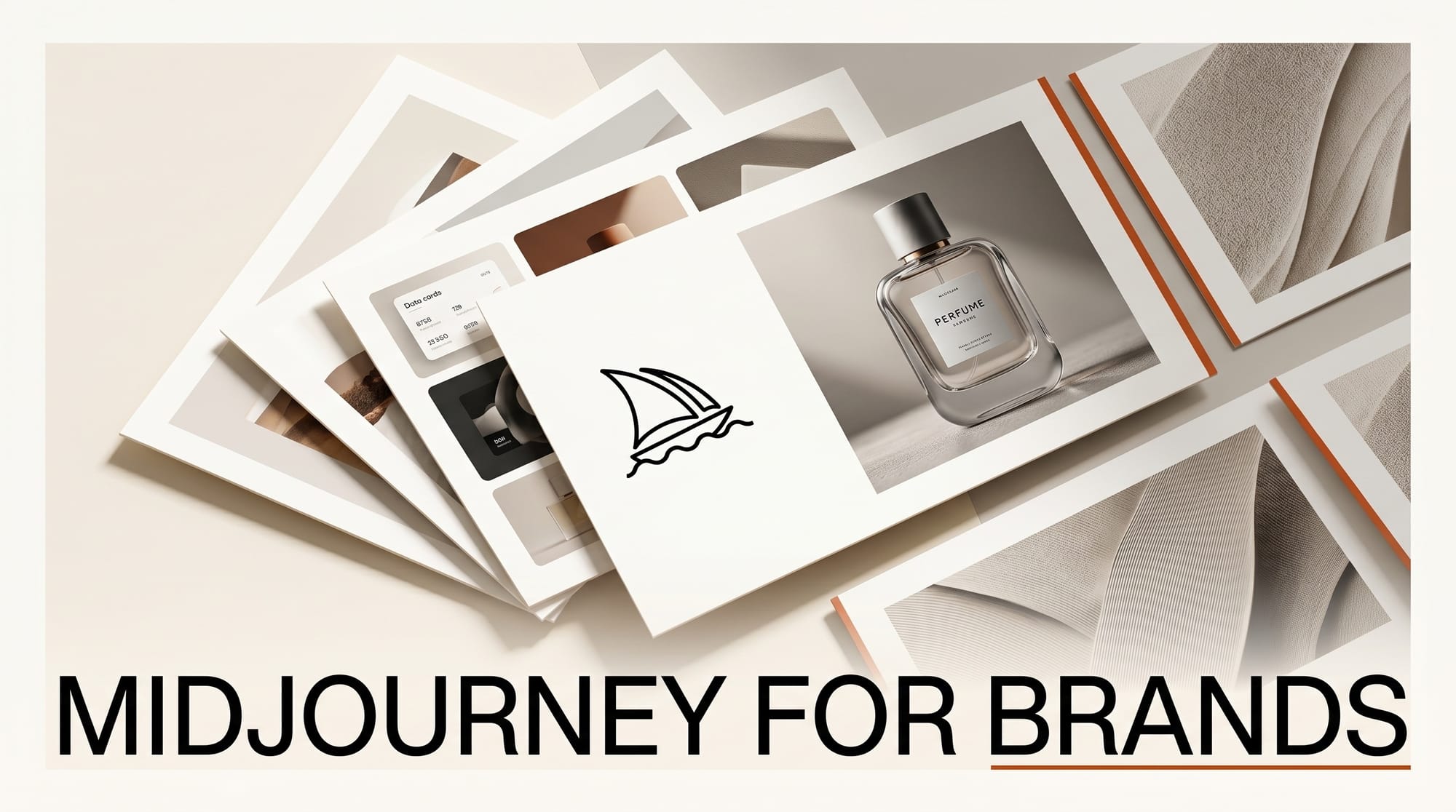
Midjourney v8 in 2026 is the highest aesthetic ceiling for brand-design imagery -- the model that serves agency creative directors, in-house brand teams, and freelance designers when the deliverable has to look great, not just plausible. This is the working brand designer's complete guide to running Midjourney in production: which features actually ship, how to lock a brand aesthetic across hundreds of generations, and where the workflow integrates with Photoshop, Figma, and the rest of the design stack.
What Midjourney v8 does for brand work
Midjourney v8 ships through the dedicated web app at midjourney.com plus a legacy Discord interface. The web Editor is where the brand-design value lives in 2026: a Photoshop-style canvas with selection tools, masking, inpaint via Vary (Region), and outpaint via Pan and Zoom. The model handles photorealism, illustration, 3D-render look, anime, and editorial styles at strong fidelity.
The features that matter for brand consistency:
- --cref -- Character reference. Lock a face, a product, or a mascot across hundreds of generations.
- --sref -- Style reference. Lock a visual aesthetic (palette, light, texture, composition language) across a campaign.
- Style Tuner -- Generate a sample matrix from a brief, pick the best 16 frames, and the model encodes a custom Style Tune ID for that brand aesthetic.
- --niji -- Anime/illustration sub-model that brand designers use for stylized campaign art and editorial illustration.
- Personalization -- Train a personal aesthetic profile from your previous likes and ratings.
Setup: brand designer pipeline first session
- Subscribe to Midjourney Standard ($30/mo) or higher. Basic tier works for testing but throttles fast generations.
- Open midjourney.com, sign in, go to the web app. The legacy Discord interface still works but the web Editor is now the primary surface.
- Build a brand mood board folder. Drop in 30-50 reference images that capture the brand aesthetic: palette swatches, photo references, prior brand assets, competitor visual benchmarks.
- Generate a style reference. Upload 3-5 of the strongest mood images, run --sref against a generic prompt, and verify the output captures the intended aesthetic.
- Save the --sref code as part of the brand standards document. Reuse on every campaign generation.
- Run a sanity test. Prompt: "[brand] hero image, [campaign theme], --sref [code] --ar 16:9 --v 8". Verify aesthetic consistency.
Production workflow 1: campaign hero generation
- Brief from the creative director: campaign theme, audience, deliverable list.
- Pull the brand --sref code, the seasonal mood --sref code, and any product/character --cref codes.
- Generate 12-20 variations on the central concept. Pick 4 strong directions.
- Use Vary (Region) to refine specific zones: tighten composition, swap out background, fix hand or text artifacts.
- Use Pan / Zoom to extend frames for different aspect ratios (square, vertical story, ultra-wide hero).
- Export final at the highest resolution available. Pull into Photoshop for grading, retouching, and final print prep.
- Drop a thumbnail set into Figma for layout decisions in context.
Production workflow 2: character locks for brand mascots and spokesperson
The character reference feature in 2026 is genuinely useful for brand work, not just fan art.
- Generate the canonical character: 4-6 strong shots showing the face, expression range, and key stylistic cues.
- Pick the strongest single image. That image becomes the --cref source.
- Run new prompts with --cref pointing to that image. The character holds across new poses, lighting, and environments.
- For products: same pattern works for branded packaging, hero objects, signature artifacts.
- Build a library of approved --cref images. Reuse across campaigns to maintain brand consistency.
Limitations: --cref handles broad strokes. Fine details like exact hair part lines or specific tattoo placement still drift between generations. For pixel-locked consistency on hero shots, hand off to a 3D retopology in Blender or use Photoshop layer compositing.
Production workflow 3: stylized illustration sets via --niji
- For illustration-style brand assets (children's brands, lifestyle wellness, fashion editorial), use --niji 8.
- Combine with --sref for a brand-locked illustration aesthetic.
- Generate spreads of 9-16 frames. Pick the 4 strongest.
- Refine via Vary (Region) for character and prop edits.
- Export to Adobe Illustrator for vector tracing if the deliverable needs to be vector. Photoshop for raster finishing.
Production workflow 4: photo-real product environments
- Photograph the product in a clean studio shoot, or generate the product via --cref from a single reference.
- Generate the brand environment: location, lighting, mood. Use --sref to lock the brand aesthetic.
- Place the product into the generated environment. Two approaches: (a) generate the environment, then composite the product in Photoshop with shadows and color grading, or (b) use Editor's inpaint to seat the product directly.
- Final retouch in Photoshop: color match, depth-of-field tuning, brand color overlays.
Comparison: Midjourney v8 versus DALL-E versus Imagen 4 versus Stable Diffusion
| Capability | Midjourney v8 | GPT Image 1 | Imagen 4 | Stable Diffusion XL / FLUX |
|---|---|---|---|---|
| Aesthetic ceiling | Highest | Strong | Strong | Variable, depends on model + LoRA |
| Photo-realism | Excellent | Strong | Excellent | Excellent with FLUX or Realistic Vision |
| Brand consistency (cref/sref) | Best (--cref + --sref) | Limited | Style consistency mode | LoRA training (custom) |
| Inpaint / outpaint | Vary (Region) + Pan/Zoom | Built-in | Built-in | Built-in |
| Local / offline run | No (cloud-only) | No | No | Yes (best for self-hosting) |
| Workflow integration | Web app, Discord, API | ChatGPT chat + API | Slides, Vertex AI | ComfyUI, Forge, A1111 |
| Price (entry tier) | $10/mo | $20/mo (ChatGPT Plus) | $19.99/mo (Gemini Advanced) | Free (self-hosted) |
Designer verdict. For brand work where the aesthetic ceiling matters, Midjourney v8 wins. For chat-integrated quick concepts and Custom GPT brand assistants, GPT Image 1. For Workspace teams already in Slides, Imagen 4. For full self-hosted control with custom LoRAs, Stable Diffusion XL or FLUX through ComfyUI.
Pricing and tier picks for 2026
- Basic ($10/mo) -- 200 fast generations/mo. For hobbyists and one-off testing.
- Standard ($30/mo) -- 15 fast hours/mo + unlimited relaxed. The default tier for working freelancers.
- Pro ($60/mo) -- 30 fast hours/mo + unlimited relaxed + stealth mode. The right tier for agency work where client confidentiality matters.
- Mega ($120/mo) -- 60 fast hours/mo + unlimited relaxed + stealth. For production design teams running heavy campaign volume.
- Commercial use -- Included on all paid tiers. The Basic tier's 200 generations cap is the practical limit for sustained commercial use.
Integration with the wider design stack
- Photoshop -- Final retouch, layered compositing, print prep. The Photoshop AI features (Generative Fill, Generative Expand) handle smaller fixes; Midjourney provides the hero generation.
- Figma -- Layout context. Drop Midjourney exports into Figma frames to evaluate compositional choices in deliverable context.
- Illustrator -- Vector finishing. Use Image Trace on Midjourney exports when the deliverable needs to be vector.
- Lightroom -- Color grading at scale. Apply brand-color profiles across generated assets.
- Substance 3D Sampler -- For converting Midjourney textures into PBR-ready materials.
- ComfyUI -- Pair Midjourney concept frames with ComfyUI's controlnet workflows for technical refinement. See our ComfyUI 2026 definitive workflow guide.
What to watch in 2026
- Video -- Midjourney's video model rolled out in beta and is expected to reach feature parity with Sora 2 and Veo 3 through Q3 2026.
- 3D -- A Midjourney 3D model is in private alpha. Expected to enter public beta late 2026.
- API -- A first-party Midjourney API is in early access. Removes the unofficial scraping pattern most agencies have run for years.
- Style Tuner expansion -- Style codes that span both image and video output (when video ships at parity).
Frequently asked questions
Can I use Midjourney for client commercial work?
Yes. Commercial rights are included on all paid tiers (Basic, Standard, Pro, Mega). Trademark and likeness restrictions still apply -- you cannot generate a logo from a competitor's brand or a recognizable celebrity for commercial use.
Does Midjourney work locally / offline?
No. Midjourney is cloud-only. For offline brand-image generation, use Stable Diffusion XL or FLUX through ComfyUI on a local GPU.
How do I lock a character across 100 different shots?
Generate a strong reference image, save its URL, then prefix every new prompt with --cref pointing to that URL. The model holds the character across new poses, lighting, and environments. For pixel-perfect locks, composite manually in Photoshop.
Can Midjourney match a specific brand color exactly?
Approximately, not exactly. The model captures palette intent through --sref but specific hex codes drift. Always finish in Photoshop or Lightroom with brand-color profiles applied.
How does Midjourney compare to Adobe Firefly for designers?
Firefly wins on Photoshop integration and IP-cleared training data (important for some agency contracts). Midjourney wins on aesthetic ceiling. Many brand designers run both: Firefly for inside-Photoshop generative fill, Midjourney for hero campaign work.
Is the Discord interface still supported?
Yes, but new features ship to the web app first. Discord has become a legacy channel.
Keep reading
- AI Image Generation 2026 Complete Guide
- State of AI Design Tools 2026
- Claude for Creative Work: Anthropic Connector Suite
- AI for Content Creators 2026
This guide will be updated as Midjourney v8 capabilities ship through 2026. Subscribe to our weekly Tuesday digest for what shipped this week and what is worth your time.