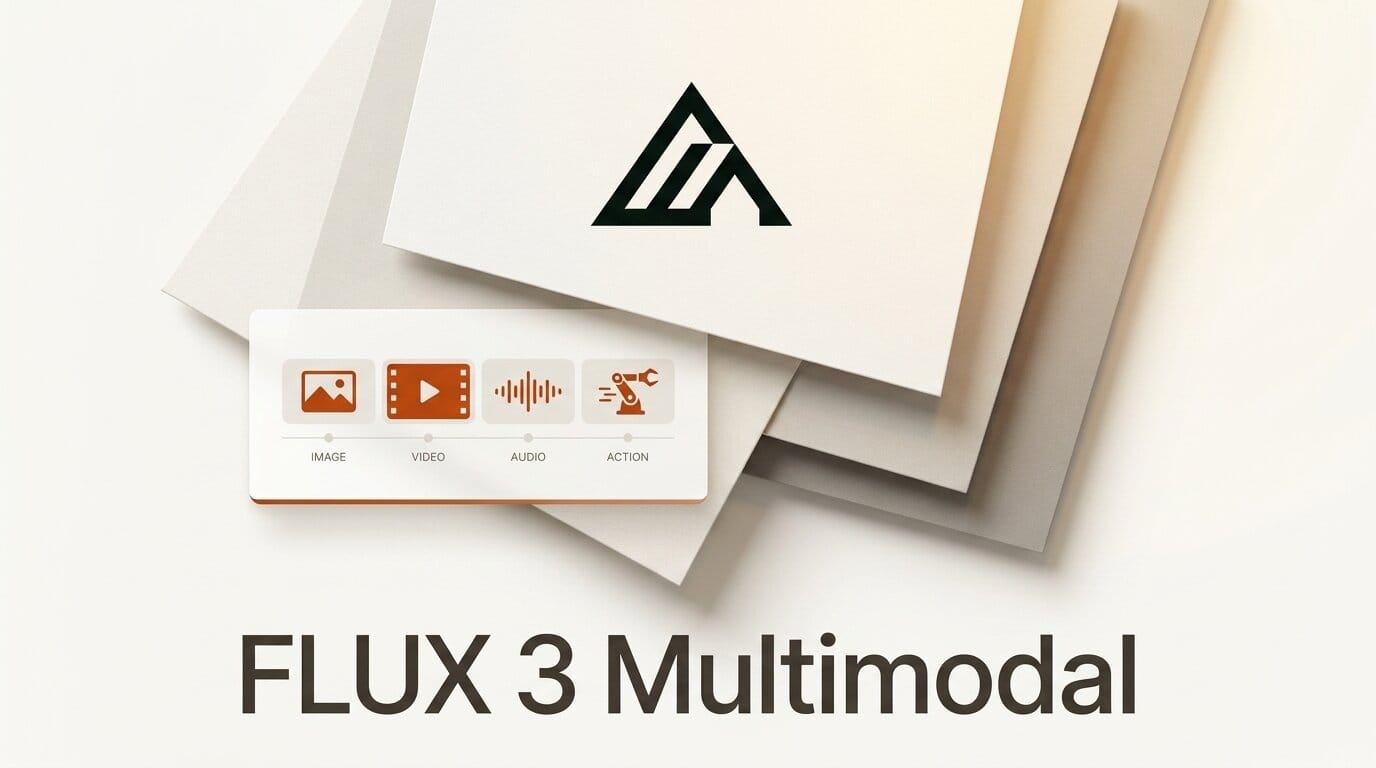
Black Forest Labs shipped FLUX 3 on July 23, 2026, and it is a different kind of release from the image models that made the company famous. FLUX 3 is a single multimodal foundation model that generates images, generates and continues video with synchronized audio, and predicts physical action, all inside one architecture. Early Access to FLUX 3 Video is live now, an open-weight FLUX 3 Dev backbone is on the way, and the whole thing is built on Self-Flow, the training method the lab published earlier this year.
For creators, the headline is not any single feature. It is that image, video, and audio generation now share one model instead of three separate pipelines you have to stitch together. This is a look at what actually shipped, how the video model stacks up against the field, and how to start using it today.
What FLUX 3 Actually Ships
FLUX 3 is not one download. Black Forest Labs is releasing it as a family of five variants, each targeting a different slice of the generation stack, all trained on the same multimodal backbone.
| Variant | What it does | Availability |
|---|---|---|
| FLUX 3 Video | Text-to-video, image-to-video, video-to-video, plus generative video-audio continuation and multi-shot chaining up to several minutes | Early Access now |
| FLUX 3 Image | Image synthesis and editing across styles, aspect ratios, and resolutions with improved multilingual text rendering | Early Access in the coming weeks |
| FLUX 3 Action | Native action prediction integrated into the model | Rolling out |
| FLUX-mimic | Robotic manipulation, built with mimic robotics | Partnership release |
| FLUX 3 Dev | Open-weight multimodal backbone for self-hosting and fine-tuning | Hugging Face and GitHub |
The video model is the piece most creators will reach for first. A single generation produces up to 20 seconds of footage, and BFL's "agentic chaining" stitches individual clips into longer, multi-shot sequences that run several minutes. Because audio is generated in the same pass, you get synchronized sound, multilingual dialogue, and keyframe transitions without a separate audio model or a manual sync step.
FLUX 3 vs the Video Generation Field
Black Forest Labs published preliminary human-preference evaluations pitting FLUX 3 Video against the current crop of video models. These are the lab's own early numbers, measured as the percentage of viewers who preferred FLUX 3, so treat them as a directional signal rather than an independent benchmark. Even discounted, the spread is wide.
| Compared against | Viewers preferring FLUX 3 |
|---|---|
| Luma Ray 3.2 | 93% |
| Runway Gen-4.5 | 77% |
| Grok Imagine Video | 69% |
| Kling v3 Pro | 60% |
| Gemini Omni Flash | 52% |
| Seedance 2.0 | 52% |
The pattern is telling. Against the closest competitors, Gemini Omni Flash and Seedance 2.0, FLUX 3 is at a statistical coin flip, which is honest of BFL to publish. The larger margins come against models that trade quality for speed or that focus on a narrower slice of the video task. The company notes evaluations are early and it expects further improvements, which is the usual caveat but worth keeping in mind before you rebuild a whole workflow around a single win-rate chart.
The Five Variants and Who Each Is For
The split matters because most people do not need all five. If you produce short-form video, FLUX 3 Video plus chaining covers text-to-video and image-to-video with audio baked in. If you build product imagery or edit stills, FLUX 3 Image is the direct successor to the FLUX line that put Black Forest Labs on the map, now with stronger multilingual text rendering, which has historically been the weakest point of diffusion image models.
FLUX 3 Action and FLUX-mimic are the surprising additions. Action prediction and robotic manipulation are not generative-media features, and their presence signals that Black Forest Labs is following through on the physical-AI direction it has been signaling. For most creators these two are not relevant yet, but they explain why FLUX 3 is described as a foundation model rather than an image or video product. If you want the raw backbone to fine-tune, FLUX 3 Dev is the open-weight release to watch.
Self-Flow: Why One Model Handles Everything
The reason FLUX 3 can span image, video, and audio in one architecture is Self-Flow, the training approach Black Forest Labs released earlier this year for aligning multimodal generation and understanding. Rather than bolting a video head onto an image model, Self-Flow trains video, image, and audio simultaneously against scaled compute and data, so the model learns a shared representation across modalities.

The practical payoff is consistency. When the same model generates a clip and its audio and its follow-on shot, the style, lighting, and motion carry across the sequence instead of drifting the way they do when you chain separate specialized tools. That coherence across a multi-shot sequence is the hardest thing to get right in AI video, and it is where a unified model has a structural advantage over a pipeline of best-of-breed parts.
What This Enables for Creators
Here is a concrete workflow FLUX 3 makes possible today, using the Early Access video model:
- Draft the opening shot. Write a text prompt for your establishing frame, or upload a still and use image-to-video to bring it into motion.
- Generate with audio in one pass. Let FLUX 3 produce the clip and its synchronized soundtrack together, up to 20 seconds, including dialogue in your target language.
- Chain the next shot. Use agentic chaining to continue from the last frame into a new shot, keeping style and motion coherent, and repeat until you have a multi-shot sequence running several minutes.
- Edit stills in the same family. When FLUX 3 Image opens, generate thumbnails, posters, and product frames that match your video's look without leaving the FLUX ecosystem.
The value is collapsing a three-tool pipeline, one for image, one for video, one for audio, into a single model with a consistent output. For solo creators and small teams, that is fewer subscriptions, fewer handoffs, and fewer places for style to break, and with FLUX 3's published rates spanning all modalities it is one bill instead of three. If you fine-tune, the open FLUX 3 Dev backbone, released through the Black Forest Labs GitHub organization, means you can build all of that on weights you host yourself.
How to Get Access Today
FLUX 3 Video Early Access is available now, and developers can start against the API using the BFL documentation, which is where request formats and endpoints are documented. FLUX 3 Image Early Access opens in the coming weeks, and the open-weight FLUX 3 Dev backbone lands on the same Black Forest Labs channels where the previous FLUX weights and reference code live.
Frequently Asked Questions
Is FLUX 3 open source?
Partly. FLUX 3 Dev is an open-weight multimodal backbone released through Black Forest Labs' Hugging Face and GitHub organizations. The hosted FLUX 3 Video and Image models run through BFL's API and dashboard under Early Access.
How long can FLUX 3 videos be?
A single generation produces up to 20 seconds. Using agentic chaining, individual clips are stitched into longer multi-shot sequences that run several minutes while keeping style and motion coherent.
Does FLUX 3 generate audio too?
Yes. FLUX 3 Video produces synchronized audio in the same pass as the video, including generative video-audio continuation and multilingual dialogue, so you do not need a separate audio model.
How does FLUX 3 compare to Runway and Kling?
In Black Forest Labs' early human-preference tests, viewers preferred FLUX 3 over Runway Gen-4.5 in 77% of comparisons and over Kling v3 Pro in 60%. Against Gemini Omni Flash and Seedance 2.0 it was roughly even at 52%. These are the lab's own preliminary numbers.
What is Self-Flow?
Self-Flow is Black Forest Labs' training method for aligning multimodal generation and understanding. It trains image, video, and audio together so FLUX 3 learns a shared representation, which is what lets one model handle all three modalities with consistent output.
Why does FLUX 3 include robotics and action prediction?
FLUX 3 Action adds native action prediction and FLUX-mimic, built with mimic robotics, targets robotic manipulation. They reflect Black Forest Labs' move toward physical AI and are the reason FLUX 3 is positioned as a foundation model rather than only an image or video generator.