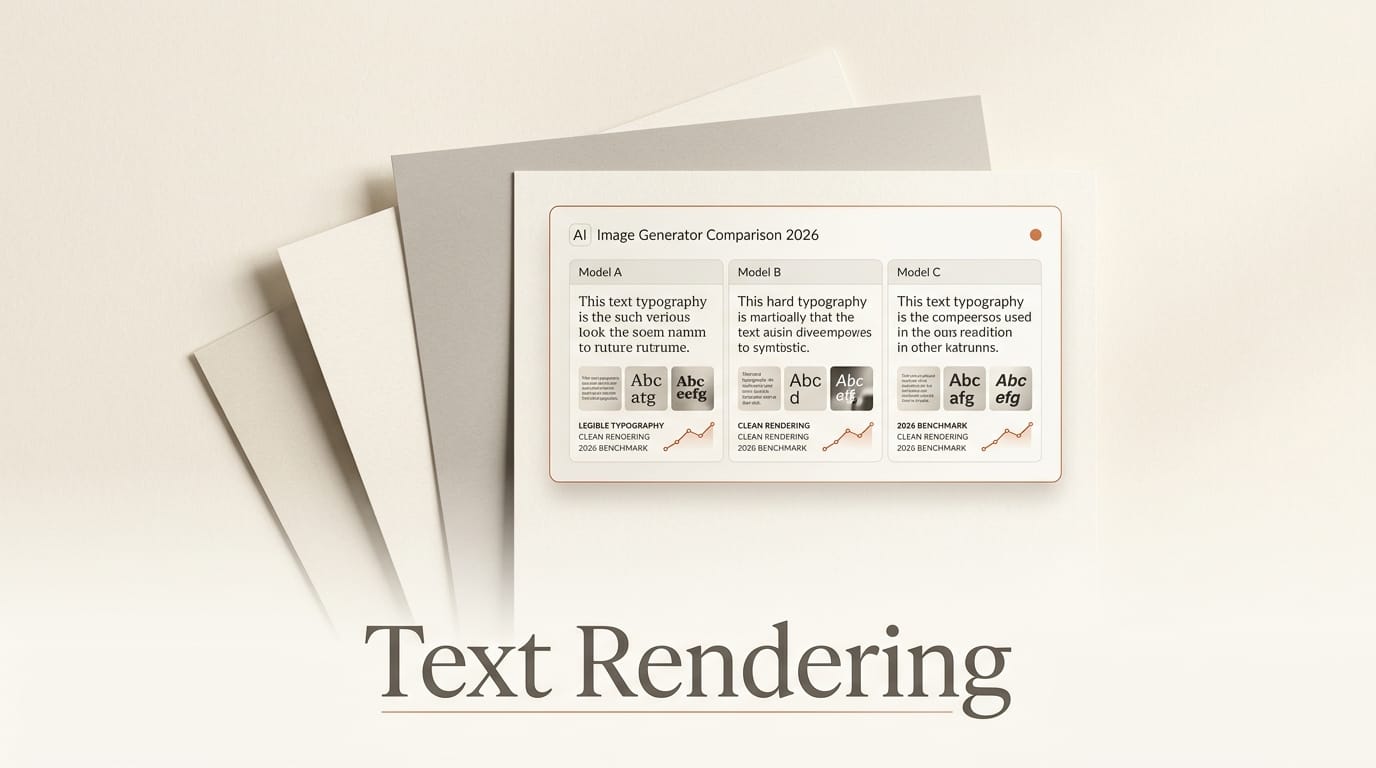
If you need words inside an AI image, spelled correctly and laid out on purpose, five models lead in 2026: Ideogram 4, Google's Nano Banana Pro, OpenAI's GPT Image 1.5, Reve 2, and Alibaba's Qwen-Image. The one-line verdict: Ideogram 4 is still the safest pick for short, punchy typography like logos and posters, Reve 2 wins for dense layouts you need to edit precisely, and Nano Banana Pro wins for long, multilingual passages. This comparison is built from each model's documented capabilities and public evaluations, not a single fresh lab test, so treat it as a map of strengths rather than a leaderboard.
Text rendering is the hardest thing an image model does. Every other quality, lighting, composition, and style, degrades gracefully. A misspelled headline or a garbled sign does not. That is why "which AI image generator handles text best" is a different question from "which AI image generator looks best," and why the answer depends heavily on the kind of text you are placing.
Quick Picks
Pick Ideogram 4 if you make logos, posters, banners, and social graphics where a few words in English need to be crisp and correctly spelled. Typography is the reason Ideogram exists, and it remains the default for text-forward marketing art.
Pick Nano Banana Pro if you need long paragraphs, signage, infographics, or the same text rendered across multiple languages. Google positions it as the strongest model for legible text, from a short tagline to a full paragraph, at up to 4K.
Pick GPT Image 1.5 if you already work inside ChatGPT or the OpenAI API and want dense, small text in mockups and UI screens, plus precise edits that preserve existing logos and faces.
Pick Reve 2 if you treat an image like a design file: environmental typography such as street signs, packaging, menus, and labels, positioned exactly where you want, at native 4K, and editable after the fact.
Pick Qwen-Image if you want extremely long prompts and dense text, equations, or twelve-language layouts, and you are comfortable working hosted-only inside Qwen Chat without downloadable weights.
How Each Tool Renders Text
The five leaders solve the typography problem in genuinely different ways, and those differences decide which one fits your job. Below is the head-to-head on the dimensions that matter for text, followed by the reasoning behind each row.
| Model | Text strength | Long or dense text | Multilingual | Max resolution | Layout and editing | Weights |
|---|---|---|---|---|---|---|
| Ideogram 4 | Short typography leader | Good | English and Latin scripts strongest | 2K | Prompt plus reference, native transparency | Closed (hosted) |
| Nano Banana Pro | Long and legible leader | Excellent | Strong, translates and localizes | 4K | Localized edits, lighting and camera controls | Closed (hosted and API) |
| GPT Image 1.5 | Dense and small text | Very good | Good | High | Precise edits, preserves logos and faces | Closed (hosted and API) |
| Reve 2 | Environmental typography leader | Excellent | Multilingual in-image text | Native 4K | Layout-first, edit like a design file | Closed (hosted and API) |
| Qwen-Image 3.0 | Dense and long-prompt text | Excellent | Twelve languages | High | Prompt-driven, hosted only | Closed (1.0 and 2.0 were open) |
Short typography: Ideogram sets the bar
Ideogram was founded in 2022 by four former Google Brain researchers specifically to fix the typography problem that broke earlier generators. Ideogram 4, its current flagship, adds native transparency so words and marks come out on clean backgrounds ready for compositing, and it renders at 2K. For a headline, a logo lockup, a product name on packaging, or a poster where a handful of words must be spelled correctly and styled deliberately, it remains the reference. The tradeoff is scope: it is tuned for short, high-impact typography rather than paragraph-length body copy, and it is most reliable in English and other Latin-alphabet scripts, with non-Latin scripts like CJK still improving. Our full breakdown of Ideogram 4 covers its ComfyUI path in detail.
Long and multilingual passages: Nano Banana Pro
Google is unusually direct about this one. It calls Nano Banana Pro, officially Gemini 3 Pro Image, "the best model for creating images with correctly rendered and legible text directly in the image, whether you're looking for a short tagline, or a long paragraph." Built on Gemini 3 Pro, it leans on the model's multilingual reasoning to generate, localize, and translate text across languages, so you can produce the same signage or infographic in English and Korean without garbled characters. It outputs at 2K and 4K with a wider range of textures, fonts, and calligraphy, and adds localized edits plus lighting and camera controls. If your text is long, informational, or needs to ship in several languages, this is the model to beat.
Dense, small text and edits: GPT Image 1.5
OpenAI's GPT Image 1.5, released in December 2025 as the successor to gpt-image-1, focused its upgrade squarely on denser and smaller text, the kind you find in UI mockups, dashboards, and infographic captions. It also improved instruction following and precise editing that preserves important details like faces, lighting, and existing logos, runs up to four times faster than its predecessor, and supports batch generation through the API. If your workflow already lives in ChatGPT or the OpenAI API and you need small text to stay legible inside a busy composition, it is the natural fit. Our deep dive on GPT Image 1.5 covers its editing pipeline.
Environmental typography and layout: Reve 2
Reve 2 takes a structurally different route. Instead of hallucinating words into pixels, it separates planning from rendering: it first builds the image as an editable, code-like layout in which every object, region, and word carries a position, a size, and a local description, then renders that plan at native 4096 by 4096. Because the words are placed as structured layout rather than guessed, it handles environmental typography, street signs, packaging, labels, menus, and license plates, better than almost anything else, and you can move or rewrite an element afterward without redrawing the whole frame. It launched on June 3, 2026, includes multilingual in-image text, and ranks in the top two on the LMArena text-to-image leaderboard.
Very long prompts and dense layouts: Qwen-Image
Alibaba's Qwen-Image 3.0, released on July 21, 2026, pushes prompt length and text density hard: roughly 4,500-token prompts, text legible down to about 10 pixels, dense-layout and equation rendering, and twelve-language support inside a single image. The catch is access. Where Qwen-Image 1.0 and 2.0 shipped open under Apache 2.0, version 3.0 is hosted only inside Qwen Chat with no downloadable weights, no benchmarks, and no technical report. If you need the longest prompts and densest text and do not need to run the model locally, it is powerful, but it no longer fits an open, self-hosted pipeline. Our analysis of the 3.0 release covers what breaking the open lineage means.
When Each Tool Wins
Ideogram 4 wins the logo and poster job. When the deliverable is a small number of words that have to be perfect, spelled right, styled on brand, and cut out on a transparent background, it is the lowest-risk choice and the fastest path to a usable asset.
Nano Banana Pro wins the paragraph and the passport of languages. Long body copy, informational infographics, and multilingual campaigns are where its legibility and translation strengths compound, especially at 4K where fine text stays sharp.
GPT Image 1.5 wins the product mockup. Dense UI text, small captions, and edits that must not disturb an existing logo or face play to its precise-editing focus, and the API and batch support make it the pick for programmatic pipelines.
Reve 2 wins the design-file workflow. If you want to place a menu, a sign, or packaging copy exactly and revise it like layers, its layout-first architecture is a category of its own, and native 4K means no upscaler smearing on the type.
Qwen-Image wins the extreme prompt. Equations, tables, tiny legible text, and twelve-language layouts driven by very long prompts are its edge, as long as hosted-only access works for you.

Pricing and Access
Access model matters as much as raw quality once you move from experimenting to shipping. Nano Banana Pro and GPT Image 1.5 are available both in consumer apps and through APIs, which makes them the straightforward choices for automated or high-volume work. Reve 2 offers a free tier plus Lite at 7.99 dollars per month and Pro at 19.99 dollars per month, and exposes an API for its layout workflow. Ideogram 4 is hosted with a free tier and paid plans centered on its typography strengths. Qwen-Image 3.0 is the outlier: it is hosted only inside Qwen Chat, with no weights to download, which is a real change from the open 1.0 and 2.0 releases that many local pipelines were built on. If self-hosting or offline generation is a requirement, none of the current text leaders ship open weights, and Qwen-Image's shift closes the door that was previously the open option.
The Bottom Line
There is no single best AI image generator for text in 2026, because "text" is really several jobs. For short, high-stakes typography like logos and posters, Ideogram 4 is still the safest bet. For long, legible, multilingual passages, Nano Banana Pro leads and Google says so plainly. For dense small text and precise edits inside an existing image, GPT Image 1.5 fits, especially through its API. For anything you need to place and edit like a design file, Reve 2's layout-first approach is unmatched. And for the longest prompts and densest text, Qwen-Image 3.0 is powerful but now hosted only. Match the model to the kind of words you are placing, and the right pick is usually obvious.
Frequently Asked Questions
Which AI image generator is best for text in 2026?
There is no universal winner. Ideogram 4 leads for short typography like logos and posters, Nano Banana Pro leads for long and multilingual passages, and Reve 2 leads for editable, precisely placed environmental text such as signs and packaging. Choose by the type of text you need.
Why do AI image generators struggle with text at all?
Most image models generate pixels directly, so words are effectively drawn rather than typed, which invites misspellings and garbled characters. Models tuned for text, like Ideogram, or built around structured layouts, like Reve 2, reduce this by treating words as deliberate elements instead of texture.
Can any of these models render long paragraphs correctly?
Nano Banana Pro is positioned specifically for long, legible text from a short tagline to a full paragraph, and Qwen-Image 3.0 handles very long prompts with dense text and equations. Short-typography specialists like Ideogram are stronger on headlines than on body copy.
Which model is best for non-English text?
Nano Banana Pro generates and translates text across languages, and Qwen-Image 3.0 supports twelve-language layouts, so both are strong for multilingual work. Ideogram is most reliable in English and other Latin-alphabet scripts, with non-Latin scripts still improving.
Are any of these text-capable models open source?
Not the current text leaders. Qwen-Image 1.0 and 2.0 shipped open under Apache 2.0, but version 3.0 is hosted only with no weights, and Ideogram, Nano Banana Pro, GPT Image 1.5, and Reve 2 are all closed. If you need to self-host, you are currently working from older open releases.