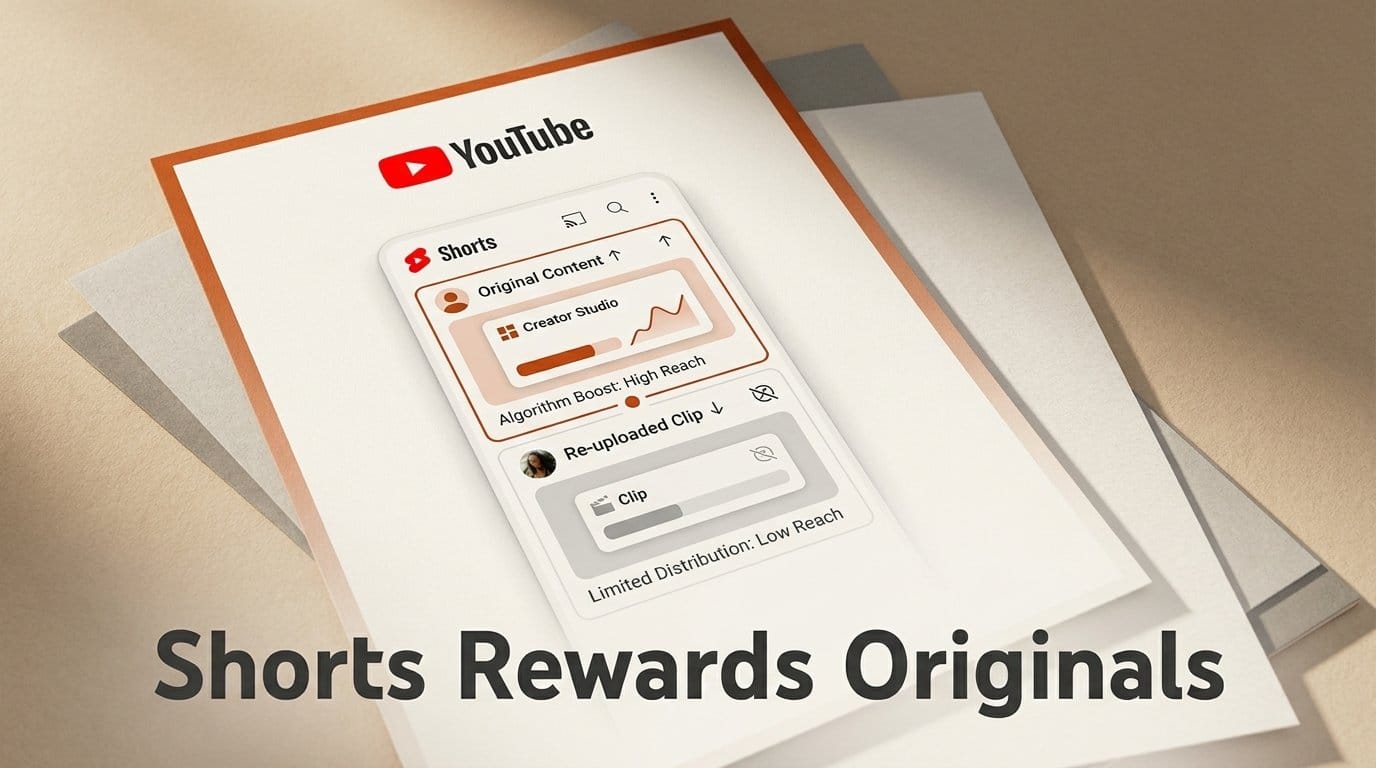
On October 1, 2026, YouTube said it is updating its Shorts recommendation systems to "further prioritize original content and reduce the reach of content re-uploaded from other creators without adding anything of your own." The post, signed by JJ of TeamYouTube in the YouTube Help Community, warns that channels "primarily aggregating or re-uploading other creators' videos without significant changes will likely see less distribution within the Shorts feed." It gives no start date and no numeric threshold, and 9to5Google reported on October 2 that the change appears to be live already.
For anyone running an AI clipping, compilation or repurposing pipeline, the practical question is which steps still count as adding something of your own. This piece lines the October 1 post up against the rules YouTube has already published, compares them with TikTok, Instagram and Facebook, and ends with a five-step check you can run on a Short before you post it. Everything below comes from the platforms' own help pages and named reporting; where YouTube has not said something, we say so.
What YouTube changed on October 1
The change is to ranking, not to the rules. The post describes it as an update to "our recommendation systems" and links to a single policy page, YouTube's spam policy, saying the change "is also aligned with our existing YouTube policies." Nothing in it removes videos, issues strikes or changes Partner Program terms. A Short that lands on the wrong side is simply shown to fewer people in the Shorts feed.
Two sentences do the work. The first is about channels, not single videos: the target is a channel "identified as primarily aggregating or re-uploading" other people's work. The second is about edits: "Rather than making minor technical edits or template-based changes simply to alter a video, focus on bringing your own voice, storytelling, or distinct point of view to the conversation." If you use another creator's clips, YouTube asks for "your own original commentary, unique edits, or storytelling."
The second sentence is the one that lands on AI tools. "Template-based changes" describes most bulk repurposing setups: the same caption style, the same stock music bed, the same zoom-and-subtitle preset applied to clips pulled from someone else's video. The post does not name AI or any tool, and the English version does not mention voice-over. PPC Land's write-up reads it as excluding narration that only describes what is on screen; that is a fair reading of the older policies below, but it is an interpretation, not the October 1 wording.
What YouTube already counts as reused content
The clearest guide to "adding something of your own" is the much longer list in YouTube's channel monetization policies, under Reused content. That policy decides Partner Program eligibility rather than reach, but the October 1 post borrows its language, so it is the best evidence of where the line sits.
Allowed to monetize, in YouTube's own examples: clips used for a critical review, a movie scene "where you've rewritten the dialog and changed the voiceover", sports replays where you explain the moves, reaction videos "where you comment on the original video", other creators' footage "where you add a storyline and commentary", and edited footage with effects that "demonstrates substantive editing and shows it's unique to your channel."
Not allowed: "Short videos you compiled from other social media websites", "Content uploaded many times by other creators", "Content that exclusively features readings of other materials you did not originally create, like text from websites or news feeds", and "Songs modified to change the pitch or speed, but are otherwise identical to the original song." Two lines matter most for automated channels. The policy applies "even if you have permission from the original creator", and it is "not based on copyright, permission, or fair use." A licence to clip a podcast does not make the clip yours.
AI is named directly. The same page's section on generic or repetitive content rules out "AI-generated content made with generic or unoriginal templates giving the impression of mass production without adding the creator's original, authentic insights or perspective." The spam policy goes further, listing "Automated or synthetic mass-production" with the example of channels "that use the exact same background music and repetitive AI generated imagery across many videos, with each video reading out an AI-generated script", plus "Detection evasion" such as "speeding up audio, heavy filters, cropping."
Which AI repurposing workflows are at risk
Mapping those published rules onto the workflows creators actually run gives a fairly clear picture. The middle column is our reading; the right column is YouTube's wording that supports it.
| Workflow | Where it stands | YouTube's wording |
|---|---|---|
| AI clipping your own long video or podcast into Shorts | Safe: it is your content | The update targets content "re-uploaded from other creators"; "Content that primarily features the uploading creator" is allowed |
| Clipping another creator's podcast with auto-captions and a preset, no commentary | At risk | "minor technical edits or template-based changes"; applies "even if you have permission" |
| Reaction or breakdown recorded over someone else's clip | Safe if your commentary carries the video | "Reaction videos where you comment on the original video"; "Using clips for a critical review" |
| AI voice reading a Reddit thread or news article over stock footage | At risk | "exclusively features readings of other materials you did not originally create" |
| Faceless channel with the same music, AI images and AI script on every upload | At risk, and a spam-policy example | "Automated or synthetic mass-production" |
| Speeding up, mirroring or cropping a clip to dodge detection | Spam | "Detection evasion" |
| YouTube's own Reimagine remix | Not addressed | The October 1 post does not mention it |
The faceless row deserves a note, because a lot of our readers build those channels. A faceless channel is not the problem; interchangeable output is. If you followed our faceless YouTube video guide, the test is whether the script, the argument and the visuals are yours and change from video to video, not whether your face is on screen.
The Reimagine row is the open question. YouTube launched Reimagine on March 18, 2026 as a Veo-powered remix tool that turns a frame of any eligible Short into a new 8-second clip, and it says "every Reimagined Short links directly back to the original work." 9to5Google flagged that it is unclear how those remixes fare under the new ranking. YouTube has not said.

How YouTube compares with TikTok, Instagram and Facebook
YouTube is the last of the big four short-video feeds to say this out loud. TikTok's Community Guidelines already mark "Reused or unoriginal content posted without creative edits, such as clips that show someone else's watermark or logo" as ineligible for the For You feed. Instagram widened its rule on April 30, 2026: PetaPixel reported that accounts built mostly on reposts stop being recommended across photos, carousels and Reels, quoting Adam Mosseri: "If most of what you post to Instagram is someone else's content, your account is no longer going to be recommendable." Facebook moved first, on July 14, 2025, with stronger measures against unoriginal content.
| YouTube Shorts | TikTok | |||
|---|---|---|---|---|
| Latest change | October 1, 2026 | Standing For You feed rule | April 30, 2026 | July 14, 2025 |
| Penalty | Less distribution in the Shorts feed | Ineligible for the For You feed | Not recommended to non-followers | Reduced distribution on everything shared; monetization paused for a period; duplicates demoted |
| Judged at | Channel ("primarily aggregating") | Each post | Account ("most of what you post") | Account (repeat reuse), plus each duplicate video |
| Not enough | Minor technical edits, template-based changes | No creative edits; GIF-only clips | Crediting the creator, watermarks, minor crops (per PetaPixel) | "stitching together clips or adding your watermark" |
| Counts as yours | Commentary, unique edits, storytelling | "anything new" added to the material | Commentary, remixing, creative reinterpretation | "creative editing, voiceover or commentary" |
Two differences matter for AI workflows. Facebook is the only one that lists voice-over by name as a meaningful enhancement; YouTube allows a rewritten voice-over but rejects narration that only reads material you did not write. And YouTube is explicit that permission does not help, which rules out the "we licensed the clips" defence that some clipping agencies rely on. If you post the same Short to all four feeds, build to YouTube's standard and you clear the others.
A five-step originality check before you post a Short
None of the four platforms publishes a score, so the check has to be your own. This takes a couple of minutes per Short and catches the patterns YouTube describes.
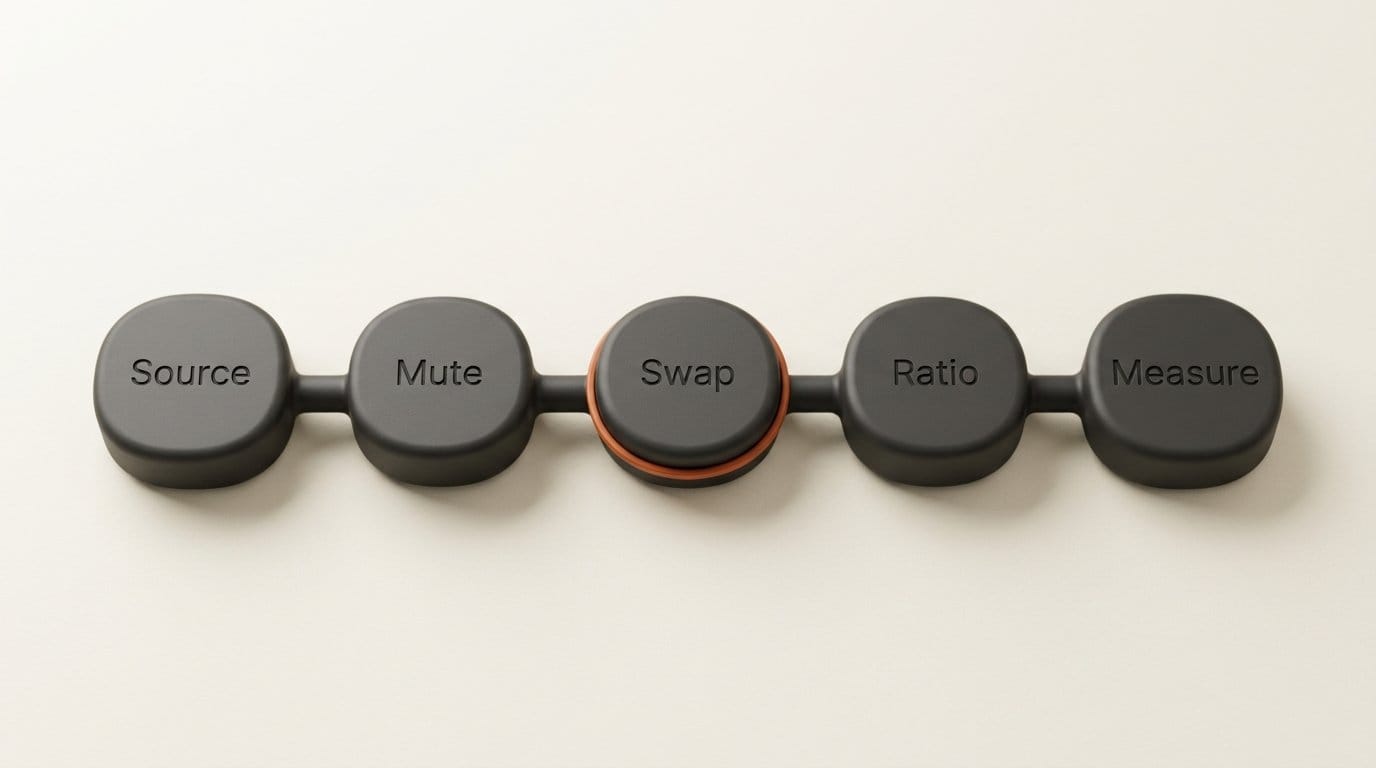
- Source check. Is the footage yours? If you filmed it, recorded it or generated it from your own script, clip away; the October 1 change is aimed at re-uploads from other creators. If not, continue.
- The mute test. Turn off the original audio and hide the auto-captions. If nothing of yours is left (no voice making a point, no on-screen argument, no new footage), the Short is a re-upload with a template on top.
- The swap test. Could your caption style, music and script be pasted onto any other clip in your queue without changes? Interchangeable output is what "template-based changes" describes. Write the hook and the commentary per video, even if the preset stays.
- The ratio test. Look at your last 20 Shorts. If most are other creators' footage, the channel-level wording ("primarily aggregating") points at you even when each clip has some commentary. Shift the mix toward your own footage.
- Measure it. In YouTube Studio, compare views from the Shorts feed traffic source for original uploads against reused ones over two to four weeks. YouTube gives no status flag for this change, so your own split is the only early signal.
What YouTube has not said
The post is short, and the gaps are real. There is no start date, though 9to5Google reads the change as already live. There is no definition of "primarily" or of "significant changes", and no number of uploads that tips a channel over. AI tools are not mentioned, Reimagine included. There is no indicator in YouTube Studio telling a channel it has been flagged, which PPC Land contrasts with the account-level notices Instagram uses.
Monetization rules did not change on October 1, but they did not need to. The reused-content and repetitive-content rules quoted above already cost channels Partner Program access; the new part is that the same behaviour now also costs reach in the Shorts feed, before any reviewer looks at the channel. For creators who were relying on volume to find the occasional hit, that is the bigger change. For context on how platforms are treating synthetic media more broadly, see our coverage of YouTube's automatic AI labels.
Frequently asked questions
Does YouTube's Shorts originality update affect monetization?
Not directly. The October 1 post changes recommendations in the Shorts feed. Monetization is governed by the separate reused-content policy in YouTube's channel monetization rules, which already applied to the same kinds of channels.
Can I still use AI to clip my own podcast into Shorts?
Yes. The update targets content re-uploaded from other creators. YouTube's policy lists "Content that primarily features the uploading creator" as allowed, so AI clipping of your own long-form video is not what this change is about.
Does adding an AI voice-over make a re-upload original?
Only if the voice-over adds something. YouTube allows a scene where "you've rewritten the dialog and changed the voiceover" but rejects content that "exclusively features readings of other materials you did not originally create." A voice that narrates what is already on screen adds little.
Does permission from the original creator make a re-upload safe?
No. YouTube says its reused-content policy applies "even if you have permission from the original creator" and is "not based on copyright, permission, or fair use." Permission solves copyright, not originality.
Is YouTube's Reimagine remix tool affected?
YouTube has not said. Reimagine, launched March 18, 2026, links every remix back to the original Short, but the October 1 post does not mention it or any other AI tool.
How is YouTube's rule different from TikTok's?
TikTok judges each post: reused content without creative edits is ineligible for the For You feed. YouTube's wording targets channels that are "primarily" aggregating, and it reduces reach rather than making a post ineligible.