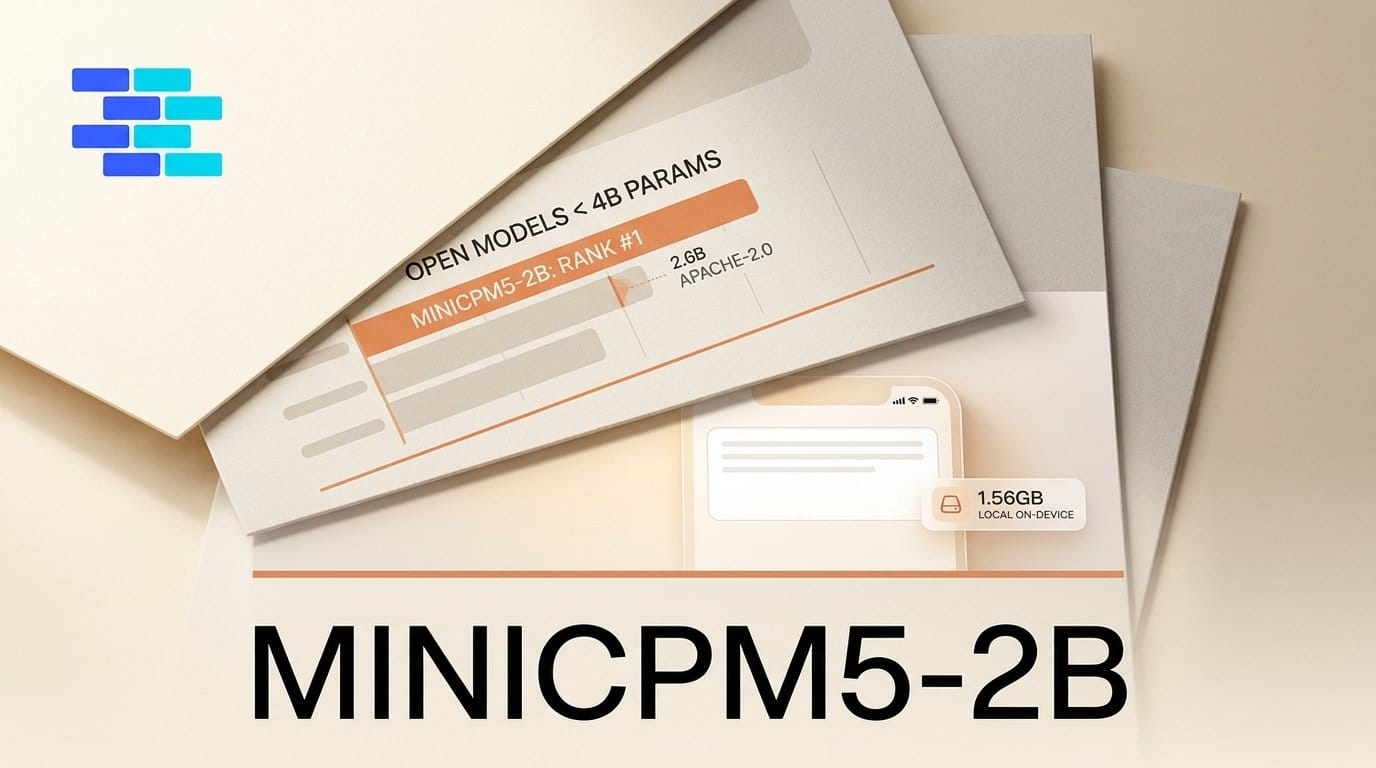
OpenBMB released MiniCPM5-2B on September 7, 2026, a 2.6 billion parameter dense model under an Apache-2.0 license with a 131,072 token context window. Artificial Analysis ranks it #1 of 47 open-weights models at or under 4B parameters. The number that matters more for anyone running models locally: the Q4_K_M quantization is 1.56 GB on disk. That fits on a phone.
OpenBMB's own benchmark table puts MiniCPM5-2B at a 53.9 average across 34 evaluations, ahead of every 4B-class model it lists, including Qwen3.5-4B at 51.1 and granite-4.2-3B at 42.7. Those are vendor-reported figures, and reading past the average is where the story gets useful, because this model is dramatically better at some things than its size suggests and clearly worse at others.
What OpenBMB actually shipped
The weights landed on Hugging Face on September 6 at 11:35 UTC and the announcement followed on September 7. The architecture is unremarkable on purpose: a standard LlamaForCausalLM stack, 42 layers, 16 query heads and 2 key-value heads using grouped-query attention, 2,516,756,480 parameters total. Text only, no multimodal input, knowledge cutoff December 31, 2025.
What is not unremarkable is the post-training. OpenBMB trained separate reinforcement-learning teacher models for math, code, agentic tasks and writing, then used on-policy distillation to fold those specialists back into a single released model. The MiniCPM technical report covers the lineage. The effect shows up clearly in the results: this reads like a model tuned to act rather than to know.
Day-one runtime coverage is unusually complete. The OpenBMB/MiniCPM repository ships deployment cookbooks for Transformers, vLLM, SGLang, llama.cpp, Ollama, LM Studio, MLX, ArcLight and vLLM Ascend, plus FlagOS builds for nine chip vendors. An MLX build for Apple Silicon and the GGUF quantizations were staged on September 5, a day before the main repo. A LiteRT-LM variant was added to the repo on September 8.
How MiniCPM5-2B compares
Every figure below is from OpenBMB's published comparison table. The 2B-class column is the fair fight; the Qwen3.5-4B and granite-4.2-3B columns are models roughly 1.5x larger.
| Benchmark | MiniCPM5-2B | LFM2.5-2.6B | Qwen3.5-2B | Qwen3.5-4B | granite-4.2-3B |
|---|---|---|---|---|---|
| Average (34 evals) | 53.9 | 33.2 | 28.0 | 51.1 | 42.7 |
| LiveCodeBench v6 | 69.1 | 42.1 | 20.2 | 56.4 | 58.9 |
| SWE-bench Verified | 46.4 | 6.0 | 5.0 | 33.6 | 36.8 |
| AIME 2025 | 86.5 | 41.9 | 29.6 | 78.8 | 79.4 |
| MMLU-Pro | 70.8 | 65.2 | 64.3 | 78.0 | 65.8 |
| GPQA-Diamond | 70.2 | 55.8 | 45.6 | 77.1 | 55.9 |
| Terminal-Bench v2.1 | 8.6 | 4.5 | 3.0 | 25.8 | 13.9 |
| SWE-bench Pro | 14.4 | 0.6 | 0.8 | 28.2 | 12.3 |
| τ²-Bench Telecom | 97.1 | 90.4 | 69.0 | 92.1 | 40.9 |
| BFCL v4 | 66.6 | 61.1 | 43.6 | 56.8 | 52.2 |
| GAIA Text-103 | 88.7 | 49.5 | 47.9 | 78.6 | 57.3 |
| NoLiMa (long context) | 68.1 | 0.7 | 17.1 | 43.5 | 5.1 |
Against its own weight class the result is a rout. LFM2.5-2.6B, which Liquid AI positions as an on-device agent model, scores 6.0 on SWE-bench Verified against MiniCPM5-2B's 46.4. Qwen3.5-2B scores 5.0. On NoLiMa, a long-context retrieval test, LFM2.5-2.6B scores 0.7 and MiniCPM5-2B scores 68.1. These are not incremental gaps.
Where it loses, and why that matters
A press release stops at the average. The interesting part is the four rows where a 4B model beats it, because they form a pattern.
Qwen3.5-4B wins MMLU-Pro (78.0 to 70.8), GPQA-Diamond (77.1 to 70.2), SuperGPQA (52.8 to 40.8) and MATH-500 (99.0 to 94.6). Those are knowledge and recall benchmarks, and they are exactly what you would expect a physically larger model to win. Parameters store facts, and 2.6 billion of them store fewer facts than 4 billion.
The more consequential losses are Terminal-Bench v2.1 (8.6 against Qwen3.5-4B's 25.8) and SWE-bench Pro (14.4 against 28.2). Both measure long-horizon autonomous work, the kind where a model runs unattended for many steps and has to keep its own plan straight. MiniCPM5-2B scores 46.4 on SWE-bench Verified, where tasks are shorter and better specified, then falls off a cliff when the horizon extends. IBM's granite-4.2-3B shows the same shape less severely, and we covered that family's agentic coding positioning when it shipped.
The practical translation: give this model tightly scoped tasks with clear tool definitions and it performs far above its size. Hand it a multi-hour autonomous terminal session and it will lose the thread. That is a real constraint, not a footnote.
The dense versus MoE tradeoff nobody advertises
Artificial Analysis scores MiniCPM5-2B at 14 on Intelligence Index v4.3, and at 15 on v4.2 in its release writeup. OpenBMB's own launch post claimed 23, a figure from an earlier index revision. Scores that move by a third between benchmark versions are a reminder to compare models within a single index snapshot and never across revisions.
Inside the v4.2 snapshot, one model under the sub-4B banner scores higher: Ling 3.0 Tiny at 16. It is a mixture-of-experts model with 1.3B active parameters out of 7.9B total. That distinction is the whole ballgame for local deployment. Ling activates fewer parameters per token than MiniCPM5-2B does, so it can be faster, but you still need all 7.9B parameters resident to run it. MiniCPM5-2B is dense, so active and total are the same 2.6B, and the Q4_K_M file is 1.56 GB against roughly 4 GB for a comparably quantized 7.9B MoE.
On a server that difference is a rounding error. On a laptop already running a browser, an editor and a design tool, or on a phone, it decides whether the model loads at all. This is the tradeoff we walked through in more general terms in our local AI versus cloud AI decision guide: for on-device work, resident memory is usually the binding constraint, not throughput.
Running it this afternoon
The fastest path to a real answer is the hosted MiniCPM5-2B demo Space, which costs nothing and takes about a minute. If it handles your prompts, move local:
- Pick a quantization. Q4_K_M at 1.56 GB is the default choice for laptops and phones. Q8_0 at 2.68 GB is worth it if you have 8 GB or more of free RAM and are doing tool calling, where quantization damage tends to show up first. F16 is 5.04 GB.
- Pull it into your existing runtime. If you already run Ollama or LM Studio, the GGUF files drop straight in. Apple Silicon users should prefer the MLX build over GGUF for better memory behavior.
- Use SGLang if tool calling is the point. OpenBMB recommends it specifically, and it ships a built-in
minicpm5parser that converts the model's XML-style tool calls into OpenAI-compatible JSON. Without that parser you will be writing the translation layer yourself. - Scope the tasks. Given the Terminal-Bench result, wire this into short, well-defined loops: classify an inbox, rename and tag an asset library, extract structured data from documents, drive a local MCP server. Do not point it at an unattended multi-step build.
If you have never set up a local agent loop, our walkthrough on running a local AI coding agent on one GPU covers the surrounding plumbing.
Why this matters for creative work
Most creative pipelines do not need a model that knows things. They need a model that can reliably call a function, read a result and call the next one, without shipping the contents of a client project to someone else's server. A 97.1 on τ²-Bench Telecom and 66.6 on BFCL v4, both function-calling benchmarks, is the relevant capability, and MiniCPM5-2B posts those numbers in 1.56 GB.
That combination is what makes the release notable rather than merely good. Apache-2.0 means no usage restrictions to read past, no excluded territories and no commercial gate. Nine-vendor FlagOS coverage means it is not locked to NVIDIA. Fine-tuning recipes for TRL, LLaMA-Factory, ms-swift and unsloth ship in the same repo, so specializing it on your own asset taxonomy or house style is a weekend project rather than a research effort.
Frequently asked questions
What hardware do I need to run MiniCPM5-2B?
The Q4_K_M quantization is 1.56 GB, so roughly 3 GB of free RAM covers the weights plus working context at modest lengths. Any Apple Silicon Mac, most laptops from the last five years and recent flagship phones can run it. Long-context work at anywhere near the full 131,072 tokens needs substantially more headroom for the KV cache.
Is MiniCPM5-2B really the best model under 4B parameters?
By Artificial Analysis's independent ranking it is #1 of 47 open-weights models at or under 4B. Ling 3.0 Tiny scored higher on Intelligence Index v4.2, but it has 7.9B total parameters and only qualifies as small if you count active parameters rather than resident ones.
What is MiniCPM5-2B bad at?
Long-horizon autonomous work. It scores 8.6 on Terminal-Bench v2.1 and 14.4 on SWE-bench Pro, both well behind Qwen3.5-4B. It also trails on knowledge benchmarks such as MMLU-Pro and GPQA-Diamond, which is the expected cost of fewer parameters. It is text only, with no image or audio input.
Can I use MiniCPM5-2B commercially?
Yes. It is released under Apache-2.0, which permits commercial use, modification and redistribution with no territorial restrictions and no separate commercial license.
How does it compare to LFM2.5-2.6B for on-device agents?
They are nearly the same size and not close in capability on OpenBMB's numbers: 46.4 against 6.0 on SWE-bench Verified, 68.1 against 0.7 on NoLiMa, 53.9 against 33.2 on the overall average. LFM2.5-2.6B remains competitive on instruction-following benchmarks such as IFEval, where it scores 93.4 against 86.7.
Which runtime should I use for tool calling?
SGLang, because it ships a minicpm5 parser that converts the model's XML-style tool calls into OpenAI-compatible JSON. llama.cpp and Ollama work for general chat and generation, but you will need to handle that conversion yourself.