In a blind test that Ipsos ran for Deezer, 97% of 9,000 listeners could not tell fully AI-generated songs from human ones. Yet across 16 preregistered experiments with 27,491 participants, people rated the same creative writing lower once they believed AI had written it. That is the honest answer to "do audiences care if you use AI": they rarely notice, and they care a lot once they know. We read 12 studies and surveys published between November 2024 and October 2026, plus platform data from Deezer and YouTube, to work out what an AI label costs a creator, when hiding it costs more, and how to disclose without losing your audience.
Background
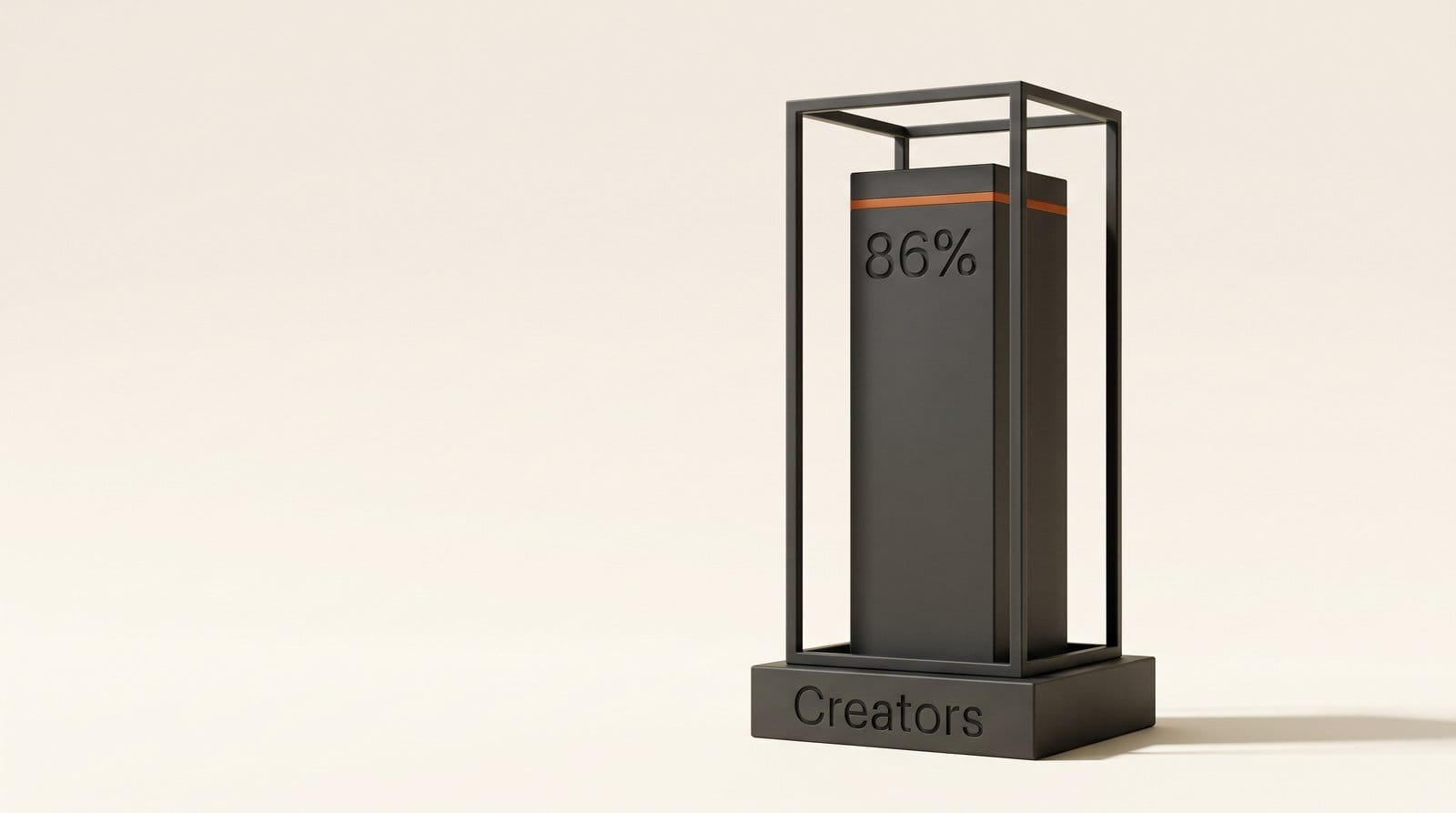
Using AI is no longer the unusual choice. In Adobe's Creators' Toolkit Report, run by The Harris Poll with more than 16,000 creators in eight countries in September 2025, 86% said they actively use creative generative AI and 76% said it helped grow their business or following. YouTube CEO Neal Mohan wrote in his January 2026 letter that more than 1 million channels used YouTube's AI creation tools every day in December.
Audiences are making things with AI too. The Reuters Institute's Generative AI and News Report 2026, fielded by YouGov with about 2,000 people per country, found that 31% of people in six core countries have used generative AI to create media, and image creation almost doubled in a year, from 10% to 19%.
Platforms now require you to say so. YouTube's letter states that "creators must disclose when they've created realistic altered or synthetic content", and since May 2026 YouTube has labelled photorealistic AI video automatically even when the creator does not. So the useful question is no longer whether to use AI. It is what your audience does when it finds out.
Deep Analysis
Most people cannot tell AI work from yours
On detection, the evidence is lopsided. Beyond the 97% of Deezer's listeners who failed the blind test, 52% said they felt uncomfortable about not being able to tell the difference. Microsoft's AI for Good Lab ran a "Real or Not" quiz with more than 12,500 people and about 287,000 image judgments; the preprint reports "an overall success rate of only 62%". People did best on human portraits and worst on natural and urban landscapes, the kind of shot that often fills B-roll and stock libraries.
Voices are no easier. In a Queen Mary University of London study published in PLOS One in September 2025, voice clones made with ElevenLabs' Instant Voice Cloning were judged human 58% of the time in one experiment and 70% in another, against 62% and 72% for the real voices. The gap between clones and real voices was not statistically significant. Generic AI voices designed from scratch did much worse, judged human only 39% to 41% of the time.
Writing follows the same pattern. In Porter and Machery's study in Scientific Reports, 1,634 readers identified AI-generated poems with 46.6% accuracy, below chance, and were more likely to call the AI poems human than the poems actually written by people. People know they are guessing: in Pew Research Center's June 2025 survey of 5,023 US adults, 76% said it is extremely or very important to tell AI work from human work, and 53% were not confident they could.
The label alone costs you
Here is the catch. When people are told AI was involved, they mark the work down, whatever its quality. The largest study so far, by Raj, Berg and Seamans, ran 16 preregistered experiments with 27,491 participants. Evaluations of creative writing dropped whenever people believed AI wrote it or helped write it, across metrics, contexts and content types. The drop runs through perceived authenticity, and the authors conclude the penalty "may be stubbornly difficult to mitigate, at least at this time." Porter and Machery saw the same thing: poems got lower quality ratings when readers were told AI wrote them, whether or not it had.
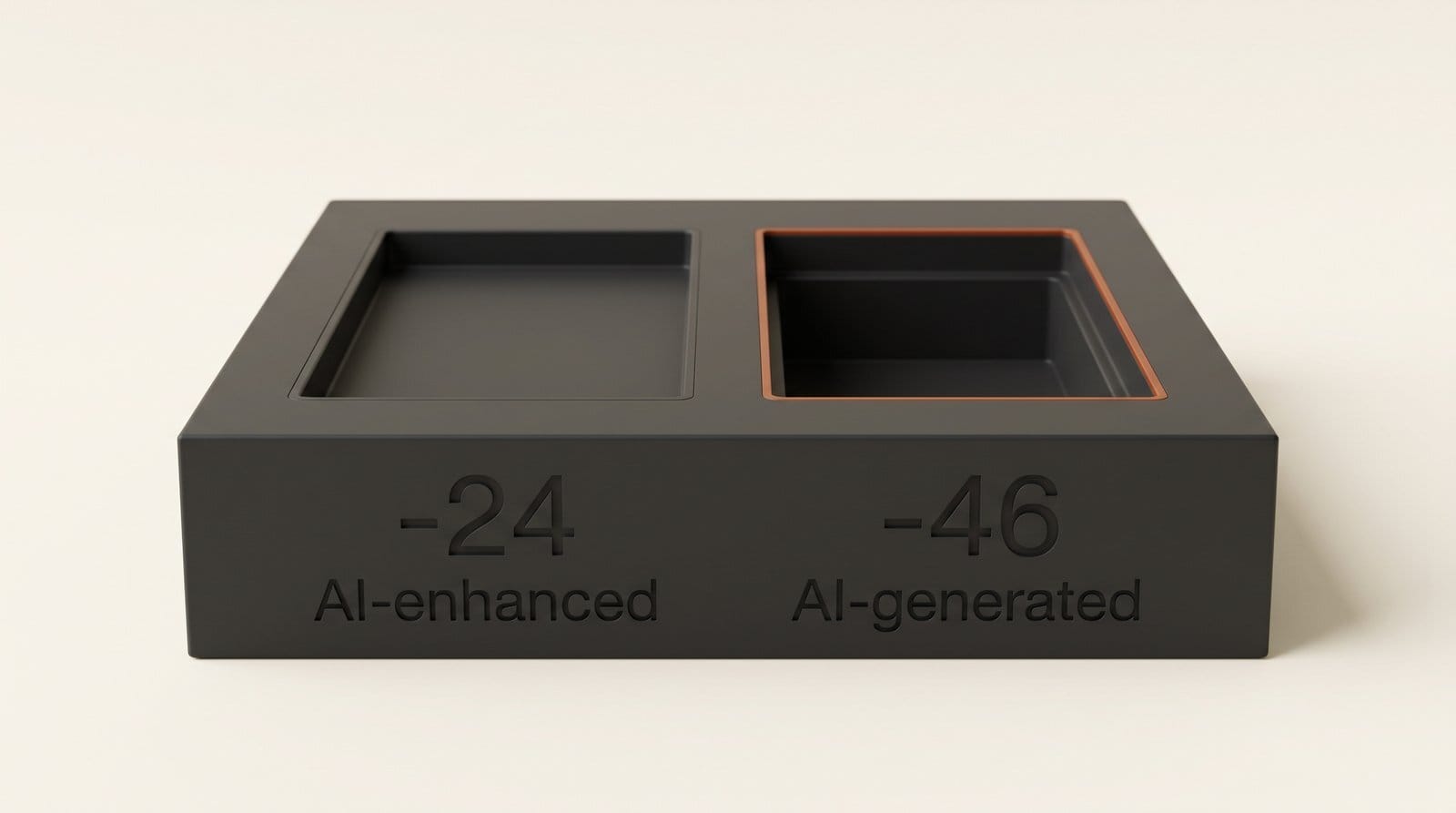
On social feeds the penalty is large. Researchers at Copenhagen Business School, in a study in Electronic Markets with almost 700 participants, showed people identical posts with different labels. Emotional posts labelled "AI-enhanced" got about 24 percentage points less emotional engagement than the same post labelled human-made. Labelled "AI-generated", they got about 46 points less. Informative posts lost about 13 and 27 points.
A USC team (Carney, Riveros and Tully) compared TikTok engagement before and after the platform made AI disclosure mandatory in September 2023, then ran experiments. In their working paper, disclosures reduced engagement and how much viewers identified with the creator. Their explanation, given in Stanford Social Innovation Review's coverage: viewers assume the creator put in less effort. It was not about the content looking worse or about distrust of AI in general.
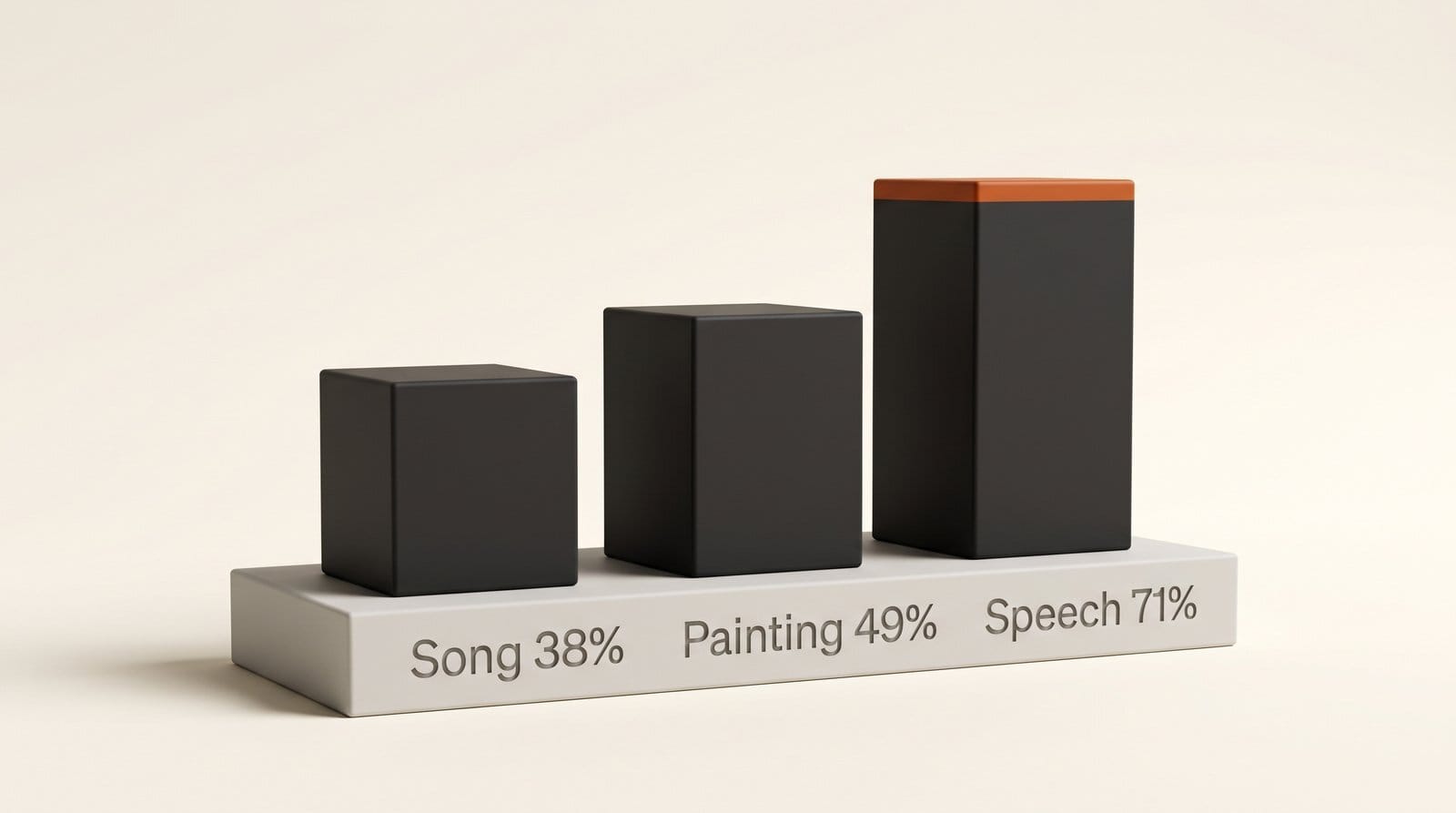
How much the penalty bites depends on the work. Pew asked what people would do if they learned AI was involved: 38% would like a song less and 58% would not change their view; for a painting, 49% would like it less; 56% would react negatively to a news article; and 71% would like a political candidate less after an AI-written speech.
Hiding it costs more, and hiding is getting harder
If a label costs engagement, the tempting move is to say nothing. The research says that is the worst bet. Oliver Schilke and Martin Reimann ran 13 experiments with more than 5,000 participants on what they call the transparency dilemma. Reported by the University of Arizona, disclosing AI use lowers how trustworthy you seem, but "quietly using AI can trigger the steepest decline in trust if others uncover it later."
Audiences also say outright that they want to be told. In the Deezer and Ipsos survey, 80% agreed that fully AI-generated music should be clearly labelled. In an Adobe Express survey of 850 US consumers published in February 2026, nearly three in four said brands should disclose AI-generated voice or music.
Staying quiet is also getting harder to pull off. YouTube labels photorealistic AI video on its own. Google's SynthID Detector is open to the public and reads the invisible watermark that Google's and several partners' tools embed. In the EU, the AI Act's Article 50 transparency rules have been enforceable since August 2, 2026. The "uncovered later" scenario Schilke and Reimann describe is getting more likely, not less.
Effort and the medium set the price
The penalty is not fixed. The clearest lever is how much of the work AI did. In the Copenhagen study, "AI-enhanced" cost about half as much as "AI-generated" (24 points against 46 on emotional posts). For emotional posts, showing the AI-enhanced label only after people had seen the post cut that penalty by about 13 points; for fully AI-generated posts, timing made no difference.
The Reuters 2026 report draws the same line for news across nine countries. Comfort was 67% for news made entirely by a human, 45% for mostly human work with some AI help, 19% for AI work with human oversight and 12% for news made entirely by AI. The big drop comes when AI stops being a helper and becomes the author.
The wording of the label matters too. In the USC research as described by SSIR, a disclosure showing the creator "did put work into the post" softened the hit, and detailed, creator-written disclosures naming which parts used AI did better than a generic "made with AI" tag.
The market data agrees. Deezer's July 2026 update counts nearly 90,000 fully AI-generated tracks delivered a day, more than 50% of all deliveries on peak days, yet those tracks get between 1% and 3% of streams, and up to 85% of their streams in 2025 were fraudulent. Fully AI music fills the shelves; listeners mostly walk past it.
Impact on Creators
Put together, the studies give a working rule: use AI where your audience is not paying for your effort, say so in your own words, and keep the part they come for visibly yours. How that plays out depends on what you make.
YouTubers and video editors. Realistic synthetic footage has to be disclosed on YouTube anyway, so the choice is only how you word it. Write it yourself in the description and name the parts: "The 1920s street shots are AI-generated; script, voice and edit are mine." That is the creator-written, effort-showing disclosure the USC team found does least damage. AI for cleanup, captions and color sits on the "AI-enhanced" side of the Copenhagen numbers.
Musicians. Listeners cannot hear the difference, but 80% want fully AI tracks labelled, and on Deezer those tracks earn 1% to 3% of streams. AI for stems, mastering or demo ideas is a tool; a fully AI vocal is a different product with a different audience. Our comparison of AI music rules on seven streaming services shows which ones already hide or demote those tracks.
Illustrators and designers. Art takes a steeper hit than music: 49% of Americans would like a painting less if AI was involved, and 66% of adults under 30, against 36% of those 65 and older. If people buy your hand, keep AI on the steps they do not pay for (mockups, backgrounds, cleanup, client variations) and say which steps those were.
Podcasters. A cloned voice passes as human, which is exactly why being found out hurts. Only 8% of consumers in the Adobe Express survey were comfortable with AI voices in podcasts, and 58% said they would trust a brand less if it used AI voices in ads. Use AI for transcripts, show notes and cleanup, and keep your own voice on the episode.
Writers and newsletter authors. Writing has the most robust evidence of a penalty: 16 experiments, and the authors doubt it can easily be fixed. Use AI for research, outlines and proofreading, and keep the sentences readers subscribed for in your own voice.
| Study or survey | Who and when | What it found |
|---|---|---|
| Deezer and Ipsos | 9,000 adults, 8 countries, Oct 2025 | 97% could not tell AI music from human; 80% want fully AI music labelled |
| Microsoft AI for Good Lab | 12,500+ people, ~287,000 judgments, 2025 preprint | 62% accuracy at spotting AI images; worst on landscapes |
| Queen Mary University of London | 50 people per experiment, PLOS One, Sep 2025 | Voice clones judged human as often as real voices |
| Porter and Machery | 1,634 + 696 readers, Scientific Reports, Nov 2024 | 46.6% accuracy on AI poems; told "AI", ratings fall |
| Pew Research Center | 5,023 US adults, Jun 2025 | 38% like a song less, 49% a painting, 71% a speech |
| Raj, Berg and Seamans | 16 experiments, 27,491 people, 2026 | Persistent penalty on writing believed to involve AI |
| Schilke and Reimann | 13 experiments, 5,000+ people, 2025 | Disclosure lowers trust; being found out lowers it most |
| Copenhagen Business School | ~700 people, Electronic Markets, Aug 2026 | AI-enhanced label -24 points, AI-generated -46 (emotional posts) |
| Carney, Riveros and Tully (USC) | TikTok posts + experiments, Journal of Consumer Research, forthcoming | Disclosure cuts engagement because viewers infer less effort |
| Reuters Institute 2026 | ~2,000 per country, 9 countries, Aug to Sep 2026 | Comfort 45% for AI-assisted news, 12% for fully AI news |
| Adobe Express | 850 US consumers, Feb 2026 | 58% trust a brand less with AI voices in ads; 8% accept AI podcast voices |
Key Takeaways
1. Most people cannot spot AI work: 97% failed Deezer's music test, image spotting runs at about 62%, and voice clones pass as human.
2. A label still costs you. Writing believed to involve AI is rated lower across 16 experiments, and "AI-generated" posts lost about 46 points of emotional engagement in the Copenhagen study.
3. Hiding is the worst option. Trust falls furthest when someone else uncovers your AI use, and YouTube, SynthID and the EU AI Act make that more likely.
4. The penalty roughly halves when AI assists rather than authors, and a specific, creator-written disclosure softens it further.
5. Medium matters: music gets the mildest reaction, art and writing a steeper one, and political or news content the harshest.
What to Watch
Labels are turning automatic. With YouTube labelling realistic AI video itself, watermark detectors open to the public and Article 50 in force in the EU, the creator's choice is shifting from whether a label appears to whether you write it before a platform does. The USC findings suggest that difference matters: a platform's generic tag reads as low effort, your own note about what AI did reads as craft.
The penalty may not stay this size. Raj, Berg and Seamans hedge with "at least at this time", and the Reuters data shows 22% of 18 to 24 year olds comfortable with fully AI-made news against 7% of those 55 and over. Yet Pew found the under-30s the harshest judges of AI songs and paintings. Watch the next Reuters and Pew waves to see which way young audiences move, and the USC paper's final version in the Journal of Consumer Research for how much engagement a TikTok disclosure actually costs.
FAQ
Can people tell if content is AI-generated?
Mostly not. In a 9,000-person test for Deezer, 97% could not tell AI music from human music. In Microsoft's image quiz, people were right 62% of the time, and in a Queen Mary study, voice clones were judged human about as often as real voices.
Should I disclose that I used AI in my content?
Yes. Disclosure costs some trust, but research by Schilke and Reimann found trust falls furthest when others uncover undisclosed AI use later. YouTube requires disclosure of realistic synthetic content and labels some of it automatically.
Does labelling content as AI reduce engagement?
Yes, measurably. In a Copenhagen Business School study, emotional posts labelled "AI-generated" got about 46 percentage points less emotional engagement than the same posts labelled human-made, and "AI-enhanced" posts about 24 points less. A USC study found the same direction on TikTok.
How should I word an AI disclosure?
Write it yourself and be specific about which parts used AI and which parts you made, for example "background music generated with AI; footage, script and edit are mine". USC researchers found detailed, creator-written disclosures that show effort draw a weaker penalty than a generic "made with AI" tag.
Do younger audiences mind AI content less?
It depends on the content. Pew found 53% of US adults under 30 would like a song less if AI was involved, against 26% of those 65 and older. For news, the Reuters Institute found 18 to 24 year olds more comfortable with fully AI-made news (22%) than those 55 and over (7%).