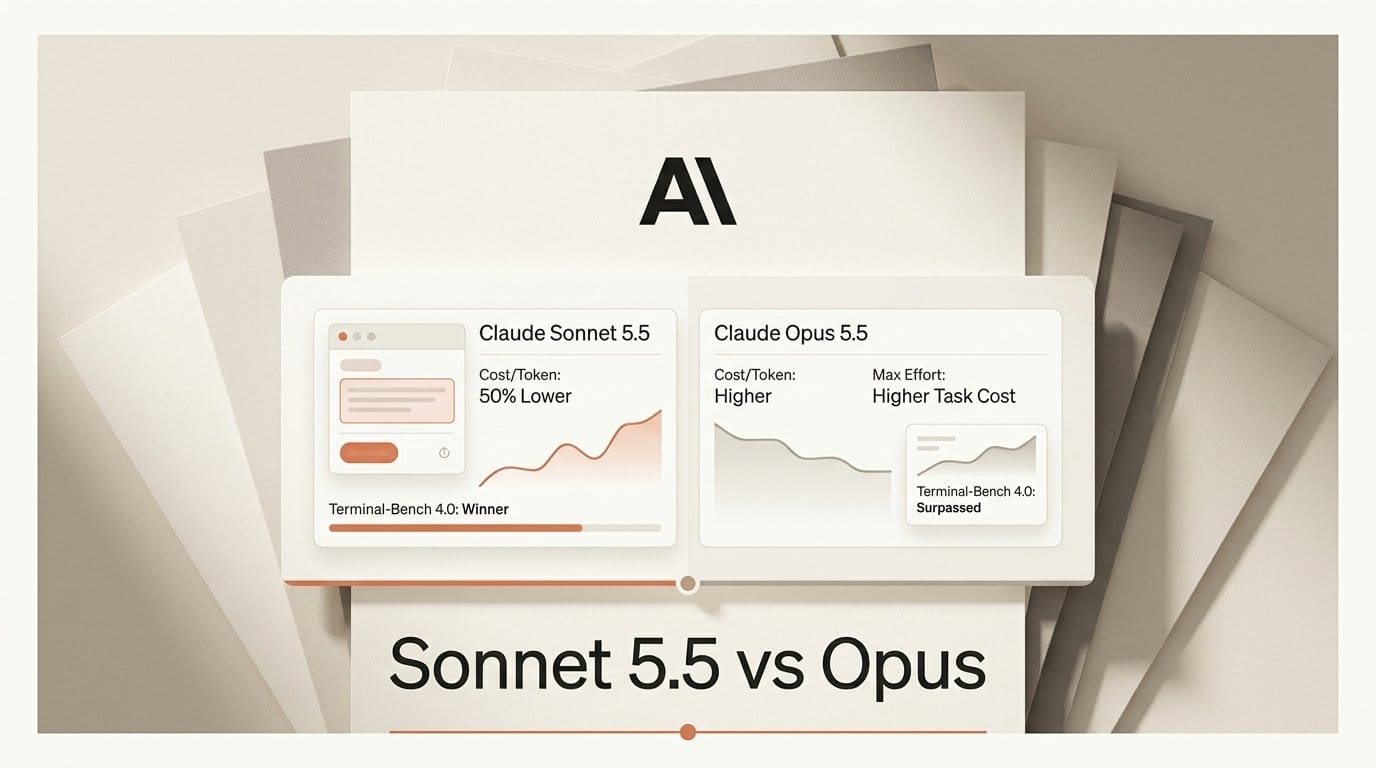
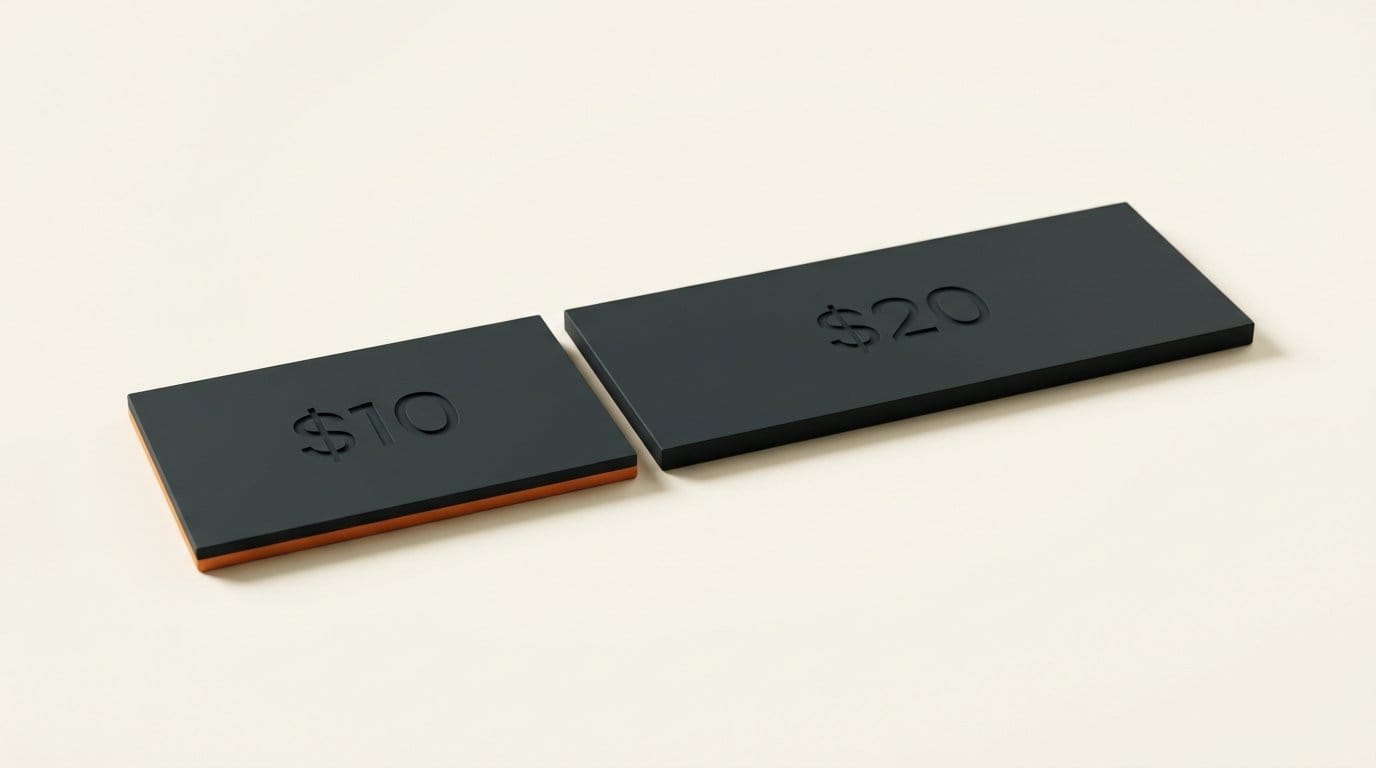
Anthropic released Claude Sonnet 5.5 on 28 September 2026 at $2 per million input tokens and $10 per million output tokens, half the rate of Claude Opus 5.5, and on Anthropic's own chart it beats Opus 5.5 on Terminal-Bench 4.0, 70.6% to 66.4%. On launch day Artificial Analysis ranked it third of 216 models on its Intelligence Index with a score of 56, two points behind Opus 5.5.
The number that should shape how you use it is on the same Artificial Analysis page. At max effort, Sonnet 5.5 cost $7.60 per task to run the index. Opus 5.5 cost $5.98. The model with half the price per token cost 27% more per finished task, because it generated 410M output tokens where Opus 5.5 generated 260M. The cheaper model is only cheaper if you keep it off max.
What Anthropic Shipped on September 28
Sonnet 5.5 uses the model ID claude-sonnet-5-5, with a 1M token context window, 128K maximum output tokens, and a June 2026 knowledge cutoff, according to the model overview page. It is live on the Claude API, Amazon Bedrock (as anthropic.claude-sonnet-5-5), Google Cloud, Microsoft Foundry and Claude Platform on AWS, and Anthropic commits to keeping it available until no sooner than 28 September 2027. AWS published its own Bedrock launch post the same afternoon.
The price did not move. The pricing page lists Sonnet 5.5 at $2 input, $10 output, $2.50 for five-minute cache writes and $0.20 for cache reads, identical to Sonnet 5. That is itself a change from what buyers were told in June: Sonnet 5 launched at $2 and $10 as an introductory rate that was due to rise to $3 and $15 on 1 September, and a pricing-page footnote now says that increase "will not occur."
Anthropic's two headline claims are that Sonnet 5.5 "generates outputs 30%+ faster than Sonnet 5" and that "in our testing, it costs up to 30% less per task than its predecessor" because it needs fewer tokens. In Claude Code and the Claude apps the default effort is medium; on the Claude Platform it is high. TechCrunch reported that a new Haiku will follow "in the coming weeks."
Sonnet 5.5 vs Opus 5.5 vs Sonnet 5 on Anthropic's Benchmarks
Anthropic published eight evaluations against Sonnet 5 and Opus 5.5. Sonnet 5.5 leads Opus 5.5 on one of them, Terminal-Bench, and trails on the other seven, by as little as 1.7 points on OSWorld and as much as 8.2 on FrontierCode.
| Benchmark | Sonnet 5.5 | Sonnet 5 | Opus 5.5 |
|---|---|---|---|
| Terminal-Bench 4.0 | 70.6% | 10.3% | 66.4% |
| FrontierCode 1.1 | 46.2% | 42.4% | 54.4% |
| CursorBench 4.0 | 55.5% | 34.1% | 57.8% |
| GDPval-AA v2.1 | 1844 | 1449 | 1846 |
| AA-Briefcase v1.1 | 1811 | 1359 | 1822 |
| Humanity's Last Exam | 64.5% | 54.9% | 67.7% |
| OSWorld 2.1 | 80.1% | 57.0% | 81.8% |
| Chartography | 61.6% | 15.6% | 64.4% |
Two footnotes change how to read the table. Opus 5.5's Terminal-Bench figure is reported at xhigh effort, "which represents the model's highest score." And Sonnet 5.5 scored lower on FrontierCode at max effort than at xhigh: at max it more often ran Claude Code's code-review skill across many subagents, which in two cases led to a timeout or to edits beyond the task's scope. The same page lists OpenAI's GPT-6 Sol at 1487 on GDPval-AA, 357 points under Sonnet 5.5.
The gap to Sonnet 5 is the real story. Terminal-Bench went from 10.3% to 70.6% and Chartography from 15.6% to 61.6%. Anthropic also says it is the first Sonnet model to beat Pokémon Red from screenshots alone. Anthropic's own caveat is that "Opus 5.5 remains clearly stronger at complex, open-ended work requiring sustained judgment." The system card has the full evaluation detail.
The Bill at Max Effort: Sonnet 5.5 Costs More per Task Than Opus 5.5
Artificial Analysis runs every model through the same Intelligence Index at max effort and publishes what it cost. That makes it the one launch-day source where the cost per task and the score come from the same run. Here are the four models a Sonnet buyer is choosing between.
| Max effort, Artificial Analysis | Sonnet 5.5 | Opus 5.5 | Sonnet 5 | GPT-6 Sol |
|---|---|---|---|---|
| Intelligence Index | 56 (#3 of 216) | 58 (#1) | 38 (#58) | 48 (#20) |
| Price per 1M, input / output | $2 / $10 | $4 / $20 | $2 / $10 | $2 / $10 |
| Output tokens to run the index | 410M | 260M | 370M | 77M |
| Cost per task | $7.60 | $5.98 | $5.09 | $1.06 |
Read across the bottom row. At max effort Sonnet 5.5 cost 27% more per task than Opus 5.5, 49% more than Sonnet 5, and 7.2 times GPT-6 Sol, which carries exactly the same $2 and $10 rate card. It also generated 11% more output tokens than Sonnet 5 on the same tasks, the opposite of "far fewer tokens."
That is not a contradiction of Anthropic's claim, and it is worth being precise about why. Anthropic's "up to 30% less per task" is from its own testing and does not say at which effort. The customer figures on the launch page point the same way: Balyasny Asset Management saw about 121,000 tokens per answer against 497,000 on Sonnet 5, and Slack measured roughly 14% fewer output tokens. Those are workloads at the settings those teams chose. Artificial Analysis measured max, where the model is told to spend whatever it takes.
One caveat applies to all launch-day numbers. Anthropic says Artificial Analysis ran GDPval-AA and AA-Briefcase on a pre-release deployment with a structured-outputs bug that has since been fixed. It does not say whether the index run was affected. Treat $7.60 as a day-one figure that could move.

Why Effort, Not Price per Token, Decides Your Bill
The effort parameter controls how many tokens Claude spends on a response, thinking included, across five levels: low, medium, high, xhigh and max. On Sonnet 5.5 the levels are recalibrated, so the migration guide warns that a level "doesn't produce the same amount of thinking as on Claude Sonnet 5." A setting copied from your old config is not the same setting.
Two defaults now point in different directions. Sonnet 5.5 defaults to high on the API. Opus 5.5, as we reported on its launch, defaults to medium. Swap models without setting effort and you are comparing Sonnet at high against Opus at medium, and the price per token tells you almost nothing about which bill comes out lower.
Anthropic's recommended starting points are specific. Start at high for most work. For agentic coding and multistep tool use, start at medium for well-specified tasks and move to high for harder or longer ones. For chat and latency-sensitive work, start at medium or low. None of those recommendations is max, and the FrontierCode footnote shows max can lower quality as well as raise cost.
Five Breaking Changes Before You Swap the Model ID
The what's new page lists five changes that break code already running on Sonnet 5, plus one that breaks nothing and still changes what your users see.
- Thinking cannot be turned off with
disabled.thinking: {"type": "disabled"}now returns a 400 error. The lowest setting isbetween_tools, which works only at low, medium or high effort and returns a 400 at xhigh or max. - Forced tool use is gone.
tool_choiceof typeanyortoolreturns a 400, including on the token-counting endpoint. Useautowithstrict: trueand say in the prompt when the tool applies. On Bedrock, structured outputs are not available for Sonnet 5.5, so validate tool input in your own code. - Thinking blocks are tied to the conversation. For accounts created on or after 31 August 2026, replaying a Sonnet 5.5 thinking block after editing earlier history returns a 400. Keep conversations append-only and change instructions with mid-conversation system messages.
- Old computer use is rejected. On the Claude API and Google Cloud,
computer_20251124returns a 400; usecomputer_toolset_20260801. Bedrock still accepts the old tool. - Some advisors are refused. With the advisor tool, Opus 4.8, Opus 4.7 and Sonnet 5 advisors return a 400, and every accepted advisor returns its advice encrypted.
The silent one: notes longer than a sentence or two that the model writes between tool calls now arrive as thinking blocks, empty at the default display setting. An interface that streams those notes goes quiet, with no error. Non-default temperature, top_p or top_k values also return a 400, and higher-risk cybersecurity requests visibly fall back to Sonnet 5.
How to Migrate From Sonnet 5 in Six Steps
The full migration guide covers every starting model back to Sonnet 3.7. For a Sonnet 5 codebase, this is the order that avoids surprises.
- Run the migration skill. In Claude Code, run
/claude-api migrate this project to claude-sonnet-5-5. It swaps the model ID, fixes breaking parameters and produces a checklist, and asks you to confirm the scope before it edits anything. - Search for the five breakers yourself. Grep for
"disabled",tool_choice,computer_20251124,temperatureand any advisor model names. Do not trust a single pass. - Set effort explicitly on every request. Put the level in
output_config.effort. Never leave it to the default while you are measuring. - Run an effort sweep on 10 to 20 real tasks. Try low, medium and high. Record output tokens, wall time and cost per finished task, not per request. Anthropic says the same thing: "re-baseline cost."
- Run Opus 5.5 at medium on the same tasks. If Sonnet 5.5 only matches Opus 5.5 at xhigh or max, the Artificial Analysis numbers say Opus may be the cheaper model for that job.
- Handle refusals. A decline returns
stop_reason: "refusal"with a category such ascyberorgeneral_harms. Configure fallback or retry logic before production traffic hits it.
One cost saving needs no code change: the minimum cacheable prompt drops from 1,024 tokens to 512, so shorter system prompts now cache at $0.20 per million.
Who Should Switch Today, and Who Should Wait
Switch now if you run Sonnet 5 at medium or high for coding agents, terminal work or document tasks. You pay the same per token, Anthropic's customers report fewer tokens at those settings, and the Terminal-Bench and OSWorld gains are large enough to show up in real runs. Claude Code users get it at medium effort by default, which is the setting the evidence favors.
Think twice if you run at max effort for the best possible answer. On the only public measurement with cost and score side by side, Opus 5.5 was two points higher and $1.62 cheaper per task. If your job is price-sensitive and tolerant of a lower score, GPT-6 Sol ran the same index for $1.06 a task at the same rate card.
Wait a week if you depend on forced tool use, disabled thinking, or streamed text between tool calls. Those need code changes, and Bedrock users lose structured outputs on this model. Our Sonnet 5 review has the baseline to compare against.
Frequently Asked Questions
How much does Claude Sonnet 5.5 cost?
$2 per million input tokens and $10 per million output tokens, with cache reads at $0.20 and five-minute cache writes at $2.50. That is the same as Sonnet 5, whose planned rise to $3 and $15 was cancelled. The Batch API halves both rates to $1 and $5.
Is Claude Sonnet 5.5 better than Opus 5.5?
On Terminal-Bench 4.0, yes: 70.6% against 66.4%. On the other seven benchmarks Anthropic published, Opus 5.5 scores higher, by as little as two Elo points on GDPval-AA and as much as 8.2 points on FrontierCode. Artificial Analysis ranks Opus 5.5 first and Sonnet 5.5 third on its Intelligence Index.
Is Sonnet 5.5 cheaper than Opus 5.5 per task?
Per token it costs half as much. Per task it depends on effort. At max effort Artificial Analysis measured $7.60 per task for Sonnet 5.5 against $5.98 for Opus 5.5, because Sonnet generated 410M output tokens to Opus's 260M. At lower effort Anthropic and its customers report large token savings.
What effort level should I use with Sonnet 5.5?
Anthropic recommends starting at high for most work, medium for well-specified agentic coding and tool use, and medium or low for chat. The API default is high; Claude Code and the Claude apps default to medium. Run your own sweep, because the levels are recalibrated from Sonnet 5.
Will my Sonnet 5 code break on Sonnet 5.5?
It can. Requests using thinking: disabled, forced tool_choice, the computer_20251124 tool on the Claude API or Google Cloud, some advisor models, or non-default temperature return a 400 error. Edited conversation history can also fail on accounts created after 31 August 2026.
Is Claude Sonnet 5.5 available in Claude Code and on Bedrock?
Yes. It runs in Claude Code and the Claude apps at medium effort by default, and on Amazon Bedrock as anthropic.claude-sonnet-5-5, Google Cloud, Microsoft Foundry and Claude Platform on AWS as claude-sonnet-5-5.