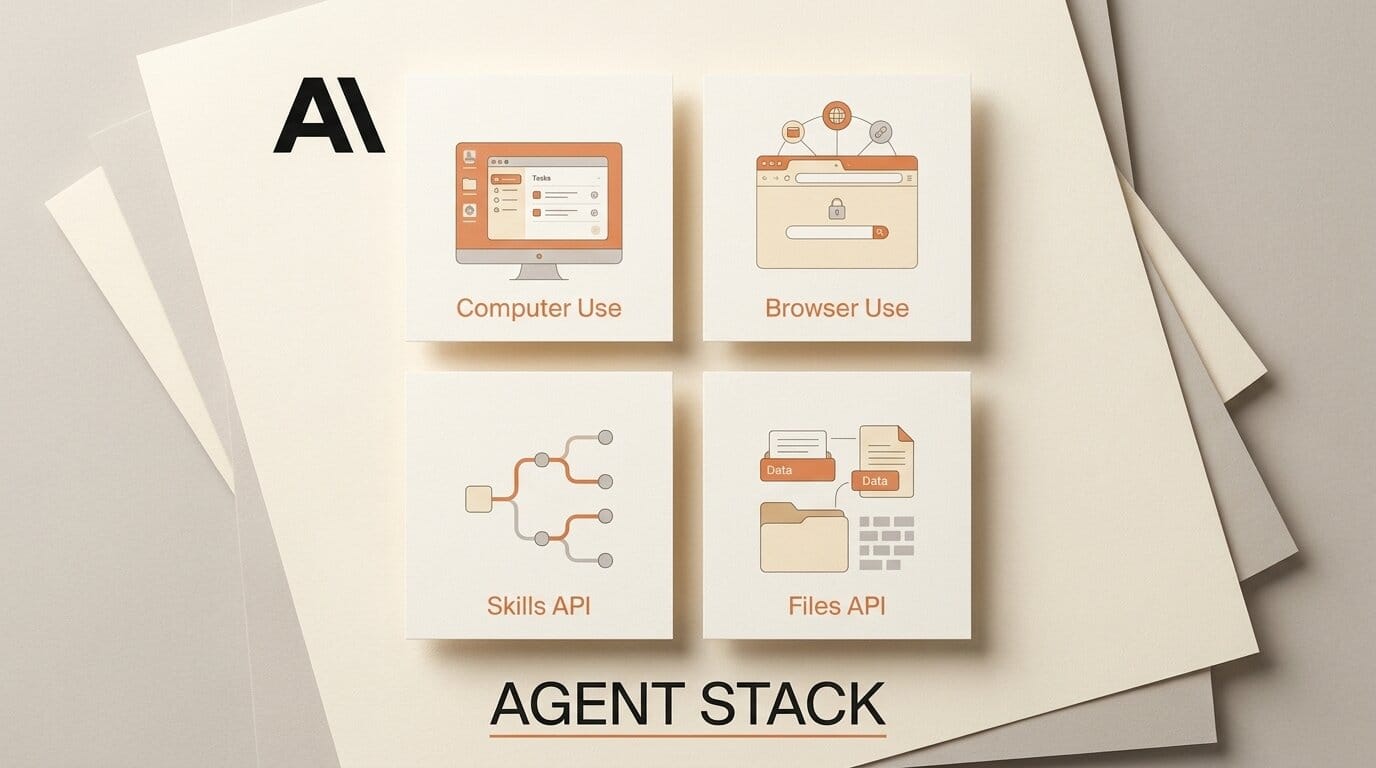
Anthropic moved four agent building blocks to general availability on the Claude Platform on August 20, 2026: the computer use tool, a new browser use tool, the Skills API, and the Files API. The Files API now carries 1 TB of storage per organization with rate limits five times higher than before, and computer use is eligible for HIPAA-regulated workloads under a business associate agreement. Together the four pieces cover the loop most production agents need: operate software, navigate a web app, apply a repeatable method, and hand back a finished file.
The release matters less as a feature list than as a change in posture. Until now, teams wiring Claude into a real workflow assembled these parts themselves from previews, custom sandboxes, and their own file storage. Anthropic is now shipping all four as supported surfaces, which changes what a small studio can put in front of a paying client.

What Anthropic shipped
The announcement covers four distinct pieces, each of which changes a different part of an agent run.
Computer use, now with multi-action turns. The computer use tool lets Claude work with software through screenshots plus mouse and keyboard actions. The August release lets the model emit several sequential actions in a single call rather than one action per round trip. For any task that involves a dozen clicks in a row, that collapses a dozen model calls into one.
Browser use, the new piece. The browser use tool reads page structure, including the accessibility tree, alongside the screenshot. Instead of guessing that a submit button sits at a pixel coordinate, the agent targets the element, the form, or the tab directly. That is the difference between an automation that survives a CSS change and one that does not.
Skills API. The Skills API lets you upload and version a skill, which is a folder holding instructions, scripts, and templates. Skills execute inside Claude's own code execution sandbox, so there is no server for you to run. This is the same skills concept that has been spreading across the tooling ecosystem, including Vercel's skill packs, now with a managed API behind it.
Files API. The Files API raises organization storage to 1 TB, lifts rate limits by 5x, and adds automatic expiration so generated artifacts clean themselves up instead of accumulating.
Where each capability runs
Availability is not uniform across the four, which matters if you are already committed to a cloud.
| Capability | What changed | Where it runs |
|---|---|---|
| Computer use | Multi-action turns, HIPAA eligible under BAA | Claude Platform, Vertex AI coming |
| Browser use | New tool, reads page structure and accessibility tree | Claude Platform, Vertex AI coming |
| Skills API | Upload and version skills, runs in Claude's sandbox | Claude Platform, Microsoft Foundry |
| Files API | 1 TB per org, 5x rate limits, auto expiration | Claude Platform, Microsoft Foundry |
Skills and Files reached Microsoft Foundry at the same time as the Claude Platform. Computer use and browser use are listed as coming to Google Cloud Vertex AI rather than shipping there today. If your agent runs on Vertex, the two tools that touch a screen are the ones you cannot schedule yet.
Building a production run with all four
The parts are more interesting combined than separately. Here is the shape of a run that uses each one, using a client deliverable as the example.
1. Package the method as a skill. Write the repeatable part of the job into a skill folder: the instructions, a script that formats output, and a template. Upload it through the Skills API and pin a version. Every future run references that version rather than a prompt you paste by hand.
2. Let browser use gather the inputs. Point the browser use tool at the web app holding the source data, whether that is an analytics dashboard, a CMS, or a client portal. Because it targets elements rather than coordinates, the same script keeps working after the vendor ships a redesign.
3. Fall back to computer use for desktop software. Anything without a usable web surface still needs the screenshot path. Multi-action turns matter most here, since desktop workflows are where long click sequences pile up.
4. Return the artifact through the Files API. The agent writes the finished export, and automatic expiration clears it after the retention window you set. With 1 TB per organization you are no longer rationing storage across concurrent runs.
This is the same assembly logic behind agent harness projects we have covered, including TrueForge and DeepSeek's open harness. The difference is that Anthropic now supports the whole chain rather than leaving you to glue it.
What the numbers show so far
Anthropic published one customer result alongside the release. Asteroid, running a claims workflow, reported the task dropping from 32 minutes to 13 minutes, roughly 30 percent lower cost across the workflows tested, and a 100 percent completion rate.
Treat that as a vendor-supplied data point rather than an independent benchmark. The useful signal is the shape of the gain, not the exact figure. A 32 to 13 minute drop on a click-heavy process is consistent with what multi-action turns should do: most of the old time was round trips, not reasoning. If your own workflow is reasoning-bound rather than click-bound, expect a smaller improvement.
What this means for creators and small studios
The practical unlock is client-facing automation you can actually charge for. A one-person studio can now package a repeatable deliverable as a versioned skill, run it against a client's web tools, and return a finished file, without standing up a server, a headless browser fleet, or an artifact store.
The HIPAA eligibility line is narrow but real. Computer use under a BAA opens regulated work that was previously off the table for agent automation entirely. That is a category of client, not a feature.
The honest caveat is that screen-driving agents remain the least reliable part of any stack. Browser use reduces the brittleness by reading structure instead of pixels, but it does not eliminate the need for a human check on anything consequential. Ship these into workflows where a wrong action is cheap to reverse before you ship them into workflows where it is not, a point worth reading alongside our coverage of agent permission gaps.
Frequently asked questions
What is the difference between computer use and browser use?
Computer use drives any software through screenshots plus mouse and keyboard input, so it works on desktop applications. Browser use is scoped to web pages and reads the page structure, including the accessibility tree, so it can target a specific element, form field, or tab rather than a screen position. Browser use is more reliable inside a browser; computer use is the fallback everywhere else.
Do I need to host anything to use the Skills API?
No. Skills run inside Claude's own code execution sandbox. You upload a folder of instructions, scripts, and templates, version it, and reference that version from your runs.
How much file storage do I get?
The Files API provides 1 TB per organization, with rate limits five times higher than the previous version, plus automatic expiration so old artifacts are removed without a cleanup job.
Can I use these on Google Cloud or Microsoft Azure?
Skills and Files are available on the Claude Platform and Microsoft Foundry. Computer use and browser use are on the Claude Platform, with Vertex AI listed as coming rather than available today.
Is this suitable for regulated work?
Computer use is now eligible for HIPAA-regulated workloads under a business associate agreement. That covers the tool's eligibility, not your overall compliance posture, so the rest of your pipeline still needs its own review.
How much faster do agents actually get?
Anthropic cites one customer, Asteroid, reporting a claims workflow dropping from 32 minutes to 13 minutes with about 30 percent lower cost and a 100 percent completion rate. Gains concentrate in click-heavy tasks, because multi-action turns remove round trips rather than making the model think faster.