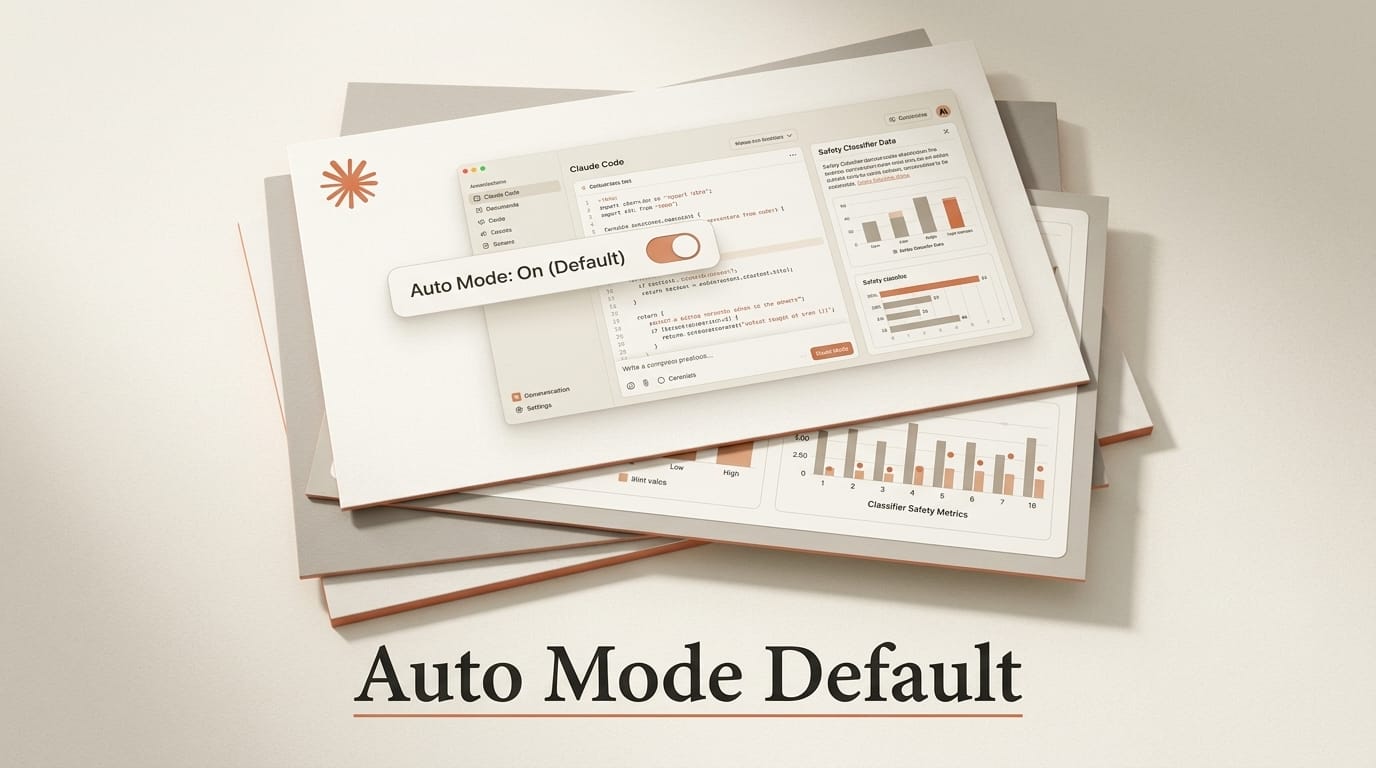
On August 7, 2026, Anthropic announced that auto mode will become the default in Claude Code for Pro, Max, and Team plans starting August 14. The change flips a setting that already exists as opt-in, but the framing is what matters: Anthropic is calling this a safety upgrade, not a convenience one, and backing it with a controlled study. Before millions of coding sessions change how they run, it is worth reading the numbers closely and asking what a creator should actually verify before the default flips.
Background
Auto mode routes each tool call through a classifier that blocks irreversible, destructive, or out-of-environment actions instead of pausing to ask for approval on every step. When it blocks something, Claude Code usually finds a safer path or asks for direct sign-off. The practical effect is fewer permission prompts and longer uninterrupted agent runs. Today it is opt-in; on August 14 it becomes the default for consumer and team tiers, while staying opt-in for Enterprise, the Claude API, and the AWS, Bedrock, Google Cloud, and Microsoft Foundry platforms. You can switch modes at any time with Shift+Tab in the CLI or the mode dropdown in the desktop app, and the auto mode configuration reference documents how to pin a mode so it persists across sessions.

Deep Analysis
Anthropic's case rests on a specific set of numbers. Taken together they are a strong argument, but each one carries a caveat that a careful reader should hold onto.
Auto mode versus human review, metric by metric
The headline comparison is machine against human. In a controlled study of 1,053 paid testers, Anthropic reports that humans caught 13.6% of dangerous commands while auto mode caught 89%. In real-world sessions it says 6.3% of manually approved runs contained unintended harm versus 2.4% under auto mode, and that auto mode users ship roughly 25% more pull requests. The direction is consistent: the classifier catches more, lets less harm through, and slows people down less. The caveat is that the human baseline here is a person clicking approve on a long stream of prompts, which is exactly the condition under which humans rubber-stamp. The study measures classifier-versus-fatigued-human, not classifier-versus-careful-review.
Prompt injection is where the gap is widest
The most striking figures are on prompt injection, the attack where hidden instructions in a file or web page try to hijack the agent. Anthropic's production case studies report a 0% attack success rate against Claude models in auto mode, compared with 5.83% against GPT-5.6 Sol in Codex auto-review mode. If those numbers hold up under independent testing, that is a meaningful safety separation between the two most popular coding agents, and it matters most for creators who let an agent read untrusted inputs like scraped pages or third-party repositories. The caveat is the phrase if they hold up: these are the vendor's own case studies, and injection resistance is notoriously sensitive to the exact attack set used.
The residual miss rate Anthropic admits
The most honest number in the announcement is the one that is not zero. Anthropic says red-teaming cut the classifier miss rate from 12% to 7%, and it openly acknowledges that 7% is not zero. That means roughly one in fourteen dangerous actions can still slip past the gate. Developer Simon Willison welcomed the confidence but flagged exactly this residual rate, calling for outside verification before anyone treats the numbers as settled. The right way to read auto mode is not as a guarantee but as a filter that catches most of what a tired human would miss, while still leaving a tail you are responsible for.

Impact on Creators
For most creators using Claude Code on side projects, documentation, or content tooling, the default flip will feel like an upgrade: fewer interruptions, more finished pull requests, and a classifier watching for the destructive commands that are easy to approve by reflex. The risk is concentrated in a specific case. If your Claude Code work touches production systems, secrets, or anything hard to reverse, the 7% residual miss rate is the number that should govern your behavior, not the 89% catch rate. Test auto mode on a throwaway branch first and confirm the classifier stops the actions you expect it to before you trust it against anything important.
The other practical consideration is untrusted input. Because the injection numbers are strongest where the agent reads outside content, the creators who benefit most from auto mode are the ones whose agents ingest scraped pages, external documents, or unfamiliar repositories. If that is your workflow, the safety separation from Codex is a real reason to prefer Claude Code in auto mode, provided you verify the behavior yourself rather than taking the case studies on faith.
Key Takeaways
Anthropic is making auto mode the default because its data says the classifier beats a fatigued human on catching dangerous commands, reducing real-world harm, and shipping more work. The prompt-injection separation from Codex is the most consequential claim if it survives independent testing. The most important number is the admitted 7% miss rate, which means auto mode is a strong filter, not a guarantee. Before August 14, decide deliberately whether you want it on by default, especially if your work touches anything irreversible.
What to Watch
The open question is independent verification. Anthropic's numbers are internally consistent and unusually candid about their limits, but every headline figure comes from the vendor, and the injection results in particular depend on the attack set chosen. Watch for third-party red-teams to publish their own auto-mode catch rates and injection success rates against both Claude Code and Codex, because that is what will confirm or puncture the 0%-versus-5.83% claim. Watch, too, whether the default flip changes real-world incident reports once millions of sessions run under it, and whether Anthropic keeps publishing the miss rate as it evolves. The behavior is easy to change with Shift+Tab, so the decision that actually matters is not the default itself but whether you review your permission habits now rather than discovering the new behavior mid-session next week.