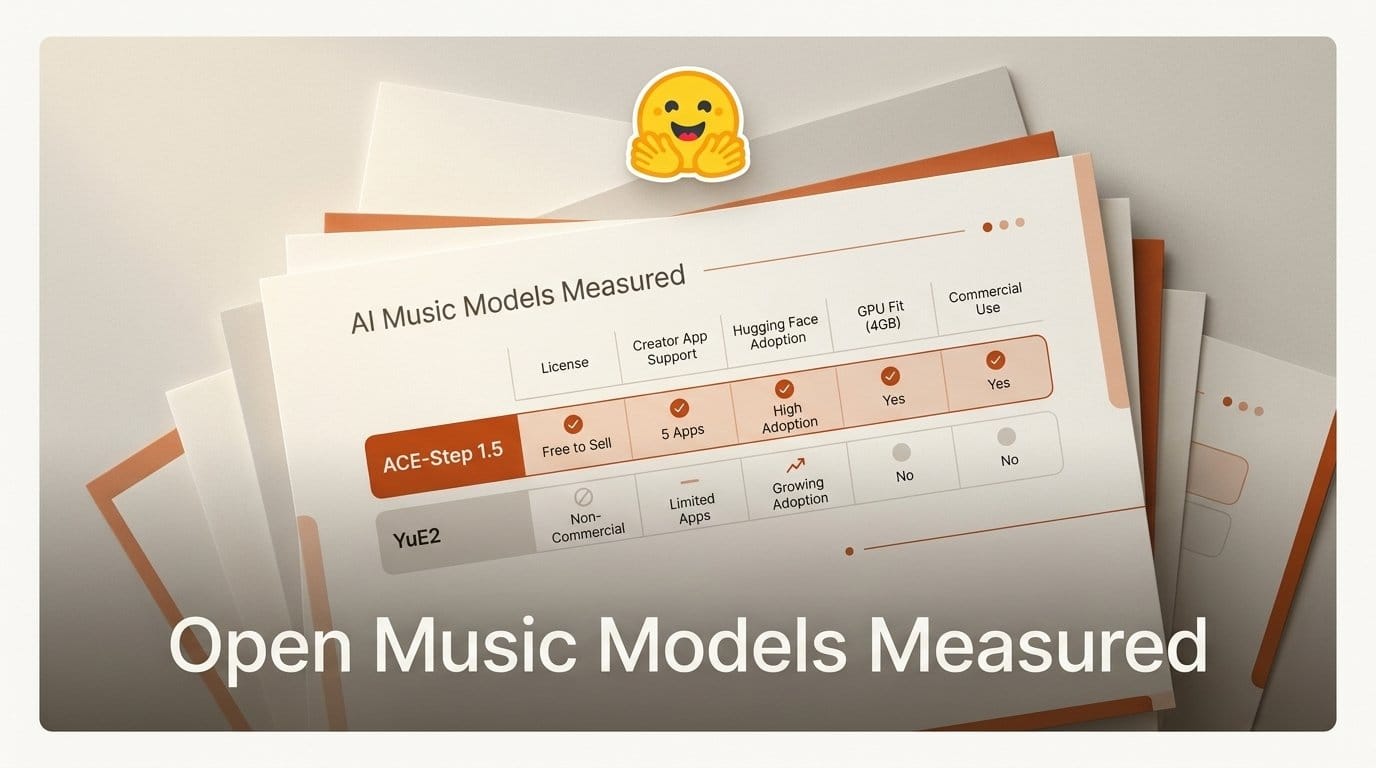
Only one open-source AI music model passes all three tests a working creator cares about. ACE-Step 1.5 is the only one of 12 open music model families that you can sell songs from with no conditions, that runs in all five creator apps we checked, and that its makers say fits on a graphics card with under 4 GB of memory. The newest model with the loudest launch, YuE2, fails the first test: its weights are licensed for non-commercial use only.
We pulled data from five public sources: the Hugging Face Hub API for 12 open music model families (the official repos, the Comfy-Org repackages, and every community model that declares one of them as its base in the Hub's model tree), the license text of every family, each model card's own speed and memory figures, and the source code of five creator apps that run these models: ComfyUI, audio.cpp, Wan2GP, KoboldCpp and SwarmUI. Here is what the numbers say about which open music model is worth your time, which ones you can use for paid work, and which ones you can open in an app instead of a code editor.
Key Findings
1. ACE-Step 1.5 is the only model that clears every bar
Three questions decide whether an open music model is useful to someone making songs for a channel, a client or a release. Can you sell what it makes? Can you run it in an app you already have? Will it fit on your graphics card? ACE-Step 1.5 is the only family that answers yes to all three.
Its weights are MIT licensed, and the model card says plainly that "you can strictly use the generated music for commercial purposes." It is also one of four families whose makers describe the training data: professionally licensed tracks, public domain and royalty-free music, and synthetic audio rendered from MIDI. It runs in all five apps we checked, the only family that does. And the card says the standard model "runs locally with less than 4GB of VRAM" and generates a full song in under 10 seconds on an RTX 3090. Those speed and memory figures are the vendor's, not ours; we did not generate audio for this report.
The community has noticed. ACE-Step 1.5 has 95 community models built on it, 38 of them LoRAs (small add-on files that teach a model a genre, a voice or a sound), the most of any family released in 2026, and 129 Hugging Face Spaces where you can try it in a browser.
| Family | Sell your songs? | Creator apps (of 5) | Smallest GPU its makers name |
|---|---|---|---|
| ACE-Step 1.5 | Yes (MIT) | 5 | Under 4 GB |
| YuE2 | No (CC BY-NC 4.0) | 4 | 24 GB recommended |
| MiniMax Music 3 | Yes, labelled as AI | 4 | 8 GB with layer streaming |
| Stable Audio 3 | Yes under $1M revenue, after registering | 3 | Not stated |
| HeartMuLa | Yes (Apache 2.0) | 2 | Not stated |
| ACE-Step v1 | Yes (Apache 2.0) | 2 | Not stated |
2. The most downloaded open music model is one you cannot sell from or open in any app
Meta's MusicGen drew 2,182,993 downloads in the past 30 days, 51.5% of the 4,239,786 downloads across all 12 families. That makes it the most downloaded open music model on Hugging Face by a wide margin, more than ACE-Step 1.5, YuE2 and MiniMax Music 3 combined.
It is also a dead end for creators. MusicGen dates from June 2023, its weights are CC BY-NC 4.0, so no commercial use, its card names researchers and "amateurs seeking to better understand those models" as the intended users, and it takes a text description (plus a melody, in one version), no lyrics. None of the five creator apps we checked supports it. One repo, musicgen-medium, accounts for 1,923,299 of those downloads. The Hub counts a download each time a script fetches a model's configuration file, so tutorials, notebooks and automated tests that load MusicGen every run count every time. The download number tells you MusicGen is the default in code examples. It does not tell you anyone is making music with it.
The same pattern holds across the board: the five families that run in no creator app (MusicGen, the original YuE, Magenta RealTime 2, DiffRhythm and Tencent's LeVo) account for 2,220,521 downloads, more than half the total, yet drew just 4 new community models between them in the past month.
3. YuE2 moved backwards on licensing, and is still growing fastest
M-A-P's first YuE models went the other way. In January 2025 the team moved YuE to Apache 2.0 "in response to overwhelming requests from our community," and the card still says it encourages creators "to sample and incorporate outputs generated by our model into their own works, and even monetize them," asking only for credit. YuE2, released on 9 September 2026, ships its weights under CC BY-NC 4.0. Remiqora, a desktop music studio that runs YuE2, spells out the result in its own README: YuE2 tracks cannot be used commercially without separate permission.
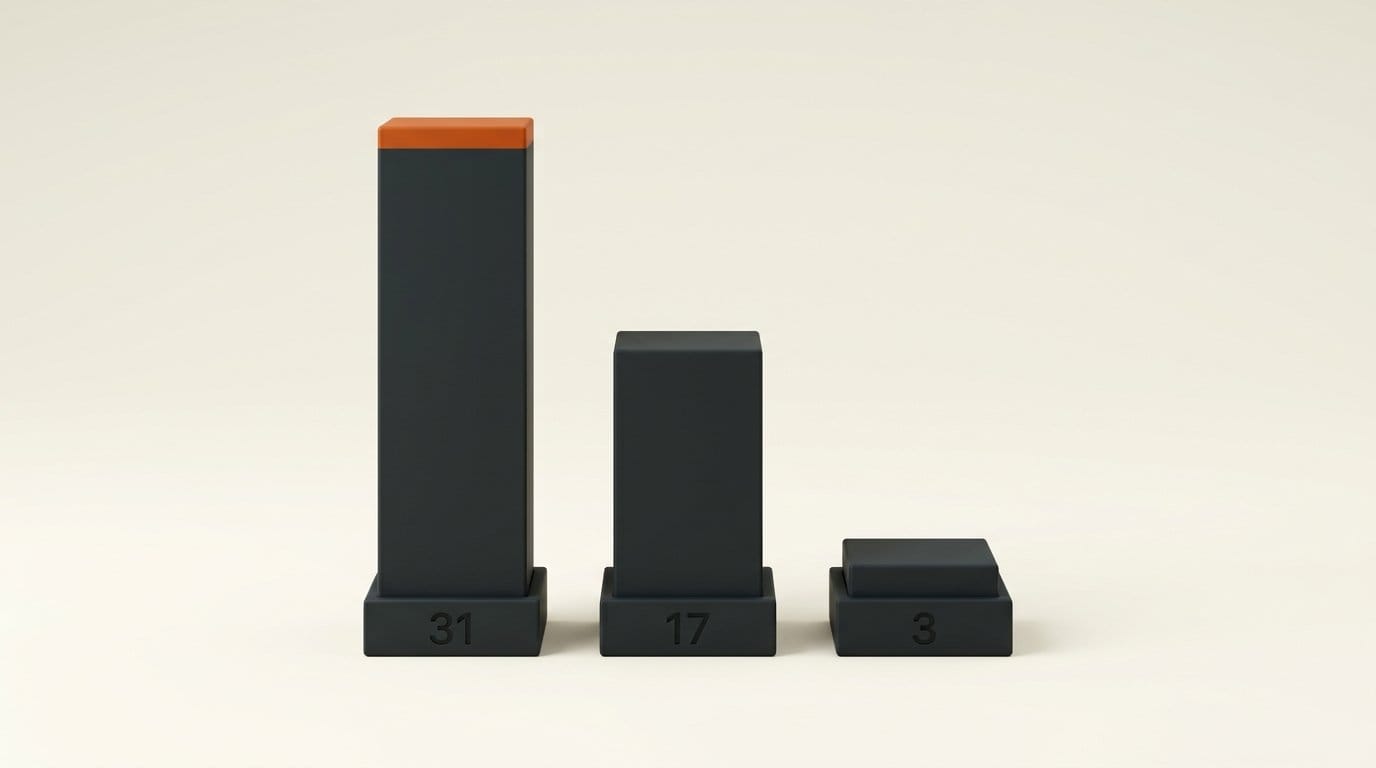
That has not slowed it down. YuE2 gathered 31 new community models in the past 30 days, the most of any family and nearly twice ACE-Step 1.5's 17. Twenty of the 31 are LoRAs, 8 are compressed versions for smaller graphics cards and 3 are fine-tunes, so people are already training styles and voices on a model they cannot sell from. MiniMax Music 3, released a month earlier, added 3. YuE2 also sits in four of the five apps already, five weeks after launch.
The quality case is real but narrower than the launch line. As we found when we read YuE2's benchmark tables against Suno v5, its headline win depends on generating several songs and keeping the best one. On speed, M-A-P's own card reports a 3.6-minute song in 71 seconds on an RTX 4090, peaking at 11.18 GiB of video memory, and recommends a 24 GB card.
| Family | Released | New in 30 days | All community models | LoRAs |
|---|---|---|---|---|
| YuE2 | 9 Sep 2026 | 31 | 41 | 20 |
| ACE-Step 1.5 | 23 Jan 2026 | 17 | 95 | 38 |
| MiniMax Music 3 | 7 Aug 2026 | 3 | 68 | 23 |
| MusicGen | 8 Jun 2023 | 3 | 240 | 201 |
| Stable Audio 3 | 16 May 2026 | 2 | 24 | 1 |
| DiffRhythm | 2 Mar 2025 | 1 | 2 | 1 |
| Every other family | 0 |
4. ComfyUI is the front door: 81.3% of downloads go through its repackages
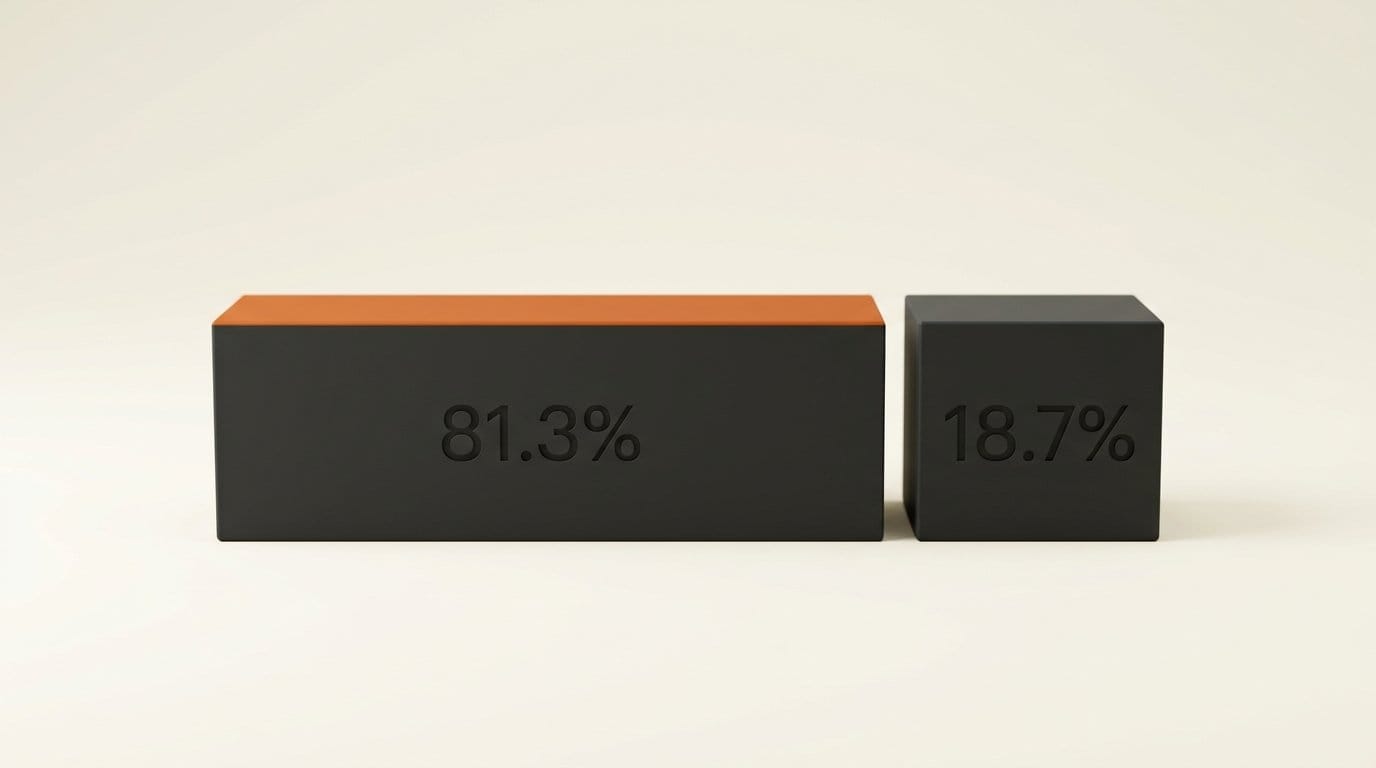
Six of the 12 families have an official repackage from Comfy-Org, the company behind ComfyUI. For those six, the repackages drew 1,634,123 downloads in the past 30 days against 376,224 for the original repos: 81.3% of the traffic. For MiniMax Music 3 it is 98.6%: 456,886 downloads of the ComfyUI files against 6,383 of MiniMax's own repo.
Comfy-Org also moves fast. The MiniMax Music 3 repackage went up one day after the model, YuE2's two days after, and the Stable Audio 3 files are dated 12 May, before Stability's own repos. If you want to know whether a new open music model is ready for people who do not write code, the Comfy-Org page is the signal to watch.
| Family | Original repos | Comfy-Org repackage | ComfyUI share |
|---|---|---|---|
| ACE-Step 1.5 | 131,319 | 552,168 | 80.8% |
| MiniMax Music 3 | 6,383 | 456,886 | 98.6% |
| YuE2 | 65,923 | 435,934 | 86.9% |
| Stable Audio 3 | 150,111 | 124,624 | 45.4% |
| Stable Audio Open | 22,488 | 24,049 | 51.7% |
| ACE-Step v1 | 0 | 40,462 | 100.0% |
5. "Free to sell" means four different things
Every family here is called open, and the licenses split four ways. Six let you sell what you make with nothing more than a credit: ACE-Step 1.5 (MIT), ACE-Step v1, the original YuE, HeartMuLa and DiffRhythm (all Apache 2.0), and Magenta RealTime 2, whose weights are CC BY 4.0 and whose card says Google "claims no rights in outputs you generate."
Three let you sell with conditions. The MiniMax-Music3 Community License allows commercial use, but item 11 of its acceptable use policy forbids publishing generated content "in or to any public environment" without "clearly and prominently disclosing" that it is machine-generated. Upload a MiniMax Music 3 track to a streaming service or a video and you have to say it is AI. Businesses above $20 million in yearly revenue need MiniMax's written sign-off. Stable Audio 3 and Stable Audio Open use the Stability AI Community License: you own your outputs, commercial use is free if you or your company make under $1 million a year, and you must register with Stability at stability.ai/community-license first.
Two forbid it: YuE2 and MusicGen, both CC BY-NC 4.0. And one is unclear. Tencent's LeVo song model, also called SongGeneration, no longer has an official home: on 14 October its Hugging Face page returned an access error and its GitHub repository returned "not found". What remains are re-uploads by other users, the largest carrying an "unknown" license tag.
| Family | License | Selling your songs |
|---|---|---|
| ACE-Step 1.5 | MIT | Yes. Card says outputs may be used commercially |
| ACE-Step v1 | Apache 2.0 | Yes |
| YuE (v1) | Apache 2.0 | Yes. Card encourages it, asks for credit |
| HeartMuLa | Apache 2.0 | Yes |
| DiffRhythm 2 | Apache 2.0 | Yes |
| Magenta RealTime 2 | CC BY 4.0 weights | Yes. Google claims no rights in outputs |
| MiniMax Music 3 | MiniMax-Music3 Community | Yes, if you label it as machine-generated |
| Stable Audio 3 | Stability AI Community | Yes under $1M revenue, after registering |
| Stable Audio Open | Stability AI Community | Yes under $1M revenue, after registering |
| YuE2 | CC BY-NC 4.0 weights | No |
| MusicGen | CC BY-NC 4.0 weights | No |
| LeVo / SongGeneration | Unknown, official repos offline | Unclear |
6. Eight of twelve can sing your lyrics; the big-brand models cannot
If you want a finished song with vocals, the field narrows. Eight families take lyrics and sing them: ACE-Step 1.5, ACE-Step v1, YuE2, YuE, MiniMax Music 3, HeartMuLa, DiffRhythm and LeVo. The three backed by the largest companies, Stability's Stable Audio, Meta's MusicGen and Google's Magenta RealTime 2, take a text or audio description and make instrumental music. Stability's Stable Audio 3 announcement does not mention vocals, and the apps that run it offer a prompt box with no lyrics field.
That makes the instrumental models a different tool, not a worse one. Stable Audio 3 Medium generates tracks up to 6 minutes 20 seconds and is trained on fully licensed data, according to Stability, which makes it a strong fit for video beds, podcast intros and game loops. Magenta RealTime 2 is built for live, streaming generation you steer as it plays, steered by text, audio examples and MIDI, and Google says it runs on-device.
| Family | Lyrics and vocals | Longest output its makers state | Memory its makers state |
|---|---|---|---|
| ACE-Step 1.5 | Yes, 50+ languages | Up to 10 minutes | Under 4 GB VRAM |
| ACE-Step 1.5 XL | Yes | Same family | 12 GB with offload and INT8; 20 GB recommended |
| YuE2 | Yes, Chinese and English | 3.6-minute example song | 24 GB GPU and 24 GB RAM recommended |
| MiniMax Music 3 | Yes | Up to 5 minutes | Under 24 GB; about 22 GB with offload; 8 GB with layer streaming |
| HeartMuLa | Yes: Chinese, English, Japanese, Korean, Spanish | Not stated | Not stated |
| DiffRhythm 2 | Yes | "Full-length songs" | Not stated |
| Stable Audio 3 | No lyrics input | Medium 6:20; Small 2 minutes | Not stated |
| Magenta RealTime 2 | No, instrumental | Continuous, real time | On-device; 2.4B and 230M sizes |
| MusicGen | No, English descriptions | Not stated | Not stated |
7. Five families run in no app at all
We read the source code of five apps that creators use to run open models locally and checked which music models each one actually registers, not which ones are mentioned in a comment. ComfyUI supports six families: ACE-Step 1.5, ACE-Step v1, YuE2, MiniMax Music 3, Stable Audio 3 and Stable Audio Open. Wan2GP, a one-window app aimed at people with modest graphics cards, also supports six: both ACE-Step versions, YuE2, MiniMax Music 3, Stable Audio 3 and HeartMuLa. audio.cpp, which ships its own web interface, supports five. SwarmUI supports three, and KoboldCpp, a single-file app better known for chat models, supports one: ACE-Step 1.5.
MusicGen, the original YuE, Magenta RealTime 2, DiffRhythm and LeVo appear in none of them. For a creator that means a model you can only reach through a browser demo on Hugging Face Spaces or by installing it yourself from code.
| Family | ComfyUI | audio.cpp | Wan2GP | KoboldCpp | SwarmUI | Total |
|---|---|---|---|---|---|---|
| ACE-Step 1.5 | Yes | Yes | Yes | Yes | Yes | 5 |
| YuE2 | Yes | Yes | Yes | Yes | 4 | |
| MiniMax Music 3 | Yes | Yes | Yes | Yes | 4 | |
| Stable Audio 3 | Yes | Yes | Yes | 3 | ||
| ACE-Step v1 | Yes | Yes | 2 | |||
| HeartMuLa | Yes | Yes | 2 | |||
| Stable Audio Open | Yes | 1 | ||||
| MusicGen, YuE (v1), Magenta RealTime 2, DiffRhythm, LeVo | 0 |
Trend Analysis
Rising: YuE2, on momentum alone: 31 new community models in a month and four apps in five weeks. ACE-Step 1.5, the steady base: the largest 2026 community, 95 models, and the only five-app family.
Stable: MiniMax Music 3 and Stable Audio 3. Both have big ComfyUI download numbers but little new community work, 3 and 2 new models in the past month. People are using them as they ship rather than building on them.
Emerging: the all-in-one desktop music studio. Remiqora (MIT) packages ACE-Step 1.5 and YuE2 with stem splitting, a multitrack editor and LoRA training, and offers an experimental installer for Windows and Apple Silicon Macs that needs no Python or command-line setup.
Declining: MusicGen and the first-generation research models. MusicGen still tops the download chart, but 3 new community models in a month on a base of 240, and zero creator apps, say the work has moved on.
Predictions
1. The next major open song model will be in ComfyUI within three days of release. MiniMax Music 3's repackage took one day, YuE2's two, and Stable Audio 3's was ready before launch. ACE-Step 1.5's took 11 days in January; the gap has closed since.
2. YuE2 will pass MiniMax Music 3 in community models by the end of December. YuE2 has 41 after five weeks and is adding about 30 a month; MiniMax Music 3 has 68 and added 3 in the past month.
3. ACE-Step 1.5 will still be the only open music family in all five apps at the end of 2026. YuE2 and MiniMax Music 3 each lack only KoboldCpp, whose music support is a dedicated ACE-Step port rather than a general music engine.
4. More open music licenses will add an AI-disclosure clause like MiniMax's. A license that makes labelling the creator's job moves that responsibility off the model maker, and MiniMax wrote one for its first open music model. We will count how many open music releases in the first half of 2027 carry one.
What This Means for Creators
If you make songs to sell or release: start with ACE-Step 1.5. It is the one model with a clean commercial license, a stated licensed-data training set, every major app and a small memory footprint. HeartMuLa is the Apache 2.0 second option if you sing in Japanese, Korean or Spanish, and it runs in Wan2GP and audio.cpp.
If you want the best-sounding open vocals and do not plan to sell them: try YuE2 for demos, songwriting sketches and personal projects. Keep those tracks out of anything paid, including monetized videos, unless M-A-P gives you separate permission.
If you publish to streaming services or video platforms: MiniMax Music 3 is commercially usable, but every public upload has to be clearly labelled as machine-generated. If you would rather not label, pick a model whose license does not require it.
If you need background music for video, podcasts or games: Stable Audio 3 is built for instrumental beds up to 6:20, trained on licensed data according to Stability. Register with Stability before you use it for paid work, and plan for an enterprise license if your business passes $1 million a year.
If you do not want to touch code: ComfyUI is where the open music models arrive first, and its repackages carry 81.3% of the downloads for the models that have one. Wan2GP covers six families in one window, and Remiqora offers a desktop installer, with the caveat that it is experimental and unsigned, so Windows and macOS will warn you on first launch.
Full Data
| Family | First released | Downloads, original repos (30 days) | Downloads, Comfy-Org (30 days) | Community models | LoRAs | New in 30 days | Spaces | Apps (of 5) | License |
|---|---|---|---|---|---|---|---|---|---|
| ACE-Step 1.5 | 23 Jan 2026 | 131,319 | 552,168 | 95 | 38 | 17 | 129 | 5 | MIT |
| ACE-Step v1 | 28 Apr 2025 | 0 | 40,462 | 18 | 12 | 0 | 42 | 2 | Apache 2.0 |
| YuE2 | 9 Sep 2026 | 65,923 | 435,934 | 41 | 20 | 31 | 62 | 4 | CC BY-NC 4.0 |
| YuE (v1) | 26 Jan 2025 | 9,946 | 0 | 72 | 1 | 0 | 63 | 0 | Apache 2.0 |
| MiniMax Music 3 | 7 Aug 2026 | 6,383 | 456,886 | 68 | 23 | 3 | 57 | 4 | MiniMax-Music3 Community |
| Stable Audio 3 | 16 May 2026 | 150,111 | 124,624 | 24 | 1 | 2 | 28 | 3 | Stability AI Community |
| Stable Audio Open | 24 May 2024 | 22,488 | 24,049 | 30 | 0 | 0 | 118 | 1 | Stability AI Community |
| MusicGen | 8 Jun 2023 | 2,182,993 | 0 | 240 | 201 | 3 | 257 | 0 | CC BY-NC 4.0 |
| Magenta RealTime 2 | 28 May 2026 | 25,798 | 0 | 7 | 0 | 0 | 18 | 0 | CC BY 4.0 |
| HeartMuLa | 14 Jan 2026 | 8,918 | 0 | 8 | 0 | 0 | 46 | 2 | Apache 2.0 |
| DiffRhythm (1 and 2) | 2 Mar 2025 | 1,784 | 0 | 2 | 1 | 1 | 26 | 0 | Apache 2.0 |
| LeVo / SongGeneration | Official repos offline | 0 | 0 | 11 | 0 | 0 | 0 | 0 | Unknown |
Downloads are the Hugging Face Hub's 30-day counts, which record requests for a model's configuration or weight files, so they are a rough signal and favor models that scripts load often. Community models are repos that declare a family's official or Comfy-Org repo as their base, excluding the audio.cpp model bundle, which declares ACE-Step 1.5 but packages more than 100 models. App support was checked in each app's source code on 14 October 2026. Speed and memory figures come from each model's card and were not measured by us.
Frequently asked questions
What is the best open-source AI music generator in 2026?
For most creators, ACE-Step 1.5. It is MIT licensed with commercial use stated on its card, runs in ComfyUI, audio.cpp, Wan2GP, KoboldCpp and SwarmUI, sings lyrics in 50+ languages, and its makers say it runs in under 4 GB of video memory. YuE2 is the strongest newer option for vocals, but its weights are non-commercial.
Can I sell songs made with YuE2?
No, not without separate permission from M-A-P. YuE2's weights are licensed under CC BY-NC 4.0, which rules out commercial use. The original YuE models are Apache 2.0, and their card encourages creators to monetize what they make, with credit to "YuE by HKUST/M-A-P".
Is ACE-Step 1.5 free for commercial use?
Yes. Its code and weights are MIT licensed, and the model card says the generated music can be used for commercial purposes. The ACE-Step team says it trained the model on licensed tracks, public domain and royalty-free music, and synthetic audio made from MIDI.
Do I have to label songs made with MiniMax Music 3 as AI?
Yes, if you publish them. Item 11 of the acceptable use policy in the MiniMax-Music3 Community License forbids putting generated content in any public environment without clearly and prominently disclosing that it is machine-generated. Commercial use is otherwise allowed, and businesses over $20 million in yearly revenue need written authorization from MiniMax.
Can I use Stable Audio 3 music in paid work?
Yes, if you or your company make under $1 million a year and you register with Stability AI first. The Stability AI Community License says you own your outputs. Above $1 million in annual revenue the license ends and you need an enterprise license from Stability.
Which open music model runs on a small graphics card?
ACE-Step 1.5, which its makers say needs under 4 GB of video memory for the standard model. MiniMax Music 3's card says it can fit 8 GB cards by streaming the model layer by layer, at a cost in speed. YuE2's card recommends a 24 GB card, although compressed community versions aim lower.
Which open music models can sing lyrics?
ACE-Step 1.5, ACE-Step v1, YuE2, YuE, MiniMax Music 3, HeartMuLa, DiffRhythm and Tencent's LeVo all take lyrics and generate vocals. Stable Audio 3, Stable Audio Open, MusicGen and Magenta RealTime 2 make instrumental music from a description.
This research was produced by Creative AI News.
Subscribe for free to get the weekly digest every Tuesday.