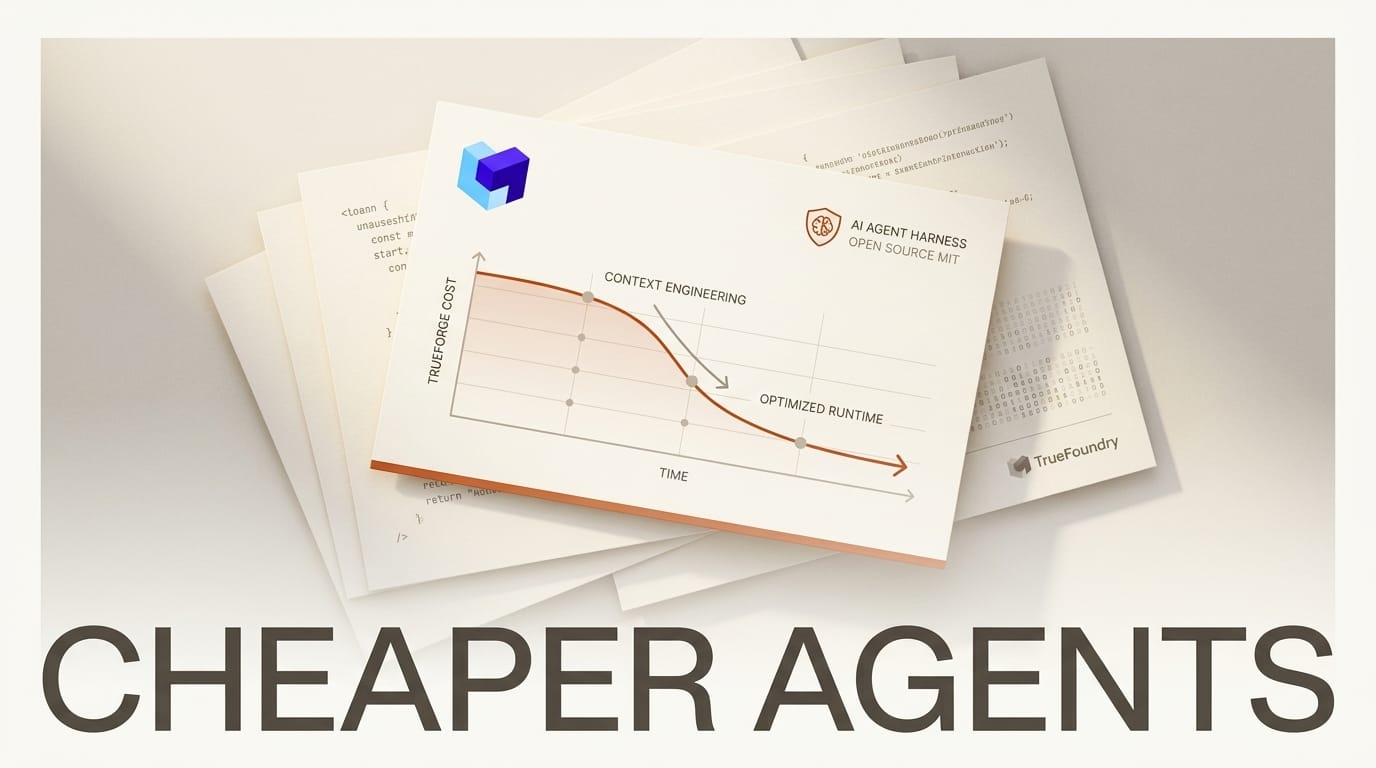
On August 19, 2026, TrueFoundry released TrueForge, an open source agent harness under the MIT license on GitHub and PyPI. The company claims 30 to 75 percent lower cost per completed task than Anthropic's Claude Managed Agents, achieved almost entirely through context engineering rather than a cheaper model.
The harness layer has been the least examined part of the agent stack. Everyone compares models. Almost nobody compares the runtime that decides what those models see, which is where a surprising share of the bill is actually decided.
What an Agent Harness Actually Is
A harness is the runtime that turns a language model into a working agent. It runs the execution loop: model calls, tool invocation, sandboxing, approvals, context management, and session state. The model reasons. The harness decides what reaches the model, what the model is allowed to do, and what happens with the results.
TrueForge exposes that loop three ways: a chat UI, an HTTP API with a TypeScript SDK, and an embeddable UI SDK. The project page covers the hosted option, though the open source release runs standalone with your own model API keys.
If the category is unfamiliar, the shape will be after one example. We covered DeepSeek's open agent framework earlier this month, which addresses the same layer from a different angle. The pattern is becoming a real category rather than a set of one-off scaffolds.

How TrueForge Cuts Token Spend
The cost claim rests on three specific techniques, and they are worth understanding because you can apply the thinking whether or not you adopt this tool.
The first is deferred schema loading. Most harnesses dump every available MCP tool schema into context at the start of every reasoning loop. With a large tool set that is a substantial fixed cost paid on every single turn, for tools the agent will never call. TrueForge delays loading a tool's schema until it is actually needed.
The second is subagent delegation. Rather than running every subtask through the frontier model holding the full conversation, it hands narrow subtasks to smaller models with narrow context. Most subtasks do not need the big model or the long history.
The third is output offloading. When a tool returns something large, a file listing, a query result, a scraped page, the naive approach pastes it into the active context where it is re-sent on every subsequent turn. TrueForge writes oversized outputs to flat files and passes references instead.
None of this is exotic. What is notable is that it is the default rather than something each team reimplements badly, and that the savings come from the harness rather than from accepting a weaker model.

What You Get Out of the Box
The release ships more than a loop. There are over 40 built-in tools, sandboxed execution, human-in-the-loop approvals, automatic context compaction, generative UI streaming, and web search powered by Tavily.
Vendor neutrality is the design decision with the longest tail. Any model can be plugged in, and models can be swapped per task to optimise for latency, quality, or cost. That is the direct consequence of open sourcing the layer that would otherwise lock you to one provider's agent product.
Licensing is MIT, which is about as permissive as it gets. The open source release is free to run with your own keys. The hosted platform is self-serve with usage-based pricing, which is the commercial model most of these projects land on.

The Claims Worth Checking
Independent coverage at launch, including InfoWorld and The New Stack, reported the cost figures as company claims rather than independently reproduced benchmarks. That framing is the right one to carry into your own evaluation.
The 30 to 75 percent range is vendor-reported, and the spread is the tell. A number that varies by more than a factor of two across the range is highly workload dependent, not a property you can assume will transfer.
Where the savings should be largest is easy to predict from the mechanism. If your agent has many registered tools and calls few of them, deferred schema loading is worth a lot. If your tools return large outputs, offloading is worth a lot. If your workload is a short conversation with two tools and small responses, the overhead the harness removes was never big enough to matter, and you should expect the low end or less.
The honest way to evaluate this is to instrument your own workload for token spend by category before switching anything. If you do not know what fraction of your spend is tool schemas re-sent every turn, you cannot know what removing them is worth.
One more consideration: comparing against a specific competitor's managed product is a marketing choice as much as a technical one, and the comparison was run by the party with an interest in the outcome. Treat it as a hypothesis to test on your workload.
Key Takeaways
1. TrueForge is an open source, MIT-licensed agent harness released August 19 on GitHub and PyPI, free to run with your own model keys.
2. The cost reduction comes from context engineering, deferred tool schemas, subagent delegation, and output offloading, not from using a weaker model.
3. Vendor neutrality means per-task model swapping, which is the point of open sourcing this layer.
4. The 30 to 75 percent claim is vendor-reported and highly workload dependent. Measure your own token spend by category before assuming it transfers.
What to Watch
The interesting question is whether the harness becomes a commodity layer. If open harnesses reliably deliver most of what managed agent products offer, the differentiation moves back to models and to the tools themselves, which is better for anyone building on top.
The second thing to watch is whether context engineering techniques standardise. Deferred schemas and output offloading are general ideas, not proprietary ones. If they become table stakes across every harness, the cost comparison that makes this release notable disappears within a couple of quarters, which would be a good outcome for everyone paying the bills.
Frequently Asked Questions
What is an agent harness?
The runtime layer that turns a language model into a working agent. It handles the execution loop, tool calls, sandboxing, approvals, context management and session state, deciding what the model sees and what it is allowed to do.
Is TrueForge free?
The open source release is MIT licensed and free to run with your own model API keys. TrueFoundry also offers a hosted platform with usage-based pricing.
How does it actually reduce costs?
Three techniques: it delays loading MCP tool schemas until needed rather than sending all of them every turn, delegates subtasks to smaller models, and writes oversized tool outputs to files instead of keeping them in active context.
Will I really save 30 to 75 percent?
It depends heavily on your workload. Savings are largest when you have many registered tools you rarely call and tools that return large outputs. Short conversations with few tools will see far less.
Which models does it work with?
It is vendor neutral by design. Any model can be integrated, and models can be swapped per task to trade off latency, quality and cost.
Where do I get it?
GitHub at truefoundry/trueforge, and PyPI. The repository is the place to start for installation and configuration.
Deep dive by Creative AI News.
Subscribe for free to get the weekly digest.