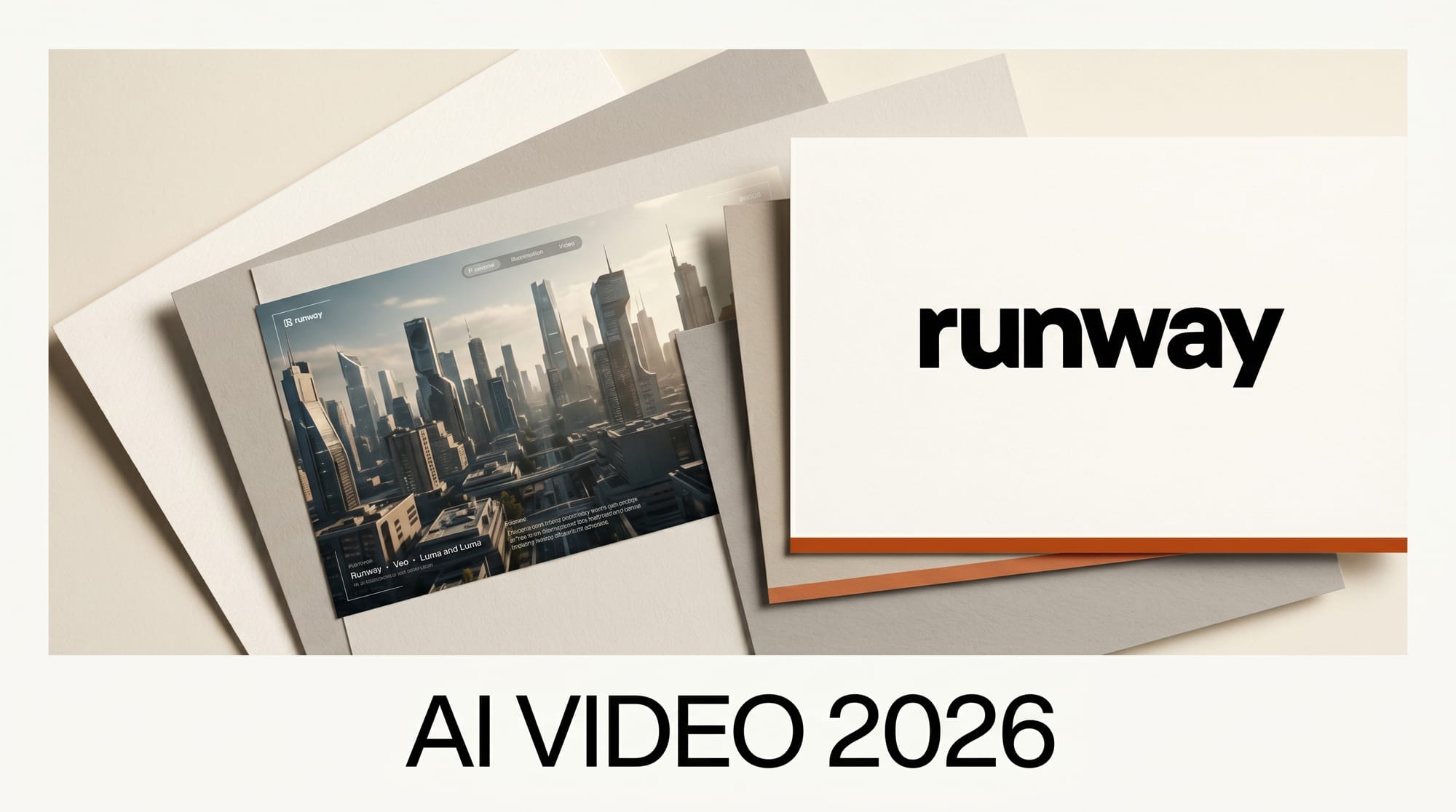
AI video generation in 2026 is no longer a research demo -- it is a production pipeline shipping commercials, films, music videos, and social content every day. This is the working creator's complete guide: which model to use for which job, how the open-source side stacks up against the commercial leaders, what the tooling around generation looks like in 2026, and where the legal and creative landscape is going next.
The models below are filtered for working creators, not researchers. Every tool here is publicly accessible (web app, API, or open weights), exports usable video files, and has been used in real commercial or commercial-grade indie work in the last 90 days. If a model crossed the production threshold, it is here. If it is still a paper-only result, it is not.
TL;DR -- Which AI video tool for which job
- Hero shots and short films: Runway Gen-4 for narrative consistency, Luma Dream Machine for cinematic motion, Pika Professional for stylized work.
- Cost-conscious commercial: Google Veo 3.1 Lite halves the per-clip cost while keeping near-Veo-3 quality.
- Open-source self-host: Alibaba Wan 2.7 and Tencent HunyuanVideo derivatives, Skywork Matrix-Game-3.0 for real-time.
- Avatars and talking heads: HeyGen Avatar V for cross-uncanny-valley quality.
- Editing inside ComfyUI: Seedance 2.0, Wan2.7, and frame-synced music via Sonilo.
- 4D and reshoots: Vista4D reshoots any video in 4D.
- Adobe-native pipelines: Adobe Firefly Video Editor with Kling 3.0 integration.
- NLE companion AI: TwelveLabs Rodeo as the editor's AI co-pilot.
- Quick comparison head-to-head: our benchmark comparison runs the same prompt across six models.
The state of AI video generation in 2026
2026 is the year AI video crossed three thresholds that had been holding the field back since 2023. First, narrative consistency: Runway Gen-4 and Luma Innovative Dreams both ship multi-shot scenes with the same character across cuts, the same environment across angles, and the same lighting across time. Second, motion fidelity: faces emote, hands stay attached, water flows like water, and crowds no longer melt. Third, cost: Veo 3.1 Lite, the open-source explosion led by Wan 2.7 and HunyuanVideo, and ComfyUI integration of every major model put generation into the per-clip cost range that commercial production can absorb.
The numbers tell the story. Runway's CEO claims AI could let Hollywood produce 50 films for $100M. Whether or not that exact number holds, the direction is real -- the per-shot cost of generative VFX and B-roll is collapsing for the work AI does well. Luma and Wonder Project launched a full AI filmmaking studio. Shutterstock added a commercial AI video generator. Every major NLE -- Adobe Premiere, DaVinci Resolve, Avid Media Composer -- shipped meaningful AI tools in 2026.
The year is also a legal inflection point. YouTube creators are suing Apple and Amazon over alleged AI video training. Studios shipping AI-assisted content are documenting prompt-and-iteration logs alongside their asset libraries. The "AI replaces filmmakers" narrative is dead; the "AI changes the economics of filmmaking, and the legal regime is still catching up" reality is here.
Quick comparison: leading commercial AI video models
| Model | Provider | Strength | Free tier | Commercial-use license |
|---|---|---|---|---|
| Gen-4 | Runway | Narrative consistency, director control | 125 credits | Yes (paid tier) |
| Veo 3.1 / 3.1 Lite | Google (Vertex AI, Flow) | Cinematography, cost-efficiency | Limited (Google AI Studio) | Yes (paid) |
| Dream Machine / Innovative Dreams | Luma | Cinematic motion, smooth camera | Yes (limited) | Yes (paid) |
| Pika Pro | Pika Labs | Stylized work, fast iteration | Yes (limited) | Yes (paid) |
| Kling 3.0 (incl. via Adobe Firefly) | Kuaishou | Realistic motion, available in Adobe | Yes (limited) | Yes (paid) |
| MiniMax Hailuo / Music 2.6 | MiniMax | Affordable quality at scale | Yes | Yes (paid) |
| HeyGen Avatar V | HeyGen | Talking-head avatars | Yes (limited) | Yes (paid) |
| Sora 2 | OpenAI | (Shutting down -- see Sora alternatives below) | -- | -- |
The leading commercial AI video models
Runway Gen-4 -- Best for narrative consistency
Runway Gen-4 is the strongest commercial AI video model for working filmmakers in 2026. Multi-shot scenes maintain character and environment continuity across cuts. Director-level controls (camera angle, movement, lens choice) work as advertised. The Gen-4 API now surfaces Seedance 2.0 alongside Runway's native models, giving a single API the option to swap between models per shot.
Runway's strategic shift in 2026 is toward ecosystem over single-product -- they are betting on integrating into existing VFX pipelines (Nuke, Resolve, Premiere) rather than trying to be a complete production environment alone. This is the right call for working professionals: the tool integrates as one node in a larger graph.
Google Veo 3.1 and Veo 3.1 Lite -- Best for cost-conscious quality
Google's Veo line had the biggest cost-quality breakthrough of 2026. Veo 3.1 Lite cut per-clip costs roughly in half while retaining near-Veo-3.1 quality on most prompts. For commercial-volume creators producing dozens of clips per day, this is the most defensible economic choice in the commercial tier.
Veo also shipped 1080p-to-4K upscaling on Vertex AI, which closes the resolution gap between AI generation and traditional production. The pipeline is now: generate at standard res, upscale on Vertex, master in DaVinci Resolve or Premiere -- all production-grade.
Notable: Google Vids added free AI avatars built on Veo 3.1, which is the consumer-facing entry point for Workspace users.
Luma Dream Machine and Innovative Dreams -- Best for cinematic motion
Luma's Dream Machine has consistently produced the smoothest camera motion in the commercial tier. The recent Innovative Dreams launch in partnership with Wonder Project packages Dream Machine into a director-aware filmmaking pipeline aimed at indie-to-mid-tier production.
Worth tracking: Luma's Dream Brief tested AI ads at Cannes Lions, the largest professional advertising test of generative video to date. The early results: AI-assisted ad production is now competitive with traditional shoots on quality at significantly lower budgets.
Adobe Firefly Video and Kling 3.0 -- For Adobe-native teams
Adobe Firefly Video Editor integrated Kling 3.0 as a generation backend, exposed through Frame.io Drive for shared review. For studios already on Adobe with Frame.io review workflows, this brings AI generation directly into the existing pipeline without a separate tool.
Adobe's broader AI strategy in 2026 is integration-first: generation through Firefly, editing through Premiere, rotoscoping through After Effects 26.2 Object Matte, and color through Premiere Color Mode. The whole stack benefits more than any single piece would.
Open-source AI video -- production-grade in 2026
Open-weights video models crossed a real quality threshold in 2026. The stack you can self-host today rivals the commercial offerings from late 2024.
Alibaba Wan 2.7 -- Strongest open-weights commercial-quality model
Wan 2.7 in ComfyUI is the strongest open-weights video model for working creators in 2026. Apache-licensed, runs on a single high-end consumer GPU, and ships frame quality close to commercial Veo or Runway tiers on most prompts. The native integration into ComfyUI means it slots into existing workflows alongside image generation, control nets, and prompt engineering pipelines.
Alibaba also shipped Wan 2.7-Image for unified image generation and editing, and a stealth video model under the codename HappyHorse -- first topped the AI video leaderboard, with benchmark analysis confirming Alibaba's stealth lead in the open-weights space.
Tencent HunyuanVideo, Hy3, and the rebuild ecosystem
Tencent HunyuanVideo's open-weights release in 2025 set the foundation for a community-driven ecosystem. The Hy3 rebuild (HunyuanVideo's full architecture refresh, 21B-active mixture-of-experts) is the next step. Combined with Tencent OmniWeaving -- a unified video generation framework covering seven distinct video tasks (text-to-video, image-to-video, video-to-video, etc.) -- Tencent is the major lab pushing open-weights video forward fastest.
Skywork Matrix-Game-3.0 -- Real-time open-source video
Skywork Matrix-Game-3.0 is the first credible open-source real-time video model -- generates frames at frame-rate-usable speeds for in-game and live applications. The deployment is non-trivial but the use cases (procedural cutscenes that adapt to player state, dynamic backgrounds in live broadcast, generated content responding to live events) are entirely new.
LTX HDR Beta -- First open HDR AI video
LTX HDR Beta from Lightricks is the first open-source AI video model that generates HDR output natively. For commercial cinema and high-end streaming production, HDR has been a baseline for years; AI generation finally caught up. Expect this to be the standard for the next generation of open-weights models.
Specialized AI video tools and adjacent categories
Avatars: HeyGen, Bansi, Google Vids
Talking-head AI avatars crossed the uncanny valley in 2026. HeyGen Avatar V is the leader on identity preservation, expression range, and lip-sync accuracy. HeyGen HyperFrames let developers write HTML and render video for AI agents -- closing the loop from data to spoken video presentation. HeyGen's developer platform makes the whole stack programmable.
Bansi AI auto-edits talking-head videos in minutes -- fewer manual cuts, automatic captions, automatic B-roll. For YouTube creators producing weekly explainers, this is meaningful time savings.
4D and reshoots: Vista4D
Vista4D from Eyeline Labs reshoots any video in 4D. The model reconstructs a moving 3D scene from a single video, allowing new camera angles, new lighting, and new composition without reshoots. For continuity work, B-roll generation, and any project that loses access to original talent, this is a production tool that did not exist a year ago.
Music video and frame-synced audio: ComfyUI Sonilo, MiniMax Music
ComfyUI Sonilo generates AI music synced frame-by-frame to AI-generated video. MiniMax Music 2.6 adds AI cover and style transfer for music videos -- enabling vocal versioning at scale. For music video production specifically, the pipeline (Wan 2.7 video, Sonilo audio sync, MiniMax cover variations) is the strongest open-weights stack of 2026.
Editor co-pilots: TwelveLabs Rodeo
TwelveLabs Rodeo sits in the editor as a co-pilot -- finds clips by description, identifies emotional beats, suggests cuts. For long-form podcast video, documentary, and reality production where the editor sifts hours of footage daily, this is the highest-leverage subscription on the editor side.
Workflow stacks creators are running today
Three pattern stacks dominate working creator workflows in 2026:
- Indie filmmaker (1-3 person): Runway Gen-4 or Luma Dream Machine for hero shots, ComfyUI Wan 2.7 for B-roll volume, DaVinci Resolve 21 for post (free), ElevenLabs for voice, Suno for music. Total tooling cost under $80/mo.
- Music video producer: Wan 2.7 in ComfyUI for visuals, Sonilo for sound design, MiniMax Music 2.6 for cover variations. Open-weights stack means frame-rate-cost ratio is the lowest in the industry.
- Commercial / advertising: Runway Gen-4 for hero, Veo 3.1 Lite for variations, Luma Dream Machine for cinematic motion. Frame.io for review, Adobe Firefly Video for finishing. Studio-grade pipeline at indie-grade cost.
- Talking-head / explainer creator: HeyGen Avatar V for the avatar, Bansi for auto-editing, ElevenLabs for voice cloning, Adobe Premiere for finishing.
One signal: Clapper shipped native AI video generation for creators as a stand-alone editor. The pattern in 2026 is consolidation -- the best tools are becoming integrated platforms rather than research demos.
The legal landscape
The legal regime around AI video is still catching up to the technology. Three flashpoints to watch:
- Training data lawsuits: YouTube creators are suing Apple and Amazon over alleged AI video training without consent or compensation. The outcome will shape commercial-use AI video for the next decade.
- Output copyright: The US Copyright Office has held that purely AI-generated works are not copyrightable, but works with substantial human creative input are. Studios shipping AI-assisted content document prompt-and-iteration history to defend the human-creative-input position.
- Voice and likeness rights: Voice cloning of real people requires explicit consent. Some jurisdictions are codifying this. Avatar likenesses face similar regulatory pressure. Always verify consent for any real-person voice or likeness in commercial work.
The anti-slop movement is the audience-side companion to the legal movement. Audiences are increasingly negative on visibly AI-generated content; production teams are using AI invisibly for the boring parts and reserving human craft for the visible parts.
What's coming next in AI video
- 4D reshoot at scale: Vista4D's beta becomes general availability mid-to-late 2026. Reshoot economics for principal photography change permanently.
- Real-time generation in production: Skywork Matrix-Game-3.0 and similar models hit frame rates that make AI-rendered live broadcasts viable. First broadcast-rate generative content likely 2026.
- Native NLE generation: Premiere and Resolve both add native generative panels in 2026. Generation moves from "separate tool" to "click-and-generate inside the timeline."
- Open-weights HDR and 4K: LTX HDR is the first; expect Wan, Hunyuan, and Skywork to follow.
- Convergence of video and 3D: Vista4D's 4D reconstruction and Apple LGTM's Gaussian splatting are pointing at a single representation -- generated content that is both a 2D video and a navigable 3D scene.
If you used Sora, here is what to switch to
OpenAI is shutting down Sora -- for working creators who built workflows around Sora 2, the migration question is real. Recommended replacements by use case:
- Sora users who valued narrative consistency: Runway Gen-4.
- Sora users who valued cinematography: Luma Innovative Dreams or Veo 3.1.
- Sora users who valued cost: Veo 3.1 Lite or open-weights Wan 2.7.
- Sora users who valued integration: Adobe Firefly Video with Kling 3.0.
How AI video models compare on the same prompt
For a head-to-head comparison on identical prompts, our AI video generation benchmark 2026 runs the same prompts across six models -- Runway, Veo, Luma, Pika, Kling, and Wan 2.7. This is the closest thing to an apples-to-apples test that exists for commercial AI video right now.
Frequently asked questions
Which AI video model is best for filmmakers in 2026?
For narrative consistency across multi-shot scenes, Runway Gen-4 leads. For cinematic motion and smooth camera work, Luma Innovative Dreams. For cost-volume work, Veo 3.1 Lite. For Adobe-native teams, Firefly Video with Kling 3.0. Most working filmmaking studios use a mix -- Runway or Luma for hero shots, Veo Lite or Wan 2.7 for B-roll volume, finishing in Premiere or Resolve.
Can AI video models be used commercially in 2026?
Yes, on paid tiers. Runway, Luma, Pika, Kling, MiniMax, HeyGen, Veo all grant commercial-use rights to paying subscribers -- read the specific tier terms. Open-weights models like Wan 2.7 (Apache), HunyuanVideo, and LTX HDR are commercially usable per their licenses. Voice cloning of real people and avatars based on real likenesses require explicit consent and may face regional regulations.
What is the cheapest professional AI video setup?
For a self-hosted commercial-grade pipeline: ComfyUI plus Wan 2.7 plus DaVinci Resolve 21 (free) plus ElevenLabs Creator tier ($22/mo) plus Suno Pro ($10/mo). For about $32/mo plus the GPU hardware to run Wan 2.7 locally, you have a complete production-grade video, audio, and post stack. For cloud-only without local GPU: Runway Pro ($35/mo) plus the rest is the entry point at roughly $90/mo.
Is open-source AI video as good as commercial?
For most workflows in 2026, yes. Wan 2.7 ships frame quality competitive with mid-tier Runway and Luma output, and it runs on a single high-end consumer GPU. Commercial models still lead on edge cases (extreme motion, specific style consistency, very long clips) but the gap is narrower than in any prior year. Open-weights also wins on iteration speed and cost -- generate, discard, iterate without per-clip API costs.
Will AI replace human filmmakers?
No. The work AI does best in 2026 is acceleration of specific tasks: B-roll, atmospheric inserts, cleanup of imperfect captures, color matching, basic compositing. Human craft (composition, performance direction, story, color grading at the hero-shot level) remains required. The shift is that small teams now ship work that previously required large teams. Demand and budget allocations are the open questions.
Where does AI video integrate into Premiere, Resolve, and After Effects?
Premiere now has Color Mode (AI grading), Generative Extend, and Adobe Speech to Text. After Effects 26.2 added AI Object Matte for one-click rotoscoping. DaVinci Resolve 21 ships ten new AI tools in the free tier covering color, audio, and transcription. Adobe Firefly Video Editor integrates Kling 3.0 directly. The integration is real and accelerating.
How long does it take to generate a usable AI video clip?
Commercial models (Runway, Luma, Veo, Pika): 30 to 90 seconds per clip via API. Open-weights via ComfyUI Wan 2.7: 60 to 180 seconds depending on GPU and resolution. Real-time models (Skywork Matrix-Game-3.0): frame rate, but quality and length are constrained. The sweet spot for working creators in 2026 is 1-2 minutes per clip with multiple variations generated in parallel.
Next steps
If you are starting fresh with AI video in 2026, the practical entry path is: subscribe to Runway Creator ($15/mo) for a month, run several real projects, decide whether to upgrade to Pro or move to a self-hosted Wan 2.7 setup based on your use case. For specialized work (talking heads, music video, VFX), pair a generation tool with a workflow tool from the relevant section above.
For ongoing coverage, our best AI video generators 2026 ranks the commercial models for specific use cases, our AI for VFX artists 2026 complete guide goes deeper on post-production, our benchmark comparison tests the leading models on the same prompts, and our previous landscape article remains a useful overview. Our weekly newsletter ships every Tuesday with what shipped this week and what is worth your time.