Visual effects in 2026 looks different from 2024. Roto, keying, color, and motion-graphics tasks that consumed days now finish in minutes -- not because the work disappeared but because the AI tools handle the boring 80 percent and free human VFX artists for the 20 percent that actually requires craft. This is the working VFX artist's guide to the AI tools shipping production-grade output right now.
Filtering criteria: every tool below has been used on at least one shipped commercial project in the last six months, or is open-weights and integrates into existing VFX pipelines (After Effects, Nuke, DaVinci Resolve, Houdini, Maya). Research demos that have not crossed into production are excluded.
TL;DR -- Which AI tool for which VFX task
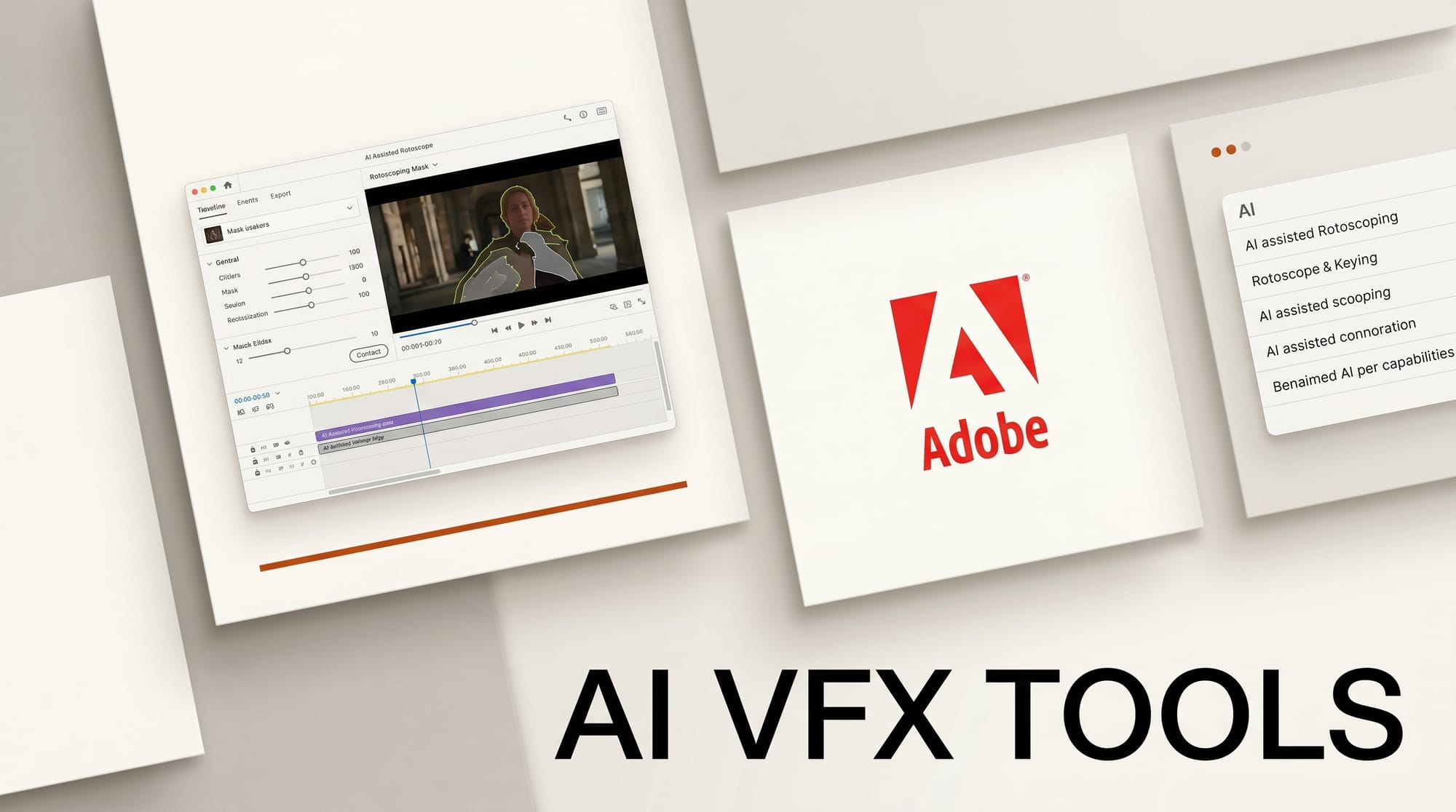
- Rotoscoping and matte extraction: Adobe After Effects 26.2 AI Object Matte for one-click roto, free with Creative Cloud.
- Green-screen and keying: Vizrt AI Keyer for keyless virtual production, traditional Premiere Pro Ultra Key for legacy work.
- Color grading: DaVinci Resolve 21 AI tools (free) and Adobe Premiere Color Mode.
- Reshoots and continuity fixes: Vista4D from Eyeline Labs reshoots any video in 4D.
- AI-generated VFX shots: Runway Gen-4, Luma Innovative Dreams, Pika Professional.
- Spatial capture and virtual production: Sony XYN for studio-grade scans.
- Motion graphics and titles: Maxon Autograph (free) and Adobe After Effects.
- Sparse-photo 3D scenes: AnyRecon for indie scene reconstruction, Sony XYN for production.
Quick comparison table
| Tool | VFX task | Where it runs | Free tier | Production-ready |
|---|---|---|---|---|
| After Effects 26.2 AI Object Matte | Rotoscoping, matte | After Effects | With CC subscription | Yes |
| Vizrt AI Keyer | Keying without green screen | Vizrt platform | No (broadcast pricing) | Yes (live) |
| DaVinci Resolve 21 AI tools | Color, audio, transcription | Resolve | Yes (free Resolve) | Yes |
| Adobe Premiere Color Mode | Color grading | Premiere Pro | With CC subscription | Yes |
| Vista4D | 4D reshoot from video | Web, API | Yes (limited) | Beta |
| Runway Gen-4 | Generative VFX shots | Web, API | Yes (125 credits) | Yes |
| Luma Dream Machine / Innovative Dreams | Generative VFX | Web, API | Yes (limited) | Yes |
| Sony XYN | Spatial capture, 3D scenes | Hardware + cloud | No (studio licensing) | Yes |
| Maxon Autograph | Motion graphics | Native macOS, Windows | Free | Yes |
1. Adobe After Effects 26.2 AI Object Matte -- Rotoscoping in one click
Rotoscoping has been the single most time-consuming VFX task for thirty years. After Effects 26.2 AI Object Matte tracks subjects across frames automatically -- including the long-tail edge cases (hair, motion blur, partial occlusions) that traditional Roto Brush couldn't handle. The output is a clean alpha matte that you can refine in seconds rather than build from scratch over hours.
This is part of Creative Cloud -- no separate purchase. For studios already on Adobe, this is the single biggest time saving in the 2026 release.
2. Vizrt AI Keyer -- Beyond green screen
Vizrt's AI Keyer, announced at NAB 2026, replaces traditional chroma-key compositing for live virtual production. Instead of needing a green or blue background, the AI segments the talent from any background in real time. For broadcast and live virtual production, this is the workflow that makes set-extension and virtual sets viable on tighter budgets and locations.
Vizrt's pricing targets broadcast studios and high-end virtual production houses. For traditional post-production keying, Adobe Premiere Pro Ultra Key plus After Effects Roto Brush still ships solid results -- but the gap is closing fast.
3. DaVinci Resolve 21 + Adobe Premiere Color Mode -- AI color grading
Color is the second-largest time sink in post. Two tools cover most working VFX colorists in 2026:
- DaVinci Resolve 21 bundles ten new AI tools in the free tier -- match shots from a reference, auto-balance under shifting lighting, AI-driven secondary keys, color sample propagation across long timelines. Free is the right price for indie filmmakers.
- Adobe Premiere Color Mode brings Resolve-class color grading inside Premiere Pro for the team that already lives there. Avoids the round-trip to Resolve and back.
Recommendation: if you are starting fresh, Resolve. If you are already deep on Premiere with a five-year project bin and a Premiere-trained team, Color Mode now keeps you home.
4. Vista4D -- Reshoot any video in 4D
Vista4D from Eyeline Labs is the wildcard on this list. Take any input video; the model reconstructs a moving 3D scene that can be rendered from new camera angles, with new lighting, with different shot composition. For continuity fixes, B-roll generation from existing footage, and shot replacement on actors who can no longer be re-photographed, this is a production tool that did not exist a year ago.
Vista4D is in beta with limited public access; Eyeline Labs and the broader Wonder Project network (Luma's filmmaking studio) are seeding it inside production teams. Worth tracking for studios planning shoots in late 2026 -- the workflow implications for principal photography are significant.
5. Runway Gen-4, Luma Dream Machine -- Generative VFX shots
Generative video is the biggest pipeline shift in VFX since digital. The current production-grade winners:
- Runway Gen-4 for shot-to-shot consistency and director-level control over motion. The strongest commercial offering for VFX-quality generated shots in 2026, particularly for environment plates and atmospheric effects.
- Luma Innovative Dreams, the Wonder Project's filmmaking studio, packages Luma's Dream Machine model into a directorial pipeline aimed specifically at production work. Watch this for production-rate VFX in indie filmmaking.
Runway's strategic shift in 2026 is also notable: they are betting on ecosystem over single-product, opening their tools to integrate with broader VFX workflows rather than trying to be a complete pipeline alone. This is the right call and good news for working VFX artists who want AI generation as one node in a Nuke or Resolve graph, not a replacement.
6. Sony XYN -- Spatial capture for virtual production
Sony XYN is the studio-grade option for capturing real environments for virtual production sets. The hardware-plus-software pipeline produces 3D scenes at film-acceptable fidelity for LED-volume background plates, second-unit B-roll, and digital double work. This is the "Cinemersive plus better camera tech" successor -- Sony's acquisition of Cinemersive Labs in 2026 consolidated the field.
For indie work, AnyRecon's sparse-photo reconstruction (covered in our AI 3D model generators guide) is the cheap-and-fast counterpart. XYN is for shows with budget; AnyRecon is for the rest of us.
7. Maxon Autograph -- Motion graphics, free
Motion graphics has been Adobe After Effects territory for two decades. Maxon released Autograph for free in early 2026 specifically targeting individual creators and small studios. The toolset covers titles, lower-thirds, animated callouts, and timeline-based motion design at parity with mid-tier After Effects features for most creator workflows.
Autograph is not a full After Effects replacement for serious VFX (no expressions language equivalent, no third-party plugin ecosystem at AE's depth), but for the 80 percent of motion-graphics work that is text plus shapes plus simple animation, free is a real argument.
8. RODECaster Studio + Adobe Podcast -- Audio post for video
Audio is the silent VFX leg. Most working VFX departments now lean on AI for audio cleanup, dialogue editing, and ambience generation:
- RODE RODECaster Studio handles AI-driven dialogue cleanup, transcription, and multi-voice mixing on a hardware-software stack designed for podcasters but increasingly used in indie video post.
- Adobe Podcast (Enhance Speech) is the simple drop-in for cleaning up dialogue tracks from imperfect production recordings -- usable in any NLE.
Recommended pipelines for 2026
Three pattern stacks we see consistently in working VFX departments:
- Indie filmmaker (1-3 person): DaVinci Resolve 21 (free) for full edit-color-finishing, AnyRecon for any 3D scene work, Maxon Autograph for titles, Runway Gen-4 for generative inserts. Total tooling cost under $50/mo if you skip Runway.
- Mid-size post house: Adobe Creative Cloud for AE (Roto, Object Matte) + Premiere Color Mode + Adobe Podcast, Resolve for color when projects warrant, Runway Gen-4 for generative work, ElevenLabs for voice replacements.
- Broadcast / virtual production: Vizrt AI Keyer for live keying, Sony XYN for capture, Wonder Project / Luma Innovative Dreams for principal generative work, full Adobe and Resolve stacks downstream.
One signal worth noting: Runway's CEO claims AI could let Hollywood make 50 films for $100M. The number is debatable, but the direction is real -- the per-shot cost of VFX is collapsing for the work that AI can do well, which lets the human VFX artist time go entirely toward the work that requires craft.
A note on the anti-slop movement
The anti-slop movement is real and growing. AI-generated VFX that looks AI-generated lands as slop and damages the project; AI used invisibly to accelerate work that humans then craft does not. The distinction is craft, not technology. Working VFX artists in 2026 are not abandoning craft for AI -- they are using AI to spend more of their craft time on the parts of the shot that matter.
What's coming next
- 4D reshoot adoption: Vista4D is currently beta. Production rollout late 2026 likely.
- Real-time generative compositing: Generative shots that update in response to live performance capture or director notes during a session.
- Generative match-move: Tracking and stabilization driven by AI scene understanding rather than feature-point math.
- NeRF and Gaussian splat workflows in major NLEs: Resolve and Premiere are both adding native support; the pipeline is consolidating.
Frequently asked questions
Is AI replacing VFX artists in 2026?
No. The work that AI handles best is the boilerplate: rotoscoping, basic keying, color matching, dialogue cleanup, simple generative inserts. The craft work -- composition, color theory, performance, story -- still requires humans. The shift is that one VFX artist now ships the work that previously required three to five, which means smaller teams handling bigger projects, not zero teams. Demand is the question; the tools are clearly here.
What is the cheapest professional AI VFX setup?
DaVinci Resolve 21 (free) plus Maxon Autograph (free) plus AnyRecon (free research access) plus a Suno or ElevenLabs subscription for audio gives you a complete production-grade VFX toolkit for under $30 per month. Add Runway Pro at $35 if you need generative shots. This kit ships short-form content, indie shorts, and corporate work at a quality bar that was unreachable on this budget two years ago.
Are AI-generated VFX shots commercial-use safe?
It depends on tool, tier, and content. Runway, Luma, and Pika commercial tiers grant rights to ship generated content. Free tiers usually do not. Voice cloning of real people requires explicit consent and is regulated in some jurisdictions. AI rotoscoping and color tools (After Effects 26.2, Resolve 21) operate on your own footage so the license is governed by your underlying material, not the AI tool. Always read the specific tier terms for each tool you ship from.
Can AI-driven VFX integrate with Nuke and Houdini?
Increasingly yes, via Python and APIs. Runway, Luma, and Vista4D all expose APIs that scripts can call from Nuke or Houdini for generative inserts. ComfyUI workflows export with full procedural control suitable for technical-director integration. The full "AI native VFX pipeline" is still emerging -- but the building blocks are now production-stable.
Which AI VFX tool is best for green-screen replacement?
For broadcast and live work: Vizrt AI Keyer. For traditional post: Adobe After Effects Roto Brush plus Object Matte handles most cases without any green screen at all. The shift to "no green screen needed" is the underlying narrative -- Vizrt for live, Adobe for post.
How long until AI-generated VFX is undetectable in feature films?
Some shots already are. The current production reality is selective use -- generative shots for atmospheric and environment work where artist time is high-cost and audience scrutiny is moderate. Hero shots and visible character work still require the full craft pipeline. The detectability gap is closing every six months. Vista4D-style 4D reshoots will likely be common in mid-budget productions by late 2026.
Next steps
If you are a working VFX artist and have not adopted any of these tools, start with the free ones: After Effects 26.2 AI Object Matte (if you have CC) or DaVinci Resolve 21 (if you don't), then add Maxon Autograph for motion graphics. The integration cost is real; verify on one project before scaling.
For ongoing coverage, our complete AI video generation landscape covers the broader generative space, our best AI 3D model generators 2026 covers the asset side, and our weekly newsletter ships every Tuesday with what shipped this week and what is worth your time.