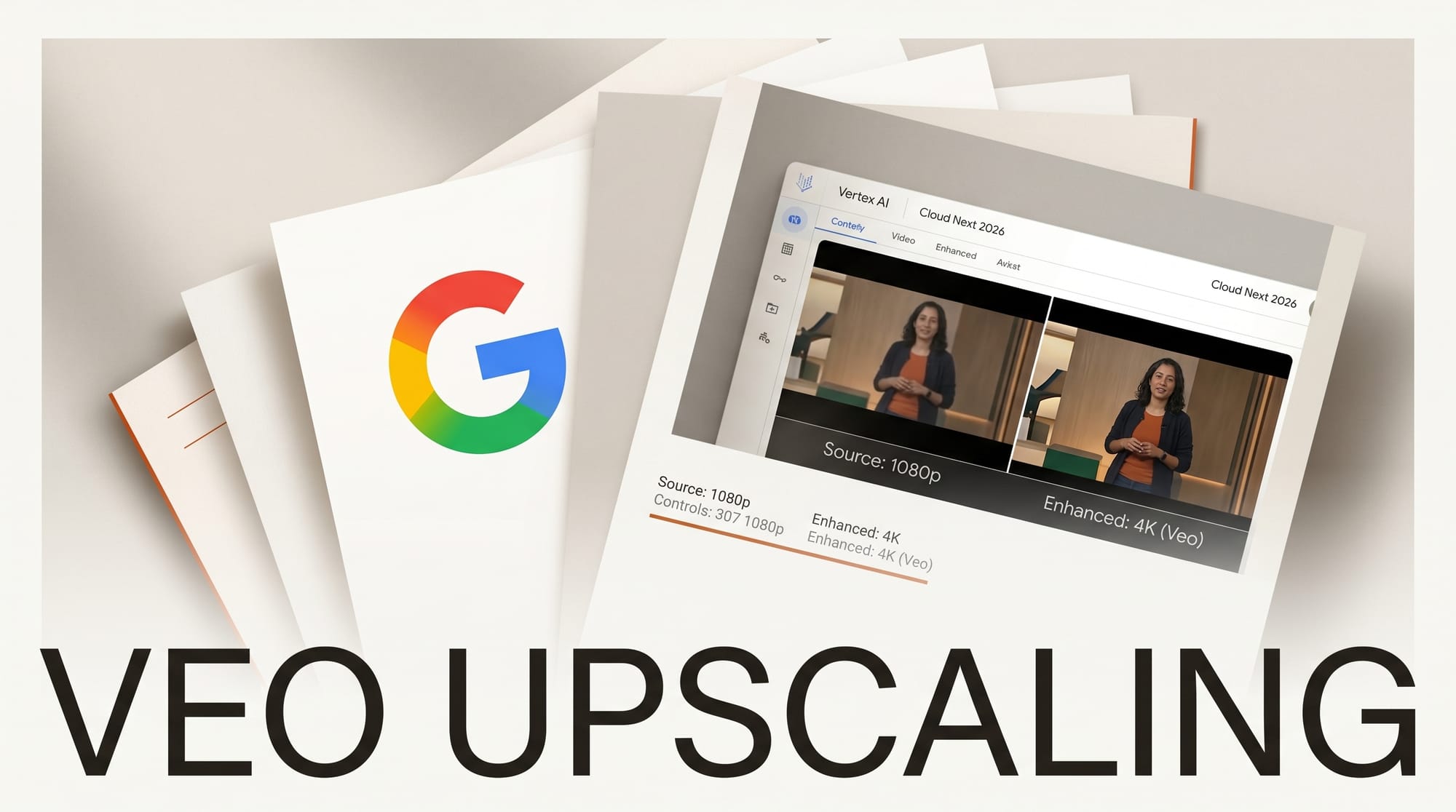
Google added a standalone Veo upscaling capability to Vertex AI on April 23, alongside the enterprise rollout of Veo 3.1 Lite. The new tool sharpens any video to 1080p or 4K, regardless of whether the source was generated by Veo, another AI model, or a traditional camera.
For the broader landscape, see our complete guide to AI video generation in 2026.
What Happened
The announcement landed during Cloud Next 2026 in Las Vegas. The upscaling endpoint is decoupled from the Veo generation pipeline, so it works on existing footage from Seedance, Runway, Kling, mobile-camera B-roll, or archival video. Filmmakers and editors can now drop a 480p or 720p clip into Vertex AI and get a higher-resolution version back without re-rendering the source.
Google also moved Veo 3.1 Lite from the Gemini API into Vertex AI for enterprise customers, completing the rollout that started March 31. The same model is now available through both Google AI Studio and the enterprise console.
Why It Matters
Upscaling has been one of the most expensive line items for AI video producers. Topaz Starlight, the current quality leader, runs as a paid desktop or ComfyUI plug-in and is GPU-bound. Hosting an upscaler at the API level means a video editor can chain generation, edit, and upscale in a single workflow, with predictable per-second pricing instead of GPU rental.
The bigger signal is that Google is treating video as a stack rather than a single endpoint. Generation, audio, and resolution enhancement now sit side by side in Vertex AI, which lowers the integration cost for any team building a creator-facing video product on top of Google's models.
Key Details
- Output resolutions: 1080p and 4K, both supported.
- Source compatibility: Any video, AI-generated or camera-captured.
- Veo 3.1 Lite enterprise: Now in Vertex AI; same pricing as the developer tier (roughly $0.05 per second of generated video, less than half of Veo 3.1 Fast).
- Free credit: $300 in new Google Cloud account credits, enough for about 100 minutes of Veo 3.1 Lite generation.
- Pairs with: The same Cloud Next release also surfaced Lyria 3 Pro music generation and Gemini 3.1 Flash Image.
What to Do Next
If you produce AI video at volume, run a side-by-side test against your current upscaler. The differentiator is not just quality but pipeline placement: an API-resident upscaler removes the local render step and makes batch processing trivial. Try it on existing low-res assets first to measure cost per minute against Topaz or Magnific.
Studios and ad agencies building on Vertex AI now have generation, music (Lyria 3), image editing (Gemini 3.1 Flash Image), and finishing in one billing surface. That changes the procurement conversation for any team that has been splitting AI video budgets across three or four vendors.