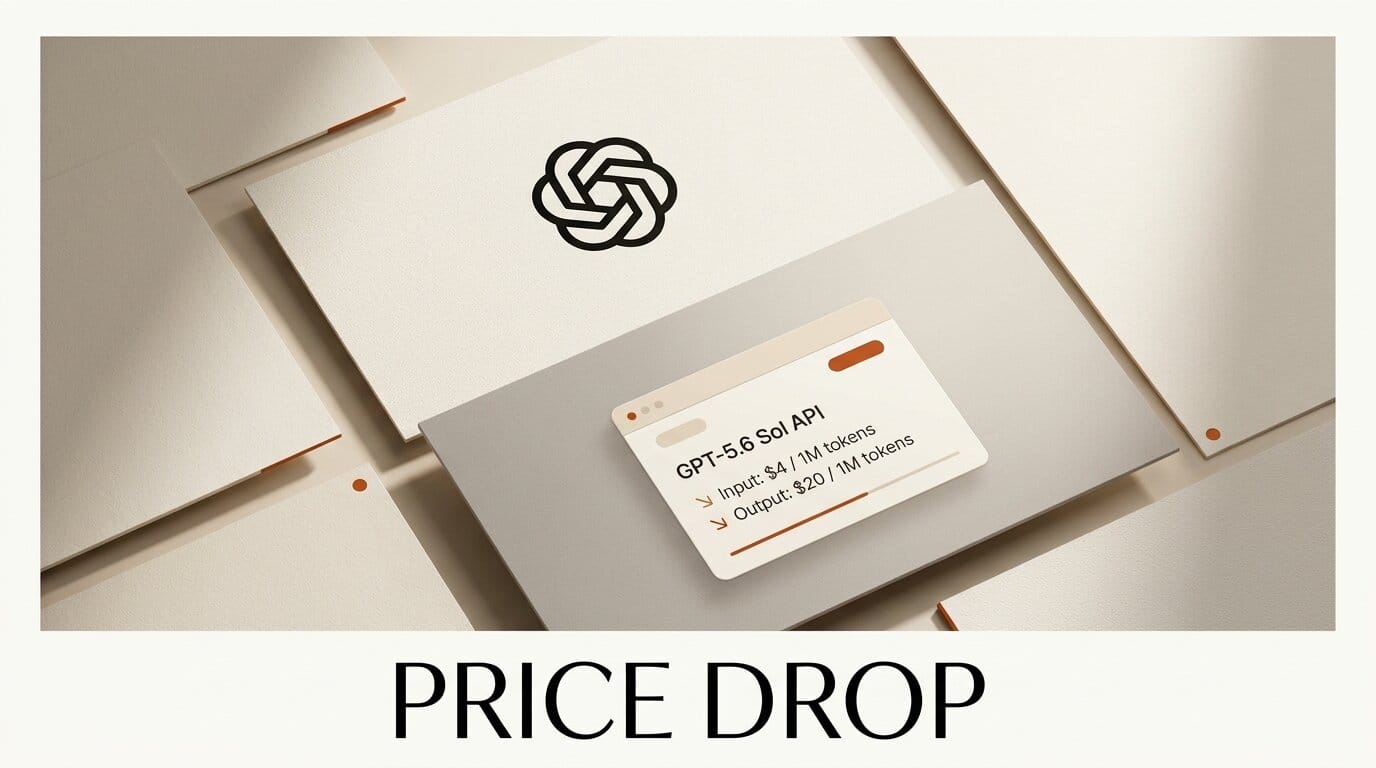
OpenAI cut developer pricing for GPT-5.6 Sol, its most expensive frontier model, on August 21, 2026. Input tokens dropped from $5 to $4 per million and output tokens from $30 to $20 per million, a 20 percent cut on input and 33 percent on output. The rate is promotional and runs for three months, through at least November 21, 2026. It applies to the pay-as-you-go API, to Codex credits, and to eligible ChatGPT Work plans. Pricing for Pro, Plus, and Business subscriptions is unchanged.
The number that matters is the comparison, not the discount. Until August 21, Sol was the priciest model in OpenAI's lineup. It now sits below Anthropic's Claude Opus 5 on both input and output, which resets the cost calculation for anyone running a frontier model inside a production pipeline.

What the new frontier pricing looks like
The cut is easier to read against the rest of the top tier. All figures are per million tokens.
| Model | Input | Output | Notes |
|---|---|---|---|
| GPT-5.6 Sol (new) | $4 | $20 | Promotional through at least Nov 21, 2026 |
| GPT-5.6 Sol (previous) | $5 | $30 | Rate in force until Aug 21, 2026 |
| Claude Opus 5 | $5 | $25 | Now above Sol on both sides |
| Claude Fable 5 | $10 | $50 | Highest listed of the three |
Output is where the difference compounds. Most agent and generation workloads are output-heavy, so a $30 to $20 move is a larger real-world saving than the headline 20 percent input cut suggests. On a job that emits a million output tokens, the change is $10 in absolute terms and a third of the line item. Current rates for each family are published on OpenAI's API pricing page and in Anthropic's pricing documentation, and both are worth checking directly rather than trusting a third-party table, including this one.
The cut was reported by Reuters and follows an earlier round in July. Two cuts inside a month on the same family is a pattern, not a promotion.
Why the price is moving now
This is the second cut on the GPT-5.6 family in under a month. In July, OpenAI cut prices on two other GPT-5.6 models as business customers grew more cost-sensitive. Two forces are visible in the timing. The first is competitive pressure from Anthropic at the top of the market and from Chinese open-weight labs at the bottom. The second is that the cost floor under frontier inference keeps falling, which we saw directly in the Ultrafast tier that runs Sol on Cerebras wafer-scale hardware. When serving gets cheaper and faster, list price follows.
There is a third factor that is easy to miss. The cut is explicitly promotional and explicitly excludes consumer subscriptions. OpenAI is discounting the surface developers meter and leaving the surface consumers pay flat for. That tells you where the competition actually is: in the API, where switching costs are a config change.

What a promotional rate actually signals
It is worth being precise about what a three-month promotional price is and is not. It is not a cost-structure announcement. OpenAI did not claim that serving Sol got a third cheaper; it set a price for a defined window and reserved the right to let it lapse. That is a marketing instrument aimed at moving workloads, and the workloads it moves are the ones that switch quickly.
Which tells you who the target is. An enterprise on an annual commit does not re-plumb its inference layer for a ninety-day discount. An independent developer, an agency, or a small product team does, because for them switching is an environment variable. The discount is priced to capture exactly the segment that can act on it inside the window.
That is good news if you are in that segment, with one condition attached: build the reversion into your plan from the start. Anthropic's published rates have held steady while OpenAI has now cut twice in a month, so the gap you are pricing against today is the volatile side of the comparison, not the stable one.

What this changes in a real pipeline
The practical question is not whether $4 is better than $5. It is which jobs move up a tier because the frontier model just got affordable enough to stop rationing.
Jobs that were already on Sol. Nothing to do except watch the invoice. If your monthly spend was output-dominated, expect roughly a third off that portion until the promotional window closes.
Jobs you downgraded to save money. This is the real opportunity. Anything you pushed to a cheaper tier because Sol's output cost was prohibitive deserves a re-test. Long-form drafting, multi-step agent runs, and code generation are all output-heavy, which is exactly where the 33 percent cut bites.
Jobs on Claude Opus 5 for cost reasons. Sol is now cheaper on both sides. That does not mean you should switch, because model fit is not price, but it does remove price as the argument for staying. Run your own evaluation rather than trusting a leaderboard.
Everything with a November deadline. The promotional rate ends around November 21, 2026. If you are budgeting a project that runs past that date, model both the promotional and the pre-cut price so a reversion does not blow up your unit economics mid-project.
How to re-test a downgraded workload in an afternoon
A concrete pass you can run today, without rewriting anything.
1. Find your output-heaviest job. Pull the last month of usage and sort by output tokens, not by call count. The savings scale with output volume, so that is where to look first.
2. Fork the prompt, not the pipeline. Point a copy of the job at Sol while the production path stays where it is. You want a comparison, not a migration.
3. Score on your own rubric. Use the outputs you already rejected from the cheaper tier as the test set. If the cheaper model's failures were the reason you added a human review step, check whether those specific failures disappear.
4. Price both paths at both rates. Compute cost at $20 per million output and again at $30, so you know whether the switch survives the promotion ending. If it only pencils at the promotional rate, treat it as temporary capacity rather than an architecture decision.
What to watch next
Watch whether Anthropic responds on Opus 5 pricing, and whether the November date slips. Promotional pricing that gets quietly extended is how a discount becomes a list price, and that is the outcome that actually changes what independent creators can afford to build. The competitive floor is also being set from below by open-weight releases that run on hardware you already own, a dynamic we covered when a frontier-class model started fitting into 8 GB of RAM.
Frequently asked questions
How much did GPT-5.6 Sol pricing actually drop?
Input fell from $5 to $4 per million tokens, a 20 percent cut. Output fell from $30 to $20 per million tokens, a 33 percent cut. The change took effect on August 21, 2026.
Is the new price permanent?
No. OpenAI listed it as promotional for three months, available through at least November 21, 2026. Budget any project that runs past that date at both rates.
Does the cut apply to ChatGPT Plus or Pro?
No. Pricing for Pro, Plus, and Business subscriptions is unchanged. The cut covers the pay-as-you-go API, Codex credits, and eligible ChatGPT Work plans.
Is Sol now cheaper than Claude Opus 5?
Yes, on both sides. Sol is $4 input and $20 output against Opus 5 at $5 input and $25 output. Claude Fable 5 sits higher at $10 input and $50 output.
Which workloads benefit most from this cut?
Output-heavy ones. Long-form generation, multi-step agent runs, and code generation emit far more output than input tokens, so the 33 percent output cut dominates the 20 percent input cut in practice.
Should I switch models because of the price change?
Not on price alone. The cut removes cost as a reason to avoid Sol, but model fit is workload-specific. Re-test the jobs you previously downgraded for budget reasons and score them on your own rubric before moving anything in production.