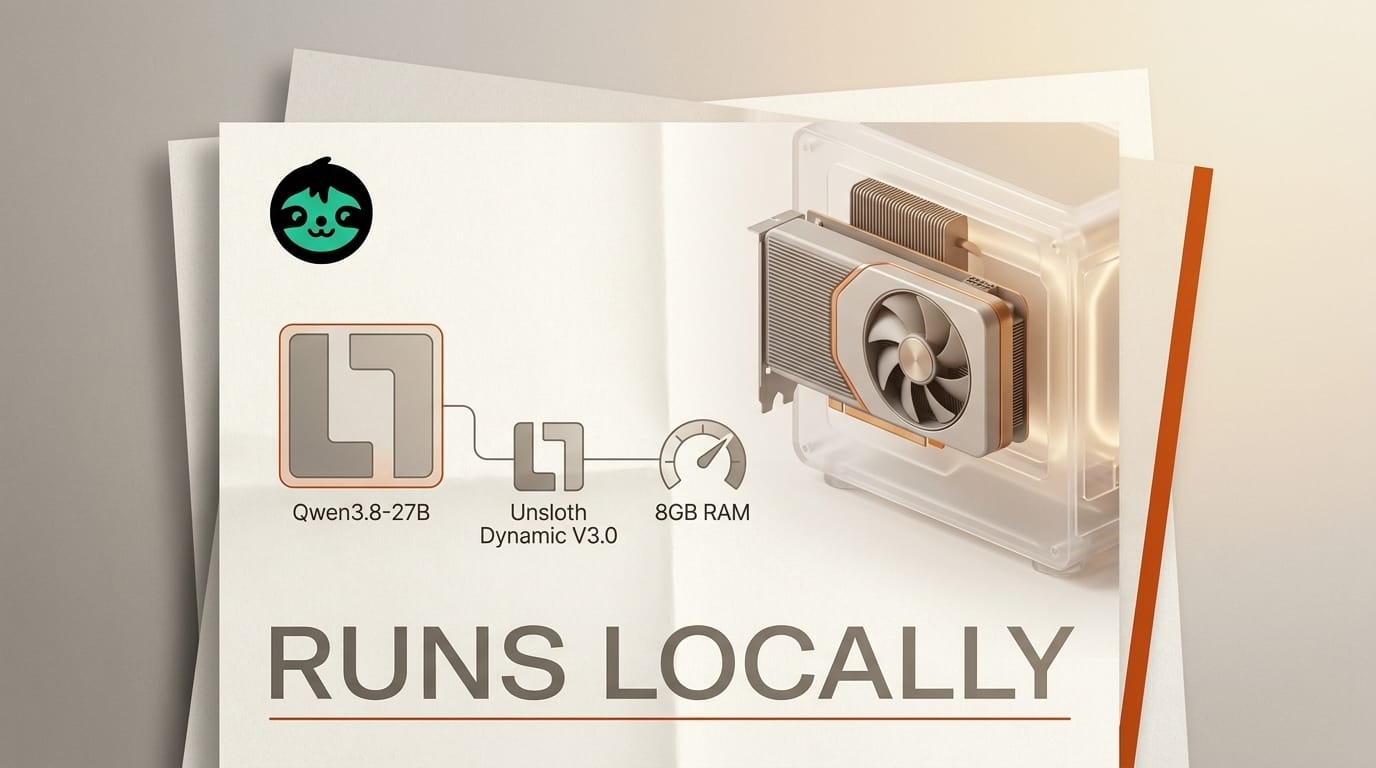
On August 20, 2026, Unsloth shipped a full Dynamic V3.0 GGUF release for Qwen3.8-27B, including a 1-bit quantization that runs in roughly 8GB of RAM. The 27-billion-parameter model that needed about 56GB at full precision now fits on hardware most creators already own.
This is the part of local AI that usually gets skipped. A model release is an announcement. A quantization release is the thing that decides whether you can actually run it.
What Unsloth Actually Shipped
Qwen3.8-27B itself landed on August 14 under Apache 2.0, a dense 27B multimodal model from Alibaba's Qwen team. You can read the specifications on the Hugging Face model card or in the official repository. Dense, not mixture-of-experts, which matters for local use: every parameter is active on every token, so quantization behaviour is predictable.
What changed on August 20 is the quantization tier. Unsloth's Dynamic V3.0 release covers the full quant ladder with a published hardware table, so you can match a build to your machine instead of guessing and running out of memory halfway through a load.
Unsloth reports roughly 10 percent higher accuracy at the same file size compared to standard quantization at equivalent tiers. The approach is selective: rather than crushing every layer to the same bit depth, Dynamic quantization keeps precision where the model is sensitive to it and compresses harder where it is not.
The quantized builds are published under the Unsloth organisation on Hugging Face, and the tooling itself is open source in the unslothai/unsloth repository. There is also a dynamic NVFP4 build that runs about 1.5 times faster than the BF16 checkpoint at comparable file size. If you have Blackwell-generation hardware, that is the build to look at.
The Hardware Math
Here is the practical picture, and it is worth being precise because "runs locally" hides a lot of variation.
| Precision | Approximate memory | Realistic hardware |
|---|---|---|
| BF16 (full) | ~56GB | Multi-GPU or datacenter card |
| FP8 | ~28GB | RTX 5090, A6000 |
| 4-bit | ~17GB | RTX 4090, 24GB consumer cards |
| 1-bit (Dynamic V3.0) | ~8GB | Mainstream laptop or desktop |
The 4-bit tier is the honest sweet spot. At roughly 17GB the model fits a single 24GB consumer GPU with headroom for context, and quality degradation at 4-bit on a dense 27B model is modest.
The 1-bit build is the headline, and it deserves a caveat. Getting a 27B model into 8GB is a real engineering result, but 1-bit quantization is lossy in ways that show up on exactly the tasks people want a big model for: long chains of reasoning, precise instruction following, code that has to compile. Treat it as the tier that lets you run the model at all, not the tier you ship client work on.
Reception suggests the interest is real rather than manufactured. The FP8 build reached the top of Hacker News, and the model passed 3 million Hugging Face downloads in its first three days.

Where This Fits In Your Workflow
The reason a local 27B matters to creators is not privacy alone. It is unit economics on repetitive work.
Batch jobs are the clearest case. Captioning a few thousand images for a LoRA dataset, generating alt text across a media library, drafting product descriptions from a spreadsheet, or classifying and tagging an archive. These are high-volume and low-stakes per item, which is precisely the profile where per-token API pricing gets expensive and where a local model that is merely good is enough.
Iteration is the second case. When you are tuning a prompt, the twentieth revision costs the same as the first if you are paying per call. Locally the marginal cost is electricity, which changes how freely you experiment.
The third case is anything you cannot send to a third party. Unreleased client work, footage under NDA, internal documents. This has always been the argument for local models. What is new is that the local option is no longer dramatically worse.
If you are already running models on your own hardware, the same tradeoffs we covered in running Stable Diffusion WebUI on Apple Silicon apply here: VRAM is the binding constraint, and quantization is how you buy your way around it. Unsloth's own desktop tooling, which we covered when it shipped for local training and inference, is the most direct path if you would rather not assemble a stack by hand.
What It Cannot Do Yet
A 27B model quantized to 4-bit is not a frontier model, and the benchmark framing around local models tends to blur that.
Context is the first limit in practice. The model card lists 262,144 tokens of native context, extensible further, but context costs memory on top of weights. If you loaded a 4-bit build into 17GB on a 24GB card, you do not have room for a very long context at speed. The advertised context and the context you can actually use on your hardware are different numbers.
Throughput is the second. Local inference on a consumer GPU is slower than a hosted API on datacenter hardware. For batch work that runs unattended this is irrelevant. For anything interactive it is immediately noticeable.
Multimodality is worth checking before you build on it. This is a native vision-language model, but tooling support for the vision path in local runtimes typically lags text by weeks. Verify your specific runtime handles image input before you design a workflow around it.
Key Takeaways
1. The August 20 news is the quantization release, not the model. Qwen3.8-27B shipped on August 14; Dynamic V3.0 is what makes it runnable on consumer hardware.
2. The 4-bit tier at roughly 17GB is the practical target for a 24GB consumer GPU. The 1-bit 8GB build is impressive but lossy.
3. Apache 2.0 licensing means commercial use is unrestricted, which matters if local output goes into client work.
4. The strongest use case is high-volume repetitive work where per-token API pricing dominates, not one-off creative tasks.
What to Watch
The pattern worth tracking is the shrinking gap between when a model ships and when a good local quantization exists. Six days here, and the quant release drew nearly as much attention as the model. That gap closing is what actually determines whether open weights matter to working creators.
The other thing to watch is dense versus mixture-of-experts for local use. Dense models quantize predictably. MoE models can be far cheaper per token but behave less consistently under aggressive quantization. If more labs ship dense models in the 20B to 30B range specifically for local deployment, that is a deliberate response to this audience.
Frequently Asked Questions
What hardware do I need to run Qwen3.8-27B locally?
For a usable experience, a 24GB consumer GPU such as an RTX 4090 running the 4-bit build at roughly 17GB. The 1-bit Dynamic V3.0 build runs in about 8GB, which brings mainstream laptops into range at a meaningful quality cost.
Is Qwen3.8-27B free for commercial use?
Yes. The model ships under Apache 2.0, which permits commercial use, modification, and redistribution. Verify the license on the model card before deploying, since licensing can change between releases.
How much quality do I lose at 4-bit?
Modest for a dense 27B model, and Unsloth reports roughly 10 percent better accuracy than standard quantization at the same size. Losses concentrate in long reasoning chains and exact-output tasks like code generation rather than general writing.
Is this better than using a hosted API?
It depends on volume and sensitivity. For high-volume repetitive work, or anything that cannot leave your machine, local wins on cost and control. For occasional complex tasks where quality matters most, a frontier hosted model is still ahead.
What is Dynamic V3.0 quantization?
A selective approach that varies bit depth by layer, preserving precision where the model is most sensitive and compressing harder elsewhere, rather than applying one bit depth uniformly across the network.
Can I fine-tune this model locally?
Fine-tuning needs substantially more memory than inference. Unsloth's documentation covers this path directly, but expect to need a 24GB card at minimum for a 27B model, and to use parameter-efficient methods rather than full fine-tuning.
Deep dive by Creative AI News.
Subscribe for free to get the weekly digest.