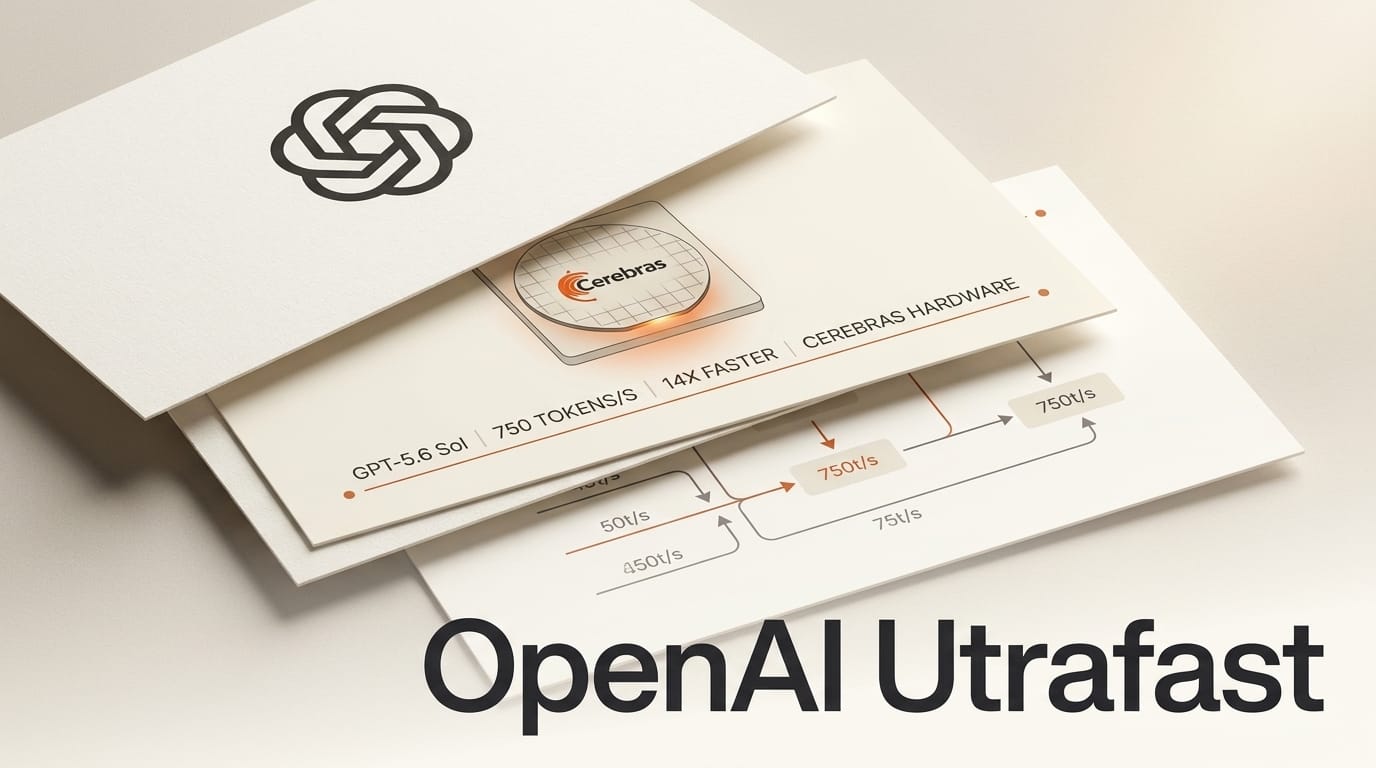
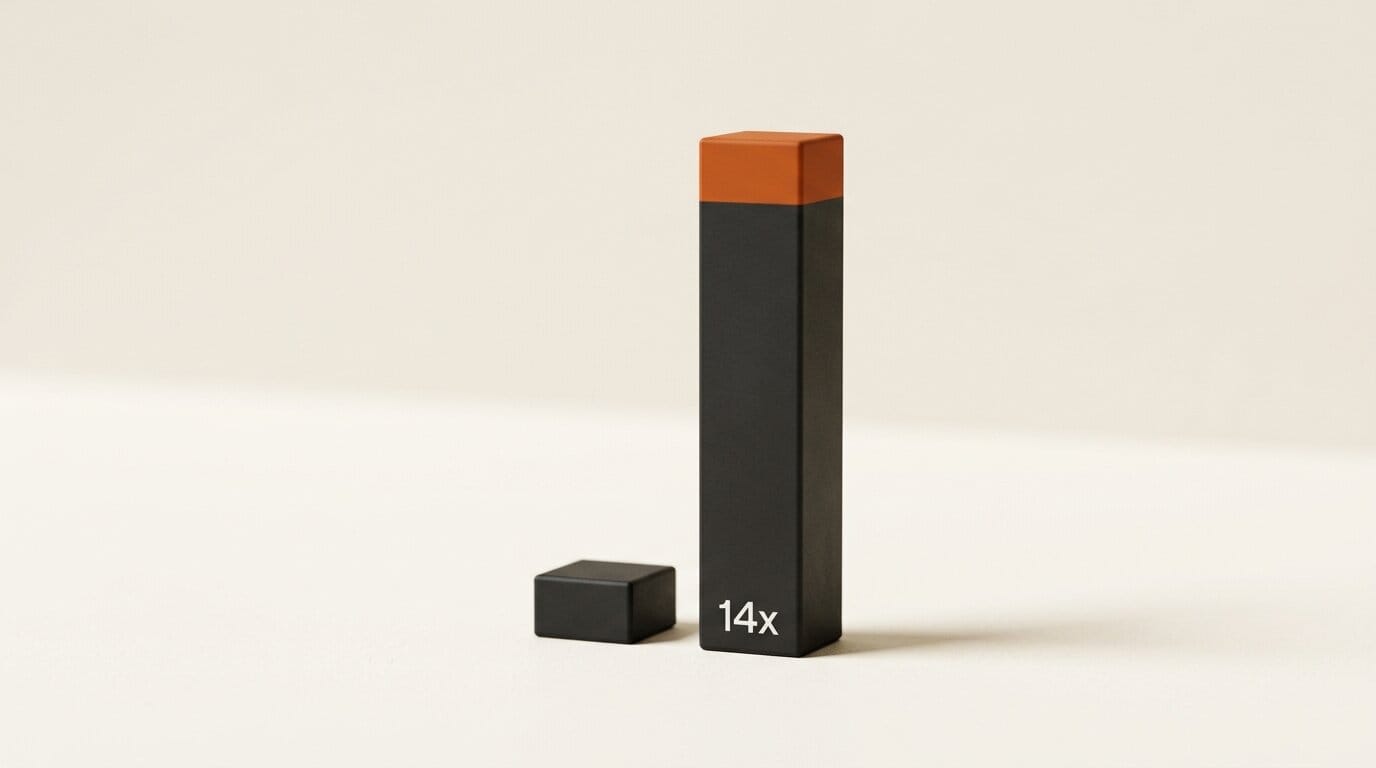
OpenAI has previewed Ultrafast, a new API service tier that runs its flagship GPT-5.6 Sol model at up to 750 output tokens per second, roughly 14 times faster than Standard processing. The speed comes from Cerebras and its wafer-scale hardware, not a smaller distilled model, which is the part that matters for anyone building agents, voice apps, or live tooling. Announced on August 13, 2026, Ultrafast is in limited preview for a handful of customers, with access widening as capacity grows.
Until now, real-time latency usually meant trading intelligence for speed: reach for a mini model or a specialized one. Ultrafast flips that trade. You keep GPT-5.6 Sol, OpenAI's most capable model, and get responses fast enough to feel interactive. As TechCrunch reported, OpenAI frames it as "more useful work per second" rather than a cheaper, dumber shortcut.
What Ultrafast Actually Ships
Ultrafast is a processing tier, not a new model. The weights are the same GPT-5.6 Sol that launched earlier this month. What changes is where and how the model runs. OpenAI routes Ultrafast requests to Cerebras infrastructure, part of a reported 10 billion dollar compute commitment OpenAI made to Cerebras earlier in 2026. The result is the same output you would expect from GPT-5.6 Sol, delivered at a token rate that GPU inference has struggled to match at this model size.
The preview is deliberately narrow. Early participants named in the launch include Jane Street, Podium, Basis, and Rogo, all firms where response time is the product. There is no public pricing and no general availability date yet. Developers can sign up through OpenAI's interest form to be notified as the tier opens up, per Testing Catalog.
The Speed Numbers, Benchmarked
The headline figure is 750 tokens per second, but the comparative benchmarks tell the clearer story. On Humanity's Last Exam, a 2,500-question PhD-level set, Ultrafast finished in 11 hours 11 minutes versus 78 hours 27 minutes for Claude Fable 5, about a 7x wall-clock speedup. On the GDP-Val economic-task benchmark, Cerebras reported a 5.6x end-to-end speedup with no measured quality loss. In a live financial-dashboard demo, a task that took 12 minutes 20 seconds on Standard finished in 1 minute 50 seconds on Ultrafast.
Here is how the tier stacks up against the fast options builders already reach for, using the figures OpenAI and Cerebras published:
| Option | Output speed | Relative speed | Status | Best for |
|---|---|---|---|---|
| GPT-5.6 Sol Ultrafast (Cerebras) | Up to 750 tok/sec | 14x vs Standard | Limited preview | Real-time agents, voice, live research |
| GPT-5.6 Sol Standard | Baseline (~50 tok/sec implied) | 1x | Generally available | Batch, background, non-interactive work |
| Opus 4.8 Fast mode | Not disclosed | Ultrafast is 5x faster | GA | Interactive coding, chat |
| Claude Fable 5 | Not disclosed | Ultrafast is 11x faster | GA | Long-form reasoning |
The Standard baseline of roughly 50 tokens per second is implied by dividing 750 by the stated 14x multiplier; OpenAI did not publish an exact Standard figure. The cross-model multipliers come directly from Cerebras, as detailed by unite.ai. Treat the competitor rows as relative, not absolute, since Cerebras measured them against its own runs.
Why Cerebras Wafer-Scale Changes the Math
The speed is a hardware story. Cerebras builds a Wafer-Scale Engine that puts 44 GB of SRAM directly onto a single wafer-sized chip. Model weights stay on-chip instead of being shuttled between high-bandwidth memory and compute, which is the bottleneck that caps token throughput on conventional GPU clusters. Keeping weights resident is why a frontier-scale model can stream at 750 tokens per second rather than the 30 to 80 tokens per second typical of GPU serving at this size.
This matters because the speedup is not a quantized or pruned version of the model. The benchmarks above show quality holding steady while wall-clock time collapses. For workloads that chain dozens of model calls, such as agent loops or multi-tool reasoning, the compounding effect is larger than the raw multiplier suggests: every step in the chain returns sooner, so the whole pipeline tightens.
What This Enables for Builders
If you build with LLMs, Ultrafast changes which product ideas are viable, not just how fast existing ones run. Three categories open up:
- Voice and conversational agents. Sub-two-second full responses make voice interfaces feel like conversation rather than request-and-wait. Interruptible, streaming voice becomes practical on a frontier model instead of a small one.
- Interactive agent loops. Coding agents, research agents, and tool-calling pipelines spend most of their wall-clock time waiting on token generation. A 5x to 14x cut turns a 12-minute agent run into under 2 minutes, which is the difference between a background job and a live tool a person watches.
- Live analytical dashboards. The financial-dashboard demo (1 minute 50 seconds versus 12 minutes 20 seconds) is the template: any dashboard that generates narrative, flags anomalies, or answers ad hoc questions can now refresh while the user is still looking at it.
John Crepezzi of Jane Street, an early tester, said the speed "makes it practical for developers to work in a more focused and productive way alongside them," per Cerebras. That focus benefit, keeping a human in flow instead of context-switching during a wait, is the underrated part of the story. For a sense of how fast frontier coding models are converging, compare our coverage of Grok 4.6's agentic coding benchmarks.
How to Get Access and Design For It
Ultrafast is available only through the OpenAI API during the preview, and only to selected customers. If you are not in the initial group, the practical move is to architect now so you can flip the tier on later. A few concrete steps:
- Isolate your model tier behind a config flag. Route latency-critical calls (voice, live UI) through a variable you can point at Ultrafast the moment access lands, without touching prompt logic.
- Instrument tokens-per-second, not just total latency. Ultrafast's benefit scales with output length, so measure throughput per call to know which endpoints will gain the most.
- Reserve Standard for batch work. Background summarization, offline enrichment, and nightly jobs do not need 750 tokens per second. Save the fast tier for the interactive path where it changes user perception.
- Design agent loops to exploit speed. If each step returns in a fraction of the time, you can afford more reasoning steps or more tool calls within the same latency budget. On-device and small-model tactics still matter for edge cases, as we covered with Liquid AI's LFM2.5.

Pricing will decide how aggressively teams adopt it. OpenAI has not disclosed a rate, and 9to5Mac noted there is no general-availability timeline. Specialized inference silicon usually carries a premium, so expect Ultrafast to be a targeted tool for the calls that need it, not a blanket default.
Frequently Asked Questions
Is Ultrafast a new model or the same GPT-5.6 Sol?
It is the same GPT-5.6 Sol model. Ultrafast is a processing tier that runs the existing weights on Cerebras hardware. You are not trading intelligence for speed the way you would by switching to a mini model.
How fast is 750 tokens per second in practice?
Fast enough that a task taking 12 minutes 20 seconds on Standard finished in 1 minute 50 seconds in OpenAI's dashboard demo. For a long agent run, that is the gap between a background job and a live, watchable tool.
Can I use Ultrafast today?
Only if you are in the limited preview. It is restricted to select API customers such as Jane Street, Podium, Basis, and Rogo. Others can register interest and wait for access to expand as capacity grows.
What powers the speed?
Cerebras Wafer-Scale Engine hardware, which holds 44 GB of SRAM and the model weights on a single chip. That removes the memory-to-compute data movement that limits token throughput on GPU clusters.
Does the speed hurt output quality?
OpenAI and Cerebras report no quality loss. On the GDP-Val benchmark, Ultrafast delivered a 5.6x end-to-end speedup with quality holding steady, and it completed Humanity's Last Exam about 7x faster than Claude Fable 5.
How much does it cost?
OpenAI has not announced pricing or a general-availability date. Given that specialized inference hardware typically commands a premium, plan to use Ultrafast selectively for latency-critical calls rather than as a default tier.