
Where to Sell AI Art in 2026: Stock Sites and Shops
You can sell AI-generated images in 2026, but most of the big stock libraries will not take them. Here is which stock sites, print shops and marketplaces accept AI art, and what each one asks for.
You can sell AI-generated images in 2026, but most of the big stock libraries will not take them. Here is which stock sites, print shops and marketplaces accept AI art, and what each one asks for.

AI music cannot go into YouTube's Content ID. YouTube only accepts reference tracks from owners with exclusive rights, and distributors now keep AI-generated songs out of it in writing.
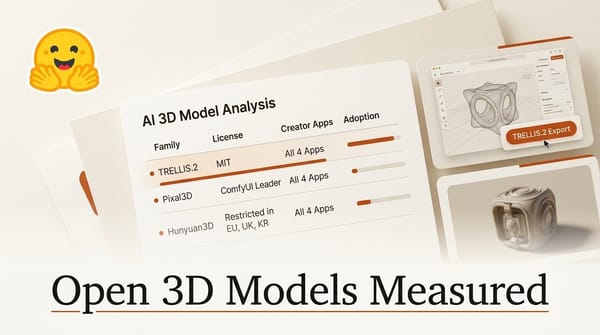
Only one of 17 open-source AI 3D model families, TRELLIS.2, is MIT licensed and runs in all four creator apps we checked. We measured adoption, licenses and app support for every family, from Pixal3D and Hunyuan3D to TripoSplat and SHARP.
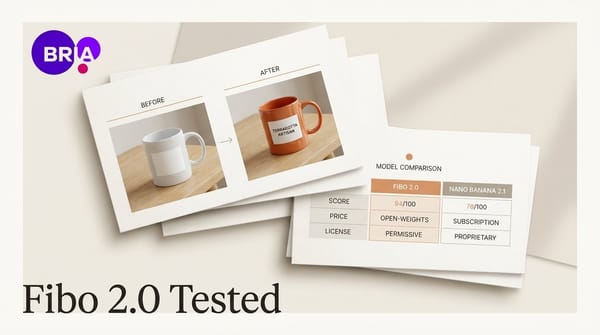
Bria Fibo 2.0 is the top-scoring open-weights image editor, trained on licensed images. It costs about what Nano Banana 2.1 does, scores lower, and the free download is non-commercial.

Black Forest Labs' FLUX 3 Image Klein is a 5.6B open-weights image model you can use for paid work if your business earns under $5M a year. It runs on 8 GB GPUs in ComfyUI and costs $0.009 per 1K image hosted. We tested its text rendering and editing.
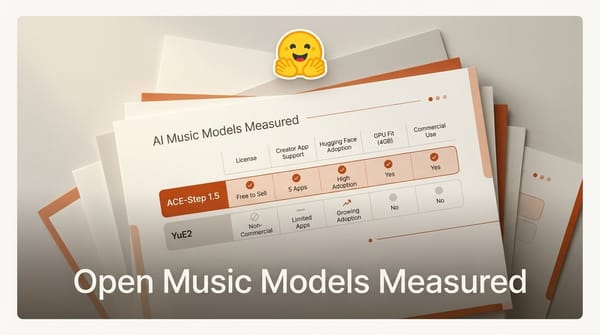
Only one of 12 open-source AI music model families, ACE-Step 1.5, is free to sell from, runs in all five creator apps we checked and fits a 4 GB graphics card. We measured adoption, licenses and app support for every family, from YuE2 to MusicGen.
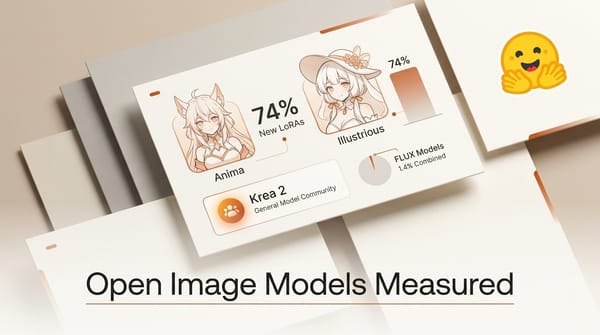
Two anime models, Anima and Illustrious XL, drew 16,934 of the 22,959 LoRAs published on Civitai in the past month, 73.8% of the total. Every FLUX model combined drew 1.4%. We measured 29 open image model families on adoption, license and app support.

MiniMax H3 drew 150 of the 311 community models built on open video models in September, 48% of the total. Its license excludes the US, the EU, the UK and South Korea. We measured 13 families on adoption, license and ComfyUI support.

The G7 Digital and Technology Ministers agreed on May 29, 2026 on a four-tier classification for AI openness. Here is what each category means for the tools you use every day.
Three major label settlements, a landmark UK court ruling, and new US Copyright Office guidance reshaped the rules for AI-generated content in the past 12 months. This research guide breaks down what creators can and cannot do with AI tools in 2026.

Udio settles with UMG and WMG, pivoting from an open AI music generator to a walled-garden fan platform where no creations can be exported. Suno retains downloads. The AI music market splits.