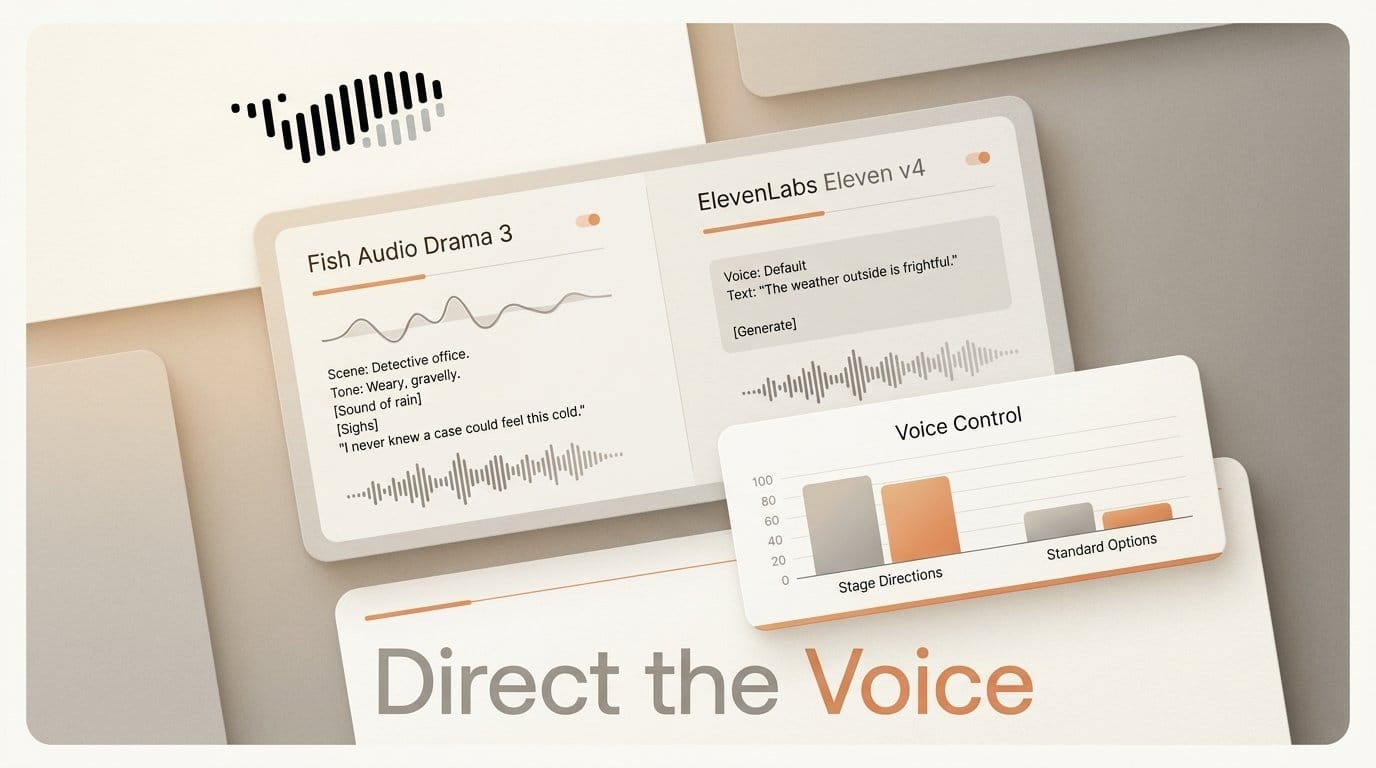
Fish Audio released Drama 3 on 13 October 2026, a text-to-speech model you direct the way you would direct an actor. You type the direction in plain words before a line, such as "barely holding it together, forcing a smile", and the voice plays it. It speaks 83 languages and is live today in Text to Speech on fish.audio, in the Fish Audio apps for iOS and Android, and through the API, at $10 per million characters until 12 November and $50 after that.
Two things make it worth a look for anyone who narrates, voices characters or makes story videos. It scored 93.2% on Artificial Analysis' independent Pronunciation Robustness test, the top result on that board, just ahead of Eleven v4 at 91.7%. And the model weights come under a new licence that lets you use them commercially for free while you and your affiliates earn under $500,000 a year. This piece compares Drama 3 with ElevenLabs' Eleven v4 and Fish's own S2.1 Pro on price and control, and walks through directing a scene in the app. We have not run Drama 3 ourselves; every performance claim below is Fish Audio's or Artificial Analysis', and the cost figures we worked out are marked as ours.
What Fish Audio shipped on 13 October
Drama 3 replaces S2.1 Pro as Fish Audio's most expressive voice model. The launch announcement lists the jobs it is built for: audiobooks, audio drama and fiction podcasts, game and animation dialogue, multilingual dubbing and short video. CEO Rissa Cao put the pitch in one line: "Voice AI has gotten very good at generating speech. The next step is directing a performance."
The practical changes over S2.1 Pro are three. Direction is followed more closely and with more feeling, according to Fish. Direction can change halfway through a line, so a sentence can start calm and end in a whisper. And hard words, names and numbers are read more accurately, which is the one claim an outside lab has checked.
Under the hood it is a large model that only uses a small part of itself at each step: 35 billion parameters, about 3 billion active per word, according to the technical report. That matters for one reason we come back to below: the free weights are far too big for a laptop.
How directing a line works
There are three kinds of direction, all documented in the Drama 3 guide, and Fish says they work the same way in the web app and the API.
- A direction for the whole line. Put it in square brackets at the start: [barely holding it together, forcing a smile] I'm fine. Really. Go on without me. Describe emotion, intent, pace, or who the character is talking to.
- Sounds and pauses where they happen. Drop [shaky breath] or [small laugh] at the exact spot in the line.
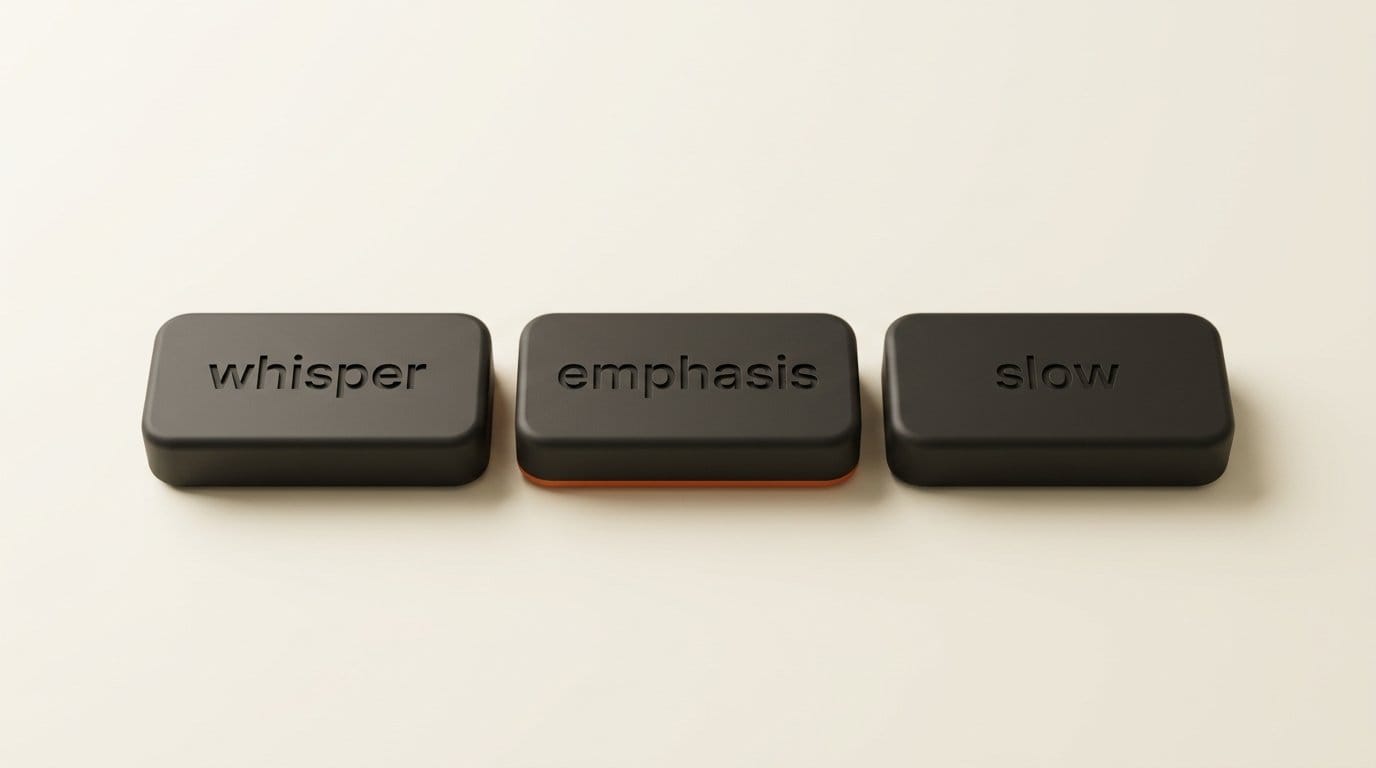
- A tag on a few words only. Wrap words in whisper, emphasis, soft, fast, slow, stress or forceful. In Text to Speech you select the words and pick the tag from the Tags menu, so there is nothing to type by hand.
The direction does not have to be in the language of the line. You can write it in whatever language you think in and have the character speak English, Japanese or Spanish. Short language switches inside a line also work, though Fish marks those as experimental and recommends a voice cloned from someone fluent in both languages.
One honest note from Fish's own post: "Takes vary, so render a few and keep the one that plays." Plan on rendering two or three versions of any line that carries weight.
Every word still lands: the pronunciation test
More feeling only helps if the words survive it. Artificial Analysis' Pronunciation Robustness benchmark puts hard words into English sentences, such as brand names, numbers, file paths and words whose reading depends on context, and human listeners check each one. Fish published the breakdown against its previous model:
| What is being read | Drama 3 | S2.1 Pro |
|---|---|---|
| Brands, places and technical terms | 95.9% | 87.3% |
| Words whose reading depends on context | 95.3% | 86.1% |
| Numbers, dates, units | 93.6% | 92.7% |
| Codes, paths, emails | 86.3% | 79.4% |
| Overall | 93.2% | 88.1% |
For a creator, the first row is the one that saves time. A tech review, a product explainer or a fantasy audiobook full of invented names is where older voices trip, and every wrong word is a re-render.
The lead over ElevenLabs is much smaller than the lead over Fish's own last model. Artificial Analysis' own post on the result, which tested the model as "Drama 3 Preview", puts Eleven v4 at 91.7% and Eleven v4 Turbo at 90.1% on the same test, so Drama 3 is ahead by 1.5 points. The same post calls it the new top open-weights model on its text-to-speech leaderboard, which is not the same as the top model overall: on the blind listening vote for overall quality, ElevenLabs still leads. Fish has published no listening test of its own against ElevenLabs, so the "most emotive" claim is still the vendor's.
Drama 3 vs Eleven v4 vs S2.1 Pro
The obvious rival is ElevenLabs' Eleven v4, released on 28 September, which led the Artificial Analysis Speech Arena on launch day and also takes inline directions such as [excited, happy]. We covered it in our Eleven v4 price comparison. Here is how the three line up for someone making audio, using each vendor's own pages:
| Fish Drama 3 | ElevenLabs Eleven v4 | Fish S2.1 Pro | |
|---|---|---|---|
| How you direct it | Plain-language brackets, sounds, word tags from a menu | Stacked audio tags and sound cues | Plain-language brackets |
| Languages | 83 | 90+ | 83 |
| API price per 1M characters | $10 until 12 Nov, then $50 | $80 | $15 |
| Entry paid app plan | Plus, $15 a month, up to 200 minutes | Creator, $22 a month, about 121 minutes | Same plans as Drama 3 |
| Free weights you can sell work from | Yes, under $500K yearly revenue | No | No (S2 Pro weights are research only) |
Plan prices are from the Fish Audio plans page and the ElevenLabs pricing page, read on 14 October. Fish says Drama 3 costs the same credits as S2.1 Pro inside its plans, so moving to the new model does not burn your monthly minutes any faster.
What an hour of narration costs
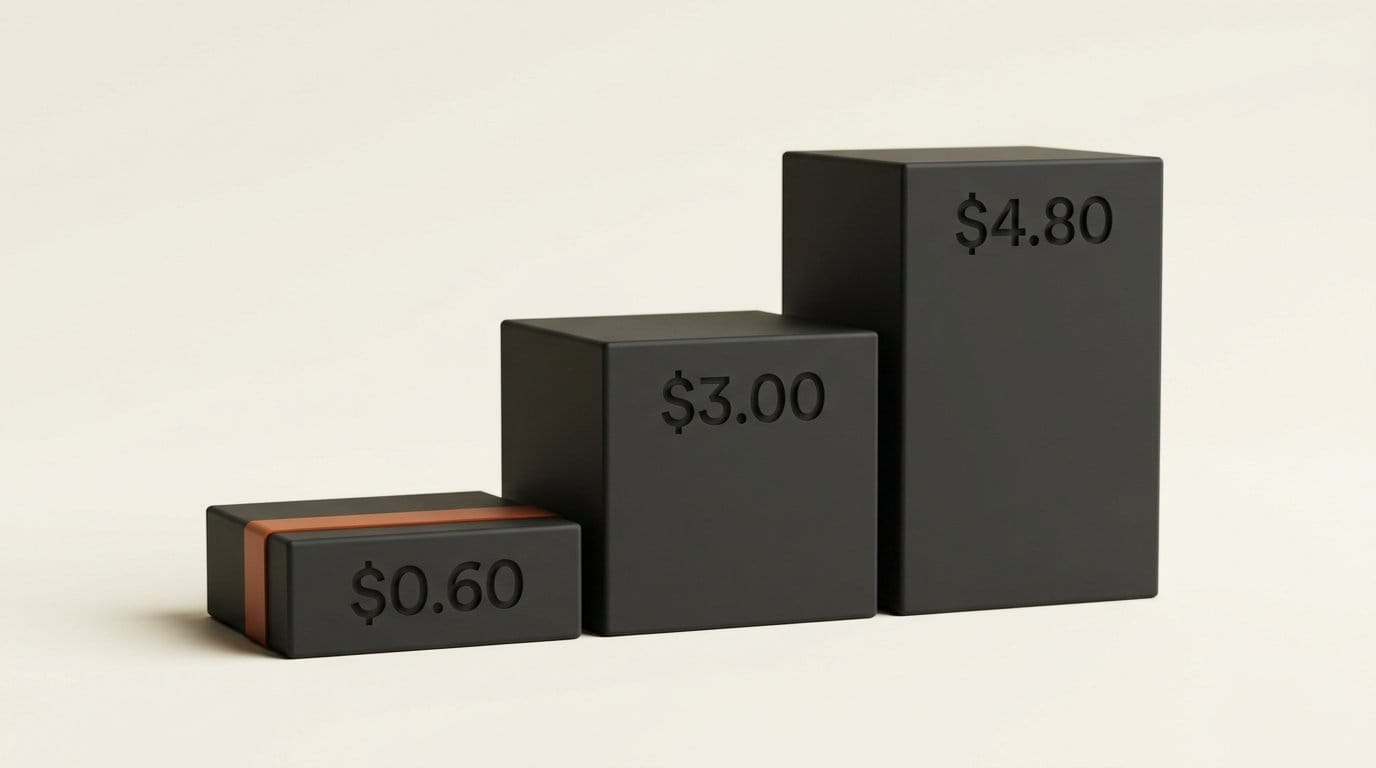
To compare like with like, we used the same ratio as our Eleven v4 piece: about 1,000 characters per minute of speech, so roughly 60,000 characters for an hour. Real speaking rates vary with voice and pace, so treat these as estimates, not quotes. API prices are from Fish's launch post and the ElevenLabs API pricing page.
| Model | Per hour (our estimate) | 10-hour audiobook |
|---|---|---|
| Drama 3, launch price to 12 Nov | $0.60 | $6 |
| Fish S2.1 Pro | $0.90 | $9 |
| Drama 3, list price from 13 Nov | $3.00 | $30 |
| Eleven v4 Turbo | $2.40 | $24 |
| Eleven v4 | $4.80 | $48 |
Most creators will not pay per character; they will pay a monthly plan. On that basis Fish Plus at $15 for up to 200 minutes works out to about 7.5 cents a minute, against about 18 cents a minute on ElevenLabs Creator at $22 for roughly 121 minutes, using each page's own minute estimates. Both vendors are discounting first months right now: Fish takes 50% off a new Plus, Pro or Max plan until 12 November, and ElevenLabs halves the first month of Creator.
Two catches. Your directions are part of the text you send, so a heavily directed script is a little longer and costs a little more. And the $10 API price is a 30-day launch window; at $50 list, Drama 3 costs more than three times S2.1 Pro, so keep S2.1 Pro for plain narration and spend Drama 3 on the scenes that need acting.
How to direct a scene in the Fish Audio app
No code needed. This is the route for a YouTube story video, a short audio drama or a podcast cold open.
- Open Drama 3. Go to Text to Speech on fish.audio or open the Fish Audio app on your phone, and choose Drama 3 as the model.
- Pick a voice per character. Use a library voice or clone one. Only clone a voice you own or have written permission to use; the Drama 3 licence bans cloning a real person without consent.
- Write the line with its direction. Start with the direction in brackets, then the words. Keep directions specific: "tired but warm, talking to a child" plays better than "sad".
- Mark the few words that matter. Select them and choose whisper, emphasis or slow from the Tags menu. Add a sound such as [small laugh] where it should fall.
- Render two or three takes of each important line and keep the best.
- Build the scene line by line. Render each character's lines in that character's voice and export the files. Drop them into Premiere Pro, DaVinci Resolve, CapCut or Audition and arrange them on the timeline with your music and effects.
- Fix a bad line by re-directing it. Change the direction on that one line and render it again. The tool that regenerates a single word in place is still in invite-only testing, so you cannot rely on it yet.
If you build in ComfyUI, the core Fish Audio Text to Speech partner node added Drama 3 as a model choice on launch day, ComfyUI Wiki reports. It calls Fish's servers with your API key, so it needs no graphics card.
The licence change, in plain words
This is the part that changes the most for small creators. Fish's previous self-hostable model, S2 Pro, came under a research licence that required a separate signed licence for any commercial use. Drama 3 comes under the new Fish Audio Community License v1.0, and it reads very differently:
- Free for commercial use while you and your affiliates earn less than $500,000 a year in total, from all sources.
- Client work is covered. A freelancer, studio or agency can make voiceovers, dubbing or audiobooks for a client of any size, as long as the client only receives the finished audio.
- You own your outputs, as far as the law allows.
- What is not allowed: offering Drama 3 to others as a voice or cloning service, cloning a real person's voice without consent, removing its watermark, or using its output to train another voice model.
The catch is size. The weights are about 40 GB on disk, and Fish ran its speed tests on an NVIDIA H200 data-centre card. This is not something you run on a MacBook or a gaming PC this week. For most creators the licence matters less as "run it yourself" and more as reassurance: the same model in the app is one you could, in principle, keep using if you ever needed to host it. For a full survey of voice models that do fit on home hardware, see our open TTS leaderboard licence check.
Who should switch now
If you make anything with acted dialogue, such as audio fiction, story videos, game or animation lines, try Drama 3 this week. The launch window is the cheapest it will ever be, the direction controls are in a menu rather than a script, and a Fish plan costs less per minute than ElevenLabs Creator.
If you narrate plain explainers or tutorials, the case is weaker. The pronunciation gain is real for brand-heavy scripts, but for a calm read S2.1 Pro on the same plan already does the job, and ElevenLabs still tops the blind listening vote: Eleven v4 Turbo led the Artificial Analysis Speech Arena at 1330 Elo on 14 October. Until someone publishes a head-to-head, that lead stands. If you already pay for ElevenLabs, render the same three lines in both apps with the same voice style before moving a project; that is a 15-minute test that settles it for your own work.
Frequently asked questions
Is Fish Audio Drama 3 free to use?
You can try it on Fish Audio's free plan, which gives 8,000 credits a month, up to about 7 minutes of audio and 500 characters per generation; Fish's FAQ says free-plan output is for personal, non-commercial use. Paid plans start with Plus at $15 a month. The open weights are free for commercial use under $500,000 in yearly revenue, but they need data-centre hardware.
How much does Drama 3 cost in the API?
$10 per million characters from 13 October to 12 November, then $50, according to Fish's launch post. One million characters is roughly 16 hours of speech at our estimate. OpenRouter's listing showed a different launch price on day one, so check the rate on whichever service you use.
Is Drama 3 better than ElevenLabs Eleven v4?
Not on overall sound, as far as anyone has measured. Drama 3 leads Artificial Analysis' Pronunciation Robustness test at 93.2% against 91.7% for Eleven v4, but ElevenLabs still leads the blind listening vote, where Drama 3 is the top open-weights model rather than the top model. Drama 3 is cheaper per minute on plans and much cheaper in the API until 12 November.
Can I use Drama 3 voices in videos I sell or monetize?
On a paid Fish plan, yes, for voices you own or have permission to use; the plans page lists commercial use from Plus up. If you run the open weights yourself, commercial use is free while your total yearly revenue stays under $500,000.
Can Drama 3 voice several characters in one scene?
Yes. Fish's API takes one voice per speaker and a speaker tag at the start of each turn, so a whole scene can go in one request. In the app, the simplest route is to render each character's lines in their own voice and assemble them in your editor.
Can I change one word without regenerating the whole line?
Not yet for most users. Fish's audio inpainting and interactive editing are in small, invite-only testing, with an editing API "coming soon". For now, change the direction on the line and render it again.