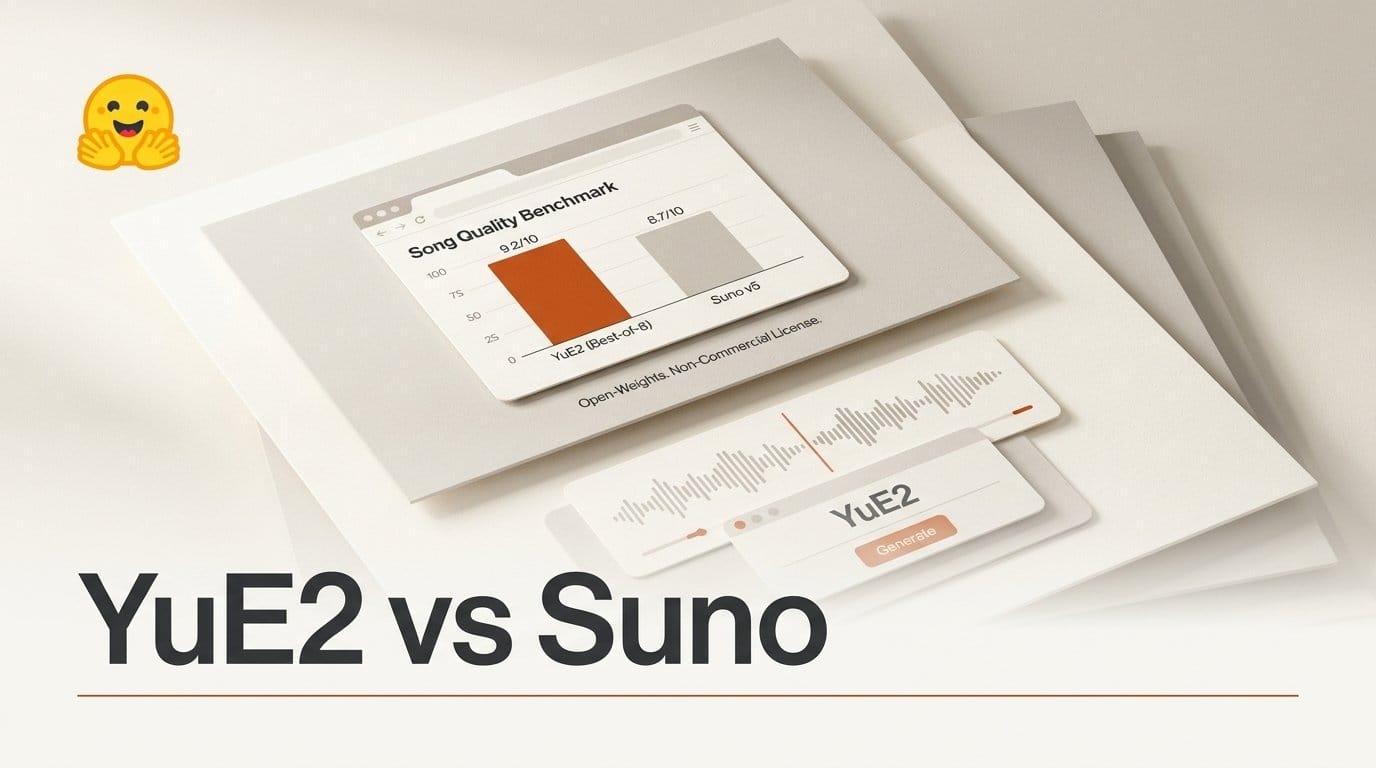
The M-A-P research collective released YuE2 on 9 September 2026, and the line everyone is quoting is the one at the top of its model card: an open music generation model that "rivals Suno v5," with a WildSongBench average of 6.9632 against Suno v5's 6.8721.
That number is real. It is also the least interesting thing in the release, and reading it as "the open model won" gets three separate things wrong. The YuE2-3B model card publishes the full benchmark tables, the selection protocol, and the wall-clock timings, which between them say something more specific than the headline: the win requires generating eight songs and throwing seven away, it costs the one metric singers care about most, and Suno still takes the two text-alignment columns outright.
Meanwhile the result that is not close at all, where YuE2 beats its nearest open competitor by roughly 1.5x, is sitting in a second table that the coverage has not mentioned. This is what the release actually contains, read off the vendor's own numbers.
What M-A-P actually shipped
This was not one model. Six repositories went up within twelve minutes of each other on 9 September, and the yue2-v0.1.6 release tag landed at 19:10 UTC the same evening.
The generator is YuE2-3B: 28 layers, 2,048 hidden size, 6,144 intermediate, and a 184,704-token vocabulary, described as "one AR-NAR Mixture-of-Transformers backbone" that writes a score and semantic tokens, then produces acoustic latents through flow matching. Around it sit a VAE in two variants, SheetSage2 for audio-to-score transcription, and MERT-v2 for music understanding. The repo claims SheetSage2 is state of the art on 10 of 13 transcription metrics and MERT-v2 on 14 of 15 MARBLE metrics.
The two VAE builds are not interchangeable and the card is unusually candid about it. YuE2-Vae-legacy "achieves higher musicality scores on benchmarks," while the default YuE2-Vae "delivers better perceptual audio quality." Every benchmark number below was produced with the legacy build. The one you get by default is the other one.

The benchmark win is real and narrower than it reads
Here are the WildSongBench results, which run over 192 prompts. SongBench Avg averages seven dimensions, Q3O scores prompt adherence from 0 to 5, and PER is phoneme error rate, where lower is better because it measures whether the lyrics come out intelligible.
| System | Open | Musicality | SongBench Avg | MuLan | AllMusicCaps | PER (lower better) |
|---|---|---|---|---|---|---|
| YuE2 (best-of-8) | Yes | 6.2666 | 6.9632 | 0.5051 | 0.3980 | 9.79% |
| Mureka 9 | No | 6.0488 | 6.9377 | 0.4394 | 0.4102 | 11.69% |
| Suno v5 | No | 5.9918 | 6.8721 | 0.5428 | 0.4353 | 8.10% |
| YuE2 (standard) | Yes | 5.9075 | 6.7316 | 0.5068 | 0.4054 | 8.44% |
| Suno v5.5 | No | 5.8087 | 6.7150 | 0.5089 | 0.3917 | 5.96% |
| Suno v4.5 | No | 5.8317 | 6.6995 | 0.5022 | 0.3873 | 5.80% |
| LeVo 2 | Yes | 5.4590 | 6.3247 | 0.3542 | 0.2680 | 26.12% |
| MiniMax Music 3 | Yes | 5.3482 | 6.2830 | 0.3928 | 0.3609 | 6.27% |
| ACE-Step 1.5 | Yes | 5.1588 | 6.0118 | 0.4372 | 0.3869 | 7.46% |
| YuE 1 | Yes | 4.0847 | 4.9165 | 0.2623 | 0.2882 | 36.38% |
Three things fall out of that ordering. First, the comparison the card makes is against Suno v5, but Suno v5 is not the runner-up. Mureka 9 scores 6.9377, which also beats Suno v5, and sits 0.0255 behind YuE2's best run rather than the 0.0911 the headline framing implies. The margin at the top of this leaderboard is thinner than a rounding convention.
Second, standard YuE2 scores 6.7316 and loses to Suno v5's 6.8721. The open model takes the crown in one configuration only.
Third, Suno v5 wins MuLan (0.5428 against 0.5068) and AllMusicCaps (0.4353 against 0.3980) against both YuE2 settings. Those are the columns measuring whether the audio matches the text you typed. On "did it make the thing I asked for," Suno is still ahead.

What best-of-8 actually costs you
The card's footnote defines the protocol plainly: "Standard YuE2 selects from two candidates; best-of-8 selects from eight," and "a pipeline call generates one candidate; selection is separate." There is no single-shot number published anywhere in the release. Even the standard row is already best-of-2.
Put that next to the timing table. On an RTX 4090 at full chain-of-thought, one 3.6-minute song takes 71.04 seconds of generation plus 214.85 seconds of audio decode, so 285.89 seconds end to end, at 11.18 GiB peak VRAM. Eight candidates is eight pipeline calls: roughly 2,287 seconds, or about 38 minutes of 4090 time for one song at the benchmark setting. The standard two-candidate setting is about 9.5 minutes.
Then there is the part that is genuinely surprising. Selection for best-of-8 is ranked "by Musicality, then Q3O, then PER." PER is the last tiebreak, so the procedure optimises for musicality and only glances at whether you can make out the words. The table shows exactly what that does: PER rises from 8.44% at standard to 9.79% at best-of-8. Generating eight songs and keeping the best one makes the vocals measurably less intelligible than generating two.
On that metric the picture is not flattering. YuE2's 8.44% is beaten by Suno v4.5 (5.80%), Suno v5.5 (5.96%), MiniMax Music 3 (6.27%), ACE-Step 1.5 (7.46%) and Suno v5 (8.10%). If your song has lyrics that need to land, five other systems currently deliver them more cleanly, and one of them is a Suno release from two versions ago.
Where YuE2 is not close: zero-shot covers
The second table is the one worth the attention, and it is the one nobody has quoted. On SHS100K zero-shot cover generation, across 948 works times two styles times two seeds for 3,792 songs per method, with no candidate selection at all.
| Method | CLEWS mAP | CLEWS Hit@1 | VINet mAP | MuLan | Musicality |
|---|---|---|---|---|---|
| YuE2 (full score) | 0.647 | 71.3% | 0.288 | 0.382 | 5.104 |
| YuE2 (without chords) | 0.598 | 67.3% | 0.179 | 0.417 | 5.490 |
| SongEcho | 0.419 | 48.4% | 0.122 | 0.366 | 3.286 |
| ACE-Step 1.5 | 0.024 | 2.4% | 0.006 | 0.166 | 3.689 |
| YuE2 (without score) | 0.006 | 0.3% | 0.004 | 0.474 | 5.691 |
CLEWS and VINet measure whether the output is recognisably still the same song, against 10,545 recordings. YuE2 with a full score hits 0.647 mAP and 71.3% Hit@1, against SongEcho's 0.419 and 48.4%. That is a 1.5x lead on identity retention, not a rounding-error win, and ACE-Step 1.5 at 0.024 mAP is not really in the same task.
The last row is the whole argument. Strip the symbolic score out of YuE2 and identity collapses to 0.006 mAP and 0.3% Hit@1, while musicality climbs to 5.691 and MuLan to 0.474, both the highest in the table. Without the score it writes the most pleasant, best-prompt-matching music here, and it is not a cover of anything. The ablation is a controlled demonstration that the score, not the audio model, is what preserves the song.
The editable score is the actual product
That result reframes what this release is. YuE2 plans in ABC notation before it synthesises, and the GitHub repo exposes the stages separately: pipe.plan(), then pipe.generate_semantic(plan), then pipe.synthesize(semantic), then pipe.decode(latents). Planning runs in three modes, cot="full" for melody and chords, cot="melody" which the card recommends for covers, and cot="off". You can also supply your own ABC score.
For a working musician that middle artefact is the difference between a slot machine and an instrument. Suno hands you a finished master; if the melody is wrong your only move is to roll again with a different prompt. YuE2 hands you a score you can open, fix the chord change you dislike, and re-render, with the rest of the arrangement following the edit. The repo builds an agentic editing loop on top of the same seam, turning written feedback into score and lyric revisions across successive versions.
Running it is not casual. The requirements are Linux, Python 3.12, and an NVIDIA GPU with BF16 support and 24GB of VRAM, plus 24GB of host RAM, producing 48 kHz stereo without quantisation. Measured peak was 11.18 GiB, so the 24GB floor is headroom for maximum context rather than the steady-state cost.
The licence is the catch
Here is the part that decides whether any of this matters for paid work. The repo splits its terms: first-party code, agent skill and documentation are Apache 2.0, but "model weights are separately licensed under CC BY-NC 4.0." All six repositories carry the same non-commercial tag.
CC BY-NC 4.0 bars commercial use. Not "attribution required," not "tell us first." A track you render with YuE2 cannot go in a client video, a monetised YouTube upload, a game you sell, or a library you license, unless you negotiate separate terms with M-A-P. The Apache-2.0 code is genuinely reusable; the thing that makes the music is not.
The timing sharpens the contrast. One day earlier, Suno shipped v6 on licensed models with Warner Music and BMG deals attached, which is Suno buying down exactly the legal risk that CC BY-NC leaves sitting with you. In the same week, the commercial tool got safer to sell work from and the open challenger arrived unusable for it. That is the opposite of how the fully open model releases in the text world have been trending.
Who should run it this week
If you make covers or need a song's structure preserved through a style transfer, YuE2 is the strongest thing available and the SHS100K margin is not subtle. Do it on non-commercial work, or start the licensing conversation early.
If you write original songs with lyrics that have to be understood, the benchmark says stay where you are for now. Five systems beat YuE2 on phoneme error rate and the best-of-8 setting makes that gap wider, not narrower.
If you are building tooling, the interesting surface is the score seam rather than the model. Planning and synthesis are separate calls, ABC is a text format your existing tools already understand, and SheetSage2 gives you a transcription front door. That composition story is more durable than a 0.0255 leaderboard margin, and it is the piece that will still be true after the next release. As with the current crop of open-source voice tools and free audio plugins, the licence terms deserve as much of your attention as the demo reel.
Frequently asked questions
Can I use YuE2 music commercially?
No, not under the default terms. The model weights are licensed CC BY-NC 4.0, which prohibits commercial use, and that covers the audio you generate with them. The code is Apache 2.0, so you can build and ship software around YuE2 freely; it is the weights, and therefore the output, that are restricted. Commercial use requires separate licensing from M-A-P.
Does YuE2 really beat Suno v5?
On one metric, in one configuration. YuE2 at best-of-8 scores 6.9632 on WildSongBench SongBench Avg against Suno v5's 6.8721. Standard YuE2 scores 6.7316 and loses to Suno v5. Suno v5 also wins MuLan and AllMusicCaps against both YuE2 settings, and beats YuE2 on phoneme error rate. Mureka 9, at 6.9377, is a closer competitor than Suno v5 is.
What hardware do I need to run YuE2?
Linux, Python 3.12, and an NVIDIA GPU with BF16 support and 24GB of VRAM, plus 24GB of available host RAM. Measured peak VRAM was 11.18 GiB on an RTX 4090 in normal use, rising to 14.08 GiB in maximum-context testing. One 3.6-minute song takes about 286 seconds end to end on a 4090.
What is symbolic planning and why does it matter?
Before generating audio, YuE2 writes a melody and chord plan as an ABC notation score, which you can read and edit before synthesis. It matters because it is what makes the output controllable and, on the cover benchmark, what preserves song identity: removing the score drops CLEWS mAP from 0.647 to 0.006 while musicality actually increases.
How does YuE2 compare to the original YuE?
It is a large jump. YuE 1 scores 4.0847 musicality and 4.9165 SongBench Avg with a 36.38% phoneme error rate; YuE2 standard scores 5.9075 and 6.7316 at 8.44%. YuE2 also adds editable symbolic scores, zero-shot covers and agentic editing, none of which existed in v1. The original code is preserved on the YuE-v1 branch.
Which VAE should I use?
Depends on your goal. The default YuE2-Vae gives better perceptual audio quality and is the one to use for listening. YuE2-Vae-legacy scores higher on benchmarks and is what every published number was produced with, so use it only to reproduce the paper's results.
Is there a technical report?
Not yet. The model card states the technical report is coming soon, and the arXiv reference currently attached to the repository is the paper for the original YuE, not YuE2. Training data details are not published in the card, which is worth noting when assessing the benchmark claims.