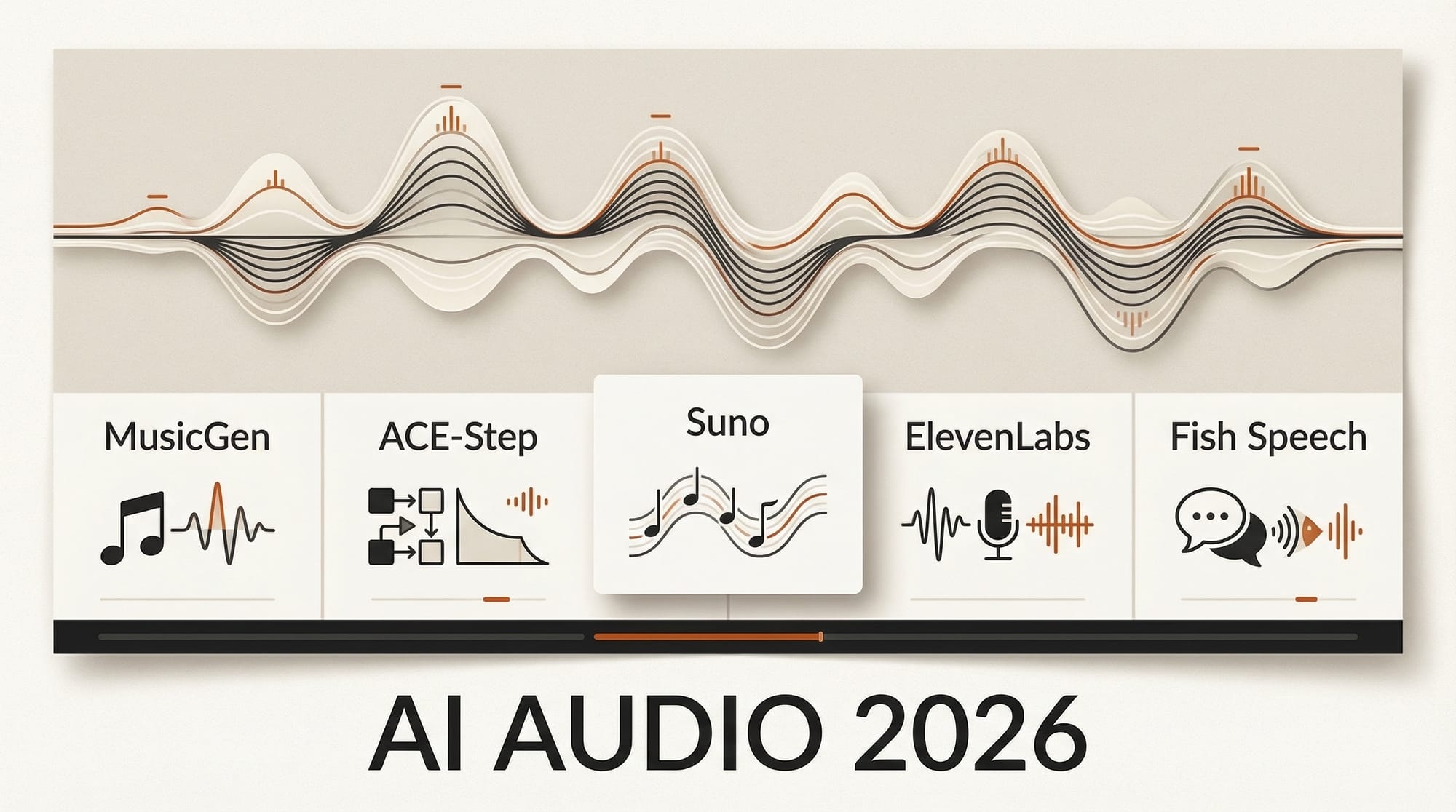
An open-source music model running on a $200 GPU now outscores Suno v5 on the SongEval benchmark. That single result captures where AI audio stands in March 2026: the gap between free and paid is collapsing, and creators who pay attention can build entire audio pipelines for almost nothing.
For the broader landscape, see our complete producer guide to AI music and audio in 2026.
This guide draws on HuggingFace model data across 50 text-to-audio models, trending HuggingFace Spaces including MusicGen and Kokoro-TTS, GitHub trending repositories like Fish Speech (28K+ stars), and hands-on testing of commercial platforms including Suno, Udio, ElevenLabs, and Stable Audio.
Key Findings
1. ACE-Step 1.5 Beats Commercial Models on Benchmarks
ACE-Step 1.5 is the biggest story in open-source music generation right now. Released in late January 2026, it scores 8.09 on AudioBox CU and 8.35 on Production Quality, topping Suno v5 on the SongEval overall metric. It generates a full song in under 2 seconds on an A100, under 10 seconds on an RTX 3090, and runs on GPUs with less than 4GB of VRAM.
The catch: Suno v5 still leads on style alignment (46.8 vs 39.1) and lyric alignment (34.2 vs 26.3). In human listening tests, ACE-Step 1.5 lands between Suno v4.5 and v5 in subjective quality. But for creators who want local, private, unlimited music generation without a subscription, it is a genuine alternative.
| Metric | ACE-Step 1.5 | Suno v5 | Winner |
|---|---|---|---|
| AudioBox CU (overall) | 8.09 | Lower | ACE-Step |
| Production Quality | 8.35 | Lower | ACE-Step |
| Coherence | 4.72 | Comparable | Tied |
| Style Alignment | 39.1 | 46.8 | Suno |
| Lyric Alignment | 26.3 | 34.2 | Suno |
| Human Preference | Between v4.5-v5 | Top | Suno (slight) |
2. The TTS Market Has Three Clear Tiers
Text-to-speech has split into distinct pricing tiers, each with a clear use case. ElevenLabs remains the premium choice at $5-$99/month with 32 languages, 3,000+ voices, and the most natural prosody in the market. Fish Audio S2 (released March 2026) now matches ElevenLabs in blind listening tests at roughly 80% lower cost: $15 per million characters vs ElevenLabs' higher rates. And Kokoro, with just 82 million parameters, runs on CPU with an Apache 2.0 license and still ranks first in the HuggingFace TTS Spaces Arena.
| Tool | Price | Languages | Latency | Best For |
|---|---|---|---|---|
| ElevenLabs | $5-$99/mo | 32 | Low | Premium quality, enterprise |
| Fish Audio S2 | $15/1M chars | 80+ | <150ms | Cost-effective production |
| Kokoro | Free (Apache 2.0) | 8 | 96x real-time | Self-hosted, English-focused |
| Fish Speech | Free (open source) | 13 | Fast | Voice cloning, multilingual |
3. Suno and Udio Dominate Commercial Music Generation
Suno and Udio are the two platforms that matter for AI music right now, and their pricing reflects a maturing market. Suno offers a free tier (50 credits/day, roughly 10 songs), a Pro plan at $10/month (2,500 credits, v5 model access, commercial rights), and Premier at $30/month (10,000 credits plus Suno Studio). Udio mirrors this structure: free (10 daily credits), Standard at $10/month (2,400 credits, stem downloads), and Pro at $30/month (6,000 credits).
The real differentiator is output quality. Suno v5 produces 44.1kHz audio with natural-sounding vocals that consistently win in head-to-head tests. Udio counters with stronger remixing tools, including inpainting (regenerating specific sections), stem separation, and a reference audio feature that lets you steer generation by uploading an existing track.
| Feature | Suno | Udio |
|---|---|---|
| Free Tier | 50 credits/day (~10 songs) | 10 credits/day (~3 songs) |
| Pro Price | $10/mo (2,500 credits) | $10/mo (2,400 credits) |
| Top Tier | $30/mo (10,000 credits) | $30/mo (6,000 credits) |
| Audio Quality | 44.1kHz, studio-grade | High quality, strong vocals |
| Stem Downloads | Premier only | Standard and up |
| Commercial Rights | Paid plans only | Paid plans only |
| Unique Strength | Best overall quality | Remixing and inpainting |
4. MusicGen Still Leads Open-Source Downloads
Meta's MusicGen remains the most-downloaded open-source music model by a wide margin. The medium variant pulls 1.4 million downloads per month on HuggingFace, the small variant hits 118K, and the large variant reaches 24K. The MusicGen Space on HuggingFace has accumulated 5,068 likes, making it the most popular audio generation demo on the platform.
MusicGen's staying power comes from its simplicity: a single text prompt generates 30-second clips with decent quality and no fuss. It is not competing with Suno on song length or vocal quality, but for short loops, background music, and prototyping, it remains the fastest path from idea to audio.
5. Fish Speech Is the TTS Project to Watch
Fish Speech has accumulated 28,338 stars on GitHub with 2,159 gained in the past month alone. The latest release, Fish Audio S2 Pro, is a 4-billion parameter model trained on over 10 million hours of audio across 80+ languages. It supports over 15,000 emotion tags, multi-speaker generation in a single pass, and sub-150ms latency.
What makes Fish Speech different from other open-source TTS projects is its Dual-Autoregressive architecture, which natively supports SGLang inference acceleration including continuous batching and paged KV cache. Translation: it scales well in production, not just on a single GPU.
6. Stable Audio Pivots to Enterprise
Stable Audio 2.5 marks a deliberate shift toward enterprise customers. The model generates three-minute tracks with structured intros and outros, supports text-to-audio, audio-to-audio, and inpainting workflows, and is trained exclusively on licensed datasets. Stability AI has partnered with both Warner Music Group and Universal Music Group to co-develop professional tools.
For individual creators, the open-source Stable Audio Open 1.0 (31K downloads on HuggingFace, 1,426 likes) remains available, but it lags behind ACE-Step 1.5 and MusicGen in community adoption. The enterprise version costs roughly $0.20 per generation, with a free community license for individuals and businesses under $1 million in annual revenue.
7. Sound Effects Get Their Own Models
A quieter trend worth noting: dedicated sound effects models are emerging. MOSS-SoundEffect from the OpenMOSS team (6,431 downloads since its February 2026 debut) focuses specifically on generating environmental sounds, foley, and SFX. This signals that the "one model does everything" approach is giving way to specialized tools for specific audio tasks.
Trend Analysis
Rising
- Local-first music generation. ACE-Step 1.5 running on a consumer GPU is the inflection point. Expect more models optimized for 4-8GB VRAM cards in the next six months.
- Emotion-controlled TTS. Fish Audio S2's 15,000+ emotion tags and per-sentence tagging represent a new level of expressiveness that was exclusive to professional voice actors a year ago.
- Licensed training data. Stability AI's partnerships with major labels signal that "ethically trained" is becoming a competitive feature, not just a PR talking point.
Stable
- Suno's commercial dominance. With 44.1kHz output and a refined UI, Suno remains the default for creators who want to generate a song and move on. The v5 model is a clear step above v4.5.
- MusicGen as the baseline. Despite being nearly three years old, MusicGen's download numbers show no sign of declining. It is the "SDXL of audio" at this point.
- ElevenLabs as TTS gold standard. Nothing else matches its combination of quality, language coverage, and voice cloning depth. The premium pricing reflects genuine premium quality.
Emerging
- Multi-speaker single-pass generation. Fish Audio S2's ability to generate dialogue between multiple voices in one inference call points toward AI-generated podcasts and audiobooks produced in minutes.
- ComfyUI audio workflows. ACE-Step 1.5 already has ComfyUI integration guides, bringing music generation into the same node-based workflow that image and video creators already use.
- Specialized sound effects models. Purpose-built models for foley, ambient, and SFX are carving out a niche that general-purpose music models serve poorly.
Predictions
- ACE-Step 2.0 will close the lyric alignment gap by Q3 2026. The current 8-point deficit against Suno v5 in lyric alignment is the most obvious area for improvement, and the team has AMD partnership resources to throw at it.
- Fish Audio will cross 40K GitHub stars by June 2026. At its current trajectory of 2,100+ stars per month, and with the S2 Pro launch driving new interest, this is a conservative estimate.
- Suno or Udio will ship a real-time collaboration feature by summer 2026. Both platforms have the infrastructure for it, and the competitive pressure to differentiate beyond generation quality is intensifying.
- At least one major DAW (Ableton, Logic, or FL Studio) will integrate an AI music generation plugin by the end of 2026. The APIs are ready. The demand is there. The only question is which DAW moves first.
- Kokoro will reach 500M parameters and support 20+ languages by year-end. Its current 82M architecture is deliberately minimal. The team's HuggingFace Arena ranking proves the approach works; scaling up is the logical next step.
What This Means for Creators
If you are producing content that needs music or voice today, here is the practical breakdown:
For background music and loops: Start with MusicGen (free, instant, good enough for most use cases). If you need full songs with vocals, try Suno's free tier first. Only upgrade to Pro if you need commercial rights or higher volume.
For voiceover and narration: Kokoro is the right choice for English-language projects where you want zero ongoing costs. For multilingual work or emotion-heavy content, Fish Audio offers the best value. Reserve ElevenLabs for client-facing work where voice quality is the product.
For local/private generation: ACE-Step 1.5 is the clear winner. It runs on modest hardware, generates fast, and the output quality is genuinely competitive with $30/month subscriptions. Pair it with ComfyUI if you are already in that ecosystem. For more free options across image, video, and coding, see our best free AI tools for creators roundup.
For enterprise and commercial production: Stable Audio 2.5 is worth evaluating if licensing provenance matters to your business. The major-label partnerships mean you are working with explicitly permitted training data.
Full Data
| Tool | Category | Price | Open Source | Key Metric |
|---|---|---|---|---|
| Suno v5 | Music Gen | Free / $10-$30/mo | No | 44.1kHz, best subjective quality |
| Udio | Music Gen | Free / $10-$30/mo | No | Best remixing and stem tools |
| ACE-Step 1.5 | Music Gen | Free | Yes | SongEval 8.09, <4GB VRAM |
| MusicGen | Music Gen | Free | Yes | 1.4M downloads/month |
| Stable Audio 2.5 | Music/SFX | ~$0.20/gen | Partial | Enterprise-licensed training data |
| ElevenLabs | TTS | Free / $5-$99/mo | No | 32 languages, 3,000+ voices |
| Fish Audio S2 | TTS | $15/1M chars | Partial | 80+ languages, 15K emotion tags |
| Kokoro | TTS | Free (Apache 2.0) | Yes | 82M params, #1 HF TTS Arena |
| Fish Speech | TTS | Free | Yes | 28K GitHub stars, 2K/month growth |
| MOSS-SoundEffect | SFX | Free | Yes | Dedicated foley/ambient model |
This research was produced by Creative AI News.
Subscribe for free to get the weekly digest every Tuesday.
Frequently asked questions
What is the best AI music generator in 2026?
Suno v5 leads commercial AI music tools on output quality and song-length coherence. Udio matches Suno on quality with cleaner instrumental separation. ACE-Step is the strongest open-source model and is free to self-host. ElevenLabs Music focuses on the artist publishing flow. Pick based on commercial use, self-hosting needs, or workflow.
Can AI generate full songs with vocals in 2026?
Yes. Suno, Udio, and ElevenLabs Music produce 3 to 4 minute songs with synthesized vocals, lyrics, and instrumental backing in one pass. Quality is indistinguishable from human-made tracks for most genres. Vocal clarity, lyrical coherence, and emotional range still trail human performance for ballads and complex narrative songs.
Is AI-generated music legal to use commercially?
Suno paid plans, Udio paid plans, and ElevenLabs Music with proper licensing all permit commercial use. ElevenLabs Music distinguishes itself with upfront Kobalt and Merlin licensing for sample clearance. Free tiers usually restrict commercial use. Always read the specific commercial license terms before releasing AI music as a paid product.
What is the best free AI voice generator in 2026?
Fish Speech leads open-source TTS on naturalness and supports zero-shot voice cloning from a 10-second sample. ElevenLabs offers a free tier with limited monthly characters. OpenAI TTS via free ChatGPT also works for short clips. For self-hosting, Fish Speech runs on a single consumer GPU with sub-second latency.
How much do AI music tools cost in 2026?
Suno runs $10 to $30 per month. Udio runs $10 to $30 per month. ElevenLabs Music starts at $5 per month. Self-hosting ACE-Step or Fish Speech is free with hardware costs. API pricing for ElevenLabs voice runs $0.18 per 1,000 characters at the lowest tier. Free tiers exist on most providers.