On 14 September 2026 Nari Labs published a post headlined Nari Labs leads Coval voice AI benchmarks, claiming its speech-to-text endpoint holds "#1 Latency, #2 WER" and its text-to-speech endpoint "#2 Latency, #1 WER". The Coval text-to-speech leaderboard, pulled the same morning at 11:19 UTC, backs about half of that. Nari's qwen3-tts-fast does sit second on latency at 65 ms median time-to-first-audio and first on accuracy at 3.8% word error rate. On speech-to-text it is second on latency, not first: Baseten serves the same Qwen3-ASR 1.7B weights at 22 ms, half of Nari's 44 ms.
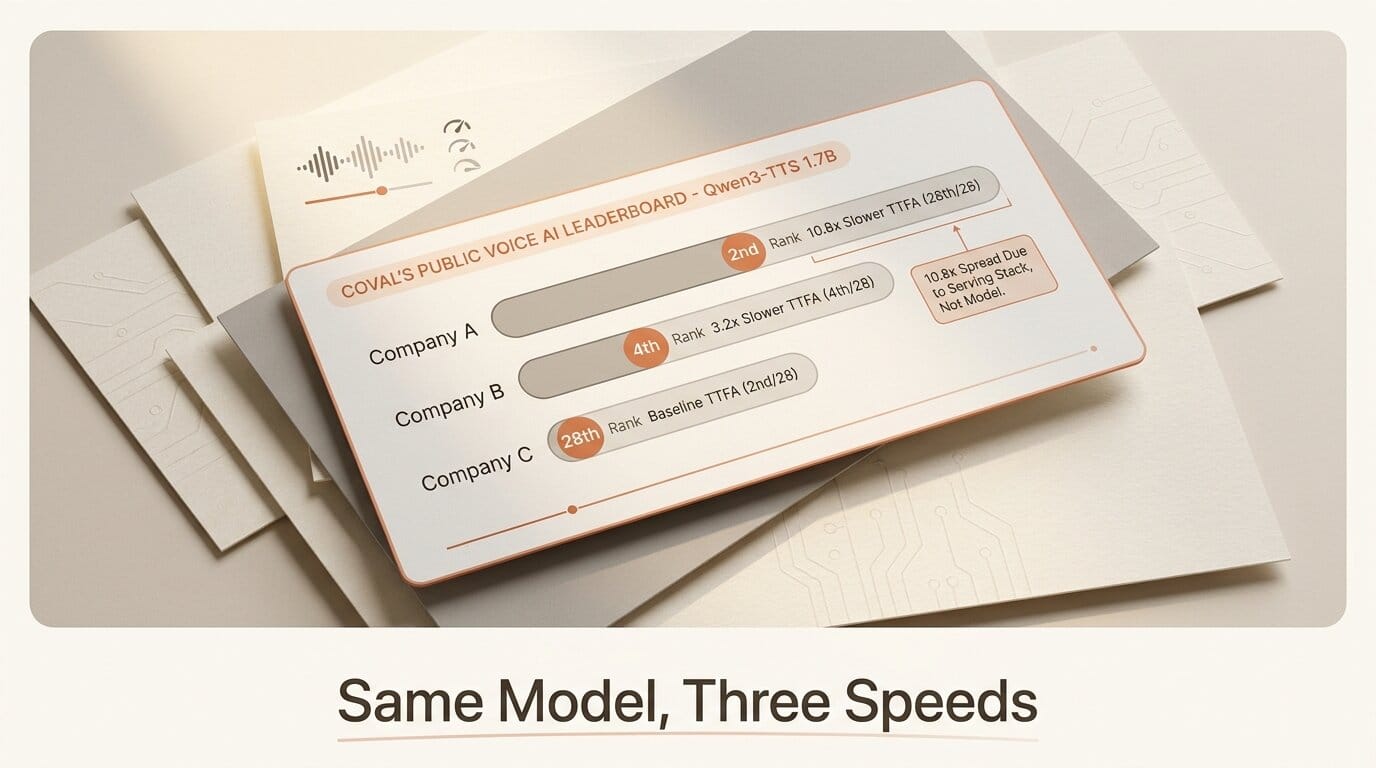
The number neither company put in a headline is the interesting one. The text-to-speech board lists three companies serving Qwen3-TTS 1.7B. Nari is 2nd of 28 at 65 ms. Baseten is 4th at 100 ms. Alibaba, which trained the model, is 28th of 28 at 699 ms. Same weights, a 10.8x spread in perceived latency and a 2.3x spread in word error rate. If you are choosing a voice model for a dubbing pass, a narration track, or a live agent, the model name is not the decision. The company running it is.
What Nari Labs actually built
Nari Labs is the two-person team behind Dia, the 1.6B open-weights dialogue model that shipped under Apache 2.0 in April 2025. Its new products are not new models. The nari-qwen3-tts repository is explicit about this: it describes itself as "a high-performance, single-H100 serving implementation" and closes with "Thanks to the Qwen3-TTS authors for releasing Qwen3-TTS." The weights are Alibaba's Qwen3-TTS 1.7B CustomVoice. The serving stack, released Apache 2.0, is Nari's.
That distinction is the whole story. Nari's README claims 10 requests per second at sub-50 ms p95 time-to-first-audio on a single NVIDIA H100 SXM, and sub-80 ms p95 at 20 requests per second. Those are inference-engineering numbers, not model-quality numbers. And on a public board that runs every 30 minutes against a frozen dataset, inference engineering is worth more rank than the model choice is.
One model, three serving stacks, a 10.8x gap
Here is the Coval text-to-speech board filtered to the rows that matter, as pulled on 14 September 2026 at 11:19 UTC against pinned dataset 87834e9ff42e. Every row below is the same 1.7B Qwen3-TTS family except the two reference points at the bottom.
| Rank | Provider | Model | Median TTFA | WER |
|---|---|---|---|---|
| 1 | Fluxions | vui | 50 ms | 5.3% |
| 2 | Nari Labs | qwen3-tts-fast | 65 ms | 3.8% |
| 4 | Baseten | qwen3-tts-1.7b | 100 ms | 5.4% |
| 28 | Alibaba | qwen3-tts-flash-realtime | 699 ms | 8.9% |
| 7 | ElevenLabs | eleven_flash_v2_5 | 185 ms | 6.7% |
| 17 | ElevenLabs | eleven_v3_conversational | 322 ms | 4.5% |
| 20 | Cartesia | sonic-3.6 | 355 ms | 5.4% |
Read the top and the bottom together. Alibaba's own hosted Qwen3-TTS endpoint is last of 28 entries, slower than Google's chirp-3-hd and OpenAI's gpt-4o-mini-tts, on the model Alibaba trained. Nari's serving of those weights is 10.8x faster to first audio and less than half the word error rate. Baseten sits between them on both axes.
Even the #1 row is Qwen3-derived. The Fluxions vui repository describes Vui Nano as a 300M autoregressive language model over the Qwen3-TTS speech codec, Apache 2.0, roughly 9x realtime on a 4090. So the top four latency slots on a 28-model commercial board are all built on the same open Chinese speech codec, differentiated almost entirely by who wrote the streaming path.
One caution on the word error rate column. Coval reports WER next to latency for text-to-speech, and identical weights producing 3.8% at one provider and 8.9% at another points at the serving path rather than the model. The published methodology does not spell out the mechanism for the text-to-speech side, so treat that as the reading rather than a documented finding.
The speech-to-text board says the same thing louder
The speech-to-text leaderboard, pulled at the same timestamp, ranks by word error rate rather than latency, which is why Nari's "#1 Latency" claim does not survive contact with it.
| WER rank | Provider | Model | Median TTFS | WER |
|---|---|---|---|---|
| 1 | AssemblyAI | universal-3.5-pro | 142 ms | 3.3% |
| 3 | Nari Labs | qwen3-asr-fast | 44 ms | 3.5% |
| 5 | Baseten | qwen3-asr-1.7b | 22 ms | 4.2% |
| 8 | Inworld AI | inworld-stt-1 | 63 ms | 4.4% |
| 10 | Cartesia | ink-2 | 129 ms | 4.9% |
| 18 | ElevenLabs | scribe_v2_realtime | 126 ms | 5.7% |
| 20 | Deepgram | nova-3 | 90 ms | 6.3% |
Two things fall out. First, Baseten and Nari are both serving Qwen3-ASR 1.7B, and Baseten is exactly 2x faster to final segment (22 ms against 44 ms) while Nari is meaningfully more accurate (3.5% against 4.2%). Same weights, opposite trade-offs, chosen by the people who wrote the server. Second, the most accurate transcriber on the board is more than 3x slower to final segment than the Qwen3 rows, which is a real choice for anyone building live captions rather than batch transcripts. Coval's own board note puts it flatly: "the fastest row can have much worse WER."
Nari's post frames itself as leading. On the snapshot we read it leads on exactly one metric, text-to-speech word error rate. Both the post and the board carry the same date, and the board re-runs every 30 minutes, so the honest reading is that the claim was true of a different snapshot or a narrower field, not that anyone is lying.
What the price gap actually is
Nari lists speech-to-text at $0.06 per hour on its Standard endpoint and $0.12 per hour on Fast, and text-to-speech at $5 per 1M characters Standard, $10 per 1M Fast. Its post frames competitors as "3.75x more" (AssemblyAI) and "2.4x more" (Deepgram). Both multiples check out, but only against one specific rate on each rate card, and that basis matters.
AssemblyAI publishes Universal-3.5 Pro at $0.21 per hour for pre-recorded audio and $0.45 per hour for the streaming realtime variant. Against Nari Fast at $0.12, the streaming rate is exactly 3.75x. Against the async rate it is 1.75x. Since Coval measures streaming latency, the streaming comparison is the fair one, but a creator batch-transcribing an archive overnight is paying the async rate and the gap narrows by more than half.
Deepgram lists Nova-3 monolingual streaming at a promotional $0.0048 per minute, $0.288 per hour, against a regular price of $0.0077 per minute, $0.462 per hour. The promotional rate is 2.4x Nari Fast. The list price is 3.85x. Deepgram's page marks the streaming discount as a limited-time offer, so that multiple is scheduled to move.
The other pricing claims in Nari's post, 5x for ElevenLabs Eleven v3 and 6.5x for Cartesia Sonic 3.6, we did not reproduce: both vendors sell character allowances bundled into monthly plans rather than a flat per-million rate, so any single multiple depends on which tier you assume. Treat those two as Nari's framing.
What to change in your voice pipeline
The practical instruction is short: stop treating the model name as the spec. If your dubbing pass, podcast transcript, or live agent currently says "Qwen3-TTS" or "Whisper" in its config, that string describes somewhere between 65 ms and 699 ms of latency depending on whose endpoint answers.
- Time your own provider before you switch anything. Measure time-to-first-audio and time-to-final-segment on your real audio, at your real concurrency, from your real region. Coval's numbers exclude connection setup by design, so your figure will be worse than any leaderboard figure.
- Separate the latency decision from the accuracy decision. On both boards the fastest row is never the most accurate row. A live caption overlay wants the 22 ms column. A dubbing script that a human will proofread wants the 3.3% column.
- Price against the mode you actually use. Streaming and pre-recorded rates differ by a factor of two at the same vendor, and at least one of the cheap streaming rates on the board is an expiring promotion.
- If the weights are open, the serving stack is a lever you own. Nari's serving implementation is Apache 2.0 and targets a single H100. Self-hosting is the version of this decision where the 10.8x spread is yours to capture rather than to shop for.
- Re-check quarterly, not once. A board that re-runs every 30 minutes will not agree with a blog post from last quarter, including this one.
How much of this should you trust
More than a vendor chart and less than your own measurement. Coval is a voice-AI testing company founded in 2024 by Brooke Hopkins, who previously built evaluation infrastructure for self-driving at Waymo, so the benchmark is published by a company that sells evaluation tooling. It is also unusually auditable: the runner, dataset manifests, and scoring live at github.com/coval-ai/benchmarks under Apache 2.0, every audio file is checked against a SHA-256 hash on fetch, and you can re-run it with your own provider keys.
The methodology document is specific about scope. Speech-to-text runs two frozen sets, a 50-utterance subset of LibriSpeech test-clean and 897 conversational clips from pipecat-ai/stt-benchmark-data. Text-to-speech runs a 30-prompt set. Latency is measured as perceived first-audible latency and explicitly excludes TCP, TLS, and session-setup round trips for every provider. Shared executions run every 30 minutes. And the doc states its own limit: "This is a research benchmark. Results reflect a specific dataset and methodology and may not generalize to production workloads." A 30-prompt text-to-speech set is a small sample to hang a 28-way ranking on.
One disclosure about our own reading. The canonical leaderboard at benchmarks.coval.ai renders its tables client-side and returns no data to a plain fetch, so every figure in this article was read from the openbenchmarks.com republication of the same Apache-2.0 benchmark, which reports its pull timestamp and dataset hash. We verified the pricing independently from each vendor's own rate card rather than taking it from Nari's post.
Frequently asked questions
Is Nari Qwen3-TTS a new model?
No. It is a serving implementation of Alibaba's Qwen3-TTS 1.7B CustomVoice weights. Nari Labs wrote the streaming server and released it Apache 2.0; it did not train the model, and its README credits the Qwen3-TTS authors directly.
Which provider is fastest for text-to-speech right now?
On the 14 September 2026 snapshot, Fluxions vui at 50 ms median time-to-first-audio, with Nari at 65 ms and Inworld's inworld-tts-2-flash at 71 ms. The board re-runs every 30 minutes, so confirm before you migrate.
Which is most accurate for transcription?
AssemblyAI Universal-3.5 Pro at 3.3% word error rate, ahead of Reson8 and Nari at 3.5%. It is also the slowest of those three to final segment at 142 ms, so the accuracy win costs latency.
Why would the same weights score a different word error rate at different providers?
Because the serving path shapes the output: streaming chunk boundaries, truncation, silence handling, and endpointing all affect what a scorer receives. Coval's published methodology details this for speech-to-text but not for text-to-speech, so on the text-to-speech side the correlation is observed rather than explained.
Can I self-host instead of paying per hour?
Yes, and that is the point of the gap. Nari's serving implementation is Apache 2.0 and documents 10 requests per second at sub-50 ms p95 on one H100 SXM, and Fluxions vui runs at roughly 9x realtime on a 4090. Whether that beats $0.06 per hour depends entirely on your utilisation.
Do Nari's public beta prices hold?
Not necessarily. Its post says the beta APIs move "to a paid GA within this week" with $20 in credits for existing accounts, so the rates quoted here are introductory and should be re-checked against the live pricing page before you build a cost model on them.