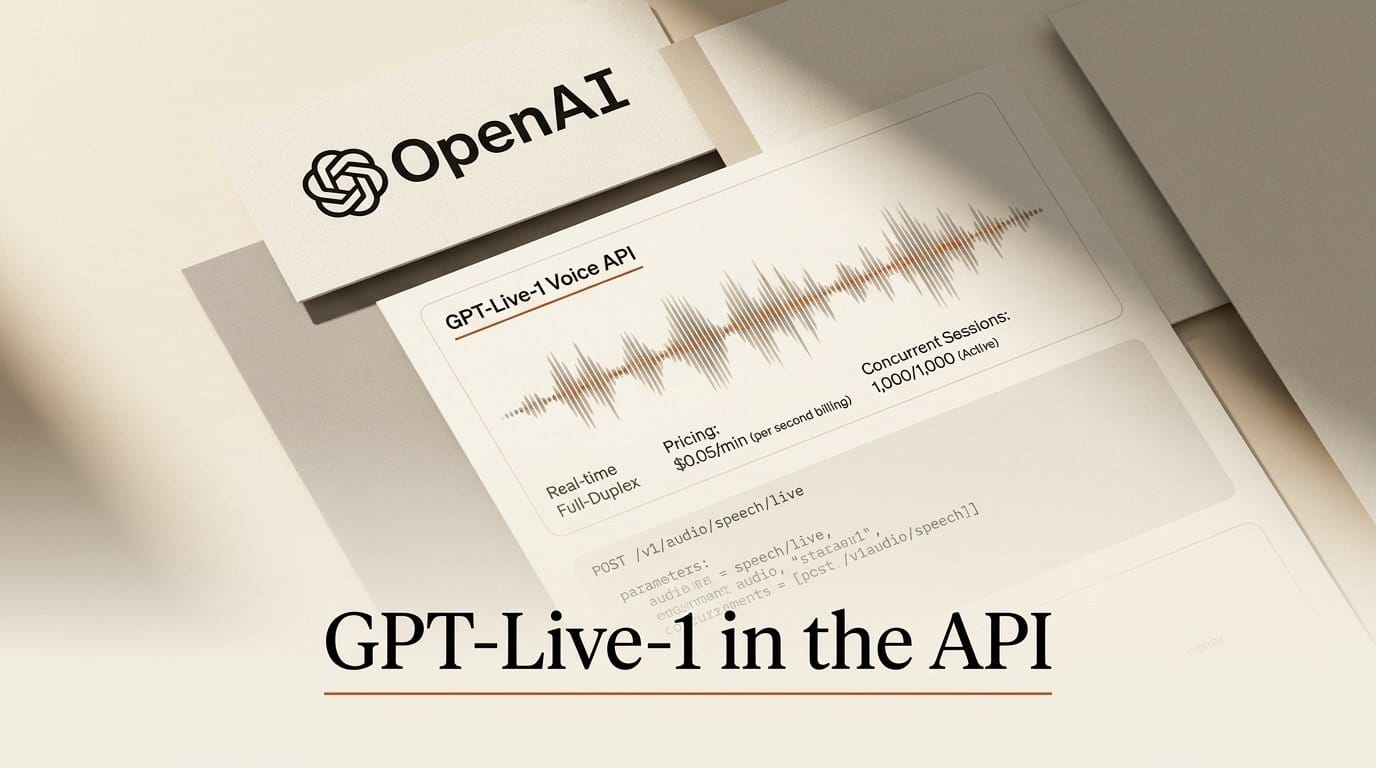
OpenAI put GPT-Live-1 into the API on 10 September 2026 as model id gpt-live-1, priced at $0.05 per minute and billed per second. It is a full-duplex voice model: it listens and speaks at the same time instead of waiting for you to stop talking. The number every outlet led with was the price. The number that will actually reshape how you build is buried in the docs, where rate limits are quoted in concurrent sessions, from 25 at Tier 1 to 500 at Tier 5, rather than in tokens per minute. Voice just stopped being a token product.
There is a second detail in that same docs page worth reading twice. v1/live/sessions is the only endpoint gpt-live-1 runs on. Chat Completions, Responses, and the existing Realtime API are all explicitly listed as unsupported. This is not a model swap. If you have a voice agent in production today, there is no line where you change a model string and ship.
What OpenAI Actually Shipped
GPT-Live-1 is not new as a model. It has been powering ChatGPT's Live voice mode since it was introduced on 8 July 2026. What shipped on 10 September is developer access to it, and that distinction matters because of how recently the answer was no. In a status check published on 16 July, the advice to teams was blunt: OpenAI's models page did not list GPT-Live, the pricing page did not show GPT-Live pricing, and the recommendation was "I would not plan a launch around the GPT-Live API today." Build on the Realtime API instead. Two months later that guidance is obsolete, which is a useful reminder of how fast the gap closes between a consumer feature and the endpoint that exposes it.
The headline capability is genuine full duplex. A conventional voice agent is three models chained together: speech to text, then a language model, then text to speech. Each handoff adds latency and a failure point, and the whole pipeline is structurally incapable of hearing you while it talks. GPT-Live-1 processes incoming and outgoing audio together, which is what lets it handle an interruption or a backchannel acknowledgment as it happens rather than after the current utterance finishes.
OpenAI quotes a 30 percentage point improvement over GPT-Realtime-2.1 on Full-Duplex-Bench, an academic benchmark from National Taiwan University, UC Berkeley, University of Washington, and MIT CSAIL that scores pause handling, backchanneling, turn-taking, and interruption management. Secondary reporting breaks that out further: turn-taking latency of 0.798 seconds against 1.41 seconds, and an interactivity score of 80.10% against 45.4% on v1.5 of the benchmark. It is worth noting that OpenAI is reporting its own scores against a third-party benchmark, not submitting to an independent leaderboard run.
The Billing Model Changed, Not Just the Model
This is the part that deserves more attention than it got. Every previous OpenAI voice option billed audio as tokens. GPT-Live-1 bills $0.05 per minute of session, metered per second, and the capacity you are allocated is expressed as how many calls can be open at once.
That inverts the planning exercise. Under token billing, a chatty user costs more than a quiet one, and your rate limit is a throughput ceiling you can smooth with queuing. Under per-minute billing with a concurrency cap, a caller sitting in silence costs exactly as much as one talking continuously, and your ceiling is a hard simultaneity limit that queuing cannot help you with. If 26 people call your Tier 1 agent at the same moment, one of them does not get a session.
| Usage tier | Concurrent sessions | Cost per hour of one open session |
|---|---|---|
| Free | Not supported | Not available |
| Tier 1 | 25 | $3.00 |
| Tier 2 | 50 | $3.00 |
| Tier 3 | 200 | $3.00 |
| Tier 4 | 300 | $3.00 |
| Tier 5 | 500 | $3.00 |
Concurrency figures are from OpenAI's model docs. The hourly figure is simply $0.05 multiplied by 60, shown to make the unit economics legible: a voice agent that stays on a call for an hour costs $3 in voice layer alone, before the model doing the thinking bills you separately.
Free tier accounts cannot call it at all. That is a meaningful gate for anyone prototyping on a trial key, and it is the clearest evidence available that this is otherwise a self-serve launch. One outlet, Unite.AI, described availability as limited and routed through OpenAI's forward deployed engineers and systems integrators. The published rate-limit ladder across five paid tiers points the other way, and we are treating the docs as authoritative here. Custom voices are unambiguously gated: those require contacting sales.

It Does Not Reason, and That Is the Design
GPT-Live-1 is a voice layer, not a brain. It handles the conversation surface and delegates reasoning and tool calls to a backend text model, with GPT-6 Astra cited for complex work, a cheaper model named Luna for high-volume tasks, and third-party models supported. Its own knowledge cutoff is listed as 31 July 2025, which sounds alarming until you remember it is not the component that is supposed to know things.
Two consequences follow, and both are easy to miss when you budget from the headline price. First, you pay twice: $0.05 per minute for voice, plus whatever the backend model bills in tokens, plus tool usage. The often-quoted benchmark result of first place on Sierra's Tau3 voice benchmark is specifically GPT-Live-1 paired with GPT-6 Astra at medium reasoning effort. That is a two-model bill. On Tau3 Voice Intelligence, the reported Pass@1 scores are 86.2% for GPT-Live-1 against 45.7% for GPT-Realtime-2.1 and 42.4% for GPT-Realtime-2.
Second, the architecture is the actual product. The reason teams report deleting so much code is that the orchestration between three models, the interrupt handling, the turn detection, and the barge-in logic all move inside the API. One healthcare customer is reported to have removed 23,000 lines of code relative to their cascaded pipeline. Language learning platform Speak, an early tester, reported that false interruptions of a learner's thinking pauses dropped by close to 80% against turn-based systems, which is the single most creator-legible number in the launch: the model stops talking over people who are still thinking.
GPT-Live-1 Against the Alternatives
The comparison that matters is not GPT-Live-1 against the last OpenAI voice model. It is against the three structurally different ways you can ship a voice agent right now. Launch coverage has focused almost entirely on the first two columns, framing this as an upgrade within OpenAI's own lineup, which understates how different the build looks depending on which column you pick.
| GPT-Live-1 | GPT-Realtime-2.1 | Cascaded STT to LLM to TTS | Open-weights full duplex | |
|---|---|---|---|---|
| Full duplex | Yes | Partial, turn-based | No | Yes |
| Billing unit | Per minute | Per audio token | Per token, three times | Your GPU |
| Headline price | $0.05 per minute | Token rates | Sum of three vendors | Hardware plus power |
| Rate limit shape | Concurrent sessions | Tokens per minute | Per vendor | None |
| Reasoning included | No, delegates | No, delegates | Yes, it is the middle | Varies |
| Tau3 Voice Pass@1 | 86.2% | 45.7% | Not directly comparable | Not published |
| Turn-taking latency | 0.798s | 1.41s | Typically worst | Varies |
| Runs offline | No | No | No | Yes |
| Voice cloning | Sales contact | Preset voices | Depends on TTS vendor | Yes, unrestricted |
The fourth column is the one worth taking seriously if your volume is real. We have covered two credible open-weights full-duplex models this year: NVIDIA VoiceChat 11B and ByteDance SeedRealtime. Neither matches GPT-Live-1 on published turn-taking scores, and neither has been run through Tau3. But the break-even is arithmetic you can do in a minute: at $3 per open session-hour, a single agent held open eight hours a day for a month costs roughly $720. Ten concurrent agents on that pattern is $7,200 a month in voice layer alone, which buys a lot of GPU.
The honest read is that GPT-Live-1 wins decisively on quality and on time-to-ship, and loses on unit economics at scale and on any workload that cannot leave your infrastructure. If you are shipping this quarter, the API is the answer. If you are running a call center, run the arithmetic before you commit.

What to Do Next
Do not plan a migration, plan a rewrite. Because v1/live/sessions does not accept your existing Realtime or Chat Completions integration, the work is a new integration path, not a config change. Budget for that honestly rather than scoping it as a model bump.
Three concrete steps for this week. First, confirm your organization is above the free tier, because free keys cannot open a session at all, and then check which concurrency tier you actually sit in before you promise anyone a launch date. Second, price the whole stack, not the voice layer: take a representative call length, multiply by $0.05 per minute, then add the backend model's token cost and any tool calls, because the $0.05 figure is roughly the floor rather than the bill. Third, if your product depends on a specific voice or a cloned one, start the sales conversation now, since the twelve stock voices ship self-serve and custom ones do not.
Frequently asked questions
Is GPT-Live-1 available to every developer?
It is available on every paid usage tier, with concurrency scaling from 25 sessions at Tier 1 to 500 at Tier 5. Free tier is explicitly unsupported. At least one outlet reported a narrower rollout routed through OpenAI's forward deployed engineers, but the published five-tier rate-limit ladder indicates a self-serve launch for paying accounts. Custom voice access is separately gated behind a sales conversation.
Can I switch my existing Realtime API voice agent to GPT-Live-1?
Not by changing a model id. OpenAI's docs list v1/live/sessions as the only supported endpoint and name Chat Completions, Responses, and Realtime as unsupported. Treat it as a new integration with a different session lifecycle, not a drop-in replacement.
What does GPT-Live-1 actually cost in practice?
The voice layer is $0.05 per minute, billed per second, which works out to $3 per hour of open session. That is not the full bill. GPT-Live-1 delegates reasoning to a backend model, so you also pay that model's token costs plus any tool usage. A five minute call is about $0.25 in voice alone.
Does it work on phone calls?
Yes. Telephony support is part of the launch, so agents can be deployed directly onto phone calls for use cases like reservations and customer support. This is one of the clearer advantages over a cascaded pipeline, where phone-quality audio and interruption handling are usually where the stack falls apart.
Why does the knowledge cutoff say July 2025?
Because GPT-Live-1 is not the component doing the knowing. It manages the conversation surface and hands reasoning to a backend text model whose cutoff is what governs factual recall. The voice model's own cutoff has little bearing on what your agent can tell a caller.
How many voices ship with it, and can I clone my own?
Twelve stock voices span a range of accents, dialects, and languages. Reporting from AlphaSignal names them as Quartz, Ripple, Vesper, Willow, Stone, Gleam, Meridian, Bossa, Tempo, Beacon, Delta, and Cinder. Custom voices are not self-serve and require contacting OpenAI sales, which is a real constraint if your brand depends on a specific voice.
Is a self-hosted open model a realistic alternative?
For high-volume, always-on workloads, increasingly yes. Open-weights full-duplex models exist and run on your own hardware with no per-minute meter and no concurrency ceiling. They trail on published turn-taking quality and none has been evaluated on Tau3. The decision hinges on volume: at low concurrency the API is cheaper than the engineering, and at high concurrency that reverses.