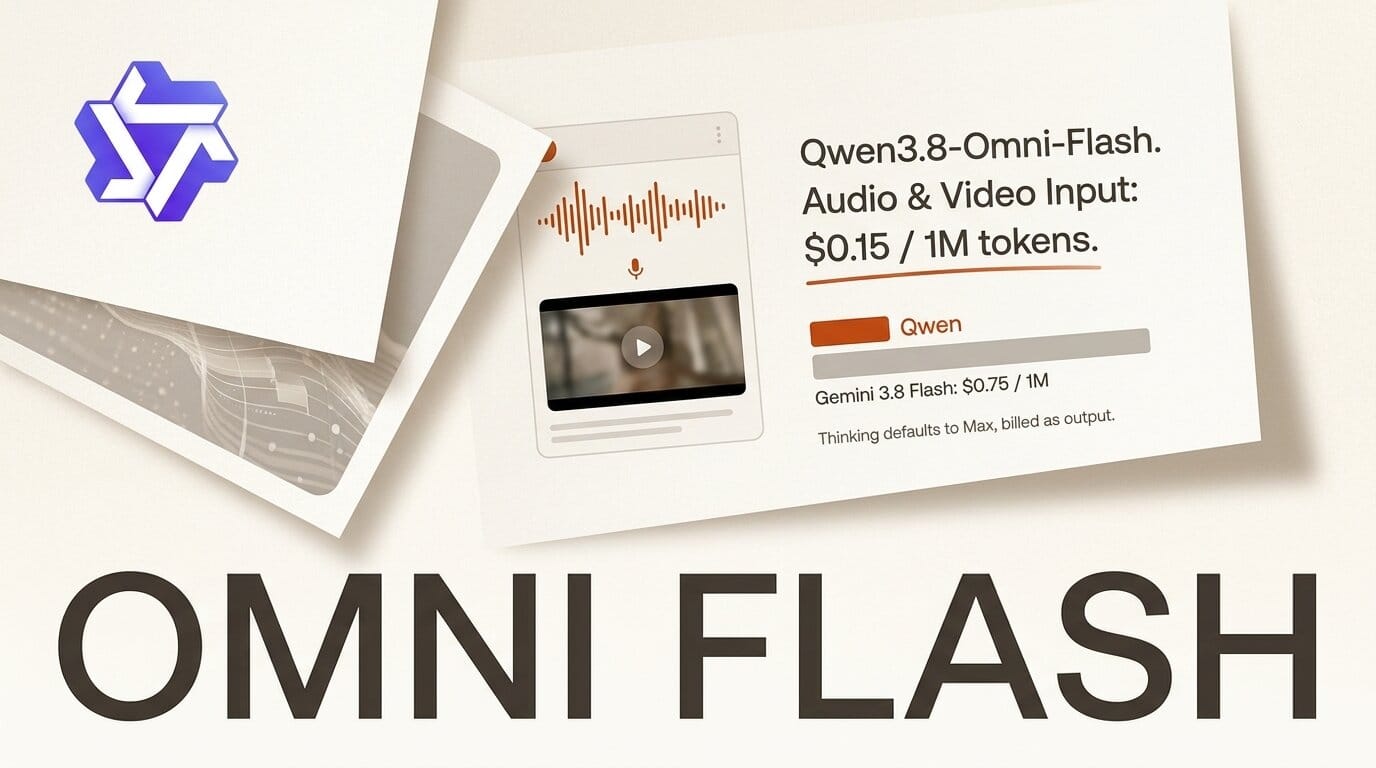
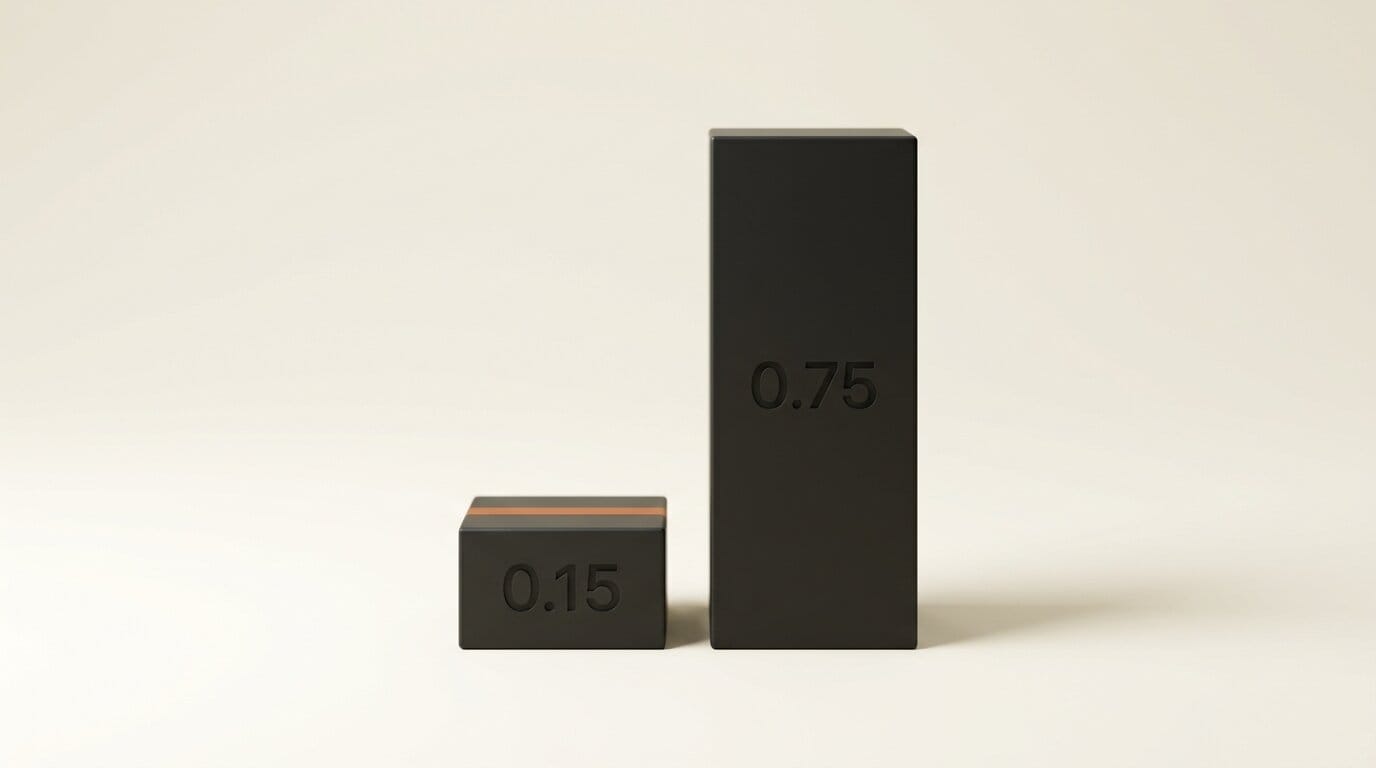
Alibaba released Qwen3.8-Omni-Flash on 18 September 2026, an API-only model that takes text, images, audio and video in, returns text out, and carries a 1M-token context window. List price is $0.15 per million input tokens and $0.47 per million output tokens, against $0.75 and $3.75 for Gemini 3.8 Flash. That is exactly 5x cheaper on input and 8x on output.
The headline everyone is running is the price cut: audio input "over 98% less per hour", video input "about 89%" less. Both of those are measured against Qwen's own previous model, Qwen3.5-Omni-Plus, not against the model you would actually be switching from. And the number that decides your bill is not on the pricing page at all. Thinking is on by default on this model, at the maximum setting, with a budget of 262,144 tokens, and Qwen's own documentation confirms that thinking tokens are billed as output tokens. On Qwen's single published video measurement, leaving that default alone costs more than ten times what reading the video costs.
What Alibaba actually shipped
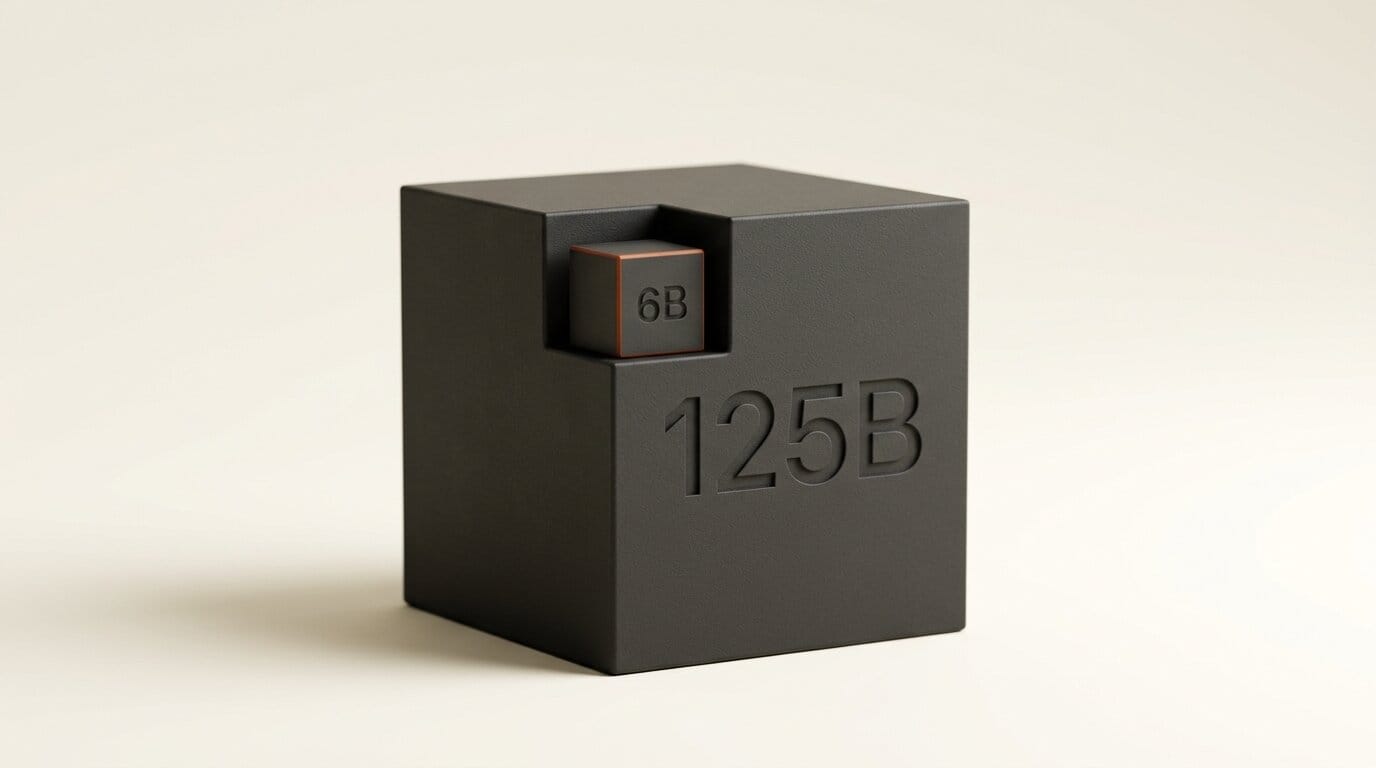
Qwen3.8-Omni-Flash is built on Qwen3.8-Flash-Next, the open-weights architecture preview Alibaba published in August. The model card gives the shape: 125B parameters with 6B activated per token, plus a 51B n-gram embedding table with 20,000,000 bigram and trigram entries, and 4B of multi-token prediction. The mixture-of-experts layer holds 512 experts, of which 10 routed plus 1 shared fire on each token. We covered that base release when it landed as the first public look at the Qwen4 architecture.
The Omni variant adds audio and video understanding on top and keeps the text quality. Documented limits are generous: video up to 2 hours and 2 GB when passed by URL, audio up to 3 hours across 113 languages, stable results with video sampled up to 15 fps, and two-channel stereo plus four-channel first-order ambisonic audio. Maximum input is 991K tokens, maximum output 131,072. It is served from six regions (Beijing, Singapore, Hong Kong, Tokyo, Frankfurt and Virginia) over DashScope and an OpenAI-compatible endpoint, as MarkTechPost documented at launch.
Crucially, there are no open weights. This is an API product. The only thing Alibaba open-sourced here is the tooling, which turns out to be the more interesting half.
The price gap against Gemini 3.8 Flash
Qwen claims its audio-video performance is "close to" Gemini 3.8 Flash and its overall audio performance sits above it. Those are Qwen's own unaudited numbers, so treat them as a vendor claim. The pricing, however, is checkable on both sides, and there is an asymmetry in it that the coverage has missed.
Google publishes a tokens-per-second rate for media, so you can convert its per-token price into a per-hour price. The Gemini token-counting documentation puts audio at 32 tokens per second and static video at roughly 100 tokens per second at default low resolution, or roughly 300 at high resolution, sampled at 1 fps.
| Media, one hour | Input tokens | Gemini 3.8 Flash at $0.75/M | Qwen3.8-Omni-Flash at $0.15/M |
|---|---|---|---|
| Audio | 115,200 | $0.086 | Rate not published |
| Video, low resolution | 360,000 | $0.270 | Rate not published |
| Video, high resolution | 1,080,000 | $0.810 | Rate not published |
Alibaba does not publish a tokens-per-second rate for Omni-Flash. That means the "98% cheaper per hour of audio" headline cannot be reconstructed from outside, and it cannot be compared to Gemini on the same basis. If Qwen tokenized video at Gemini's default low-resolution rate, an hour would land near $0.054, but that is our arithmetic on a borrowed assumption, not a published figure. Anyone budgeting a pipeline on the per-hour claim should meter a real file first.
One more thing about the Gemini column: those prices hold only through 31 December 2026. On 1 January 2027 Google's input and output both double, to $1.50 and $7.50. The gap against Qwen widens from 5x and 8x to 10x and 16x on the same day, without either vendor announcing anything.
Thinking is on by default, and it bills as output
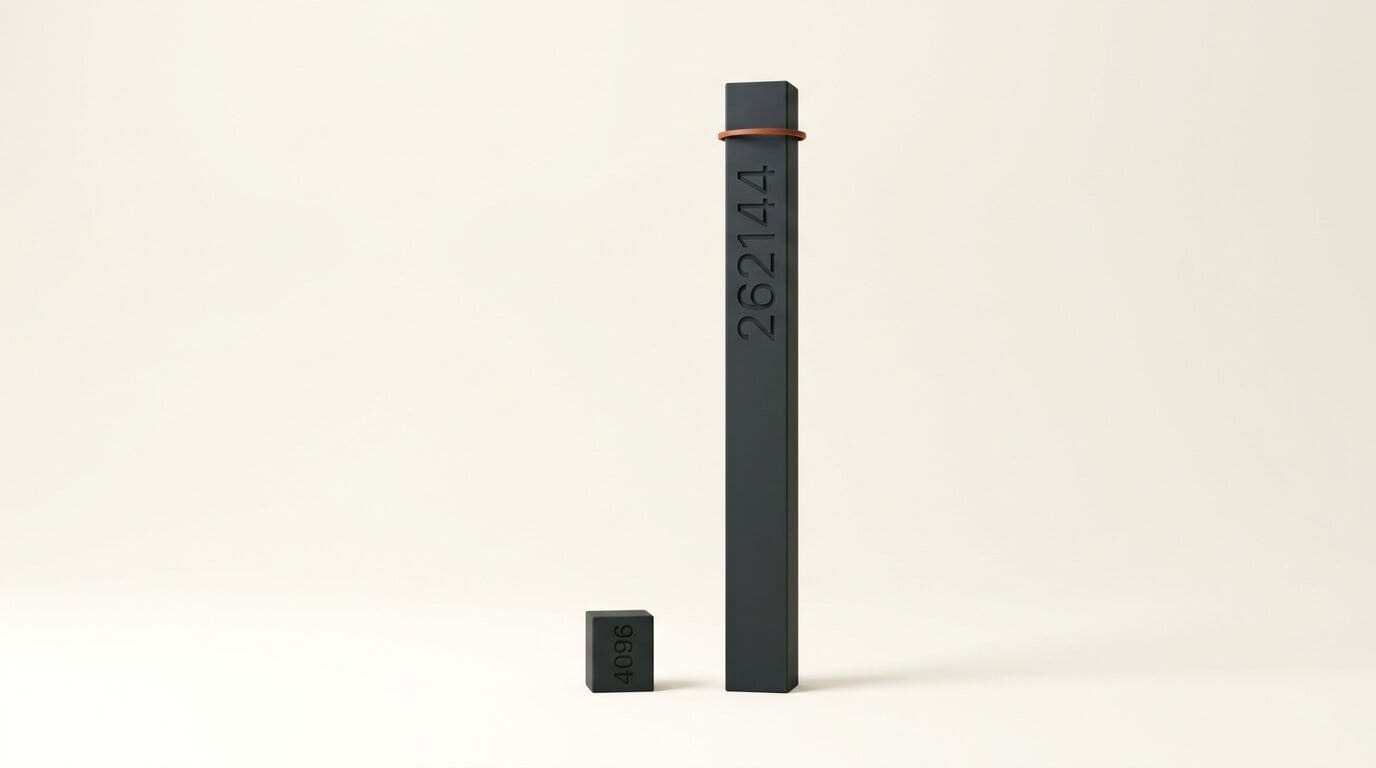
This is where the real money is. On the Qwen 3.8 line, the QwenCloud thinking guide states that reasoning_effort accepts low, medium and xhigh, and it defaults to xhigh. The xhigh budget is 262,144 tokens. The low budget is 4,096. That is a 64x spread in how much the model is permitted to think, sitting behind a parameter most people never set.
Because reasoning bills at the output rate of $0.47 per million, a request that spends its full xhigh budget costs $0.123 in thinking alone. The same request at low costs $0.0019. For scale, filling the entire 991K-token input window costs $0.149, so a maxed-out reasoning trace can cost 83% of what a maxed-out input costs, on a model being marketed on how cheap its input is.
Put that against Qwen's own video measurement. The OmniVideoBench run consumed 79,117 input tokens, which at $0.15 per million is $0.0119, a little over a cent. A full xhigh reasoning trace on that same request is $0.123. The thinking is 10.4x the cost of reading the video. The cheap part is the part being advertised.
The fix is one line in your request body, and it is the single highest-leverage change you can make on this model. Set reasoning_effort explicitly for every call. Transcription, captioning, diarization and event tagging do not need a 262,144-token deliberation budget. Note also that reasoning_effort and thinking_budget cannot be set together on this family; sending both returns an error.
What agentic perception really measures
Qwen's efficiency claim is built on what it calls agent perception mode, where the model locates the relevant segments of a long video rather than ingesting it uniformly. On OmniVideoBench, accuracy rises from 63.4 to 67.8 while token consumption falls from 145,736 to 79,117.
Two different reduction figures are circulating for this, and both are right. Working from the raw token counts above, the drop is 45.71%, and that is measured at higher accuracy. The 51.8% figure quoted elsewhere is the reduction at the same accuracy target. They are not interchangeable, and a budget built on the larger number while expecting the higher score will come in short.
There is a deeper caveat. Agentic video perception is not a Qwen invention, and the Gemini documentation describes its own agentic video mode where "token usage varies" because the model loads only the transcript, frames or audio segments it needs. So the fair comparison is agentic against agentic, and neither vendor publishes a clean number for that. The static-mode figures in the table above are the only like-for-like basis available, which means the honest summary is that Qwen is 5x cheaper per token and the per-hour gap is unknown.
The plugin layer is the part creators will use
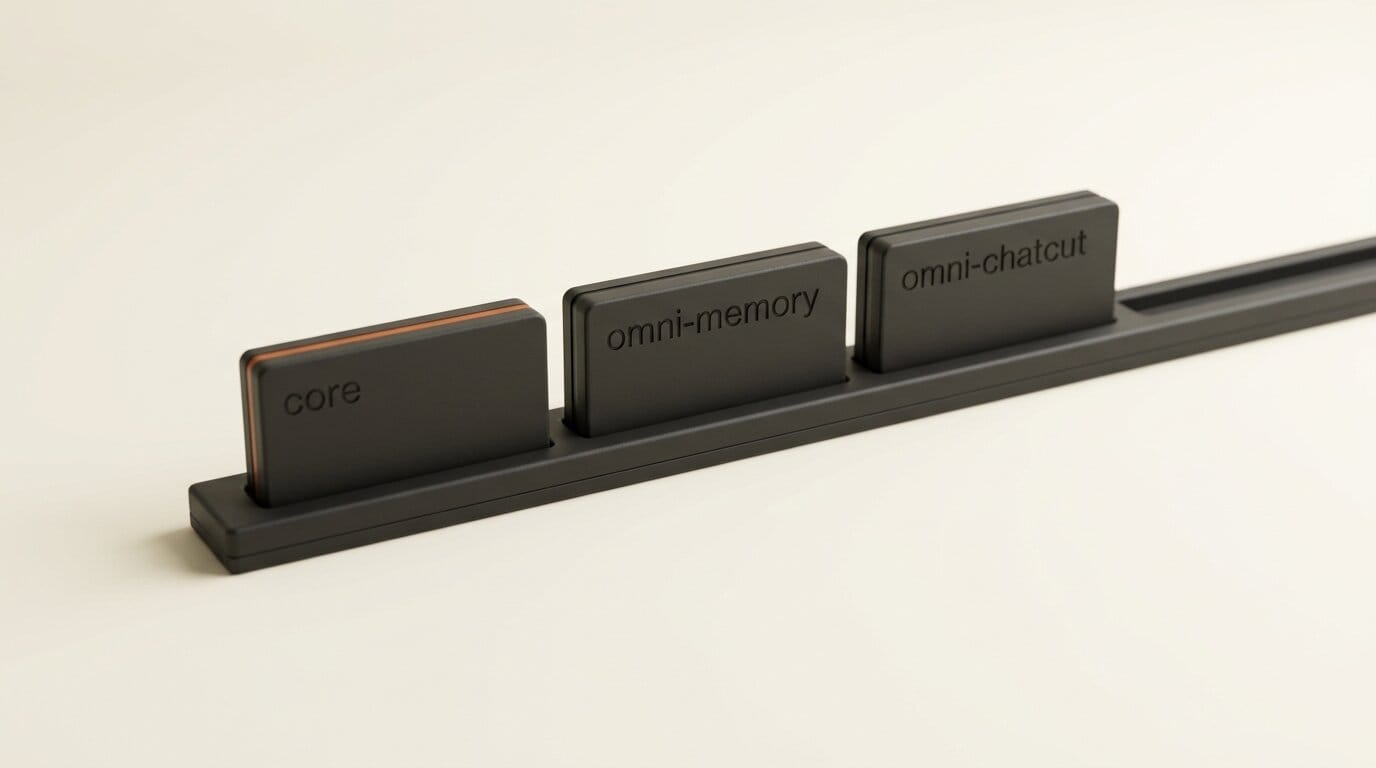
The model is closed. Qwen-MM-Plugins is Apache-2.0, has 2,887 stars, and is the reason this release matters to anyone editing video for a living. Its one-line description is the whole pitch: make any agent harness multimodal-native. The guided installer supports Claude Code, CodeBuddy, Codex, Qoder, OpenClaw, Qwen Code and Gemini CLI.
Each capability installs as a Skill plus an optional MCP server. The ones aimed at media work are specific enough to be judged:
corereads local images and video frames natively, and needs no API key in its default mode.omni-memorybuilds an audio-visual memory of a long video covering who is present, who said what, and how they said it, reading the video together with its audio track.omni-video2noteconverts a tutorial video into an illustrated PDF.omni-chatcutcovers music-to-MV, movie commentary, and speaker-preserving video translation.omni-skill-creatorturns a demonstration video into a reusable Agent Skill.blenderandfreecaddrive a running instance of each application for modelling, materials, lighting and rendering.
The repository history says something the announcement does not. The omni capabilities were tagged well before this launch, and a commit dated 17 September 2026, the day before the model went public, reads "feat: default the Omni model to qwen3.8-omni-flash". The harness shipped first and the model was swapped in underneath it as a default. For anyone already running these plugins against an older Omni model, this release is a config change, not a migration.
What it cannot do
Output is text only. This model understands audio and video, it does not generate them. It is not a Veo or a Sora competitor and it is not a text-to-speech engine; for that side of the stack our breakdown of the Qwen3 TTS serving stack is the relevant piece.
There are no open weights, so there is no local option and no fine-tuning. Everything runs against DashScope or Model Studio.
And the plugin documentation carries a limitation worth reading before you plan around it: "Most harnesses cannot yet feed audio to the main model natively. For now, audio is handled through the API instead." So the promise of an agent that natively hears is partly still routed through a separate call. Video and images are the paths that genuinely work natively today.
Try it this weekend
- Install the plugin layer into a harness you already run:
curl -fsSL https://raw.githubusercontent.com/QwenLM/Qwen-MM-Plugins/main/install.sh | bash, then use the installer's Configure and Verify actions to set a DashScope key and check forffmpeganduv. - Install
corefirst and test it with no cloud call: point your agent at a local image or a short clip and ask it to describe a specific frame. - Add
omni-video2noteand run one real tutorial video through it to an illustrated PDF. Use something you have already watched, so you can judge whether the notes are accurate rather than merely plausible. - Meter that run. Record input tokens, output tokens and reasoning tokens separately, because reasoning is inside the output number.
- Re-run the identical job with
reasoning_effortset tolowand compare both the bill and the quality. That one comparison tells you what the default is worth on your actual content, which is the only figure that matters.
Frequently asked questions
Is Qwen3.8-Omni-Flash open source?
No. The model is API-only with no published weights. The Qwen-MM-Plugins toolkit around it is Apache-2.0, and the underlying Qwen3.8-Flash-Next base architecture was released separately with open weights under the qwen-community-1.0 licence.
How much does it cost to process an hour of video?
Alibaba does not publish a tokens-per-second rate for media on this model, so an hourly figure cannot be derived from its price list. The only published datapoint is the OmniVideoBench run at 79,117 input tokens, about $0.012. Meter your own file before budgeting.
Is it really cheaper than Gemini 3.8 Flash?
Per token, yes and by a wide margin: $0.15 against $0.75 on input, $0.47 against $3.75 on output. Per hour of media it is unknown, because only Google publishes the tokens-per-second rates needed to convert. The per-token gap doubles on 1 January 2027 when Gemini's published prices double.
Why is my bill higher than the input price suggests?
Because thinking is on by default at xhigh, reasoning can consume up to 262,144 tokens, and those tokens bill at the $0.47 output rate rather than the $0.15 input rate. Set reasoning_effort explicitly on every call.
Can it generate audio or video?
No. It accepts text, images, audio and video as input and returns text only. It is an understanding model, not a generation model.
Does it work with Claude Code?
Yes, through Qwen-MM-Plugins, whose guided installer supports Claude Code, CodeBuddy, Codex, Qoder, OpenClaw, Qwen Code and Gemini CLI. Images and video read natively through the core plugin; audio is still routed through the API on most harnesses.
What is agent perception mode?
A mode where the model locates the relevant parts of a long video instead of ingesting it uniformly. It lifted OmniVideoBench accuracy from 63.4 to 67.8 using 45.7% fewer tokens. Gemini documents an equivalent agentic video mode, so this is a category feature rather than a Qwen exclusive.