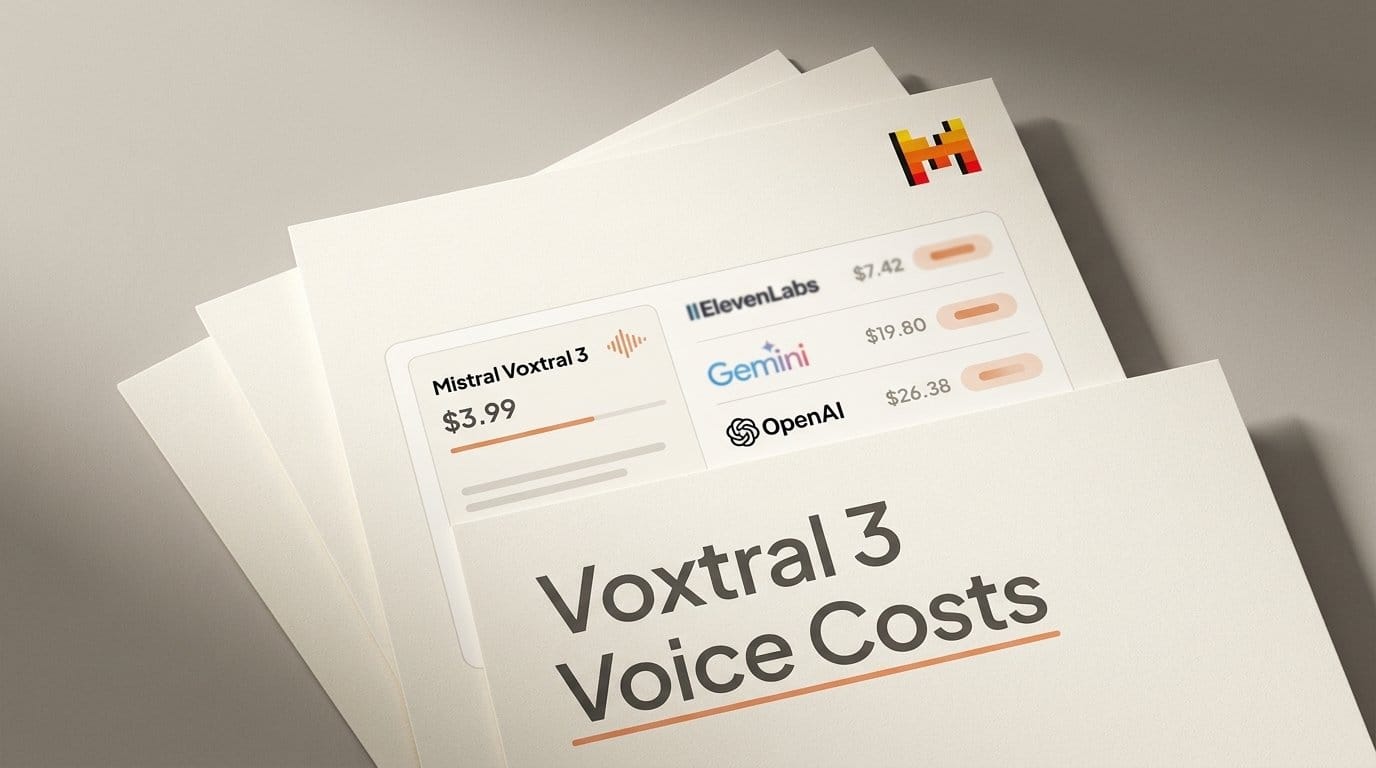
Mistral released Voxtral 3 on October 20, 2026: a new text-to-speech model at $13 per million characters, two transcription models at $0.0035 and $0.004 a minute, a real-time transcriber at $0.008 a minute, and a voice-agent kit. For a creator, that works out to about 12 cents for a 10-minute voiceover and about 21 cents for an hour of transcript with speaker labels, in 35+ voice languages and 50+ transcription languages.
The voice is cheaper than ElevenLabs, OpenAI's tts-1 and Gemini 3.8 Flash TTS at list price. It is not the cheapest voice on the market today, and its transcripts are not the cheapest either. Where it does stand out is telling speakers apart in a recording. Below we price both against the tools creators already use and show how to try it in a browser, with no code.
What Mistral shipped in Voxtral 3
Voxtral 3 is four models and one kit, all available through Mistral's API from European, US and global servers. Mistral says you can try speech generation, transcription, voice cloning and voice agents in its Studio playgrounds, which run in a web browser. Mistral's pricing page says the free plan includes Studio access.
- Voxtral Speech 3 (also called Voxtral Mini TTS 3 in the post): text to speech in 35+ languages and 50+ dialects, with preset voices in 18 language variants, from American and British English to Hindi, Korean and Vietnamese. $13 per million characters.
- Voxtral Small Transcribe 3: Mistral's most accurate transcriber, 50+ languages, with speaker labels ("diarization") and "context biasing", which means you give it names and terms to spell correctly. $0.004 a minute.
- Voxtral Mini Transcribe 3: a smaller 4B model with the same features for batch jobs. $0.0035 a minute.
- Voxtral Mini Transcribe Realtime 3: live captions with under 500 ms of delay in 35+ languages. $0.008 a minute.
- A voice-agent kit built on LiveKit that chains listening, a Mistral language model and speech into one live conversation. This is aimed at phone and support bots, not creators.
The speech model takes three explicit instructions, emotion, pacing and emphasis, and Mistral says it also reads the emotion from the text itself. The March model it replaces, Voxtral TTS, covered 9 languages at $16 per million characters, so the new voice is about 19% cheaper and covers roughly four times as many languages.
What a voiceover costs: Voxtral 3 vs ElevenLabs, Gemini and OpenAI
Text-to-speech is billed by the character. A narrator speaks about 150 words a minute, and English averages about 6 characters a word once you count spaces, so one minute of voiceover is roughly 900 characters and a 10-minute YouTube narration is about 9,000. Here is that 10-minute job at each vendor's list price.
| Voice model | Price per 1M characters | 10-minute voiceover | Note |
|---|---|---|---|
| Gemini 3.8 Flash-Lite TTS | $11 | $0.10 | Price doubles Jan 1, 2027 |
| Voxtral Speech 3 | $13 | $0.12 | New Oct 20, 35+ languages |
| OpenAI tts-1 | $15 | $0.14 | Retires Jan 6, 2027 |
| Voxtral TTS (March 2026) | $16 | $0.14 | Predecessor, 9 languages |
| Gemini 3.8 Flash TTS | $16.50 | $0.15 | Price doubles Jan 1, 2027 |
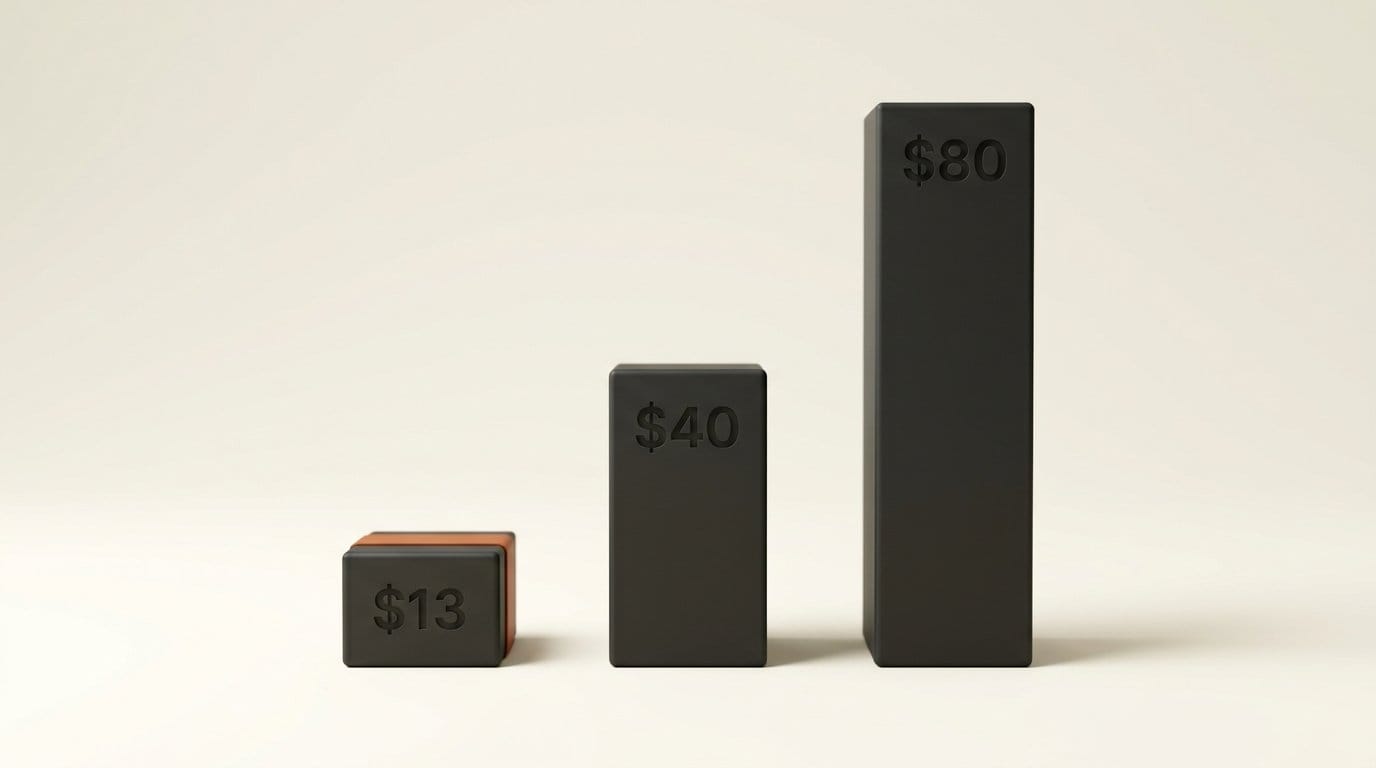
| ElevenLabs Flash / Turbo, Eleven v4 Turbo | $40 | $0.36 | ElevenLabs API list price |
| Cartesia Sonic 3.6 | $49 | $0.44 | 2nd in the arena (Sep 28) |
| Eleven v4 | $80 | $0.72 | 1st in the arena (Sep 28) |
ElevenLabs prices come from its API pricing page; the Gemini and Cartesia per-character figures are the list prices on the Artificial Analysis voice leaderboard that we used in our Eleven v4 price comparison. Two dates change this table. Google's speech prices double on January 1, 2027 (our breakdown), which puts Flash-Lite TTS near $22 and Flash TTS near $33 per million characters. OpenAI retires tts-1 on January 6, 2027. After both dates, Voxtral Speech 3 is the cheapest voice in this table.
The gaps look small per video and add up over a month. Eight 10-minute narrations is about 72,000 characters: about 94 cents on Voxtral, $2.88 on ElevenLabs Flash and $5.76 on Eleven v4. Most creators pay ElevenLabs through a monthly plan rather than the API, so treat this as the raw rate before plan bundles. Voxtral also has a subscription angle: Mistral's Pro plan ($14.99 a month) includes $15 a month in API credits. If those credits cover Voxtral, as API credits normally do, that is about 1.15 million characters, or roughly 21 hours of voiceover, every month.
Price is not quality. Eleven v4 led the Artificial Analysis blind-listening arena when we checked it on September 28 (Elo 1319), and Voxtral 3 has no arena score yet. Mistral's own charts put Voxtral ahead on quality per dollar, but those are internal tests scored by Google's gemini-3.8-flash model, not by human listeners.
Transcripts and speaker labels: where Voxtral 3 wins
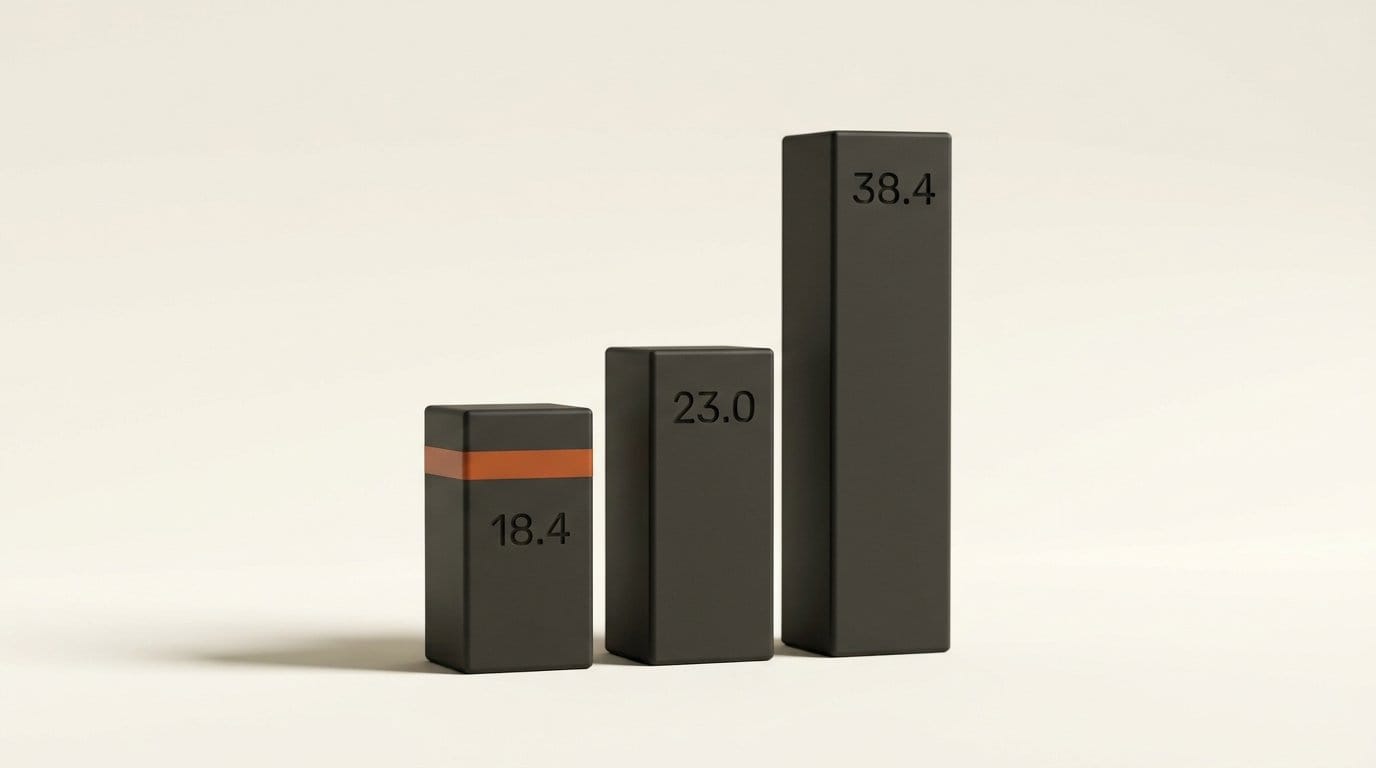
Transcription is billed by the minute of audio. For a podcaster or interviewer, the question is less "how many words did it get right" than "did it know who was talking". Mistral published a speaker-labelling test (cpWER, where a lower number means fewer words given to the wrong person or mistranscribed), and that is where Voxtral 3 stands out.
| Transcriber | Per hour of audio | Speaker-labelled error (Mistral test) |
|---|---|---|
| MAI-Transcribe-2 (Microsoft) | $0.10 | 20.3% |
| Grok Voice Transcribe 2.0 (xAI) | $0.10 | Not tested |
| Voxtral Mini Transcribe 3 | $0.21 | 18.6% |
| Scribe v2 (ElevenLabs) | $0.22 | 23.0% |
| Voxtral Small Transcribe 3 | $0.24 | 18.4% |
| GPT Transcribe (OpenAI) | $0.27 | Not tested |
| Gemini 3.5 Transcribe (Google) | $0.30 | 38.4% |
| Voxtral Mini Transcribe 2 (previous) | n/a | 30.9% |
Competitor hourly prices are the ones we collected from the Artificial Analysis speech-to-text index for our Grok Voice Transcribe 2 comparison. On plain word accuracy, Mistral's chart puts Voxtral Small level with Microsoft's model, at about 4.1% error across 45 languages, and far ahead of the free Whisper large-v3 (16.0%), which many caption apps still run.
The reading for creators: for a solo voice track or simple captions, Microsoft's or xAI's model at $0.10 an hour is half the price and about as accurate. For a two- or three-person podcast, a panel or an interview, where a wrong speaker label means an hour of fixing in your editor, the Voxtral models were the best in Mistral's test and cost about the same as ElevenLabs Scribe v2. A weekly one-hour show is about $1 a month either way. That is Mistral's own test, run on its own choice of audio, so check it on one of your episodes before switching.
Voice cloning changed, and not the way you might expect
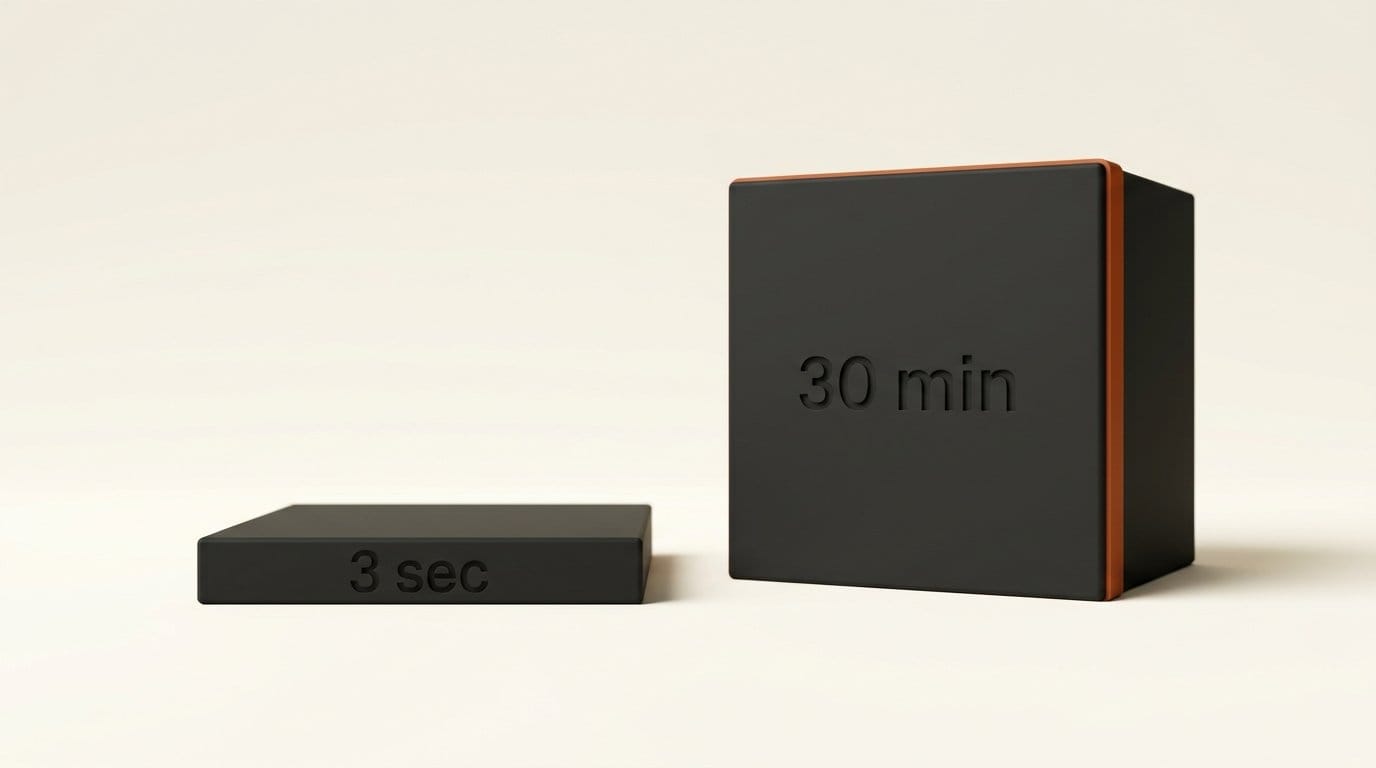
The March model, Voxtral TTS, could copy a voice from as little as 3 seconds of audio, and its weights were free to download under a non-commercial licence (our March analysis). Voxtral 3 goes the other way on both points.
- More audio, closer copy. The launch post describes "voice cloning from 30+ minutes of sampled audio" and a Pro Voice option that reproduces "a speaker's distinctive character, emotional range, and speaking style across languages, using just 30 minutes of audio." In practice, plan on recording half an hour of clean narration of yourself. Mistral does not say whether Pro Voice costs extra or needs a sales call.
- No download, for now. Mistral's Hugging Face page has no Voxtral 3 weights as of October 20; the newest uploads are October 14. Running it on your own machines means talking to Mistral's sales team. If you want a voice clone that runs free on your own PC, see our open-source voice cloning guide.
The upside of the longer sample is the cross-language part. A 30-minute recording of you in English could, by Mistral's description, produce a voiceover in your own voice in Spanish, Hindi or Korean, which is a cheap route to dubbing a channel. Mistral's documentation also requires the speaker's explicit consent before cloning a voice, so this is for your own voice or a client who has signed off, not a celebrity impression.
How to try Voxtral 3 without writing code
Mistral had not published playground guides for Voxtral 3 when we wrote this, so button names may differ from what you see. The route is:
- Sign in to Mistral Studio at console.mistral.ai with a free account. The free plan includes Studio access; the Pro plan adds the $15 monthly credit.
- Open the text-to-speech playground, paste one section of your script (a paragraph or two at a time is easier to retake) and pick a preset voice in your language.
- Direct the read. Ask for an emotion, a pace and the words to stress, for example "warm and unhurried, stress the price." Those are the three controls Mistral built the model around.
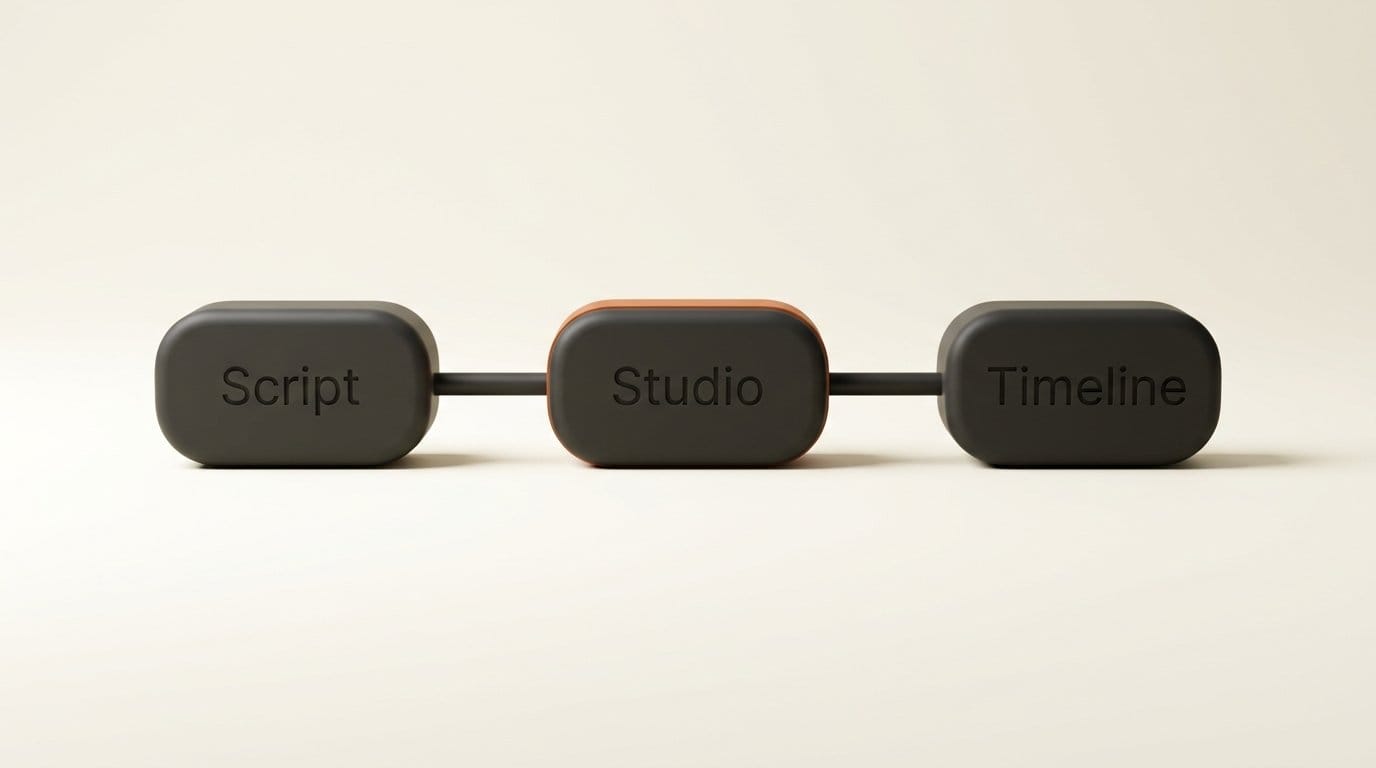
- Bring the audio into your editor. Drop the takes onto your CapCut, Premiere Pro or DaVinci Resolve timeline as you would any recorded voiceover.
- For transcripts, open the speech-to-text playground, upload an episode and add guest names and product terms as context, so they are spelled right. Check the speaker labels on the first five minutes before trusting the rest.
- Run a blind test. Put the same 60-second paragraph through Voxtral, your current ElevenLabs voice and Gemini TTS in Google AI Studio, then pick by ear, not by the price table.
Which voice tool to pick
- You narrate many videos and cost matters most: try Voxtral Speech 3. It is a sixth of the price of Eleven v4, and after January it is the cheapest of the big names in our table.
- You want the best-sounding voice and sell the result: stay on Eleven v4 until Voxtral 3 has a human-listener score. Mistral's quality claims are machine-judged.
- You publish in many languages: Voxtral's 35+ speech languages and cross-language Pro Voice make it worth testing for dubbing.
- You record multi-person podcasts or interviews: Voxtral Small Transcribe 3 is the one to test first for speaker labels. For solo captions, MAI-Transcribe-2 at $0.10 an hour is cheaper.
- You want a quick clone from a short clip, or a model that runs offline: Voxtral 3 is not that tool. The March Voxtral TTS weights or an open-source cloner still are.
Frequently asked questions
Is Voxtral 3 free?
No. It is pay per use: $13 per million characters for speech and $0.0035 to $0.008 a minute for transcription. Mistral's free plan includes access to the Studio playgrounds, and the $14.99 Pro plan includes $15 a month in API credits, which at list price would cover about 21 hours of voiceover.
How much does a 10-minute voiceover cost with Voxtral 3?
About 12 cents, assuming roughly 9,000 characters of script. The same job costs about 36 cents on ElevenLabs Flash or Eleven v4 Turbo and about 72 cents on Eleven v4 at API list prices.
Can Voxtral 3 clone my voice?
Yes, but it needs much more audio than the March model. Mistral describes cloning from 30+ minutes of sampled audio, and a Pro Voice option trained on about 30 minutes that keeps your style across languages. You need the speaker's consent, which for your own voice is you.
Can I download Voxtral 3 and run it on my own computer?
Not today. Unlike the March Voxtral TTS, there are no public Voxtral 3 weights on Hugging Face. Mistral offers self-hosting to businesses through its sales team.
Is Voxtral 3 better than ElevenLabs?
Cheaper, yes: $13 against $40 to $80 per million characters. Better sounding is unproven. Eleven v4 leads the human-voted Artificial Analysis arena, and Voxtral 3's quality claims come from Mistral's internal tests scored by an AI judge. For transcripts with several speakers, Mistral's test puts Voxtral ahead of ElevenLabs Scribe v2 (18.4% against 23.0% speaker-labelled error).
What languages does Voxtral 3 support?
Speech generation covers 35+ languages and 50+ dialects, with preset voices in 18 variants including American and British English, French, German, Spanish, Hindi, Korean, Mandarin and Vietnamese. Transcription covers 50+ languages, including all 24 official EU languages.