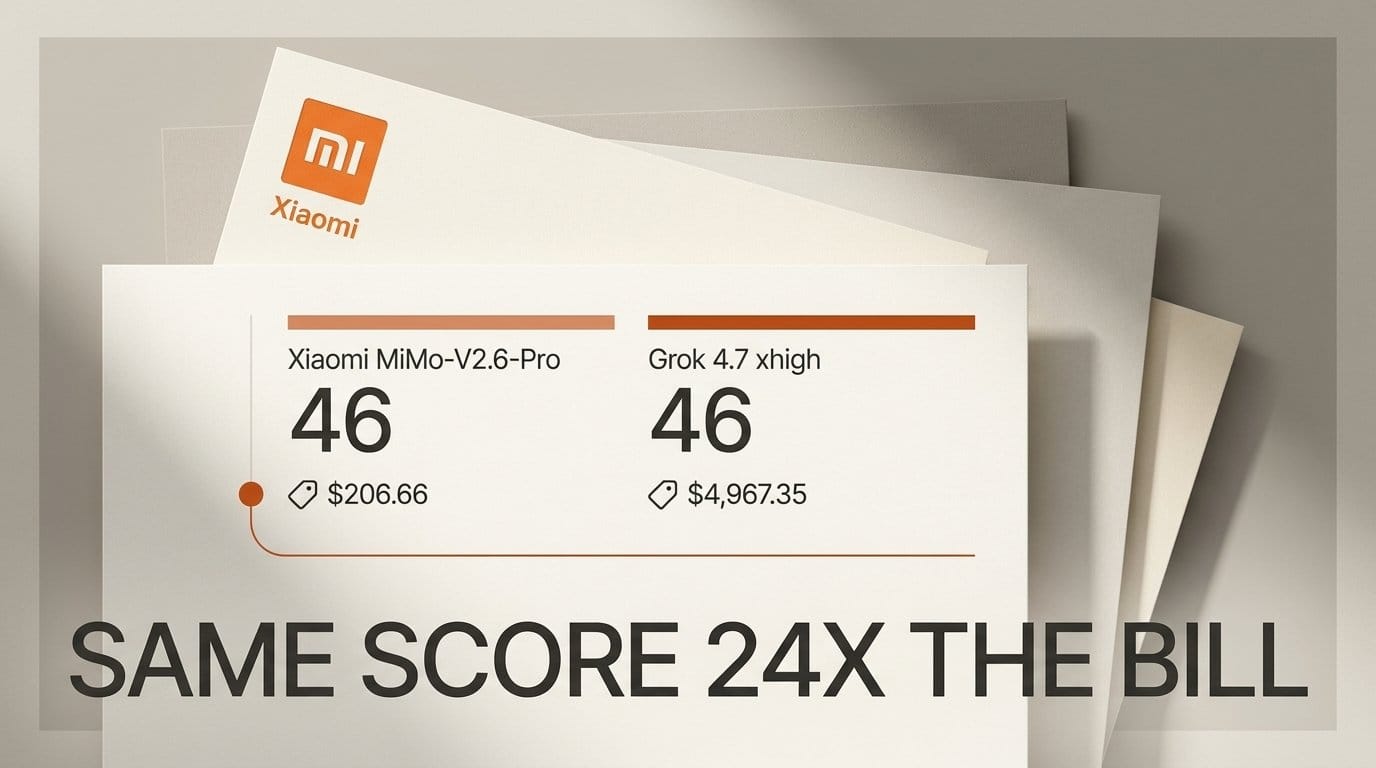
Xiaomi open-sourced MiMo-V2.6-Pro on 21 September 2026 under an MIT licence, and it entered the Artificial Analysis Intelligence Index at 46, the highest score any open-weights model has posted. The same day, SpaceXAI shipped Grok 4.7. It also scored 46.
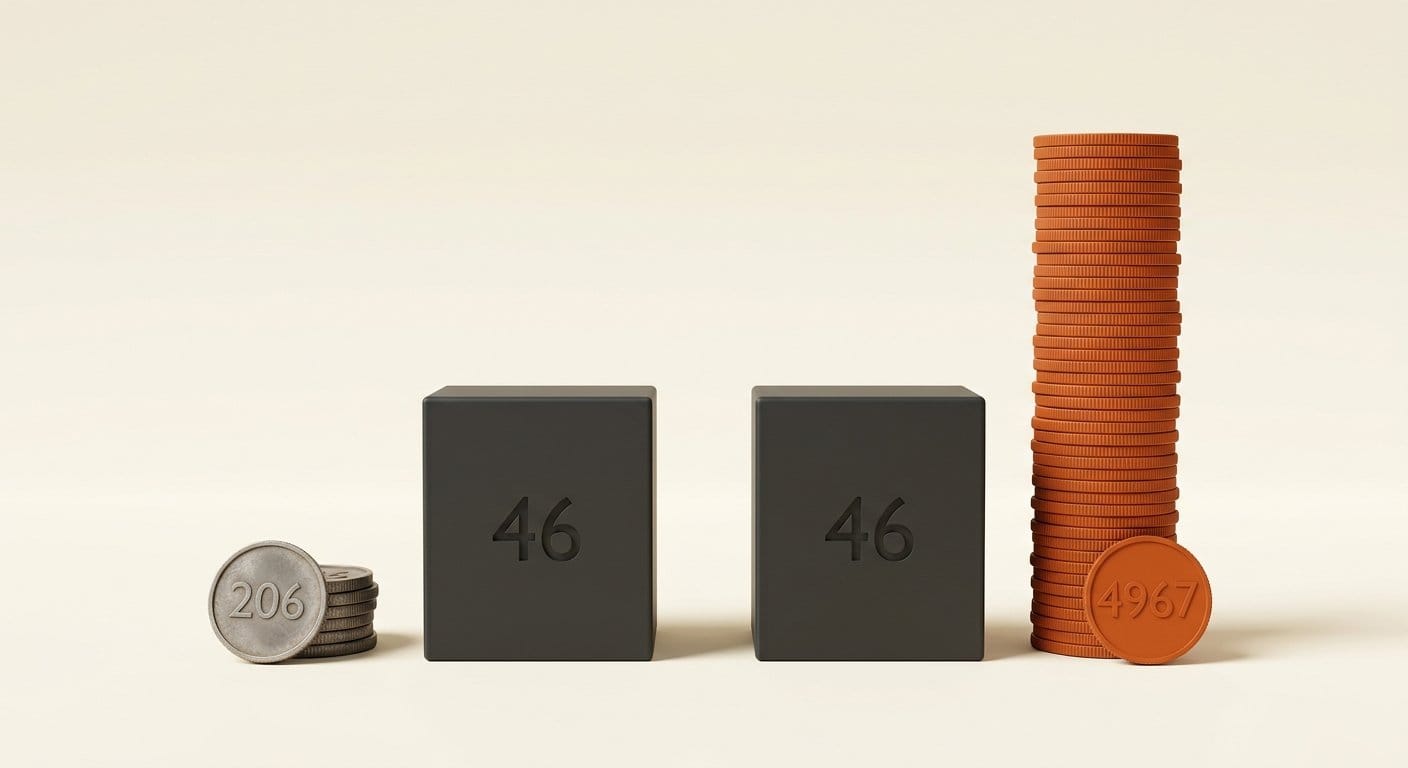
Two frontier models, one index, one number, one day. That coincidence is the most useful controlled comparison the year has handed builders, because it takes capability out of the argument and leaves only what the capability costs. Artificial Analysis publishes that figure too, on each model's own page: running the index cost $206.66 on MiMo-V2.6-Pro and $4,967.35 on Grok 4.7 at its xhigh reasoning setting. Identical evaluation suite, identical score, a bill 24 times larger.
What Xiaomi shipped on 21 September
The MiMo-V2.6 series is two natively multimodal models. MiMo-V2.6-Pro is a sparse mixture-of-experts model with 1.02T total parameters and 42B activated per token, a 1M-token context window, and text, image, video and audio input. MiMo-V2.6-Flash is the smaller sibling at 310B total and 15B activated. Both carry the MIT licence, which permits commercial use without a separate grant.
Xiaomi also published the machinery, which is the part with no real precedent. Alongside the weights it released the technical report, an end-to-end reinforcement-learning framework, composable mini-harnesses, and more than 7,000 RL task environments covering software engineering, vulnerability reproduction, knowledge work, and web design and development. TestingCatalog reported the environments ship under the same MIT terms as the weights. Labs routinely open-source checkpoints. They do not open-source the training environments that produced them, because those environments are the durable asset and the checkpoint is the perishable one.
The stated training cost is $2.62M for Pro and $850,000 for Flash, roughly $3.47M combined, across 30 RL steps and about 750,000 trajectories in under six days. Xiaomi's Fuli Luo framed the choice this way, as quoted by VentureBeat: "In an era when compute is brutally scarce, we still chose to dedicate a team of several dozen people to one goal over an extended period: scaling up RL."
The same score, and the bill that came with it
Artificial Analysis scores every model on the same ten evaluations, weighted across agents (30%), coding (20%), general reasoning (30%) and scientific reasoning (20%), and it reports what each evaluation run cost using token counts reported by the provider's own API. Because the index is a fixed suite, the cost line is directly comparable between models in a way that list prices are not.
| Model | Index score | List price in / out per 1M | Output tokens for the index | Cost of the full index run | Cost per index task |
|---|---|---|---|---|---|
| MiMo-V2.6-Pro | 46 | $0.43 / $0.87 | 140M | $206.66 | $0.13 |
| Grok 4.7 (high) | 46 | $2.00 / $6.00 | 200M | $3,880.88 | $2.73 |
| Grok 4.7 (xhigh) | 46 | $2.00 / $6.00 | 240M | $4,967.35 | $3.74 |
Read the last two columns against the third. On sticker price, Grok 4.7 is 4.7 times more expensive on input and 6.9 times more expensive on output. On finished work at an identical score, it is 18.8 times more expensive at its high setting and 24 times more expensive at xhigh. The gap on the work is roughly three to four times wider than the gap on the tokens, and only one of those two numbers appears in a pricing page.
Why the sticker price hides most of the gap
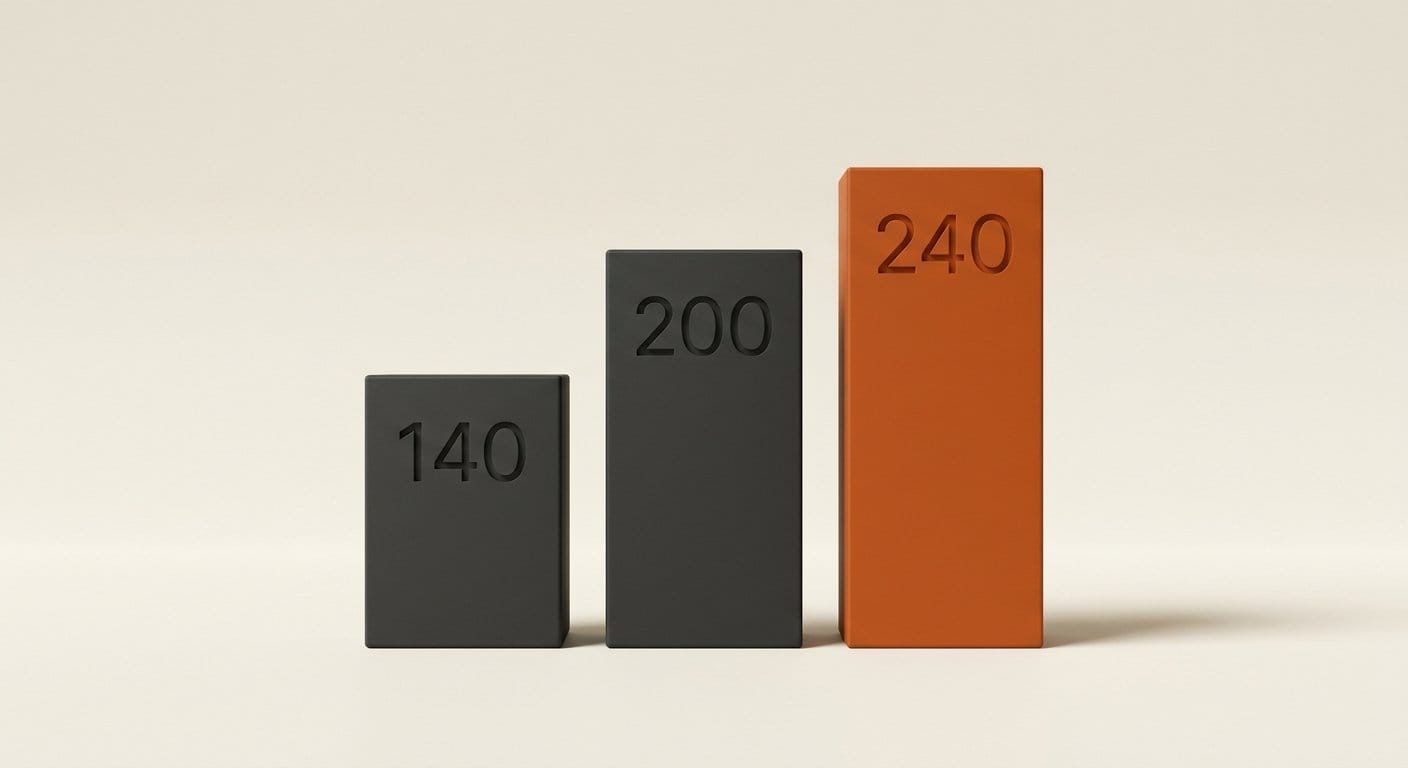
Part of the answer is verbosity, and it is the part people quote. Grok 4.7 generated 240M output tokens getting through the index at xhigh against MiMo's 140M, and the high setting still needed 200M. Artificial Analysis called Grok 4.7 "very verbose" at both settings. VentureBeat put the same measurement per task: roughly 81,000 output tokens per index task at xhigh, against 36,000 for Grok 4.6 and 27,000 for GPT-6 Astra Max.
But verbosity alone does not reach 24 times. Multiply the 6.9x output-price gap by the 1.7x token gap and you land near 12x, half the observed figure. The rest sits in the columns nobody photographs: input and cached tokens, which dominate long agentic runs where the same context is resent on every turn, and which Artificial Analysis includes using live cache-hit measurements rather than a one-off sample. Grok 4.7 charges $2.00 per million input tokens against MiMo's $0.43, and on a task that resends context forty times, the input column is the invoice.
This is the same shape of error we found in Qwen3.8-LiveTranslate's pricing, where a model that was twice the price per unit came out 30% cheaper per hour of actual work. The unit a vendor prices in is almost never the unit you consume.
The benchmark numbers in the two launch posts are not comparable
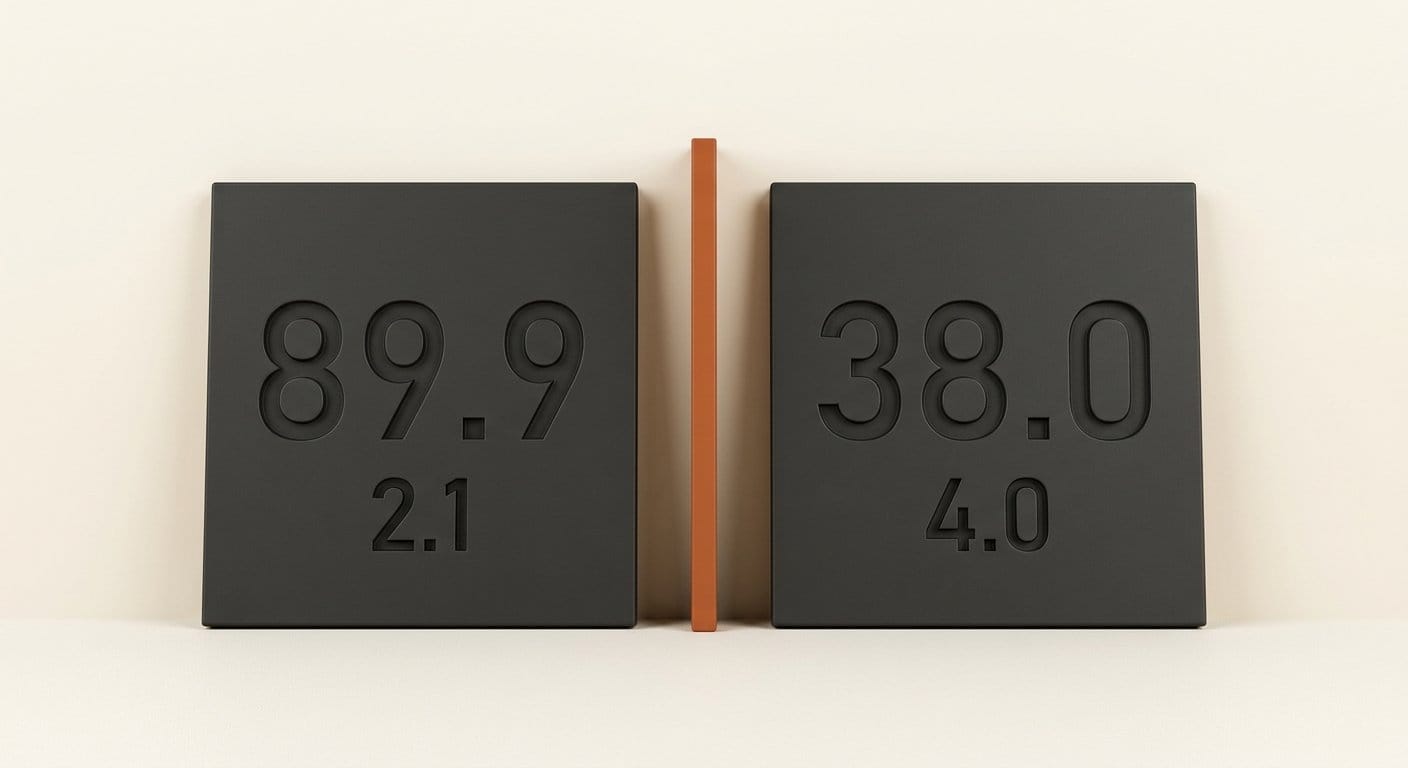
Both launch posts lead with Terminal-Bench. Xiaomi's model card reports 89.9 on Terminal Bench 2.1. SpaceXAI reports Grok 4.7 moving from 20.3% to 38.0% on Terminal-Bench 4.0. Set side by side, those numbers say Xiaomi's model is more than twice as good at terminal work, and that reading is worthless: they are different versions of the benchmark, run on different harnesses, and 4.0 is substantially harder than 2.1. Artificial Analysis uses Terminal-Bench 4.0 for both models inside the index, which is exactly why the index score is the comparable number and the launch-post table is not.
The other figures on Xiaomi's card are worth having on their own terms rather than as head-to-head evidence: 71.9 on DeepSWE v1.1, 76.9 on Toolathlon-Verified, 72.3 on MiMo VisualCoding, and 94.0 on CyberGym, where Flash actually beats Pro at 95.1. Flash trails Pro by 2.3 points on Terminal Bench 2.1 (87.6 against 89.9) while costing a third as much.
What is actually open, and what you can actually run
MIT weights are a real grant, and a welcome contrast to the research-only licence Alibaba attached to Qwen-Image-2.1 a week earlier. They are also not the same thing as a model you can run.
At four bits per parameter, 1.02T parameters is roughly 510GB of weights before you load a single token of context. Flash at 310B is around 155GB on the same arithmetic. Neither number fits a workstation, and MoE sparsity does not help here: 42B activated parameters describes what computes per token, not what has to be resident in memory. In practice the open licence on Pro buys you the right to have someone else host it, to audit it, to fine-tune it on rented hardware, and to not be cut off when a vendor deprecates an endpoint. It does not buy you local inference.
The model in the release that does run locally is MiMo-V2.6-Distill-Qwen-9B, a 9B fine-tune of Qwen3.5-9B trained on MiMo trajectories, also MIT. It scores 61.1 on SWE-bench Verified, 44.6 on SWE-bench Pro, and 37.1 on Terminal Bench 2.1. That last figure is 41% of Pro's, which is the honest summary of what distillation at this ratio preserves: a genuinely useful local coding assistant, not a local frontier model. Xiaomi describes it as "a starting point for open research in agentic reinforcement learning," and that framing is accurate.
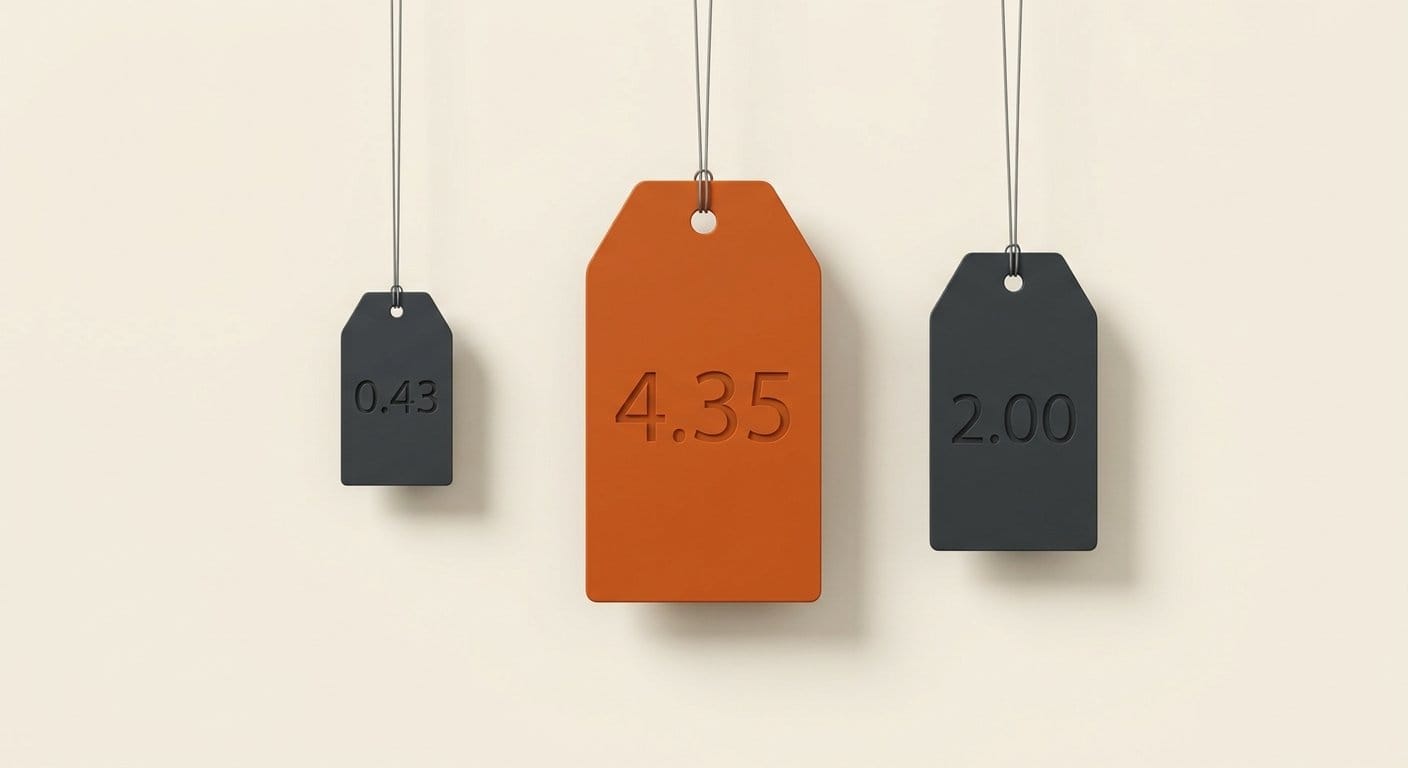
One more trap worth pricing before you commit. Xiaomi sells a faster serving tier, MiMo-V2.6-Pro-UltraSpeed, at $4.35 per million input and $8.70 per million output. That is ten times the standard Pro rate and more per token than Grok 4.7 charges at $2.00 and $6.00. The weights being open sets no ceiling on what an endpoint costs. The serving tier does, and we saw the same pattern when UltraSpeed launched on MiMo v2.5.
Which one to use this week
If you are running high-volume agentic work where the model loops over a repository, a document set or a toolchain, MiMo-V2.6-Pro at the standard tier is the obvious default to test against, and the case is arithmetic rather than ideology: it reaches the same index score for between a nineteenth and a twenty-fourth of the finished cost. Route a real workload through both for a day and compare invoices, not token counts.
Grok 4.7 keeps a narrower and still-real case. It leads on specific evaluations where Fable 5.1 Max and GPT-5.6 Sol Max trade places with it, it has first-party tooling in GitHub Copilot, and $2.00 per million input on a low-volume workload is a rounding error where migration effort is not. If your spend is under a few hundred dollars a month, the 24x multiplier is 24 times a number too small to justify the work.
Start with Flash rather than Pro if the task is bounded. At $0.14 and $0.28 per million it is a third of Pro's price, and on Xiaomi's own agent benchmarks it lands within a few points, occasionally ahead. And if you want something on your own disk today, take the 9B distill and judge it as a 9B model.
Frequently asked questions
Is MiMo-V2.6-Pro really the best open-weights model available?
On the Artificial Analysis Intelligence Index, yes, at the time of release. It scored 46, ahead of Grok 4.6 at 44, Gemini 3.8 Flash at 41, DeepSeek V4.1 Flash at 39 and DeepSeek V4.1 Pro at 36. Xiaomi is explicit that this is not comprehensive superiority: proprietary models including Claude Opus 5 and GPT-5.6 Sol beat it on several individual evaluations.
Can I run MiMo-V2.6-Pro on my own machine?
No. At 1.02T parameters it is roughly 510GB at four-bit quantisation, and the 42B activated-parameter figure refers to compute per token, not memory footprint. Flash at 310B is around 155GB and also out of reach for a workstation. Use the 9B distill locally, or rent Pro from a hosted provider.
What does the MIT licence actually permit?
Commercial use, modification, redistribution and private deployment, with no separate grant and no revenue threshold. It applies to the Pro and Flash weights, the distill, the RL framework and the 7,000-plus task environments. This is broader than the research licences several competing open-weights releases have carried this year.
Why is the cost-per-task gap so much larger than the price-per-token gap?
Because a finished task consumes more than output tokens. Grok 4.7 generates 1.4 to 1.7 times more output tokens than MiMo for the same suite, and it also charges 4.7 times more for input and cached tokens, which dominate long agentic runs where context is resent every turn. Artificial Analysis totals all of those using provider-reported counts, which is why its figure diverges from a napkin calculation on list prices.
Are the 7,000 RL environments useful if I am not training a model?
Partly. They are structured, verifiable task specifications across software engineering, vulnerability reproduction, knowledge work and web development, which makes them usable as an evaluation harness for agents you did not train. If you are choosing between coding agents, a public set of 7,000 gradeable tasks is a better basis than a vendor's own table.
Should I switch production workloads to MiMo-V2.6-Pro immediately?
Run the comparison first. The index score is a general capability measure across ten evaluations and it is not your workload. Route a representative day of real traffic through both endpoints, measure the invoice and the failure rate, and decide on that. The 24x figure tells you the comparison is worth an afternoon, not that the answer is settled.
How does Grok 4.7 compare to Grok 4.6 on cost?
Pricing is unchanged at $2.00 and $6.00 per million, with cached input at $0.50, but cost per finished task rose because token consumption rose. Grok 4.7 at xhigh uses about 81,000 output tokens per index task against 36,000 for Grok 4.6. Holding the price constant while the model talks more is a price increase measured in work rather than in tokens.