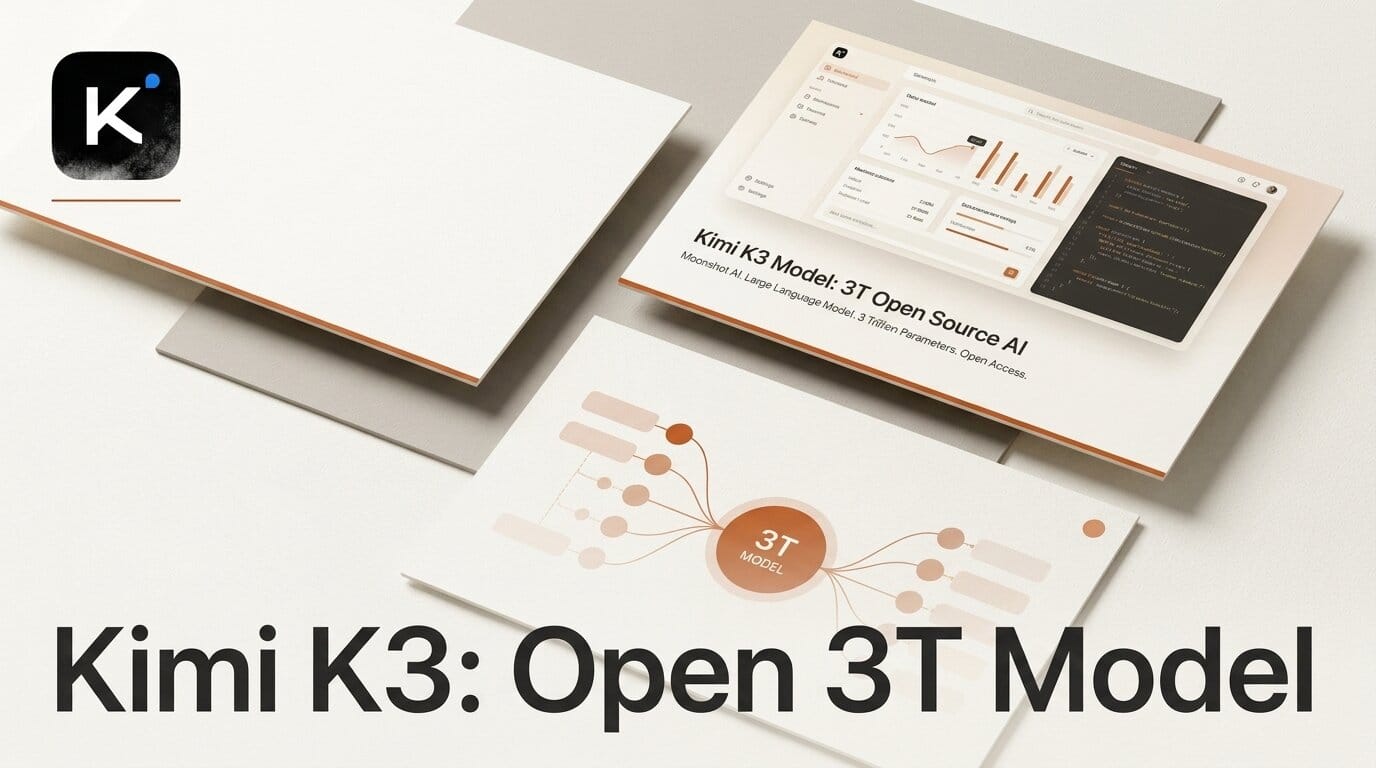
Moonshot AI has officially launched Kimi K3, and it is calling it the world's first open 3T-class model. Announced on July 16, 2026 on the official Kimi blog, K3 is a 2.8-trillion-parameter Mixture-of-Experts model with a 1-million-token context window, already selectable inside the Kimi app and live on the API. Update (July 26, 2026): the full open weights shipped a day ahead of target and are now downloadable on Hugging Face (roughly 1.4TB), making K3 the largest open-weight language model ever released.
This matters because K3 is not just another frontier model behind a paywall. It is a near-frontier system that Moonshot intends to give away, and its API is priced far below the closed leaders it is chasing. For builders, that combination of open weights, a huge context window, and aggressive pricing is the story, not the leaderboard position on any single benchmark.
Below is what the official launch confirms, how K3 actually stacks up against Claude Fable 5 and GPT-5.6 Sol, and what you can build with it today.
What Happened
The rollout leaked before it launched. A limited "K3 launch" top-up promotion briefly surfaced on Moonshot's Kimi Open Platform on July 14 and was pulled within hours, followed by a teaser on July 15. By July 16, K3 Max and K3 Cluster Max were live in the app model picker for signed-in accounts, and Moonshot published the full model page with confirmed specifications.
K3 is built on a new architecture Moonshot calls Kimi Delta Attention (KDA) with Attention Residuals, running a Stable LatentMoE framework that activates 16 of 896 experts per token. It defaults to maximum thinking effort. Early hands-on testers on Arena flagged strong 3D visualization and long-form output, with slower runtimes on the most complex tasks. Moonshot says K3 completed a GPU compiler project (MiniTriton) that matched Triton performance, and finished research work that would normally take one to two weeks in about two hours.

Kimi K3 vs the Frontier: Benchmark Comparison
Moonshot is candid that K3 still trails the two strongest proprietary models, Claude Fable 5 and GPT-5.6 Sol, on most evaluations. But the gaps are small, and on some coding and agent tests K3 either leads or draws even. TechCrunch reports the release is explicitly aimed at closing the gap with Anthropic's flagship coding models.
| Benchmark | Kimi K3 | Claude Fable 5 | GPT-5.6 Sol |
|---|---|---|---|
| DeepSWE (agentic coding) | 67.5 | 70.0 | 73.0 |
| Program Bench | 77.8 | 76.8 | 77.6 |
| Terminal Bench 2.1 | 88.3 | 84.6 | 88.8 |
| GPQA-Diamond | 93.5 | 92.6 | 94.1 |
| MMMU-Pro (multimodal) | 81.6 | 81.2 | 83.0 |
The pattern is clear: K3 beats Claude Fable 5 on Program Bench, Terminal Bench, GPQA-Diamond, and MMMU-Pro, and sits within a few points of GPT-5.6 Sol on everything except pure agentic coding (DeepSWE), where the closed models keep a real lead. On the multimodal side, Moonshot claims a 97.8 on MathVision with Python support. For an open model you can now download and run yourself, drawing even with the closed frontier on four of five headline benchmarks is the actual headline. You can pressure-test these claims yourself: an anonymous checkpoint widely believed to be K3 has been circulating on LMArena for blind comparisons.

What Creators Can Build With K3
The 1-million-token context window is the capability most creators will feel first. It lets an agent hold an entire codebase, a feature-length video script, or a stack of research PDFs in a single prompt without chunking or retrieval hacks. Combined with native vision, K3 is positioned for long-horizon work that spans code, images, and video in one session.
Moonshot highlights game development, video editing, and 3D generation as first-class use cases, not afterthoughts. That puts K3 in the same builder territory as other open MoE coding systems we have covered, such as Tencent HY3 and LongCat-2, but at a far larger scale. If you build automation pipelines, K3 can act as the long-context reasoning core that plans multi-step jobs and writes the glue code to execute them.
The Open-Weights Price Reset
K3's API pricing is the lever that will move the market: $0.30 per million tokens for cache-hit input, $3.00 for cache-miss input, and $15.00 per million output tokens. That undercuts the closed frontier by a wide margin for comparable capability, and it continues the trend our Kimi K2.7 Code coverage documented, where open-weights models matched frontier tools on tool-use benchmarks at a fraction of the price.
The open weights arriving by July 27 matter even more than the API. Once the checkpoint is public, you can run K3 on your own infrastructure, fine-tune it, and avoid per-token fees entirely for high-volume workloads. Running a 3T-class model is not trivial, but the open ecosystem has been steadily solving exactly this, as our guide to running 744B-parameter GLM on consumer hardware showed. Every cheap flagship like this one keeps downward pressure on the price of the coding and agent tools you already pay for.
How to Put Kimi K3 Into Your Workflow
You can evaluate K3 today without committing to a migration:
1. Build a small eval set. Pull five to ten real prompts from your production coding or agent work, including at least one long-context task that currently strains your model.
2. Test K3 Max in the app. Sign in at kimi.com, open the model picker, and run your eval set against K3 Max side by side with your current model. Note quality, latency, and where the 1M context changes the shape of the prompt.
3. Wire up the API for the winners. For prompts where K3 holds up, point a test branch at the Kimi API and compare cost per task against your incumbent. Watch Kimi's developer site for SDK and integration details.
4. Plan for self-hosting. If your volume is high, the open weights are out now (roughly 1.4TB on Hugging Face), so stand up an inference setup and benchmark them against the API on your own hardware.
Frequently Asked Questions
Is Kimi K3 actually open source?
Moonshot calls it the world's first open 3T-class model and says full weights release by July 27, 2026. The exact license was not published at launch, though K2 shipped under a Modified MIT license. Until the license is posted, treat K3 as open-weights with terms to be confirmed.
How big is Kimi K3?
K3 is a Mixture-of-Experts model with 2.8 trillion total parameters and 896 experts, of which 16 are activated per token. It has a 1-million-token context window and native vision.
How does K3 compare to Claude Fable 5 and GPT-5.6 Sol?
K3 leads Claude Fable 5 on Program Bench, Terminal Bench 2.1, GPQA-Diamond, and MMMU-Pro, and trails GPT-5.6 Sol narrowly on most tests. The one clear gap is DeepSWE agentic coding, where both closed models keep a lead.
What does the Kimi K3 API cost?
Pricing is $0.30 per million tokens for cache-hit input, $3.00 for cache-miss input, and $15.00 per million output tokens, which is well below the closed frontier for comparable capability.
What can I build with K3 that I could not before?
The 1M-token context plus native vision suits long-horizon work: whole-codebase agents, long-form video and script analysis, game development, and 3D generation in a single session without chunking.
When can I download the weights?
Moonshot says the full model weights will be released by July 27, 2026. Watch the Kimi developer site for the checkpoint and license.