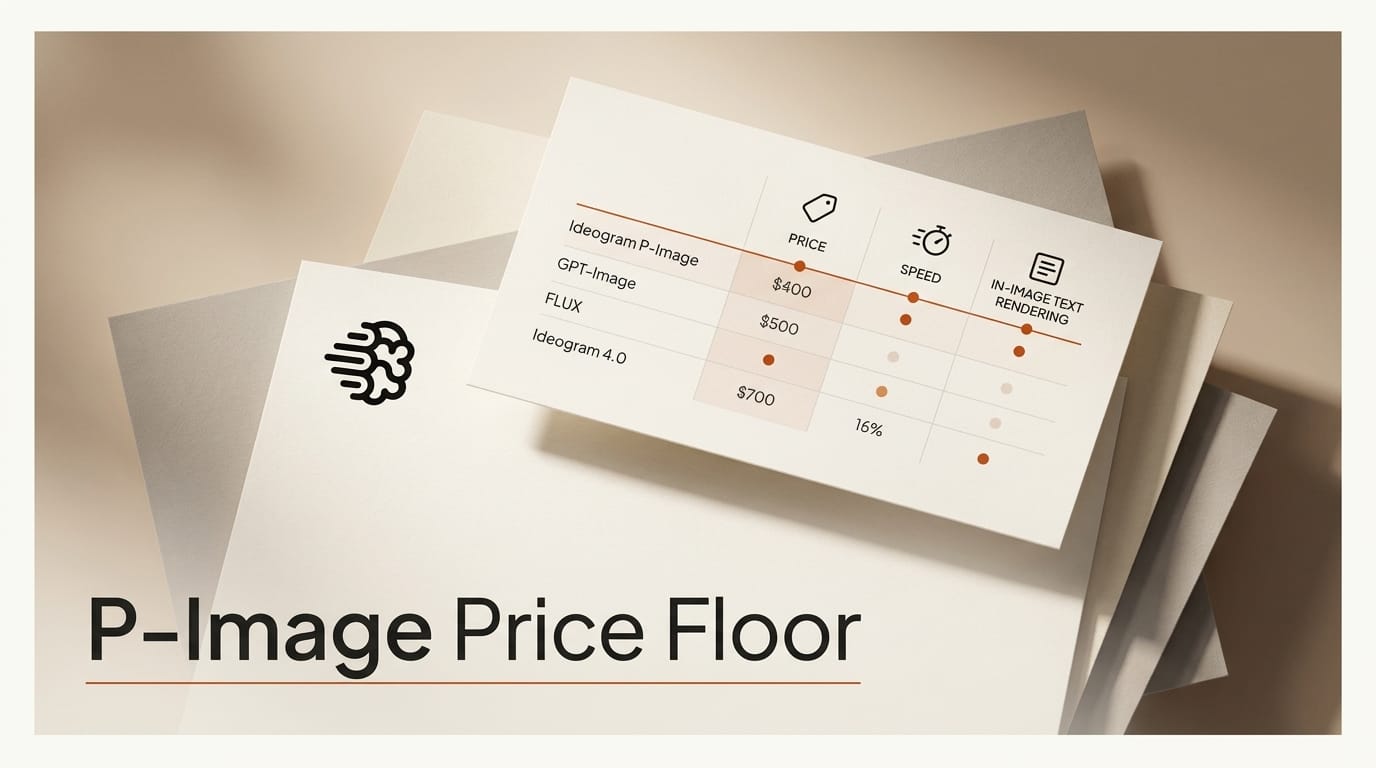
The one-sentence verdict: Ideogram P-Image resets the text-to-image price floor by pairing Ideogram's signature legible in-image text with a starting price of $0.003 per image, undercutting GPT-Image by roughly 10x to 50x while matching the cheapest open-weights option on cost. This comparison lines up P-Image against OpenAI's gpt-image-1, Black Forest Labs FLUX.1, Ideogram's own flagship 4.0, and Alibaba's Qwen-Image on the three metrics that decide how freely a creator can iterate: published per-image price, generation speed, and how the model handles text inside the frame. Every number below is drawn from the vendor's own pricing page or API documentation.
Background
Ideogram built P-Image with Pruna AI, a company that specializes in model optimization. Ideogram supplied the image model and its strength in rendering readable words inside an image; Pruna cut generation time and cost. The result is what Ideogram calls a Pareto-optimal family, meaning it is tuned to sit on the best available curve of quality against speed and cost. According to the P-Image page, a 1K image "typically returns in about 2.9 to 5.0 seconds for roughly $0.003 to $0.015 per image, depending on Quality." The model exposes four quality modes, Very Low, Low, Medium, and High, with Medium as the everyday default, and it is already live on the Ideogram API and on partner platforms including Replicate, ComfyUI, Runware, Leonardo AI, and Picsart.
That combination is unusual. Most image models make you trade one axis for another: cheap models tend to be weak at text, and models strong at text tend to be expensive. P-Image is interesting precisely because it claims to break that trade-off, which is why a head-to-head against the incumbents is worth running.
How the Models Compare
The table below uses published hosted-API prices at roughly 1K resolution. Prices for open-weights models reflect a common hosted rate, since those models are also free to self-host. Text-rendering notes reflect each model's documented design focus, not an independent benchmark.
| Model | Price per image (1K) | Quality tiers | In-image text focus | Open weights |
|---|---|---|---|---|
| Ideogram P-Image | $0.003 to $0.015 | 4 (Very Low to High) | Yes, core strength | No, hosted API |
| FLUX.1 [schnell] | $0.003 | 1 | Not a focus | Yes, Apache 2.0 |
| FLUX.1 [dev] | $0.030 | 1 | Improved, not primary | Yes, non-commercial |
| Ideogram 4.0 | $0.03 to $0.10 | 3 (Turbo, Default, Quality) | Yes, core strength | No, hosted API |
| OpenAI gpt-image-1 | $0.011 to $0.167 | 3 (low, medium, high) | Strong | No, hosted API |
| Qwen-Image | $0.035 | 1 | Good, multilingual | Flash variant open |
Price: The New Floor
On price, P-Image lands at the very bottom of the market. Its Very Low mode costs $0.003 per image, the same as FLUX.1 [schnell] on Replicate, which has been the reference point for cheap generation. The difference is the ceiling: even P-Image's top-quality output tops out around $0.015, while OpenAI's gpt-image-1 charges $0.011 for low quality, $0.042 for medium, and $0.167 for high quality at 1024 by 1024, per the OpenAI image generation guide. That makes a high-quality GPT image more than ten times the price of a high-quality P-Image render. Ideogram's own flagship 4.0 line runs $0.03 for Turbo, $0.06 for Default, and $0.10 for Quality according to the Ideogram API pricing page, so P-Image also undercuts Ideogram's premium tier by a wide margin.
In-Image Text: Ideogram's Edge
Text rendering is the axis where cheap models usually fall apart, and it is the reason P-Image is not just another budget generator. Ideogram's models are built around legible words inside the frame, the capability the company is known for, and P-Image inherits that focus. FLUX.1 [schnell] matches P-Image on price but is not designed for reliable in-image text, so for posters, ads, thumbnails, and product mockups that need a headline or a label, the two models are not interchangeable despite the identical $0.003 floor. gpt-image-1 is genuinely strong at text but charges a heavy premium for it. If your work depends on words rendering correctly, our comparison of the best AI image generators for text covers how the leaders stack up in more detail.
Speed and Batch Throughput
Speed compounds with price when you generate in volume. P-Image returns a 1K image in about 2.9 to 5.0 seconds, which is fast enough to run large A/B sweeps interactively. GPT-class image models frequently take tens of seconds per render, so the wall-clock gap on a batch of a few hundred images is measured in minutes versus hours. FLUX.1 [schnell] is also built for speed at one to four steps, which is what lets it hit the same low price. The practical takeaway is that P-Image and schnell are the two models you can afford to run hundreds of times for a single project, but only P-Image is tuned for text-heavy output at that volume.

Open Weights Versus Hosted API
One structural difference cuts across the price comparison: P-Image, Ideogram 4.0, and gpt-image-1 are hosted APIs you rent, while FLUX.1 [schnell] ships under an Apache 2.0 license and the Qwen line has an open Qwen-Image-Flash variant you can self-host. Alibaba's hosted qwen-image runs $0.035 per image on Model Studio, but the open Flash weights are free to run on your own hardware. For a creator, the choice is between paying per call for P-Image's text quality and running an open model at fixed infrastructure cost. P-Image wins when you value output quality and zero setup; open weights win when you have GPUs idling and can trade quality for control.
Impact on Creators
The clearest use for P-Image is as a draft-and-explore model in a two-tier pipeline. Point your batch node at P-Image on Medium quality, generate dozens of variations for a campaign, a storyboard, or a product mockup, then reserve a premium model only for the final hero renders. At $0.003 to $0.015 per image, generating two hundred options costs between $0.60 and $3.00 instead of the $20-plus that gpt-image-1 high quality would run, which changes how many ideas a creator can afford to test. In ComfyUI you can wire a P-Image node directly and batch variations, and the Runware prompting guide documents how the four quality modes and JSON prompts behave so you can script consistent output across a batch.
Pick P-Image if you generate text-heavy images in bulk and want the lowest cost per usable draft. Pick gpt-image-1 if you need the strongest all-around instruction following and are producing a small number of final assets where the per-image price does not matter. Pick FLUX.1 [schnell] or an open Qwen variant if you want to self-host and your work does not depend on rendered text. The same batch-then-upscale logic applies to production work like the thumbnails covered in our guide to making YouTube thumbnails with AI, where you want many cheap drafts and one polished final.
Key Takeaways
P-Image matches the cheapest hosted price on the market, $0.003 per image, while carrying Ideogram's text-rendering strength that other budget models lack. Its price ceiling of about $0.015 stays below the entry price of most premium models, so even its best output is cheap by comparison. Against gpt-image-1, the gap on high-quality output is more than tenfold. Against FLUX.1 [schnell], the price is identical but the text quality is not. Against Ideogram's own 4.0 line, P-Image trades some top-end fidelity for a fraction of the cost. The model is best deployed as the exploration tier in a two-model workflow, not as a wholesale replacement for a premium generator on final renders.
What to Watch
Ideogram has published per-image prices for the Very Low and Low modes but not for Medium and High, so the exact cost of the top tiers is still bounded only by the $0.015 figure quoted on the P-Image page. Watch whether Ideogram breaks those out, and whether the Pruna optimization approach shows up in a similarly discounted video or 3D model next. The broader signal is that model optimization companies like Pruna are now the ones setting the price floor, not the labs that trained the base models. If that pattern holds, expect every major image lab to ship a Pruna-style budget tier within the year, and expect the premium-only pricing that gpt-image-1 still commands to come under real pressure. The open-weights side is the wild card: if an open model closes the text-rendering gap, the case for any hosted budget tier narrows to convenience alone.
Frequently Asked Questions
How much does Ideogram P-Image cost per image?
Ideogram's P-Image page quotes roughly $0.003 to $0.015 per 1K image depending on the quality mode. The Very Low mode is $0.003 and the Low mode is $0.0075 on Ideogram's published chart; Medium and High cost more but are not broken out numerically beyond the $0.015 ceiling.
Is P-Image cheaper than GPT-Image?
Yes, by a wide margin at comparable quality. OpenAI's gpt-image-1 charges $0.011 for low, $0.042 for medium, and $0.167 for high quality at 1024 by 1024. P-Image's top tier stays around $0.015, so a high-quality GPT image costs more than ten times a high-quality P-Image render.
Does P-Image render text as well as Ideogram 4.0?
P-Image inherits Ideogram's text-rendering focus, which is the trait the company is known for, but 4.0 remains the flagship for top-end fidelity. P-Image is positioned as the fast, cheap tier, so for most drafts and high-volume work it is close enough, while 4.0 Quality is the choice for final hero assets.
How is P-Image so cheap and fast?
Ideogram supplied the image model and Pruna AI supplied the optimization that cut generation time and cost. The result sits on a Pareto-optimal curve of quality against speed and price, which is how it reaches the $0.003 floor while still rendering legible text.
Where can I use P-Image?
P-Image is live on the Ideogram API and on partner platforms including Replicate, ComfyUI, Runware, Leonardo AI, and Picsart. You can wire it into a ComfyUI batch node or call the Replicate endpoint directly for scripted, high-volume generation.