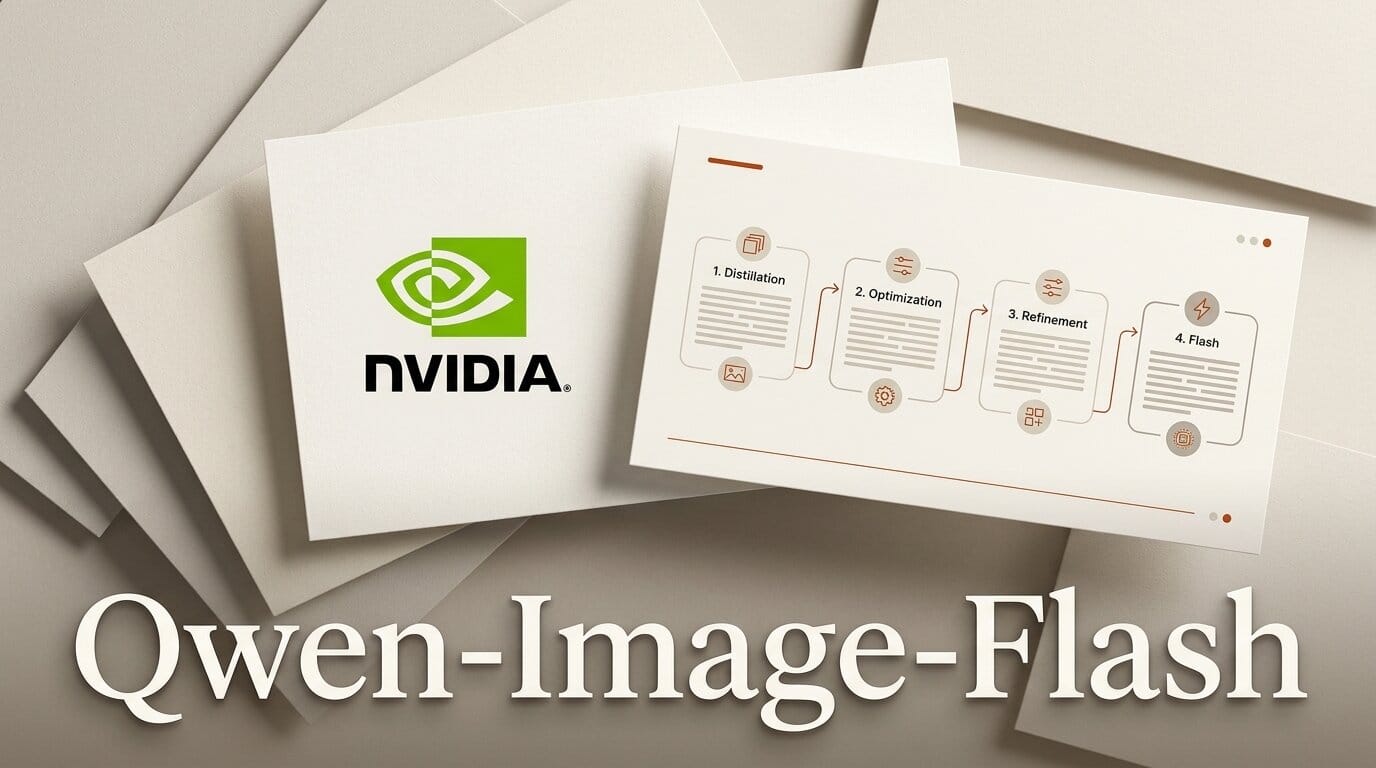
NVIDIA has published Qwen-Image-Flash, a four-step, distilled version of Alibaba's 20-billion-parameter Qwen-Image model, on Hugging Face on July 23, 2026. The full Qwen-Image normally runs 50 denoising steps to make a picture. Flash collapses that to four, and it holds on to almost all of the quality: it scores 47.080 on Qwen-Image-Bench against the original's 49.070, roughly 96 percent of the fidelity at a fraction of the compute. For anyone generating images locally or at scale, that trade is the whole story.
What NVIDIA Actually Shipped
Qwen-Image-Flash is not a new model architecture. It is a compressed copy of the open-weight Qwen-Image foundation model that Alibaba's Qwen team released under Apache 2.0. NVIDIA took that model and applied Distribution Matching Distillation, a technique that trains a fast "student" network to reproduce the output of a slow "teacher" in a handful of steps instead of dozens.
The result carries 20.43 billion parameters in the denoising transformer and 28.85 billion across the full pipeline. It is a Multimodal Diffusion Transformer (MMDiT) that generates 1024x1024 images from text prompts of up to 1,024 tokens. NVIDIA ships it under its Open Model Agreement layered on top of Qwen's Apache 2.0 terms, so it stays usable in commercial workflows. The base Qwen-Image is known for two things most diffusion models struggle with: accurate text rendering inside images and precise instruction-guided editing. Flash inherits the text-rendering strength directly.
Flash vs. the Rest of the Qwen-Image Family
Qwen-Image now exists in several forms, and picking the right one depends on whether you want fidelity, speed, or a hosted flagship. Here is how they line up.
| Model | Steps | Weights | Profile | Best for |
|---|---|---|---|---|
| Qwen-Image (full) | 50 (40 for edits) | Open, Apache 2.0 | Highest fidelity, slowest | Final renders, text-heavy art |
| Qwen-Image-Flash | 4 | Open, NVIDIA + Apache 2.0 | Near-instant, 96% of quality | Fast iteration, batch generation |
| Qwen-Image-Lightning | 4 to 8 | Open, community (LightX2V) | Claims up to 42.55x speedup | Community pipelines, ComfyUI |
| Qwen-Image-3.0 | Not disclosed | Closed, no weights | Flagship quality, hosted only | API users, no local option |
The comparison worth noting is Flash against Qwen-Image-Lightning, the LightX2V distillation that shipped as a day-zero accelerator for Qwen-Image. Lightning advertises a headline 42.55x overall speedup through an aggressive reduction in the number of function evaluations. NVIDIA's Flash is more conservative in its claims but comes with first-party tuning, published benchmark numbers, and validated support paths across NVIDIA's inference stack. If you already build on ComfyUI, Lightning is the well-trodden route. If you deploy on NVIDIA hardware and want a supported checkpoint, Flash is the safer pick.
How the Four-Step Distillation Works
The engine here is DMD2, the second-generation Distribution Matching Distillation method. Instead of teaching the student to copy the teacher's intermediate steps one by one, DMD2 trains it to match the teacher's final output distribution. NVIDIA ran multi-step DMD2 with a classifier-free guidance value of 4.0 during distillation, using its FastGen, Model Optimizer, and AutoModel tooling to do the compression.
That matters for how you call the model at inference time. Distilled diffusion models like this one bake the guidance behavior into the weights, so you run them with four steps and low or disabled classifier-free guidance, the configuration they were tuned for. Turning the step count back up or re-adding heavy guidance does not improve results; it fights the distillation. You can inspect the exact recommended pipeline on the NVIDIA build catalog, which hosts the Qwen-Image family as ready-to-run endpoints.
How Much Quality Do You Give Up
The single number that answers this is 47.080 versus 49.070 on Qwen-Image-Bench. That is a drop of about two points, or roughly four percent, in exchange for cutting denoising steps by more than 12 times. In practice, a four percent benchmark gap is the difference between a render you keep and a render you keep anyway. NVIDIA validated the model on Hopper H100 and Blackwell B200 GPUs, and the model card documents testing on a B200. The checkpoint is also listed on the NGC catalog for containerized deployment.
How to Run Qwen-Image-Flash
The fastest path is the Diffusers library. NVIDIA tested the release against diffusers 0.38.0 and transformers 5.12.1. A minimal run looks like this:
- Install the tested stack:
pip install diffusers==0.38.0 transformers==5.12.1 accelerate. - Load the pipeline from
nvidia/Qwen-Image-Flashand move it to your GPU. - Set
num_inference_steps=4and keep guidance low or off, since the distillation already encodes it. - Generate at 1024x1024, the resolution the model was distilled for.
Beyond raw Diffusers, the model supports SGLang Diffusion, vLLM-Omni, and TensorRT-LLM for higher-throughput serving, and the Diffusers documentation covers offloading options if you are tight on VRAM. For ComfyUI users, the community Lightning workflows are the more mature starting point today, with Flash checkpoints expected to slot into the same node graphs.

What This Enables for Creators
Speed changes how you work, not just how long you wait. At 50 steps, Qwen-Image is a "commit and come back" tool: you write a prompt, submit it, and check the result later. At four steps, generation is close to interactive, which unlocks three concrete workflows. First, prompt iteration becomes a live loop, so you refine wording and reroll in seconds rather than minutes. Second, batch generation for A/B testing thumbnails, ad variants, or storyboards becomes cheap enough to run dozens at a time. Third, Qwen-Image's standout text rendering now runs fast enough to prototype posters, infographics, and typographic art without a hosted API bill. If you have been comparing tools for in-image text, our rundown of the best AI image generators for text gives context on where Qwen-Image sits against the field.
Frequently Asked Questions
Is Qwen-Image-Flash free to use commercially?
Yes. It ships under NVIDIA's Open Model Agreement combined with the Apache 2.0 terms of the underlying Qwen-Image, both of which permit commercial use. Always read the license text on the model card for the specific conditions that apply to your deployment.
How much quality do you lose at four steps?
Very little. Flash scores 47.080 on Qwen-Image-Bench versus 49.070 for the full 50-step model, about a four percent difference, while running more than 12 times fewer denoising steps.
What GPU do I need to run it?
NVIDIA validated the model on Hopper H100 and Blackwell B200 GPUs. The 20-billion-parameter size means it is not a laptop model, but the Diffusers ecosystem offers CPU offloading and quantization paths that make consumer cards viable for slower runs.
How is it different from Qwen-Image-Lightning?
Both are few-step distillations of Qwen-Image. Lightning is a community project from LightX2V with an aggressive speedup claim and deep ComfyUI adoption. Flash is NVIDIA's first-party checkpoint with published benchmarks and validated support across NVIDIA's inference stack.
Can it edit images or only generate them?
This release targets text-to-image generation at 1024x1024. The full Qwen-Image model handles instruction-guided editing at 40 steps, so editing workflows still run on the base checkpoint rather than Flash.
Is this NVIDIA's model or Alibaba's?
Both, in a sense. Alibaba's Qwen team built and open-sourced the base Qwen-Image model. NVIDIA created the distilled four-step Flash version on top of it and published that checkpoint under its own organization on Hugging Face.