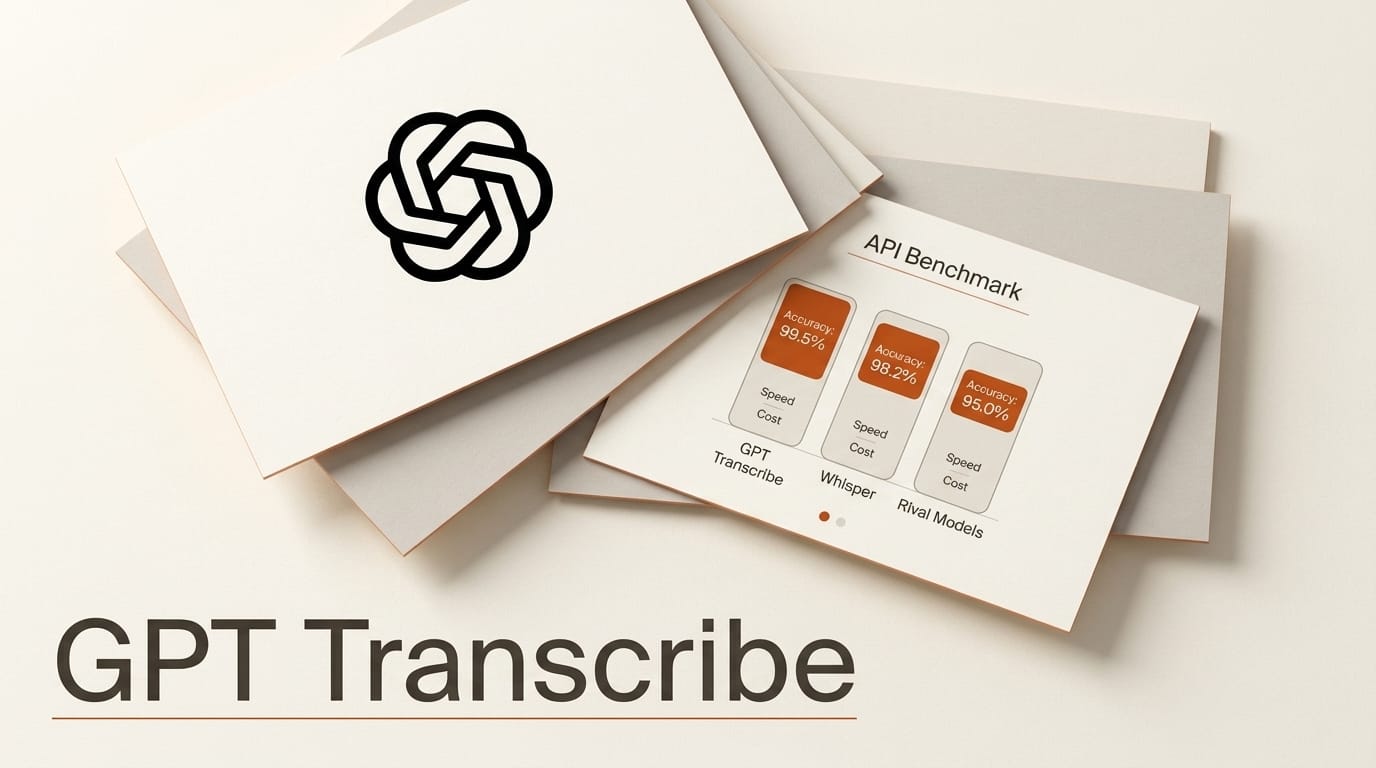
OpenAI shipped two transcription models through its API on July 29, 2026: GPT Transcribe for recorded files and GPT Live Transcribe for real-time captions. The short verdict for creators: GPT Transcribe is a genuine upgrade over Whisper and a price cut over OpenAI's own gpt-4o-transcribe, but it is not the most accurate model on the market, and it drops several features caption editors rely on. This comparison ranks it against Whisper, gpt-4o-transcribe, and the current word-error-rate leaders on the numbers OpenAI and third parties actually published, then shows which model to reach for by task.
Background
Transcription is the unglamorous backbone of a lot of creative work: subtitles for reach and accessibility, searchable archives of long recordings, show notes, and turning one video into blog posts and short clips. For two years the default in most pipelines was OpenAI's Whisper, capable but dated. GPT Transcribe replaces it with a model OpenAI positions as more accurate and more resilient to background noise, as industry outlet Slator reported at launch. Both new models are API-only, cover 57 languages, and detect the spoken language automatically, so there is no consumer app to click and no manual language selection step.
The split between the two models matters. GPT Transcribe targets asynchronous jobs, completed recordings processed after the fact, while GPT Live Transcribe is tuned for low-latency streaming captions during a webinar, stream, or call. Both accept free-form context, keyword hints, and multiple language hints, so you can prime the model with names, product terms, and jargon it would otherwise mangle. That priming step is the single biggest quality lever most creators never used with Whisper.
Deep Analysis
The Accuracy Numbers: Where GPT Transcribe Actually Lands
The headline claim is accuracy, so start there. On the industry-standard word error rate benchmark tracked by Artificial Analysis, GPT Transcribe posts a 3.31 percent word error rate, a 0.7 percentage point improvement over its year-old predecessor gpt-4o-transcribe at 3.61 percent. Against the aging whisper-1, the gap is far wider: third-party testing on the Common Voice dataset across 22 languages reported the error rate falling from roughly 40 percent to roughly 19 percent, a difference you can hear in every transcript.
What OpenAI's own marketing skips is the competitive picture. As The Decoder documented, three models still beat GPT Transcribe on the same benchmark: ElevenLabs Scribe v2 leads at 2.3 percent, Google Gemini 3 Pro follows at 2.9 percent, and Mistral Voxtral Small sits at 3.0 percent. GPT Transcribe is a strong mid-pack result, not the top of the table. For most creator work the differences between 2.3 and 3.31 percent are marginal, but if your audio is dense with proper nouns or heavy accents, the leaders pull ahead.
| Model | Word error rate | Price per minute | Best for |
|---|---|---|---|
| ElevenLabs Scribe v2 | 2.3% | Varies by plan | Highest accuracy, subtitles |
| Google Gemini 3 Pro | 2.9% | Varies by plan | Multimodal pipelines |
| Mistral Voxtral Small | 3.0% | $0.003 | Cheapest strong option |
| GPT Transcribe | 3.31% | $0.0045 | OpenAI-native pipelines |
| gpt-4o-transcribe | 3.61% | $0.006 | Superseded |
| whisper-1 | ~19% (Common Voice, 22 langs) | $0.006 | Legacy, offline via open weights |
Price vs Performance: The Trade-Off That Decides It
GPT Transcribe costs $0.0045 per minute of recorded audio, a 25 percent cut from gpt-4o-transcribe at $0.006 and from the legacy whisper-1, also $0.006. GPT Live Transcribe is the expensive tier at $0.017 per minute, priced to match OpenAI's realtime whisper option and justified by the low-latency streaming path. Those numbers land inside the current price band, but they do not win it: Mistral Voxtral undercuts the entire market at $0.003 per minute while posting a lower error rate, per the same Decoder benchmark.
Run the math on volume. A creator transcribing 40 hours of raw footage a month pays about $10.80 on GPT Transcribe versus $14.40 on gpt-4o-transcribe, and about $7.20 on Voxtral. The savings are real but small at individual scale; they only compound into a decision at agency or platform volume. For most solo creators, accuracy on your specific audio and the shape of your existing pipeline matter more than the fraction of a cent per minute.
The Feature Gaps That Bite Caption Editors
This is where the launch gets sharp. At release, GPT Transcribe and GPT Live Transcribe do not support word-level timestamps, do not export SRT or VTT subtitle files, do not perform speaker diarization, and do not translate to English. Whisper, the model people are being nudged to leave, does several of those things. If your workflow is upload audio, get a burned-in subtitle file back, GPT Transcribe alone will not close the loop; you get raw text and have to time and format it yourself or in another tool. That omission is easy to miss in a benchmark table and impossible to miss in production.
The practical read: GPT Transcribe is a transcription engine, not a subtitling suite. It pairs naturally with a transcript-first editor. Tools like the open-source Descript alternative Rescript handle the timing, speaker labels, and export that the model omits, using a stronger raw transcript underneath. If you need diarization or SRT out of one call today, ElevenLabs Scribe or a dedicated pipeline is still the cleaner path.
Recorded vs Live: Building a Captioning Workflow
Picking between the two OpenAI models is a workload question, not a quality one. For finished assets, a podcast episode, an interview, or an exported video track, point GPT Transcribe at the file and prime it with a keyword list of names and product terms before the run. OpenAI's transcription guide documents the request shape, and anyone already on Whisper can follow the migration cookbook to swap models with minimal code changes. A working caption pipeline looks like this: transcribe the file with GPT Transcribe, pass the raw text into an editor that adds timing and speaker labels, review the proper nouns the keyword hints were meant to catch, then export SRT for the platform.
For live captions on a stream or webinar, GPT Live Transcribe is the model that streams turns at low latency, and it posted a lower error rate than OpenAI's realtime whisper option in the launch benchmarks. The same-week arrival of xAI's Grok Voice Think Fast 2.0, a speech-to-speech model that claims 1.5 to 2 times better transcription than dedicated speech-to-text on a 24-language test, shows how fast the real-time audio tier is moving. For anyone building multilingual live workflows, our breakdown of VoiceHop's real-time voice translation maps where that streaming layer is heading, and the terminal-native Gladia Solaria CLI shows the developer-tooling side of the same shift.
Impact on Creators
If you are already on OpenAI and process recorded audio, the move is straightforward: swap gpt-4o-transcribe or whisper-1 for GPT Transcribe, take the accuracy bump and the 25 percent price cut, and add keyword hints you were probably skipping. The migration is a model-name change, not a rewrite. If you produce subtitles as your main output, temper expectations: you are buying a better transcript, not a finished caption file, and you will need an editor or pipeline to add the timing and formatting the model no longer provides. And if raw accuracy on hard audio is the whole game, the honest answer is that ElevenLabs Scribe, Gemini 3 Pro, and Voxtral currently sit ahead on the benchmark, with Voxtral also cheaper. GPT Transcribe wins on integration convenience for teams already inside the OpenAI stack, not on being the single best model in the field.
Key Takeaways
GPT Transcribe lands at a 3.31 percent word error rate, beating gpt-4o-transcribe and crushing legacy whisper-1, at $0.0045 per minute, a 25 percent price cut. GPT Live Transcribe handles real-time captions at $0.017 per minute. Both cover 57 languages with automatic detection and accept keyword and context hints. The catch: no word-level timestamps, no SRT or VTT export, no speaker diarization, and no English translation at launch, so it is a transcription engine, not a subtitling suite. And on pure accuracy it trails ElevenLabs Scribe v2 (2.3 percent), Gemini 3 Pro (2.9 percent), and Voxtral Small (3.0 percent, and cheaper at $0.003). Reach for GPT Transcribe when you are already OpenAI-native and want a fast, cheap, accurate transcript; reach elsewhere when you need subtitle exports or the top of the accuracy table.
What to Watch
Two things will decide whether GPT Transcribe holds its slot. First, whether OpenAI ships the missing timestamps, subtitle exports, and diarization; those are table stakes for caption workflows, and their absence is the clearest gap between this launch and a complete product. Second, price and accuracy competition, which is now brutal: Voxtral is cheaper and more accurate, Scribe v2 and Gemini 3 Pro lead the error-rate table, and the real-time tier is drawing entrants like Grok Voice Think Fast 2.0 every week. The transcription layer used to be a quiet Whisper monoculture. It is now a live, multi-vendor race where the right model depends on your exact task, and the smart move is to benchmark two or three against your own audio before committing a pipeline to any one of them.
Is GPT Transcribe more accurate than Whisper?
Yes, substantially. On the Common Voice benchmark across 22 languages, third-party testing reported the word error rate dropping from roughly 40 percent for whisper-1 to roughly 19 percent, and on the Artificial Analysis benchmark GPT Transcribe posts 3.31 percent. It is a clear upgrade over the legacy Whisper API.
How much does GPT Transcribe cost?
GPT Transcribe is $0.0045 per minute of recorded audio, a 25 percent cut from gpt-4o-transcribe and whisper-1 at $0.006. GPT Live Transcribe, the real-time captioning model, is $0.017 per minute.
Can GPT Transcribe generate SRT or VTT subtitle files?
Not at launch. GPT Transcribe and GPT Live Transcribe return text without word-level timestamps, SRT or VTT export, or speaker diarization. You need a separate editor or pipeline to add timing and produce a subtitle file.
Is GPT Transcribe the most accurate transcription model available?
No. On the Artificial Analysis word error rate benchmark it trails ElevenLabs Scribe v2 at 2.3 percent, Google Gemini 3 Pro at 2.9 percent, and Mistral Voxtral Small at 3.0 percent. It is a strong mid-pack result, and Voxtral is both more accurate and cheaper.
Should I migrate from gpt-4o-transcribe to GPT Transcribe?
For recorded audio, yes in most cases: you get better accuracy and a lower price for a model-name change, and OpenAI publishes a migration cookbook. The exception is if you depend on features GPT Transcribe drops, in which case test your specific workflow before switching.