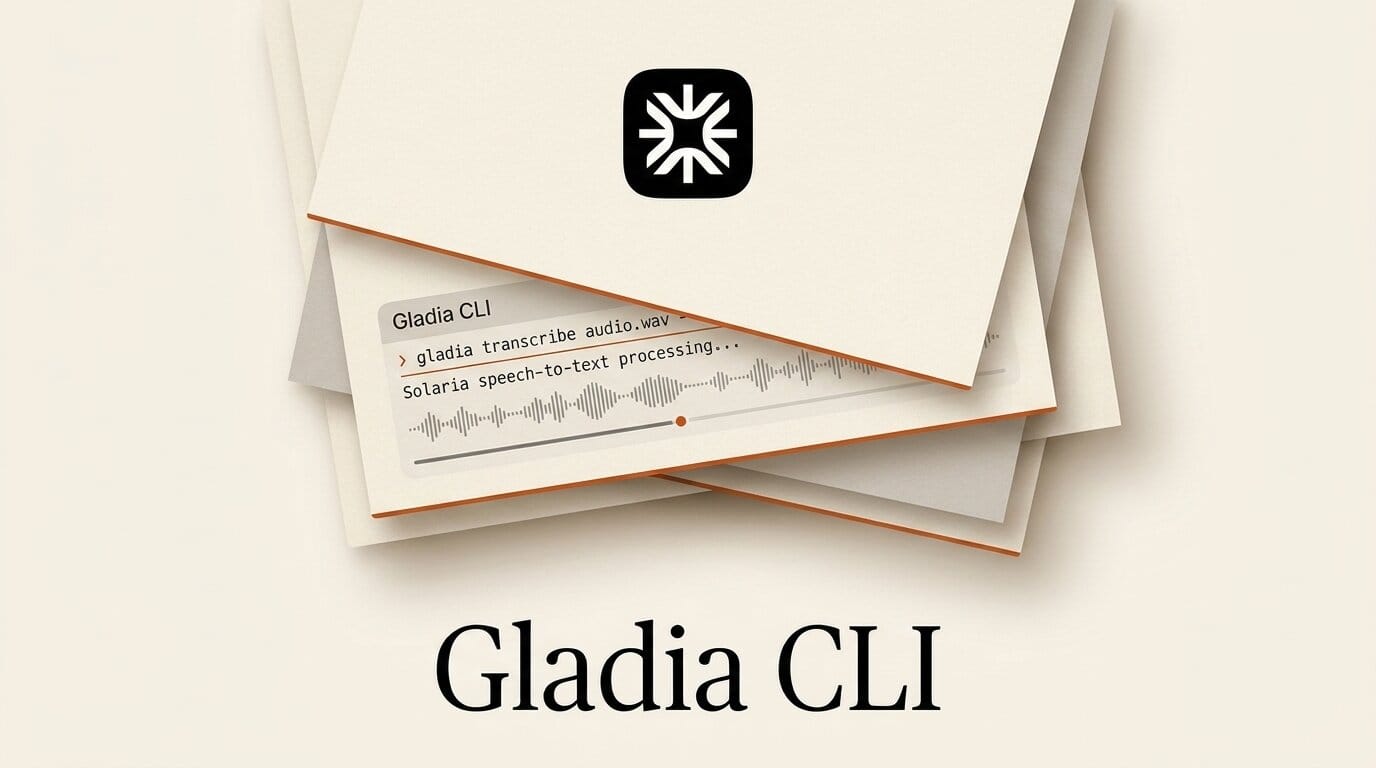
Gladia shipped a command-line version of its speech-to-text platform on July 6, 2026, and it turns audio transcription into a single terminal command. The tool, called gladia-cli and released as v1.0.3 under an MIT license, wraps Gladia's cloud API so you can transcribe any local file or remote URL, label who spoke when, and export subtitles without writing a line of code. It runs Gladia's two production models, Solaria-1 and Solaria-3, covers more than 100 languages, and writes plain text, JSON, SRT, or VTT. For video editors, podcasters, and course creators who already live in the terminal, it collapses the usual upload, wait, and export routine into one command.
What Gladia CLI Actually Does
Gladia is an audio infrastructure company that says it serves more than 300,000 developers and 2,000 enterprise teams through a single speech-to-text API. The CLI is a thin, fast client for that API written in Go, so there is no Python environment to manage and no notebook to open. You install it with one line, set an API key, and point it at a file.
Installation on macOS or Linux is a single curl command, with a PowerShell equivalent on Windows. Authentication happens through an environment variable, a saved key, or a per-command flag. From there, transcription is one verb:
gladia transcribe meeting.wav
gladia transcribe podcast.mp3 -o json
gladia transcribe mixed.mp3 --code-switching --language en,fr
gladia transcribe interview.wav --diarize -o srt
The -o flag selects the output: text, json, json-full, srt, or vtt. The --diarize flag turns on speaker separation, which Gladia ranks as a leading feature on its platform. The --code-switching flag detects language changes utterance by utterance, useful for bilingual interviews or multilingual podcasts. Because it takes a URL as readily as a local path, you can transcribe a hosted recording without downloading it first.
Solaria-1 vs Solaria-3: Which Model to Pick
The CLI exposes both of Gladia's current models through the --model flag, and they are built to complement each other rather than replace one another. Solaria-3, which Gladia announced on June 10, 2026, is tuned for messy business audio like calls and meetings in five core languages. Solaria-1 remains the choice for clean read-speech, formal recordings, and the full 100-plus language range.
| Factor | Solaria-1 | Solaria-3 |
|---|---|---|
| Best for | Clean, formal, read-speech audio | Calls, meetings, conversational audio |
| Languages | 100+ with code-switching | English, French, German, Spanish, Italian |
| Code-switching | Yes | No (one language per run) |
| English WER (Gladia set) | 12.9% | 9.6% (26% improvement) |
| Earnings22 business benchmark | Higher | 6.4% WER, ranked first |
On Gladia's internal English production set of meeting recordings and support calls, Solaria-3 posts a 9.6% word error rate against Solaria-1's 12.9%. On Earnings22, a standard financial-speech benchmark, Solaria-3 lands at 6.4% and is the only model Gladia measured under 7%, ahead of AssemblyAI at 6.9% and Deepgram at 12.0%. The practical rule: reach for Solaria-3 when your audio is conversational and English or European, and keep Solaria-1 for wide language coverage or pristine studio recordings.
Transcribe a Video for Subtitles in Five Steps
The most immediate creator use is captioning. Here is the full path from a raw recording to a subtitle file your editor can import, with no browser tabs involved.
- Install the CLI. Run the one-line install script for your platform, then confirm it works with
gladia languages. - Store your key. Grab a key from your Gladia account and save it once with
gladia auth set your_keyso you never paste it again. - Extract or point at the audio. Feed the CLI your video's audio track, an exported WAV or MP3, or a hosted URL.
- Transcribe to SRT with speakers. Run
gladia transcribe talk.wav --diarize -o srt. Diarization keeps multi-speaker panels readable, and SRT drops straight into most editors. - Import and style. Load the SRT into Premiere, DaVinci Resolve, CapCut, or your platform of choice, then restyle the burned-in captions to match your brand.
Swap -o srt for -o vtt when you are publishing to the web, or -o json-full when you want timestamps and confidence scores to build show notes or chapter markers programmatically.
Gladia CLI vs Whisper, parakeet.cpp, and Browser Tools
Command-line transcription is a crowded space, and the right pick depends on whether you value accuracy, privacy, or zero setup. Gladia's edge is a managed cloud model with strong diarization and subtitle export; the tradeoff is that audio leaves your machine and you need an API key.
| Tool | Runs | Setup | Best fit |
|---|---|---|---|
| gladia-cli | Cloud API | One-line install plus key | Diarized subtitles, multilingual audio |
| OpenAI Whisper | Local (GPU helps) | Python plus model download | Offline, private, tinkerer-friendly |
| parakeet.cpp | Local (C++) | Compile, no Python | Fast local speech-to-text on modest hardware |
| Scribix | Browser | None, open a tab | One-off files, no install at all |
If you want everything to stay on your machine, OpenAI's Whisper and the leaner, Python-free parakeet.cpp are the local options, though you handle the compute and any speaker labeling yourself. For a single file with zero setup, a browser tool like Scribix is faster to reach for. Gladia's own roundup of speech-to-text APIs lays out where each provider leads if you are comparing accuracy at scale.
What This Enables for Creators
The reason a CLI matters more than another web dashboard is scripting. Once transcription is a single command, it becomes a step in a pipeline you can automate. A podcaster can loop gladia transcribe over an episode folder to generate show notes and timestamps in one batch. A course creator can auto-caption an entire lesson library overnight. An agency can wire the JSON output into a summarizer to produce highlight reels and social clips without a human touching a transcript.
Code-switching support quietly unlocks multilingual work that most tools fumble: a bilingual interview transcribes cleanly in one pass instead of two. And because the same command runs in a shell script, a cron job, or a CI step, transcription stops being a manual chore and becomes infrastructure your other tools can build on.
Frequently Asked Questions
Is Gladia CLI free?
The CLI itself is open source under an MIT license and free to install. It calls Gladia's paid cloud API, which offers a free tier of 10 hours of audio processing with no credit card required. Beyond that you pay per usage; see Gladia's pricing page for current rates.
Does my audio stay on my computer?
No. Gladia CLI sends audio to Gladia's cloud API for processing, so files leave your machine. If local-only transcription is a requirement, use a local model such as Whisper or parakeet.cpp instead.
What output formats can I export?
Five: plain text, JSON, a fuller json-full with timestamps and confidence data, SRT, and VTT. SRT and VTT import directly into video editors and web players as subtitle tracks.
Which model should I use for a podcast interview?
For an English or European-language conversation, Solaria-3 gives the lowest error rate on conversational audio. Add the --diarize flag to separate speakers. For interviews that mix languages within a sentence, use Solaria-1 with --code-switching.
Can it transcribe a file hosted online?
Yes. The transcribe command accepts a remote URL as well as a local path, so you can point it at a hosted recording without downloading it first.
What platforms does it run on?
macOS, Linux, and Windows. The install is a one-line script on each, and prebuilt binaries are available from the project's GitHub releases page.