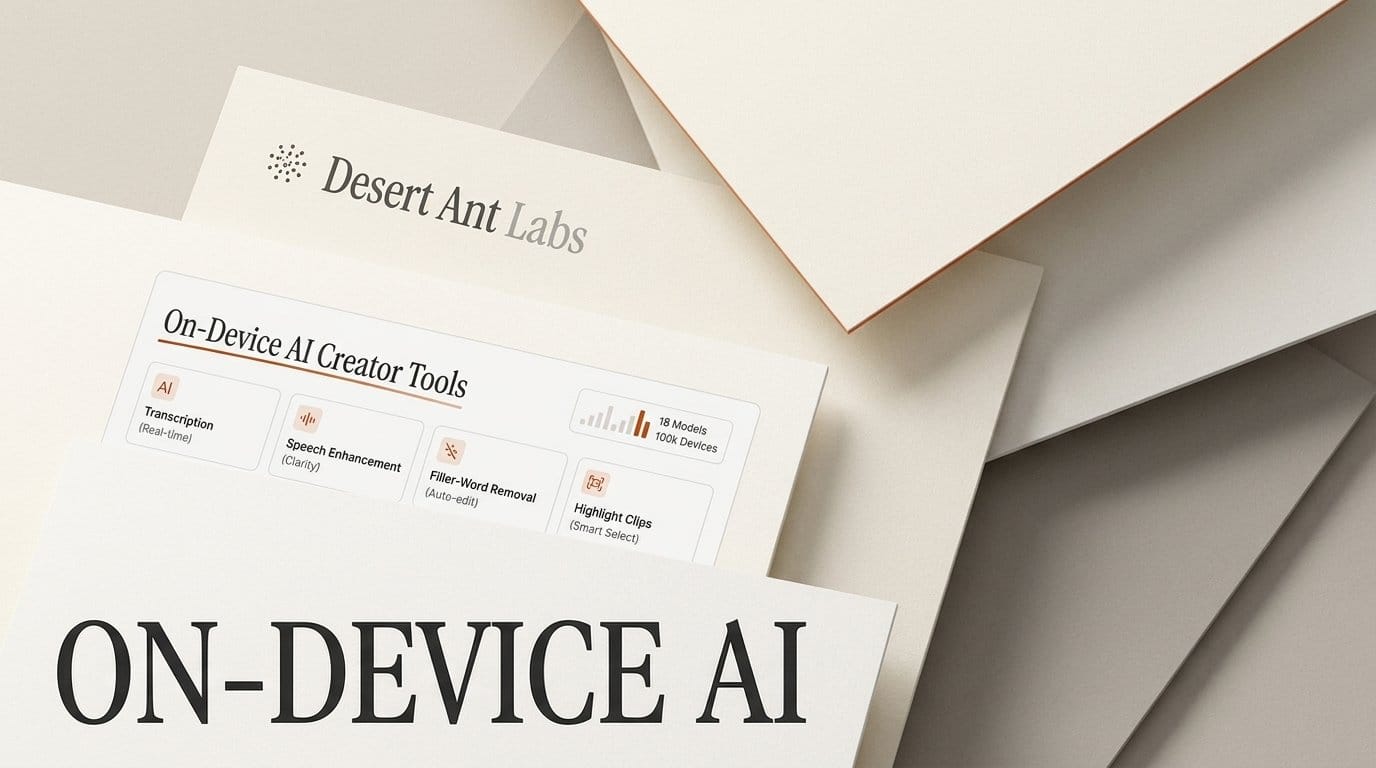
On September 8, 2026, a European lab called Desert Ant Labs published 18 small AI models that run entirely on a user's device, with SDKs for Swift, Kotlin and JavaScript and a free tier that covers the first 100,000 monthly active devices per platform, per model. Twelve are stable and six are in closed beta. The lineup is unusually specific to media work: transcription with word timestamps, speech enhancement, filler-word removal, and a model that picks highlight clips out of a long recording. The launch post is written by Paul Veugen and says the work grew out of five years building the Detail video app.
The headline numbers are real and checkable in the model cards. The framing is where you have to read carefully. This is not an open-weights release, the flagship transcription model is Apple-only today, and the speech-enhancement model is a derivative of an existing open-source project, which Desert Ant discloses. Here is what you can actually build with it this week, and what the license commits you to.
What shipped
The twelve stable models are Align, Clear, Clips, Ear, Emo, Gist, Redact, Shapes, Title, Tongue, Uhm and Voz, all listed on the models page. Six more (Eye, Face, Moderator, Schemer, Toxic and Who) are behind a closed beta. Four of them matter directly to anyone editing audio or video.
Voz is the transcription model. Its model card reports 290x realtime on long files, 2.1 seconds for 611 seconds of audio, a 7.40% average word error rate across six Open ASR Leaderboard datasets, and 2.83% word error rate on half-hour narration. Word timestamps land within a mean absolute error of 83ms on starts and 95ms on ends. It is 467MB on disk. Desert Ant's own comparison puts Whisper large-v3-turbo at 1.6GB and 50x realtime, and Apple's SpeechAnalyzer at 78x, so treat the multiples as the vendor's measurements rather than an independent benchmark. For context on what it is competing against, our speech-to-text comparison covers the cloud incumbents on accuracy and price.
Clear denoises, dereverbs and loudness-normalizes speech. It is 9.0MB in its Core ML build and its card openly states it derives from DeepFilterNet (DFN3). Reported throughput is 302x realtime on an iPhone 16 Pro for the full pipeline on a 60-second clip.
Uhm finds filler words at 20ms frame granularity without running speech recognition first, which is the part that makes it useful: you get "um" positions without paying for a transcript. It is 45MB in Core ML and is built on DistilHuBERT, trained primarily on English with acoustic transfer to Spanish, French, German and Dutch.
Clips is a 278M-parameter ranker on an xlm-roberta-base trunk that scores sentences, finds non-overlapping candidate spans and ranks them, which is how you get highlight clips out of a podcast. The card reports roughly 9 to 10 seconds to process 404 sentences on an iPhone. The launch post separately claims Clips is 10x faster than Sonnet at 470x less energy; that comparison does not appear in the model card, so it is the company's claim and not a documented benchmark.

The license is the real story
Every one of these models carries the Desert Ant Labs Source-Available License, version 1.0, dated 3 July 2026. Hugging Face shows the license tag as "other" on all of them, and the SDK repository reports no recognized SPDX license, so nothing here is Apache or MIT. Read the terms before you build a business on it, because four clauses have teeth.
The free tier is genuinely generous: free below 100,000 monthly active devices per platform, counted separately for each model. The same model on iOS and on Android each get their own allowance. The grant is perpetual and does not expire, subject to a termination clause. Above the threshold you need a commercial license through licensing@desertant.com, and Desert Ant has not published a price for that tier; a pricing page does not exist on the site as of this writing.
Two obligations come with it. You must credit Desert Ant Labs somewhere your users can see, with a short "Powered by Desert Ant Labs" line. And you may not use the models, their outputs, or anything you log from them to train a competing model. The license also blocks splitting accounts across entities under common control to stay under the threshold. The contracting party is Desert Ant Labs B.V., a Dutch entity.
Build an on-device podcast cleanup pipeline
The four models above compose into a post-production pass that never touches a server. This runs on macOS today. Budget about 800MB of models on disk.
- Install the SDK. Add desert-ant-core as a SwiftPM dependency. It wraps Core ML, LiteRT and WebAssembly behind one interface, and the ModelStore component downloads and caches weights from Hugging Face on first run, so you do not ship 800MB inside your app bundle.
- Clean the audio first, not last. Run Clear over the raw recording before anything else. Transcription accuracy on noisy field audio improves when you denoise upstream, and at 302x realtime a one-hour interview costs about 12 seconds. Doing it in this order also means the filler-word and clip models see the same cleaned signal.
- Transcribe with Voz and keep the timestamps. The 83ms start-boundary accuracy is what makes the rest of the pipeline possible. A transcript without reliable per-word times cannot drive a cut list. Ask for word-level output, not just the text.
- Run Uhm against the audio, not the transcript. Uhm works on the waveform at 20ms resolution and does not need the transcript, so it catches disfluencies that a text-first workflow silently drops. Intersect its spans with Voz's word times to produce ripple-delete ranges your editor can consume.
- Feed the cleaned transcript to Clips. Clips wants sentences, so segment on Voz's punctuation before ranking. It returns non-overlapping candidate spans with scores. Take the top three to five, map them back through the word timestamps, and you have social cuts with frame-accurate in and out points.
- Check the attribution requirement before you ship. If this pipeline ends up in something you distribute, the "Powered by Desert Ant Labs" credit is a license condition, not a courtesy.
For a working reference, Desert Ant publishes demo-clipper, an example macOS app and CLI that generates short clips fully on device, plus a command-line tool for running the models from a terminal.
What runs where today
Platform support is uneven, and the launch post does not break it down. These figures come from reading each model card individually. The gap between Clear and Voz is the one that will bite you.
| Model | Size (Core ML) | Platforms today | Replaces |
|---|---|---|---|
| Voz | 467MB | Apple only: iOS, iPadOS, macOS, Mac Catalyst, tvOS, visionOS | Cloud ASR API calls |
| Clear | 9.0MB | Apple, Android, Linux, Windows, browser, Node | Denoise plugin or cloud audio cleanup |
| Uhm | 45MB | Apple, plus browser and Python via ONNX | Manual filler-word editing |
| Clips | 284MB | Apple, Linux, Windows. No Android SDK yet | LLM calls to pick highlights |
On Hacker News, where the launch drew 235 points and 62 comments, the founder confirmed Android and web ports are coming and that some models are harder to port than others. The Clips card is blunter: Android is possible through LiteRT, but there is no Android SDK yet because of memory constraints. If you are building Android-first, Clear is the only one of these four you can ship today.

What to do next
Pull Clear and Uhm first. They are 9MB and 45MB, they cover the widest platform range between them, and they solve problems that currently cost either a plugin license or an hour of manual editing per episode. Voz is the bigger commitment at 467MB and Apple-only, so evaluate it against your existing transcription bill, such as Microsoft's MAI-Transcribe-2 pricing, before you rewrite anything. If any of this reaches 100,000 devices, email licensing@desertant.com early rather than late, because the commercial rate is not published anywhere.
Frequently asked questions
Are Desert Ant Labs models open source?
No. They are source-available under a custom license that permits reading, modifying and embedding the models but requires attribution, forbids training competing models on their outputs, and requires a paid commercial license above 100,000 monthly active devices per platform. Hugging Face lists every model's license as "other" rather than a recognized open-source license.
What does the free tier actually cover?
Use is free below 100,000 monthly active devices, counted per model and per platform independently, with no cap on how often each device runs inference. The same model on iOS and Android each get a separate 100,000-device allowance. Accounts under common control are counted together.
Is Voz more accurate than Whisper?
Desert Ant reports a 7.40% average word error rate for Voz across six Open ASR Leaderboard datasets and 2.83% on half-hour narration, against a 467MB footprint versus 1.6GB for Whisper large-v3-turbo. Those are the vendor's own measurements on their own comparison set. No independent benchmark of Voz existed at the time of writing.
Can I use these models on Android or the web?
Partially. Clear supports Android, Linux, Windows, browser and Node. Uhm has a browser and Python path via ONNX. Voz is Apple-only, and Clips has no Android SDK yet. The founder has said more ports are coming but has given no dates.
Do the models phone home?
Inference runs locally with no tokens and no logins, per the license and the product documentation. The weights themselves are downloaded from Hugging Face on first run by the SDK's ModelStore, so the initial fetch is a network operation even though inference is not.
What happens if my app crosses 100,000 devices?
You need a commercial license for that specific model on that specific platform, obtained by contacting licensing@desertant.com. Desert Ant has not published commercial pricing, so the cost of crossing the threshold is currently unknown.