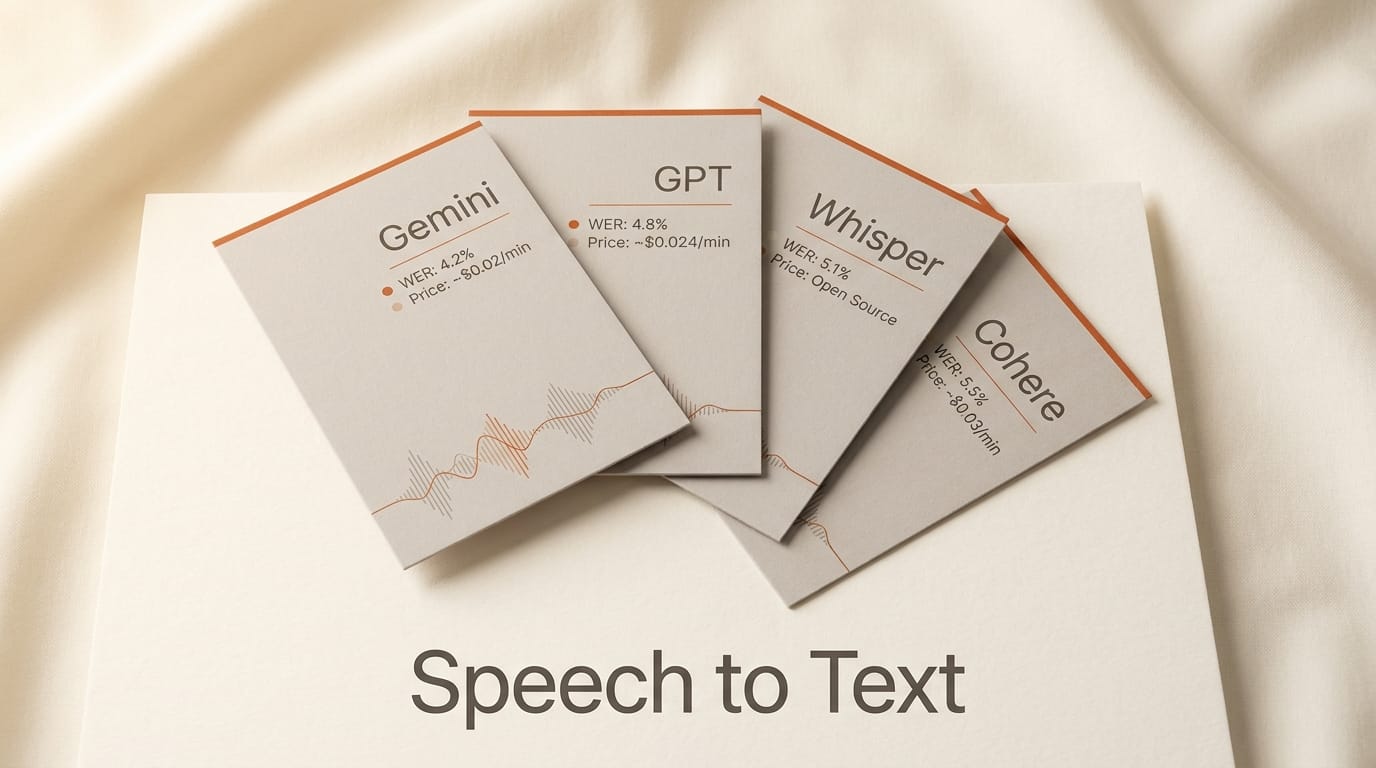
If you only want the headline: Gemini 3.5 Transcribe posts the lowest word error rate of any current speech-to-text model, GPT-4o Transcribe is the strongest all-round closed option with real-time streaming, Whisper is still the default when you need open weights you can run offline for free, and Cohere Transcribe is the open-weights pick when Arabic or a permissive license matters more than raw accuracy. This comparison tests all four on the axes that actually change a creator's workflow: accuracy, language coverage, streaming, diarization, and price.
The Short Answer
Four models now cover most transcription needs, and they split cleanly by what you are optimizing for. Pick Gemini 3.5 Transcribe if accuracy and low-latency live captioning are the priority. Pick GPT-4o Transcribe if you are already in the OpenAI stack and want a Realtime streaming endpoint plus a cheaper mini variant. Pick Whisper if you need to run transcription locally, offline, or at zero marginal cost across thousands of files. Pick Cohere Transcribe if you want open weights under a permissive Apache-2.0 license, and especially if you work in Arabic.
The numbers below are pulled from each vendor's primary documentation and, where a head-to-head figure exists, the independent Artificial Analysis Word Error Rate Index. One honest caveat up front: the four models are not all scored on a single shared benchmark, so treat cross-model WER as directional, not decimal-precise. Gemini and GPT-4o do share the Artificial Analysis index, which makes that one pair genuinely comparable.
How the Four Models Compare
Here is the side-by-side. Every figure traces back to a primary source or a named benchmark; the prose after the table explains where the comparison holds and where it breaks down.
| Model | Type | Languages | Word error rate | Streaming | Price (batch) |
|---|---|---|---|---|---|
| Gemini 3.5 Transcribe | Closed API | 85+, auto-detect | 2.6% (Artificial Analysis WER Index) | Yes, Live API | ~$0.003/min |
| GPT-4o Transcribe | Closed API | Multilingual, FLEURS-scale | 4.0% (Artificial Analysis WER Index) | Yes, Realtime API | ~$0.006/min |
| Whisper large-v3 | Open weights (MIT) | 99 | 7.44% mean (Hugging Face eval) | No, batch only | Free self-hosted; $0.006/min hosted |
| Cohere Transcribe | Open weights (Apache-2.0) | 14 | 5.42% avg (reported) | No, batch only | Free API tier |
Accuracy and word error rate
Word error rate is the percentage of words a model gets wrong, so lower is better. On the Artificial Analysis WER Index, Gemini 3.5 Transcribe lands at 2.6% for non-streaming audio, the lowest of any model on that index, and 4.0% when streaming. GPT-4o Transcribe scores 4.0% on the same index. Because those two numbers come from one shared benchmark, that is the cleanest comparison in this piece: Gemini is meaningfully ahead of GPT-4o on batch accuracy and roughly level once both are streaming.
Whisper large-v3 reports a 7.44% mean word error rate on its own Hugging Face multilingual evaluation, which is a harder, broader test than the clean English audio Whisper is famous for, so the gap to the closed models is smaller on well-recorded English than the raw number suggests. Cohere's base model is reported at a 5.42% average, though that figure comes from press coverage rather than the Cohere docs, so weight it accordingly. Google states its Gemini 3.5 Transcribe scores 5.04% non-streaming and 5.50% streaming on the multilingual FLEURS benchmark, a useful cross-check that the model holds up beyond English.
Language coverage and diarization
Whisper is still the breadth champion at 99 languages, and because the weights are open you can fine-tune it for a dialect nobody else supports. Gemini 3.5 Transcribe covers 85-plus languages with automatic detection and code-switching, meaning it can follow a speaker who flips between two languages mid-sentence without being told. GPT-4o Transcribe is broadly multilingual at FLEURS scale but OpenAI does not publish a hard count on the reachable docs. Cohere's base model is deliberately narrow at 14 languages, trading breadth for a smaller, cheaper 2-billion-parameter model.
Diarization, the job of labeling who spoke when, is where the closed models pull ahead for interview and podcast work. Gemini 3.5 Transcribe handles up to eight speakers on file transcription and three on live audio, with word-level timestamps and a custom vocabulary of up to a thousand terms for names and jargon. Whisper and Cohere Transcribe do not ship native diarization or timestamps, so multi-speaker labeling means bolting on a separate tool. If you regularly cut interviews or panels, that single feature can outweigh a fraction of a percent of accuracy.
Streaming versus batch
This is the cleanest split in the whole comparison. Gemini 3.5 Transcribe and GPT-4o Transcribe both offer real-time streaming, through Google's Live API and OpenAI's Realtime API respectively, which makes live captioning, real-time note-taking, and voice-driven interfaces viable. Whisper has no native streaming; it is an offline, batch model, and the pseudo-streaming you see in the wild is community tooling chunking audio around it. Cohere Transcribe is also batch-only, with a 25MB file cap. If your product needs captions to appear as someone speaks, your shortlist is two models, not four.
When Each One Wins
Gemini 3.5 Transcribe wins on accuracy and live work. It has the lowest word error rate on the shared index, the most generous diarization, code-switching, and sub-second streaming through the Live API. Google also reports a 70% latency improvement over its previous Chirp 3 model, and it already ships inside Gboard's Rambler feature, the Gemini macOS app, and Google Antigravity. For podcast show notes, subtitle files, and real-time captioning, it is the strongest default.
GPT-4o Transcribe wins on ecosystem fit. If your app already calls OpenAI for text or images, adding the gpt-4o-transcribe endpoint is a one-line change, and the gpt-4o-mini-transcribe variant roughly halves the cost when you can tolerate a small accuracy dip. Its 4.0% WER on the Artificial Analysis index beats the original Whisper handily, and the Realtime API covers streaming.
Whisper wins on control and cost at scale. The weights are open under an MIT license, so you can run Whisper on your own hardware with no per-minute fee, keep audio fully offline for privacy, and fine-tune it for a niche accent or vocabulary. The large-v3-turbo variant drops to 809 million parameters for faster inference with a minor accuracy trade. For anyone transcribing tens of thousands of files or working under strict data-residency rules, free and local beats a few tenths of a percent of accuracy.
Cohere Transcribe wins on open weights plus Arabic. The base model is Apache-2.0, a friendlier license than Whisper's model-card apache tag for some commercial uses, and the dedicated Cohere Transcribe Arabic model posts a 25.87% average on the Hugging Face Arabic ASR Leaderboard, the best of any open-source model there and well ahead of Whisper Large V3's 36.86% on that same board, while running several times faster. If your work is Arabic-first, this is not a close call.
Pricing and Cost
The pricing gap between open and closed is the real decision driver at volume. Whisper self-hosted is free beyond your compute, and Cohere Transcribe has a free API tier with rate limits, so both cost nothing to trial and nothing per minute if you run them yourself. Among the closed APIs, Gemini 3.5 Transcribe is the cheaper option at roughly $0.003 per minute of batch audio ($2.00 per million audio-input tokens), per Google's official pricing. GPT-4o Transcribe runs about $0.006 per minute, the same rate as OpenAI's legacy whisper-1 API, with the mini variant cutting that roughly in half.
Do the arithmetic on your actual volume. At a hundred hours of audio a month, Gemini's rate is around $18 versus roughly $36 for GPT-4o, a difference that is trivial for a solo creator and material for a product transcribing user uploads at scale. Below a few hundred hours, accuracy and diarization matter more than the price line. Above that, self-hosted Whisper's zero marginal cost starts to dominate the math, provided you can absorb the engineering to run it.
The Verdict
For most creators doing podcast, video, and interview work, Gemini 3.5 Transcribe is the model to beat right now: it leads on accuracy, has the deepest diarization, and streams. Reach for GPT-4o Transcribe when you are already committed to OpenAI or want the mini variant's lower bill. Choose Whisper when open weights, offline privacy, or free-at-scale outweigh a couple of accuracy points, and Cohere Transcribe when a permissive license or Arabic is the deciding factor. The only wrong move is switching on a spec sheet alone. Run the same real recording of your own audio through your shortlist and compare word error rate, speaker labels, and latency on material that sounds like your work, because room noise, accents, and jargon shift these rankings more than any benchmark.
Frequently Asked Questions
Which speech-to-text model is the most accurate in 2026?
On the independent Artificial Analysis Word Error Rate Index, Gemini 3.5 Transcribe has the lowest error rate at 2.6% for non-streaming audio, ahead of GPT-4o Transcribe at 4.0%. Whisper large-v3 and Cohere Transcribe score higher error rates on their own benchmarks, but those tests are not directly comparable, so accuracy on your specific audio can differ.
Is Whisper still worth using now that closed models are more accurate?
Yes, for the right job. Whisper's open MIT weights let you run it offline at zero per-minute cost, keep audio private, and fine-tune it for a specific accent or vocabulary. For high-volume or privacy-sensitive transcription, that outweighs the accuracy edge the closed APIs hold on standard benchmarks.
Which models support real-time streaming transcription?
Only the two closed models. Gemini 3.5 Transcribe streams through Google's Live API and GPT-4o Transcribe streams through OpenAI's Realtime API. Whisper and Cohere Transcribe are batch-only, so live captioning requires one of the closed APIs or third-party chunking tooling wrapped around an open model.
Do any of these models label who is speaking?
Gemini 3.5 Transcribe offers native diarization for up to eight speakers on file transcription and three on live audio, with word-level timestamps. GPT-4o Transcribe also handles multi-speaker audio through the OpenAI API. Whisper and Cohere Transcribe do not include native diarization, so labeling speakers means adding a separate tool.
What is the cheapest way to transcribe a lot of audio?
Self-hosted Whisper is free beyond your own compute, which makes it the cheapest option at high volume if you can run it. Among paid APIs, Gemini 3.5 Transcribe at roughly $0.003 per minute is the lowest, about half the cost of GPT-4o Transcribe. Cohere Transcribe also offers a free API tier with rate limits for lighter workloads.