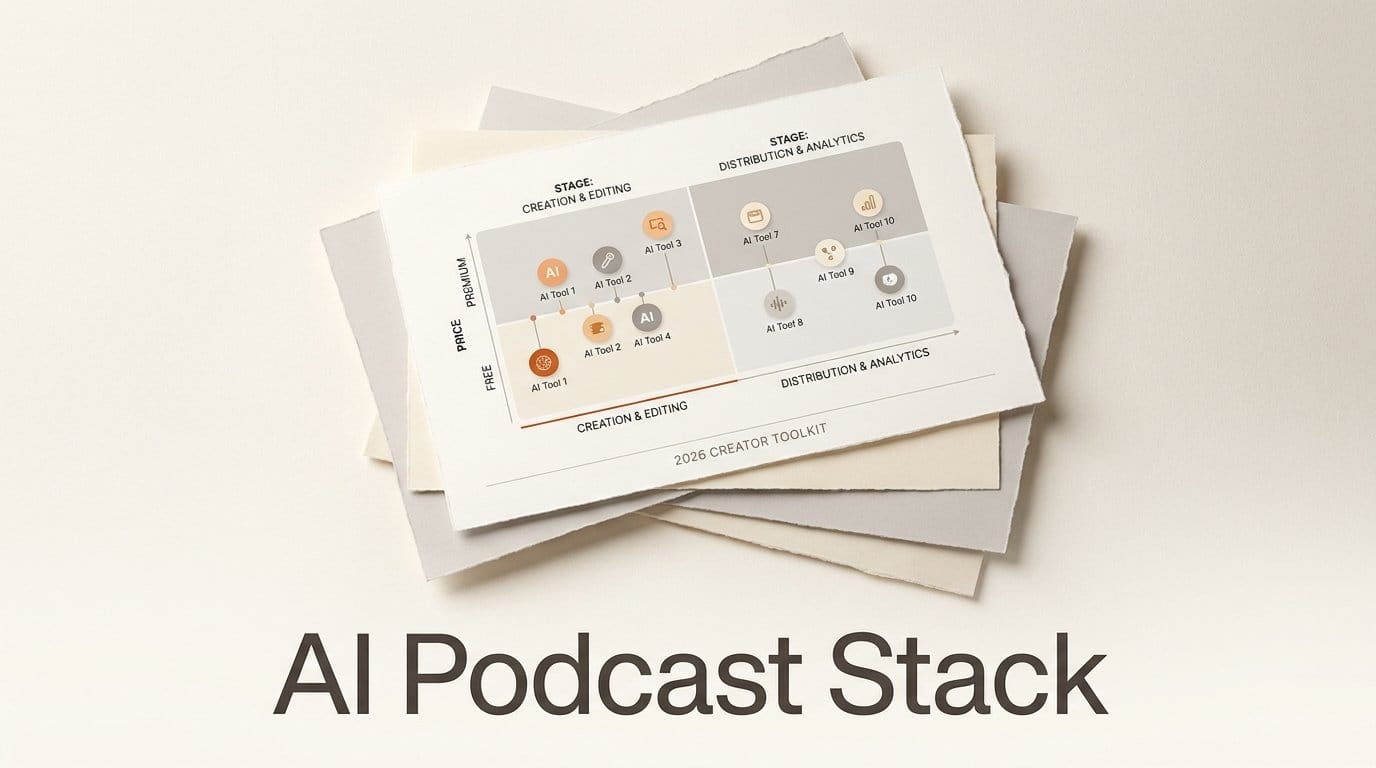
Ten AI tools now cover the whole podcast production line, and the honest verdict is that the cheap end of the stack got good enough that most shows should spend their money on exactly one paid seat. Every price below was read off the vendor's own pricing page on September 9, 2026, which turned out to matter more than expected: Riverside now answers on riverside.com rather than riverside.fm, and podcastle.ai issues a permanent redirect to async.com, where the plan tiles render without prices at all. Guides that quote a figure without a date are quoting a number that has already moved.
The useful way to choose is by production stage, not by brand. A podcast passes through five of them: record, clean up, edit, repurpose, and describe. Different tools win each one, and the pricing models behind them behave very differently once a show starts publishing more often.
Quick Picks
Pick Descript if you edit by reading. It is still the only tool where deleting a sentence in the transcript deletes the audio, and where filler removal, noise cleanup, and voice cloning live in the same timeline. Descript's Creator tier is $35 a month billed monthly or $24 billed annually, with 30 media hours and 800 AI credits a month.
Pick Riverside if you record guests remotely. Local multitrack capture at up to 4K is the thing you cannot retrofit later, and no amount of AI cleanup rescues a call recorded through a compressed video stream. Pro is $29 a month, or $24 a month on the $288 annual plan, with 5 multitrack hours a month.
Pick the free tier if you publish weekly and edit in something you already own. Adobe's Enhance Speech costs nothing, Auphonic gives 2 processed hours a month free, and whisper.cpp transcribes locally under an MIT license. That combination handles cleanup and transcripts for a weekly show at $0.
Record: Where the Episode Starts
Recording is the one stage with no AI rescue path. Everything downstream, from noise reduction to speaker separation to clip detection, works better on clean multitrack source, and worse on a single mixed file captured over a video call.
Riverside records each participant locally and uploads in the background, so guest audio is not hostage to guest bandwidth. The free plan caps at 720p and a single 2 hour multitrack session. Pro at $29 a month, or $24 on the annual plan, raises that to 4K and 5 multitrack hours a month with 15 hours of separate track downloads. Grow at $39 monthly or $34 annually ($408 a year) takes it to 15 multitrack hours and adds social scheduling. Both paid tiers bundle unlimited transcription, Magic Clips, and AI show notes, which is the pattern worth noticing: the recording tools have absorbed the repurposing features that used to require a second subscription.
Async is the other integrated option, and it is the one to approach carefully. It is what Podcastle became: podcastle.ai redirects there permanently. The free tier is now 10 lifetime AI credits and 1 hour of lifetime media upload, which is a trial rather than a usable free plan, and the paid tiers advertise 450 to 1,200 monthly credits with voice cloning at Pro and 4K export at Teams. The plan prices themselves do not render on the pricing page, only a "save 40% with yearly plans" line, so anyone budgeting around Async needs to create an account before they can see a number. That is a real cost in itself.
Clean Up: The Stage Where Free Got Good Enough
Cleanup is where the economics changed most. Three of the strongest options cost nothing.
Adobe's Enhance Speech is a free web filter that strips room tone and reverb from spoken audio, and Adobe Podcast wraps it alongside Studio, Mic Check, and transcript editing. Adobe publishes no usage limits, file length caps, or quality tiers on the Enhance Speech page, so treat throughput as unknown rather than unlimited.
Auphonic is the choice when consistency matters more than convenience. Its free tier processes 2 hours a month with the intelligent leveler, noise and reverb reduction, filtering, loudness targets, and filler and silence cutting, and it adds an Auphonic jingle. Speech recognition and automatic show notes are paid only, and free multitrack is limited to productions under 20 minutes. Paid plans are metered by hour and priced in euros: S is 9 hours at EUR 4.99, M is 21 hours at EUR 9.99, L is 45 hours at EUR 19.99, XL is 100 hours at EUR 39.99, and XXL is 250 hours at EUR 79.99, with 20% off yearly. One-time credit packs exist for shows with irregular output.
The third option is running the model yourself. whisper.cpp is a dependency-free C and C++ implementation of Whisper under an MIT license, at 53,555 GitHub stars, with its latest tagged build b4938 from August 20, 2026 and commits as recently as September 8. It runs on macOS, iOS, Android, Linux, Windows, Raspberry Pi, and WebAssembly, with Core ML on the Apple Neural Engine, CUDA, Vulkan, and ROCm acceleration, integer quantization, and real-time streaming with voice activity detection. For a show that publishes transcripts, this removes a recurring line item permanently. Our speech to text comparison covers how the hosted APIs stack up against it on accuracy.

Edit by Transcript: Descript and Eddy
Descript remains the category definition. You edit the document, the audio and video follow, and Studio Sound, filler word removal, custom voice clones, and the Underlord AI co-editor all operate inside the same project. The tier structure is the thing to read closely, because Descript meters two separate resources. Media hours run 1 free, 10 on Hobbyist, 30 on Creator, and 40 on Business. AI credits run 100 one time on free, then 400, 800, and 1,500 a month. Export resolution caps at 720p free, 1080p on Hobbyist, and 4K from Creator up. Prices are $24 a month monthly or $16 annually for Hobbyist, $35 or $24 for Creator, and $65 or $50 for Business, with translation and dubbing in 30 or more languages arriving only at Business.
That two-meter design is why a Hobbyist plan can feel expensive: 10 media hours sounds generous for a weekly 45 minute show until multitrack video doubles the count. Creator is the tier most weekly shows actually need, not the entry plan.
Eddy by Headliner is the closer alternative than its profile suggests. It transcribes in over 100 languages, does speaker diarization, removes filler words and pauses, recommends clips, and ships a Promo Pack that generates show notes with chapters, four episode art images, ten or more keywords, five or more pull quotes, blog copy, and social captions in one pass. It also learns from previous episodes to match a show's tone. The catch is commercial rather than technical: Headliner does not publish prices on the Eddy page, so a comparison against Descript requires signing up. If open source is the priority instead, Rescript targets the same transcript-editing workflow.
Repurpose: Turning One Episode Into Ten Posts
This is the stage most likely to be bought twice by accident, because Riverside and Descript both include versions of it.
Opus Clip is the specialist. Its free plan does basic clipping on spoken words only, with watermarked captions, a 1080p ceiling, and a 3 day export window. Starter at $15 a month unlocks the part people actually want: clipping driven by visual objects, sound, emotion, and genre rather than words alone, a virality score, custom clip lengths, reprompt refinement, timeline editing, 20 AI voice-overs a day, AI B-roll capped at 3 stock and 3 image clips a month, watermark-free export, and direct posting to YouTube Shorts, TikTok, and Instagram. Pro is $29 a month. The page does not publish annual rates or monthly processing minutes, so budget from the monthly figure.
Castmagic attacks the describe stage instead of the clip stage. It is priced by transcription library size rather than monthly throughput, which is an unusual and important distinction: Hobby is $19 a month billed annually ($239 a year) for a 30 hour library, Starter is $48 a month ($579 a year) for 100 hours, and Team is $139 a month ($1,669 a year) for 400 hours with 5 seats. Show notes, newsletters, timestamps, and 2,000 word outputs start at Starter. Every tier includes transcription in 60 or more languages, unlimited audiogram generation, and Zoom, Google Drive, Zapier, and RSS integrations. A library cap rather than a monthly cap means a long-running show eventually pays for its own archive.

Voice and Dubbing: One Tool, Clear Boundaries
ElevenLabs is the outlier because its free tier is deliberately unusable commercially. Free gives 10,000 credits a month with no commercial license and no voice cloning. Starter at $6 a month, or $5 annually, adds the commercial license, instant voice cloning, and Dubbing Studio at 30,000 credits. Creator at $22 a month, or $18.33 annually, is the first tier with professional voice cloning and 192 kbps output at 121,000 credits. Pro is $99, or $82.50 annually, at 600,000 credits. Speech to text is available on every tier including free.
For podcasters the decision is narrow. Instant cloning at Starter is enough to patch a mispronounced name or a dropped word. Professional cloning at Creator is what you need to generate meaningful stretches of narration, and that is also the point where the ethical and disclosure questions become real. Our open source voice cloning comparison covers the self-hosted alternatives if sending a voice print to a vendor is not acceptable.
The Full Comparison
| Tool | Stage | Free tier | Entry paid price | Metered by |
|---|---|---|---|---|
| Riverside | Record | 720p, 2h multitrack | $29/mo, $24 annual | Multitrack hours |
| Async (was Podcastle) | Record and edit | 10 lifetime credits, 1h upload | Not published | Monthly credits |
| Adobe Enhance Speech | Clean up | Free, limits unpublished | None stated | Not stated |
| Auphonic | Clean up | 2h/mo with jingle | EUR 4.99/mo for 9h | Processed hours |
| whisper.cpp | Transcribe | Entirely free, MIT | $0, your hardware | Nothing |
| Descript | Edit | 1h media, 720p export | $24/mo, $16 annual | Media hours and AI credits |
| Eddy by Headliner | Edit and describe | Trial, no card | Not published | Not published |
| Opus Clip | Repurpose | Watermarked, 1080p | $15/mo | Plan tier |
| Castmagic | Describe | None | $19/mo annual | Library hours |
| ElevenLabs | Voice | 10k credits, no license | $6/mo, $5 annual | Credits |
What It Actually Costs Per Year
Three realistic stacks, using verified annual rates where the vendor publishes them.
The free stack, $0. Record locally in any DAW, clean up in Adobe Enhance Speech, level in Auphonic's free 2 hours, transcribe with whisper.cpp. A weekly 45 minute show fits inside Auphonic's free hours with room to spare. The cost is your time and a manual workflow.
The weekly show, about $288 a year. One Descript Creator seat at $24 a month annually covers editing, cleanup, transcription, and 4K export, with 30 media hours against roughly 3 hours of weekly source. Nothing else is strictly required. Add Adobe Enhance Speech free for any guest audio Descript's Studio Sound does not fully rescue.
The interview show that ships clips, about $756 a year. Riverside Pro at $288 annually for remote multitrack, Descript Creator at $288 for editing, and Opus Clip Starter at $15 a month for clip generation. This is the point where overlap starts costing money, since Riverside Pro already includes Magic Clips and show notes. Run Riverside's built-in clipping for a month before adding Opus Clip, and only pay for the specialist if the virality scoring and visual-object clipping genuinely beat it.
The structural point behind all three numbers: flat seats such as Descript Creator and Riverside Pro cost the same whether you publish once a month or four times, while metered tools such as Auphonic, ElevenLabs, and Descript's own AI credit pool scale directly with output. A show that is growing should expect its bill to move in the metered tools first, and should check the meters before adding another flat seat. For the wider audio toolchain beyond podcasting, our AI music and audio guide covers scoring and sound design, and the RODECaster Studio is the hardware route to on-device cleanup at capture time.
What to Watch
Two shifts will reshape this list within a year. The first is on-device processing. Cleanup and transcription are now small enough to run on a laptop or a phone, and vendors are shipping models under free-below-a-threshold licenses rather than subscriptions. When cleanup costs nothing and runs offline, the paid cleanup tier stops being defensible and the recording and editing tools absorb it, which is already visible in Riverside bundling transcription and show notes into Pro.
The second is pricing opacity. Async and Eddy both decline to publish plan prices, and Adobe publishes no limits on a tool it calls free. That is a reversal of the trend toward transparent per-unit pricing, and it makes annual budgeting harder for exactly the independent shows these tools are marketed to. The practical defense is the one this guide used: read the vendor page, date the number, and re-check it before you renew.
Frequently Asked Questions
What is the cheapest AI podcast stack that actually works?
Zero dollars. Adobe Enhance Speech for cleanup, Auphonic's free 2 hours a month for loudness and filler cutting, and whisper.cpp for local transcription under an MIT license. The limitation is that Auphonic's free tier excludes speech recognition and automatic show notes, and adds an Auphonic jingle, so you are trading convenience for cost.
Do I need Descript if my recording tool already includes AI features?
Not necessarily. Riverside Pro and Grow both bundle unlimited transcription, Magic Clips, and AI show notes, which covers repurposing without a second subscription. Descript earns its seat specifically for transcript-based editing, Studio Sound, and voice cloning inside one timeline. If you do not edit by reading, the overlap is real and you are paying twice.
Why does Descript meter both media hours and AI credits?
They cover different things. Media hours limit how much footage you can import and work with, running from 1 hour free to 40 on Business. AI credits fund the generative operations such as Underlord, voice clones, and generated video, running from 400 a month on Hobbyist to 1,500 on Business. A show can exhaust either one independently, and multitrack video consumes media hours far faster than audio alone.
Is Podcastle still available?
It now resolves to Async. Requests to podcastle.ai redirect permanently to async.com, which presents an integrated recording, editing, and AI generation platform. Its free tier is 10 lifetime AI credits and 1 hour of lifetime upload, and the paid plan prices do not render on the public pricing page, so you have to create an account to see what a tier costs.
Can I clone my own voice to fix mistakes in an episode?
Yes, and the tier matters. ElevenLabs instant voice cloning starts at the $6 a month Starter plan, which also carries the commercial license the free tier lacks, and is adequate for patching a name or a dropped word. Professional voice cloning, which handles longer narration convincingly, begins at the $22 a month Creator plan. Descript includes custom voice clones on every paid tier as part of its editing suite.