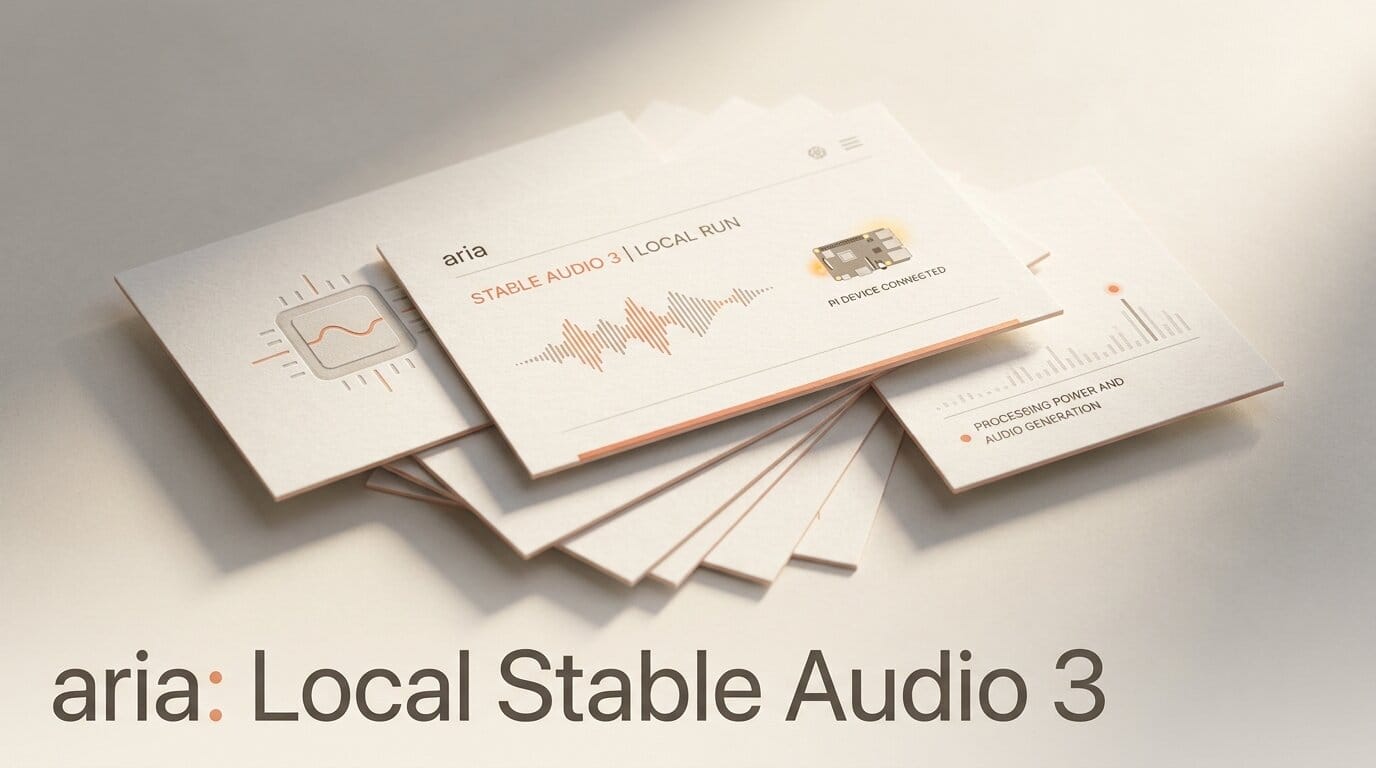
A pair of researchers just shrank studio-grade AI music generation down to a credit-card-sized computer. In a paper published on arXiv on July 9, 2026, Matteo Spanio and Antonio Roda introduced aria, a dependency-free native runtime that runs the full text-to-music pipeline of Stable Audio 3 on ordinary GPUs, CPU-only laptops, and an 8GB Raspberry Pi 5, with no Python and no deep-learning framework underneath.
The headline result is memory. Using 4-bit quantization, aria fits the 1.2-billion-parameter Stable Audio 3 model into the 8GB budget of a Raspberry Pi 5, and it starts roughly seven times faster than the official implementation while matching or exceeding generation speed. For creators who want local, private, no-subscription music generation, this is one of the clearest signals yet that on-device audio has arrived.
What aria Actually Does
aria is a native inference engine for audio diffusion models, written from scratch in C with no third-party dependencies. It owns every tensor in the pipeline: a tokenizer feeds a T5Gemma text encoder, a DiT (diffusion transformer) denoiser generates the latent, and a taae_v2 decoder renders it out to a stereo WAV file. Beyond straight text-to-music, it also supports audio continuation and inpainting.
The base model is Stability AI's Stable Audio 3, the 1.2-billion-parameter open-weight family released in May 2026 that produces 44.1kHz stereo tracks up to six minutes long. aria targets the small-music and medium variants, the ones Stability explicitly shipped for on-device composition. Because aria is plain C with an optional CUDA backend, the same binary runs on a workstation GPU, an aging laptop, or a Pi.

aria vs the Official Stack: A Quick Comparison
The official way to run Stable Audio 3 is a Python and PyTorch stack, the kind of framework-heavy setup built for datacenter GPUs. aria takes the opposite approach. Stability AI's own May 2026 launch emphasized on-device use, and aria is what that promise looks like in practice.
| Aspect | aria | Official SA3 (PyTorch) |
|---|---|---|
| Runtime | Native C, zero dependencies | Python plus PyTorch and CUDA stack |
| Startup | About 7x faster | Baseline |
| Minimum hardware | 8GB Raspberry Pi 5, CPU-only laptops, cheap GPUs | Datacenter or high-end consumer GPU |
| Quantization | fp32, 8-bit (q8), 4-bit (q4) built in | Full precision by default |
| Controllability | Training-free activation steering | Prompt and conditioning inputs |
| License | MIT code, Stability Community License weights | Stability Community License |
On an RTX 3070, aria generates a 10-second, 8-step clip in about 0.29 seconds warm, and the medium model finishes a full GPU run in roughly 2.2 seconds. The point is not raw speed on a fast card, it is that the identical pipeline degrades gracefully all the way down to a Pi.
How to Run Stable Audio 3 Locally With aria
The workflow is short enough to fit in a terminal session. aria is open source on GitHub, and the model weights come from Stability AI's Stable Audio 3 repository and Hugging Face.
- Build the binary. Run
makefor a CPU build, ormake cuda CUDA_ARCH=sm_86to enable the GPU backend for your card. - Download a model. Use
./download_model.sh small-musicto pull the small-music variant, the lightest option for constrained hardware. - Export the tokenizer. Run
python scripts/export_tokenizer.py models/small-musiconce to prepare the tokenizer assets. - Generate audio. Call
./aria -m models/small-music -p "warm romantic piano" -d 15 -s 8 -o out.wav, where-dsets duration in seconds and-ssets diffusion steps. - Tighten the footprint. Add
--precision q8or--precision q4to fit smaller memory budgets, including the Raspberry Pi.

The Quantization Breakthrough: 4-bit on a Raspberry Pi
Quantization is the heart of the paper. Instead of adding memory to compress the model, aria quantizes in place, saving memory where it matters. It offers full precision (fp32), 8-bit (q8), and 4-bit (q4) asymmetric integer quantization, and the researchers measured the quality cost with three independent checks: prompt adherence, overall audio quality, and taste preservation.
Eight-bit precision showed no measurable quality loss on any of the three measures while sharply cutting memory, and it was the fastest mode on the GPU. Four-bit added a small, bounded cost (about a 9 percent velocity error) but shrank the small-music DiT from roughly 1.6GB down to about 0.3GB, enough to run the full 1.2-billion-parameter model on an 8GB Pi. If you have followed int8 quantization in ComfyUI, this is the same idea pushed further and applied to audio.

Activation Steering and Sonic Seasoning
Because aria controls every internal tensor, it exposes something the framework stacks make awkward: training-free activation steering. The runtime can add a tensor at a known boundary in the pipeline, whether the diffusion latent, a DiT residual, the conditioning vectors, or the pre-decode latent, to nudge the output in a chosen direction.
The paper's case study calls one application "sonic seasoning," biasing generations toward specific taste associations without retraining or fine-tuning. For a creator, that is a lever for consistent mood or timbre across a set of clips, applied at inference time and reversible on the next run.
What This Enables for Creators
The practical unlock is local, private, and free-to-run music generation. A game developer prototyping level themes, a video editor scoring a rough cut, or a musician sketching loops can now generate royalty-friendly audio on hardware they already own, with no per-generation cost and no upload of prompts to a cloud service. aria joins a growing shelf of dependency-light local audio engines, alongside the wave of C and C++ audio models that skip Python entirely.
It also lowers the bar for building on top. Because the runtime is MIT-licensed C with a clean pipeline, it is a plausible base for an offline plugin, a batch render farm on cheap boxes, or an embedded instrument. Compared to cloud APIs and even to open toolkits like Meta's AudioCraft, aria's zero-dependency footprint is what makes edge deployment realistic.
What to Do Next
- Clone the aria repository and build the CPU binary to try a first generation on your laptop.
- Start with the small-music model and q8 precision for the best quality-to-memory balance, then test q4 if you are targeting a Pi or a low-RAM machine.
- Experiment with duration and step counts to trade render time against fidelity for your use case.
- If you build something on top of aria, document the model license terms, since the weights ship under Stability AI's Community License even though the code is MIT.
Frequently Asked Questions
What is aria?
aria is a dependency-free native runtime, written in C, that runs the complete Stable Audio 3 text-to-music pipeline on commodity and embedded hardware, including CPU-only laptops and an 8GB Raspberry Pi 5. It was introduced in a July 2026 arXiv paper by Matteo Spanio and Antonio Roda.
Which model does aria run?
It runs Stable Audio 3, Stability AI's 1.2-billion-parameter open-weight audio model, specifically the small-music and medium variants that were released for on-device use. The code is MIT-licensed, but the weights fall under the Stability AI Community License.
Can it really run on a Raspberry Pi?
Yes. With 4-bit quantization, aria fits the 1.2-billion-parameter model into the 8GB memory of a Raspberry Pi 5. The 4-bit mode adds a small, bounded quality cost of roughly 9 percent velocity error, while 8-bit runs with no measurable quality loss on a machine with more memory.
How much quality do you lose with quantization?
The researchers measured prompt adherence, overall audio quality, and taste preservation against normal seed-to-seed variation. Eight-bit precision showed no measurable loss on any of the three. Four-bit added a small, bounded cost in exchange for a much smaller memory footprint.
How does aria compare to the official Stable Audio 3 code?
The official stack is Python and PyTorch built for larger GPUs. aria is native C with zero dependencies, starts about seven times faster, matches or exceeds generation speed, and adds built-in quantization plus activation steering. The trade is that you build and run it from source rather than a packaged framework.
What is activation steering, or sonic seasoning?
Activation steering is a training-free way to bias what the model generates by adding a tensor at a known point in the pipeline. The paper's case study, nicknamed sonic seasoning, uses it to push generations toward chosen taste associations without retraining, applied at inference time and reversible between runs.
Is aria free to use?
The aria code is released under the MIT license, so it is free to use and modify. The Stable Audio 3 weights it loads are governed separately by Stability AI's Community License, which you should review before any commercial deployment.