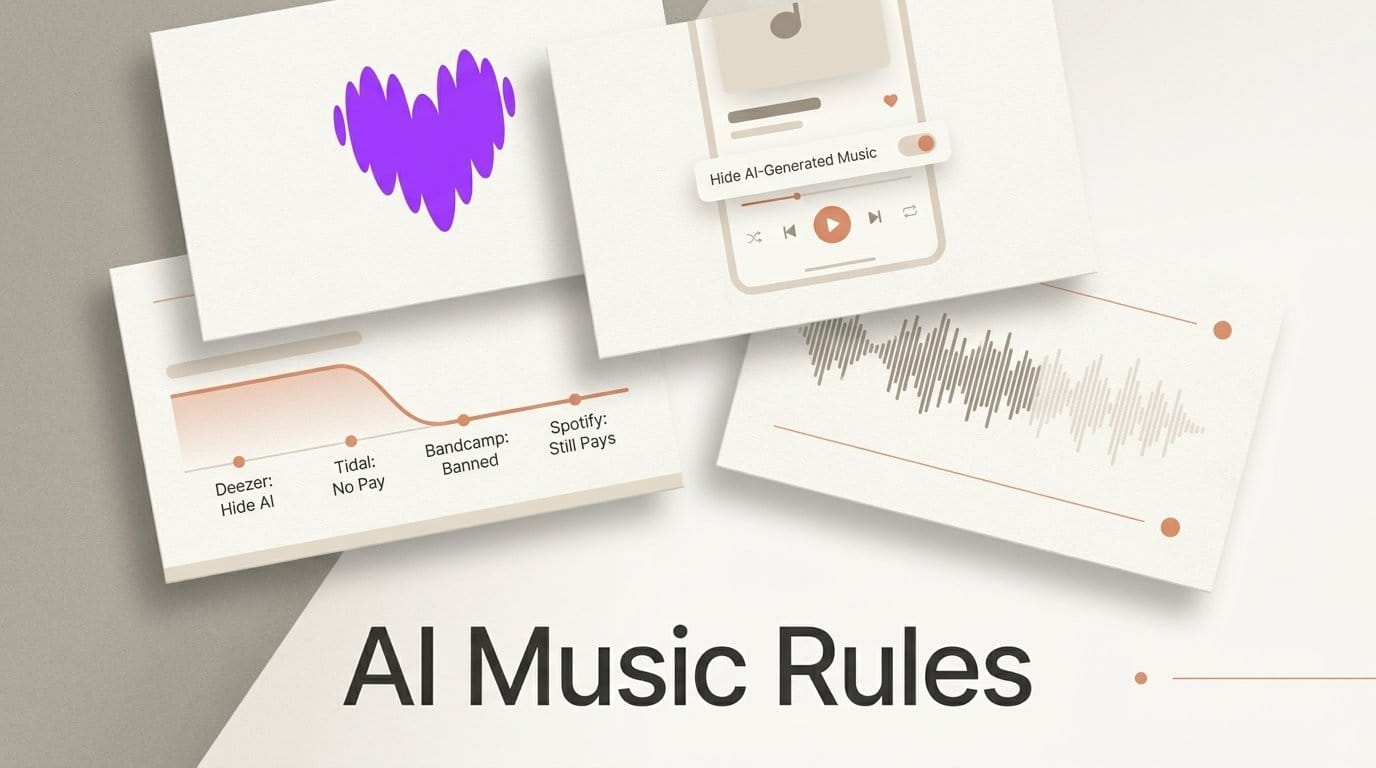
If you release songs made with Suno or another AI music app, the service you upload to now decides whether anyone finds them and whether you get paid. Deezer announced on October 13, 2026 that listeners will get a switch that removes fully AI-generated tracks, albums and the related artists from search, rolling out worldwide before the end of 2026. A day later, YouTube Music started labelling songs made primarily with generative AI. That makes seven major music services with a written AI rule, and the rules no longer agree with each other.
We read the current policy of each one: Deezer, Spotify, YouTube Music, Apple Music, Tidal, Qobuz and Bandcamp. The short version: a fully AI-generated song is still allowed on most of them, Spotify is the only one that has said in writing, for music specifically, that it recommends and pays it like any other song (as long as the artist is not a fake human), while Tidal no longer pays for it and Bandcamp bans it outright. The split that matters everywhere is between songs generated whole by an app and songs where AI helped a human make the music. Here is how each service draws that line, and how to release an AI-assisted song so it keeps its reach.
What Deezer announced, and what it already does
The new switch only covers search. When a listener turns it on, fully AI-generated tracks, albums and the artists behind them stop appearing in their Deezer search results, and turning it off brings them back. Chief executive Alexis Lanternier said: "We've seen a clear user demand for the ability to filter out AI-generated music." Deezer points to its own survey with Ipsos of 9,000 people in eight countries, in which 45% of streaming users said they want to filter out music that is 100% AI-generated, and 97% could not tell such music from human-made songs in a blind test.
The bigger penalties are already in place. Deezer detects AI music with its own tool, which it also licenses to other companies, and tags albums that contain it. Tracks it detects as AI-generated are automatically left out of algorithmic recommendations and editorial playlists. Deezer says it detected and excluded more than 42 million such tracks between January 2025 and August 2026, and tagged more than 14 million albums.
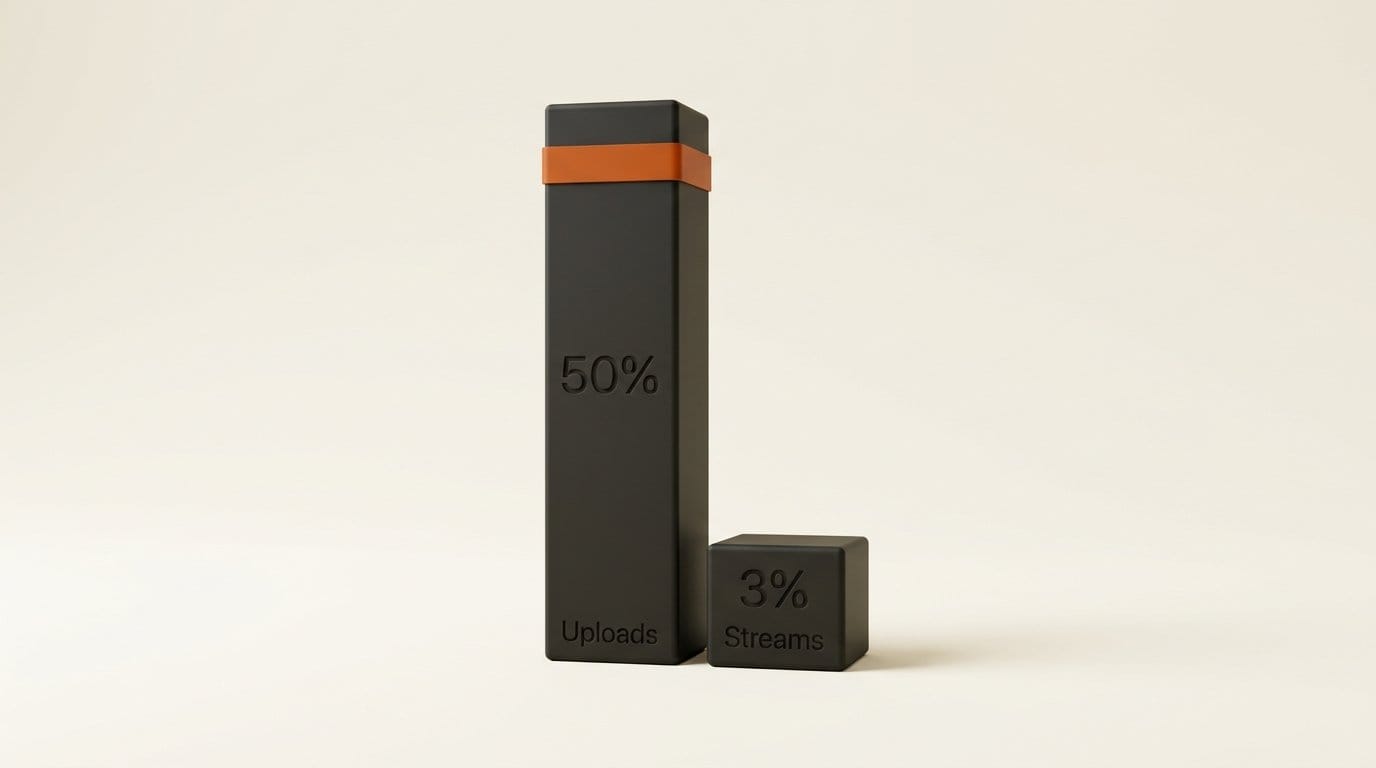
In a July 21, 2026 update, Deezer added two removal rules for AI tracks: it takes down AI tracks used for streaming fraud, and AI tracks that have not been streamed for six months or more. Its numbers explain why. Nearly 90,000 fully AI-generated tracks arrive every day, more than 50% of all new deliveries on peak days, yet they earn only 1-3% of streams. Up to 85% of the streams those tracks did get in 2025 were fraudulent, and fraudulent streams are removed from the royalty pool. Deezer says further steps, including removing or demonetizing AI content through a change to its supplier policy, are under consideration but not decided.
Where an AI song is paid, hidden or banned
This table covers songs a service treats as fully AI-generated. Every service handles AI-assisted music more gently, and we come back to that line in the next section.
| Service | Allowed? | Labelled? | Recommended? | Paid? |
|---|---|---|---|---|
| Spotify | Yes | Optional AI credits; "AI Persona" badge on AI-generated artists | Yes, unless the artist has the AI Persona badge | Yes, on the same rules as any song |
| YouTube Music | Yes | Yes, on the player page since October 14, 2026 (Fully, Partly or No Gen AI) | No change announced | No change announced |
| Deezer | Yes, but removed if used for fraud or unplayed for 6 months | Yes, album tag since 2025 | No, left out of algorithms and editorial playlists | Fraudulent streams are not paid |
| Apple Music | Yes | Tags applied by your label or distributor | No change announced | No change announced |
| Tidal | Yes, can be streamed | Yes, "AI" badge | Not stated | No royalties or fan sales since July 15, 2026 |
| Qobuz | No, its contracts forbid delivering it | Yes, album badge | No, and hidden from search unless you type the exact title | Fraudulent streams are not paid |
| Bandcamp | No, banned since January 13, 2026 | Not applicable | Not applicable | Not applicable |
Two patterns stand out. First, being allowed is not the same as being heard: on Deezer and Qobuz a fully AI song can sit in the catalog while the recommendation engine never plays it to anyone, and once Deezer's switch arrives some listeners will not find it in search either. Second, Spotify is the only service that has put in writing that a fully AI song is recommended and paid on equal terms, and even there the protection depends on the artist profile, not the song.
The line every service draws: generated or assisted
None of these rules target musicians who use AI as one tool among many. Each one aims at music an app generated whole, and each says so in its own words. Deezer's switch covers "fully" AI-generated music and states that "music that includes limited AI-assisted elements as part of a broader human creative process is treated differently." Qobuz's charter supports AI "as a creative tool for human artists" and opposes the "industrial production of AI-generated content, without human creative intervention." Tidal's cut applies to tracks it identifies as fully AI-generated.
The catch is that no service publishes an exact threshold, although YouTube's worked examples, covered below, come closest. Bandcamp bans music "generated wholly or in substantial part by AI" without defining "substantial." Apple's tags apply when AI made "a material portion" of a track, its lyrics, its artwork or its video, again undefined. In practice, a song typed into Suno as a prompt and uploaded unchanged sits on the generated side of every one of these rules. A song where you wrote the lyrics, sang or played parts yourself, and used AI for a backing track or a stem sits much closer to the assisted side, and it is the version these services say they still want.
Spotify: allowed and paid, unless the artist is fake
Spotify's position, set out in its September 2025 policy, is that "all music is treated equally, regardless of the tools used to make it," with royalties paid on listener engagement. What it polices is behavior. A spam filter tags uploaders and tracks that game the system and stops recommending them (Spotify says it removed over 75 million spammy tracks in a year), and AI voice clones are allowed only when the impersonated artist has authorized them.
The one AI-specific penalty is about identity. Since mid-September 2026, Spotify shows an "AI Persona" badge on artist profiles that represent AI-generated identities, whether the artist self-discloses in Spotify for Artists or Spotify's review team flags a profile whose name and imagery appear to be a photorealistic AI person. Badged artists are left out of editorial and algorithmic recommendations by default; only listeners who follow them still get them. Spotify says the badge "is about the artist's public identity, not about how the music was made," and flagged artists can appeal.
For disclosure about the music itself, Spotify runs AI credits, an optional beta that lets you mark AI use per role (lyrics, vocals, instruments, production) through supported distributors. Listeners see them in the song credits on mobile. Spotify does not say credits change recommendations or pay.
Tidal, Qobuz and Bandcamp: the hard lines
These three take the strictest positions, and each hits a different part of a release. Tidal lets fully AI-generated tracks stay up with an "AI" badge but, since July 15, 2026, they cannot be monetized, collect royalties or be sold direct to fans. Tidal also uses automated tools to remove AI music that impersonates an artist, and calls its policy a "living document."
Qobuz's AI charter, now in its second version from September 2026, goes further on paper: its contracts with distributors prohibit delivering 100% AI-generated content. Albums it still identifies as AI-generated get a badge, are left out of its algorithmic recommendations and human-picked sections such as New Releases, and drop out of search unless someone types the exact title. Bandcamp is simplest: since January 13, 2026, music made wholly or substantially by AI is not permitted, using AI to imitate other artists or styles is "strictly prohibited," and Bandcamp reserves the right to remove music on suspicion alone.
Apple Music: tags, no penalty announced yet
Apple has taken the lightest approach so far. In March 2026 it told the industry that labels and distributors should mark generative AI use with Transparency Tags across four elements, the track, the lyrics, the artwork and the music video, when AI made "a material portion" of one of them, according to Relix's report on the launch. Relix described the tags as optional for now, and Apple has not said tagged songs will be recommended less or paid less. Because the tags come from your distributor, what you declare at upload is what Apple sees.
YouTube Music: three labels, no penalty announced
YouTube Music began rolling out AI labels on October 14, 2026. A label appears on the player page when a song was "created primarily using generative AI," for example when a generative model made the composition and the vocals, and tapping it opens more detail. YouTube says the labels will also expand to the main YouTube app. It finds AI tracks through declarations from music partners and its own detection tools, so a song nobody declared can still be labelled.
YouTube's help page for music partners sets out three designations, and its examples are the clearest any service has published. Fully Gen AI: you typed a prompt into an AI music generator and downloaded the track. Partly Gen AI: AI made a bassline or a string section while you recorded your own vocals and instruments, or helped you brainstorm lyrics and melodies before you recorded; a music video made with a text-to-video model over fully human audio also counts as partly. No Gen AI: standard pitch correction such as Auto-Tune on a live vocal, or automated AI mastering. Partners declare through their delivery feed or in the attribute section of YouTube Studio, and if nothing is declared, YouTube may set the label from its own signals.
YouTube has not announced any recommendation or payment penalty for labelled songs. It says the music labels follow the same principles as its video labels, and for those it states that "a disclosure label alone does not change how a video is recommended or whether it's eligible to earn money" (YouTube, May 2026). TechCrunch's report on the launch reads it the same way: AI involvement alone does not make a track ineligible for monetization.
How to release an AI-assisted song in 2026
If you make music with AI tools and want it to reach listeners on every major service, these steps keep you on the safe side of all seven rules at once.
- Check you own the rights first. On Suno's pricing page, the Free plan comes with "no commercial rights"; Pro ($8 a month) and Premier ($24 a month) include commercial use rights. A song made on the Free plan should not go to a distributor at all.
- Put a human in the song. Write the lyrics, record your own vocal or an instrument, or rebuild the arrangement from stems in your editor. This is the difference between "generated" and "assisted" in every policy above.
- Declare AI use honestly at upload. Use your distributor's AI fields, which feed Spotify's AI credits, Apple's Transparency Tags and YouTube's Gen AI labels. If you upload to YouTube yourself, set it in the attribute section of YouTube Studio. On Spotify, disclosure alone does not reduce reach.
- Use a real artist identity. A made-up photorealistic AI singer is exactly what Spotify's AI Persona badge targets, and the badge removes you from recommendations.
- Never clone a real artist's voice or style. Spotify, Tidal and Bandcamp all ban unauthorized impersonation, and it is the fastest way to get a track removed.
- Build real listening, not volume. Deezer deletes AI tracks nobody plays for six months, and fake streams are stripped from royalties on Deezer and Qobuz. Ten songs with an audience beat a thousand uploads with none.
- Sell elsewhere if the song is fully generated. Bandcamp and Qobuz are closed to it and Tidal will not pay for it, so a fully AI song is better released on Spotify or sold from your own site.

What this means if you make songs with Suno
The direction across services is consistent even where the details differ: fully generated songs are being labelled, pushed out of recommendations and, on Tidal, unpaid, while human-led music made with AI help is left alone. Deezer's new switch adds listener choice on top of rules it already enforces, and it is unlikely to be the last. Suno itself has moved the same way, retiring every older model for licensed v6 models and adding download caps by tier.
Deezer's own figures show what pure volume earns: half of new uploads on peak days, 1-3% of streams. If you want to know how a track will be classified before you release it, Deezer also runs a free AI music detector that scans any playlist. If your song needs to be fully generated, release it where it is paid, and keep the version you plan to build a career on on the assisted side.

Frequently asked questions
Can I upload AI-generated music to Spotify?
Yes. Spotify says all music is treated equally regardless of the tools used, and pays royalties on listener engagement. It removes spam and unauthorized voice clones, and since mid-September 2026 it keeps artists with an "AI Persona" badge out of editorial and algorithmic recommendations unless a listener follows them.
When will Deezer's AI music filter be available?
Deezer announced it on October 13, 2026 and says it will roll out worldwide before the end of 2026. It has not given an exact date. When switched on, it removes fully AI-generated tracks, albums and related artists from search results.
Does Tidal pay royalties on AI-generated music?
Not on music it identifies as fully AI-generated. Since July 15, 2026, those tracks cannot be monetized, collect royalties or be sold direct to fans on Tidal, although they stay available to stream with an "AI" badge.
Is AI music allowed on Bandcamp?
No. Since January 13, 2026, Bandcamp does not permit music generated wholly or in substantial part by AI, and it prohibits using AI to imitate other artists or styles. Music that uses AI as a small part of a human-made song is not what the policy targets, but Bandcamp has not defined "substantial."
Does YouTube Music label AI-generated songs?
Yes, since October 14, 2026. A label on the player page marks songs created primarily with generative AI, and YouTube says it will expand to the main YouTube app. Songs are classed as Fully, Partly or No Gen AI from partner declarations and YouTube's own detection. Auto-Tune and automated AI mastering count as No Gen AI, and YouTube has not announced any recommendation or payment penalty.
Do I have to tell streaming services my song used AI?
It depends on the service and your distributor. Apple asks labels and distributors to apply Transparency Tags, YouTube asks music partners to declare Fully, Partly or No Gen AI, Spotify's AI credits are optional, and Qobuz's contracts forbid delivering fully AI-generated songs at all. Declaring honestly does not reduce reach on Spotify, while hiding AI use risks removal where a service's own detection finds it.
What counts as fully AI-generated music?
No service gives a precise definition. In practice, a song generated whole from a text prompt and uploaded unchanged counts as fully AI-generated everywhere. Songs where a person wrote the lyrics, performed parts or rebuilt the arrangement are treated as AI-assisted, which Deezer, Qobuz and Tidal say they handle differently.