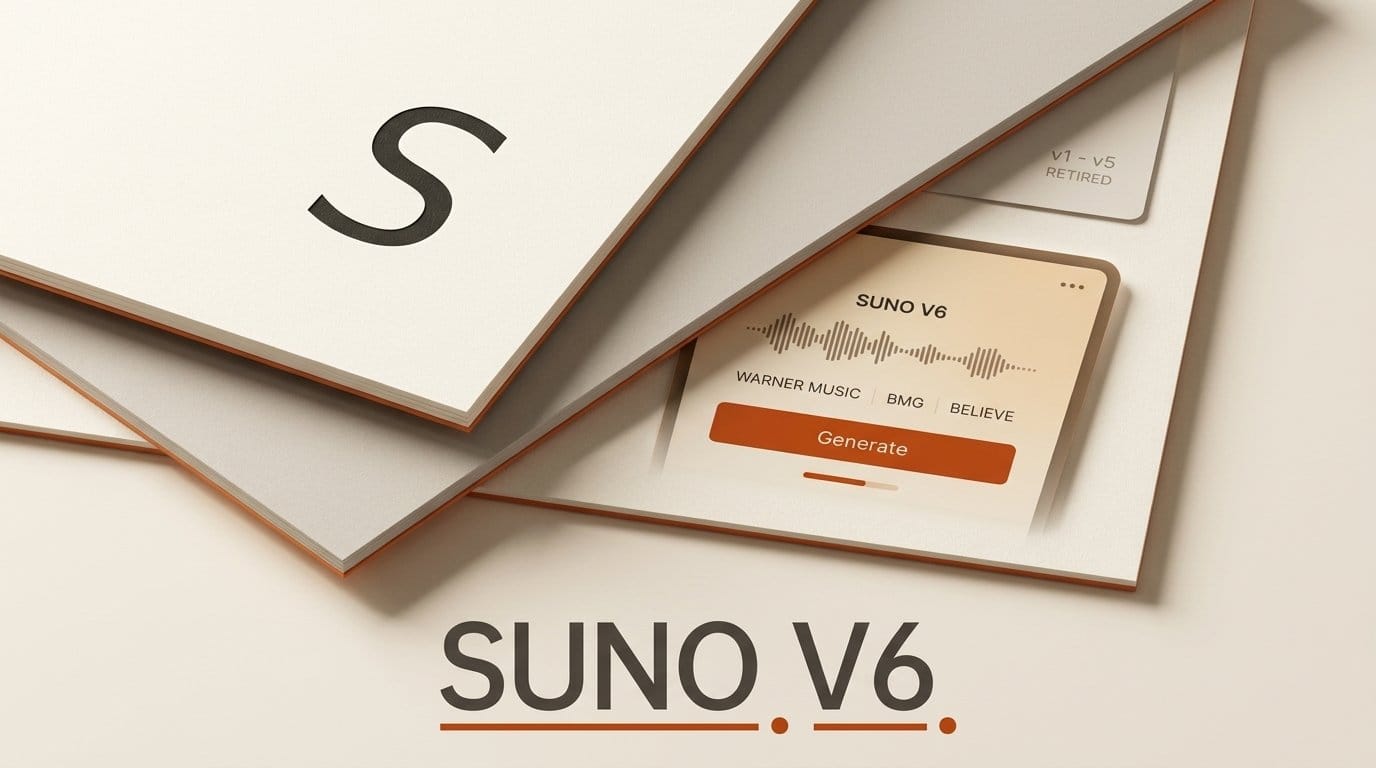
Suno launched v6 on September 9, 2026, a new generation of music models built with Warner Music Group, BMG and Believe. It is the first Suno generation developed with rightsholders rather than against them, and the company says it was trained from scratch: v6 is not trained on the data used for previous versions.
Most coverage is reading this as a legal story, and TechCrunch frames it against the copyright suits still stacked against the company. For anyone who actually makes music with these tools, the news is narrower and more immediate. Suno is permanently retiring every model it has ever shipped, and attaching a distribution path to the ones that replace them. That is a forced migration with a rights upgrade bolted on, and the two halves land at the same time.
What Suno actually shipped
v6 is three models, not one. The flagship v6 is the precise one, aimed at polished output across genres. v6-wild is deliberately less predictable, built for exploration rather than delivery. v6-mini is the fast, efficient version, and it is the one available to everyone including free accounts. Unite.AI's writeup notes the split is a product decision as much as a technical one: the unpredictable model is now a separate product surface instead of a temperature slider.
The capability list is the most interesting part and the least covered. v6 supports editing a specific section of a finished song by describing the change in plain language, rather than regenerating the whole track. Suno's example is asking for a chorus to be sung by a gospel choir. It also handles mashups that pull elements from more than one source, isolating instruments out of a sample, and updating individual lyric lines in place. References can be text, audio, images or video.
Read as a list of features that is unremarkable. Read as a workflow change it is significant, because the thing that has always made generative music unusable for real production is that you could not fix one bar. You regenerated and hoped. Section-level editing is the difference between a slot machine and an instrument.
The part that costs you something
Every previous Suno model is going away. MusicRadar reports that all of Suno's previous models will be permanently retired as v6 rolls out, and Suno's own announcement says the product moves entirely onto the v6 generation.
This is not a version bump where the old endpoint keeps working. It is a clean-room replacement, and the reason is legal rather than technical: retiring the old models draws a boundary between the Suno that trained on scraped audio and the Suno that trained on licensed catalogues. The company needs that boundary. The cost of drawing it lands on users.
If you built anything on the previous generation, it is worth being specific about what that means. The v5.5 release added voice cloning and custom models, and a custom model is an artifact trained on a base that is being switched off. Suno has not said what happens to those. Anyone with a house sound tuned on v5 or v5.5 should assume it does not survive the transition and plan accordingly rather than waiting to be told.
There is a second, subtler cost. A model trained on the catalogues of three partners is drawing from a narrower distribution than one trained on the open internet. Music Ally raises the overfitting problem directly: if the training set and the feedback loop both skew toward what is popular, niche genres get pulled toward the centre. As one framing in that piece puts it, an artist working in a narrow genre does not want the model skewing toward pop. Nobody can measure this yet. It is the right thing to test first.

What you get in return
The compensation for the migration is the thing creators have wanted from AI music since the category existed: a sanctioned way to release the output.
Suno announced a partnership with Believe and TuneCore on September 8, one day before v6. Tracks made with the industry partner model become eligible for distribution through both. TuneCore is one of the largest self-release platforms in music, and the detail that matters is that Believe and TuneCore had previously declined to distribute Suno-generated music. They reversed that position for this deal.
That reversal is the story. Until now the practical answer to "can I put this on Spotify" was a shrug wrapped in a terms-of-service clause. Commercial use rights on a Suno subscription have never been the same thing as a distributor willing to accept the track. This is the first time the two line up.
Suno also says it will begin sharing a portion of revenue with its partners from v6's launch, and is building opt-in products where individual artists can have their name, likeness, voice and compositions used, with compensation. No percentages, thresholds or payment mechanics have been published. The remix tools that program is built around are not shipping today.
How this compares on the dimension that matters
Output rights, not audio quality, is what has separated these tools in practice. Here is where the main options stand as of September 9, 2026.
| Tool | Training data | Distribution path | Model access |
|---|---|---|---|
| Suno v6 | Licensed: Warner Music Group, BMG, Believe, plus user data | Eligible via Believe and TuneCore | v6 and v6-wild on Pro and Premier, v6-mini on all tiers |
| Udio | Licensed catalogue under label agreements | Platform-native, walled | Subscription |
| ElevenLabs Music | Licensed partnerships | Commercial use by plan, no bundled distributor | Subscription and API |
| Stable Audio 3 | Open weights, licensed dataset | Self-managed, you own the pipeline | Local or self-hosted |
Suno's paid tiers are Pro at $8 a month and Premier at $24, both including commercial use rights, with annual billing at a 20% discount. Free accounts get v6-mini but no commercial rights and no downloads. We covered the download caps those tiers introduced when they landed, and they still govern how much finished audio you can actually take off the platform, which is a separate constraint from the licensing one.
The comparison worth internalising: Udio went licensed earlier but kept output inside its own walls, which made it a fan platform rather than a production tool. Suno is the first to pair a licensed model with an external distributor. If you want to avoid the question entirely, open weights like Stable Audio 3 leave you owning the whole pipeline, at the cost of doing the work yourself.

What Suno has not said
Three gaps are worth naming, because each one changes the decision and none has an answer yet.
What happens to songs already generated on retired models is unaddressed. No source covering the launch has this, and Suno's announcement does not mention it. Retiring a model and deleting its output are different things, but the company has not said which one this is.
Whether the distribution eligibility is retroactive is also unclear. The language is that tracks created with the industry partner model become eligible, which reads as v6 forward only. A back catalogue made on v5 is likely outside it.
And the litigation is not over. Suits from Universal Music Group, Sony Music, individual musicians including David Lowery and Jason Isbell, Canada's SOCAN and Round Hill Music remain live. The Warner settlement was reached in November 2025 and BMG and Believe followed; the rest have not. We tracked those cases as they split, and v6 does not resolve the ones still open. It cauterises the exposure going forward.
What to do this week
If you use Suno seriously, three things are worth doing before the retirement completes rather than after.
Export everything you care about from the older models now, at the highest quality your tier allows, and keep the stems. This is the cheapest insurance available and it stops mattering the moment the switch happens.
Then run your own overfitting test. Take three prompts in the narrowest genre you work in, generate on v6-mini and on whatever older model is still reachable, and compare. You are listening for the licensed model pulling toward the centre. If it does, you have found the real cost of this transition before it costs you a deadline.
Last, if commercial release is why you are here, the TuneCore route is the new thing on the table and it is worth testing end to end with one throwaway track before you commit a real one.
Frequently asked questions
Is Suno v6 available now?
Yes. Suno announced v6 on September 9, 2026 and it is live. v6 and v6-wild require a Pro or Premier subscription. v6-mini is available to all users including free accounts.
What happens to my songs made on Suno v5?
Suno has not said. The announcement covers retiring the models and does not address existing generated tracks. Export anything you need at your tier's highest quality now rather than assuming it persists.
Can I release Suno v6 tracks commercially on Spotify?
Tracks made with the industry partner model are eligible for distribution through Believe and TuneCore, which is a genuine distribution path rather than just a terms-of-service permission. Commercial use rights themselves come with the Pro and Premier tiers. Free accounts have neither.
Was Suno v6 really trained on different data?
That is Suno's claim. The company states v6 is not trained using the data used for previous versions, and was built on licensed material from Warner Music Group, BMG and Believe alongside user data. The claim has not been independently audited.
What is the difference between v6 and v6-wild?
v6 is tuned for reliable, polished results across genres. v6-wild is deliberately less predictable and more varied, aimed at exploration. Both are limited to Pro and Premier subscribers.
Do the lawsuits against Suno go away now?
No. Warner settled in November 2025 and BMG and Believe signed partnerships, but claims from Universal Music Group, Sony Music, individual artists, SOCAN and Round Hill Music are still active. v6 addresses future training, not past training.
Will artists get paid when their work is used?
Suno says it will share a portion of revenue with its label partners from launch, and is developing opt-in products where individual artists are compensated for use of their name, likeness, voice and compositions. No rates, thresholds or mechanics have been published, and the remix tools that program depends on are not shipping yet.