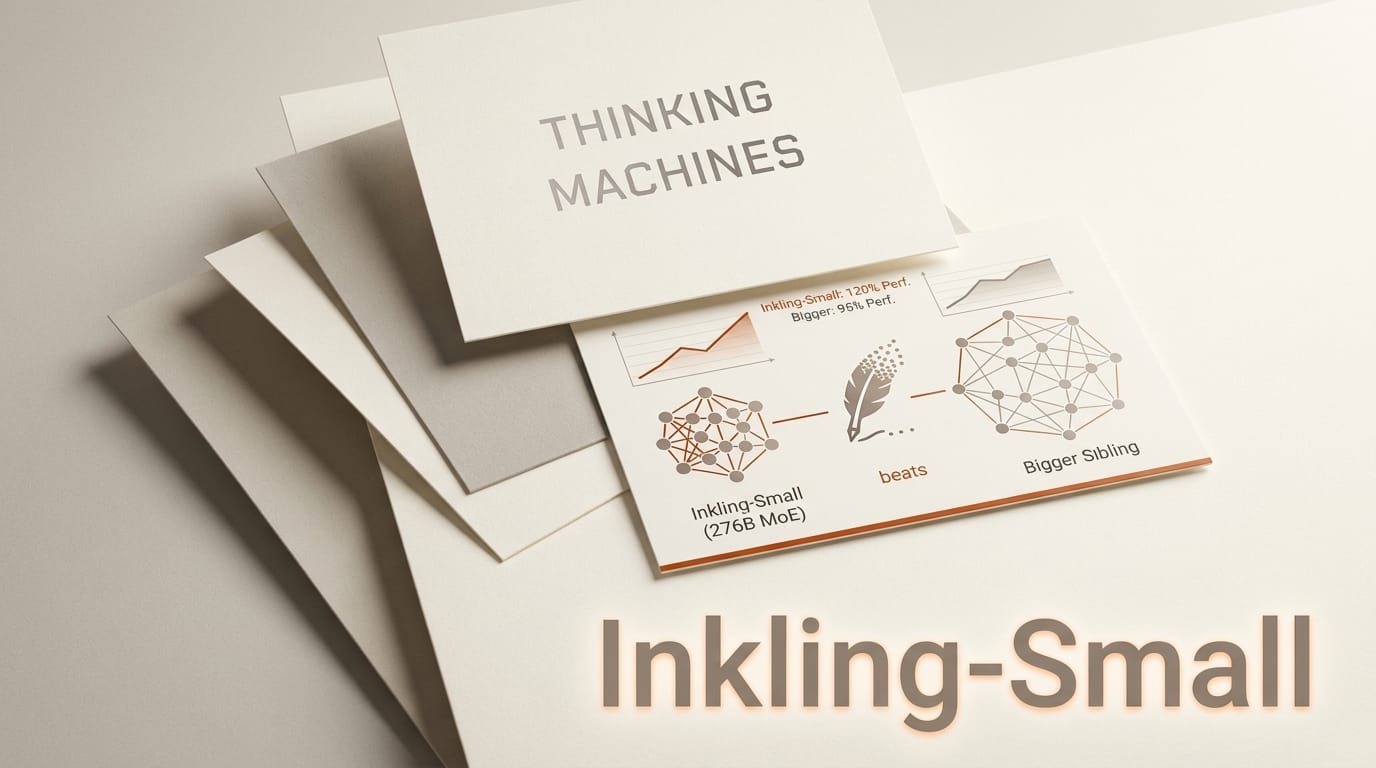
Thinking Machines Lab released Inkling-Small on July 30, 2026, a compact open-weight version of its Inkling multimodal model. It is a Mixture-of-Experts transformer with 276B total parameters but only 12B active per token, and it accepts text, image, and audio input while generating text. Despite being roughly a quarter the size of the original Inkling, it matches or beats it on several reasoning and coding benchmarks.
Try It: Run or Fine-Tune a Frontier-Class Open Model
The full weights are published on Hugging Face, so you can pull the model and serve it yourself with a standard MoE-capable inference stack. If you would rather not manage GPUs, you can fine-tune Inkling-Small through Thinking Machines' Tinker service and test text, image, and audio chat directly in the Tinker Playground. At $1.20 per million output tokens versus the larger Inkling's $4.05, it is cheap enough to sit inside an agent loop or a batch pipeline that would be too costly on the flagship tier.
Why It Matters
Open-weight releases that shrink a frontier model without gutting quality are the ones creators and builders can actually deploy. Inkling-Small keeps the 1M-token context window and native reasoning over audio and images from its larger sibling, so long-document and multimodal workflows carry over. Independent coverage from TestingCatalog notes the smaller model even edges ahead on agentic coding, which makes it a credible self-hosted backend for coding agents that previously needed a closed API.
Key Details
According to the model card, Inkling-Small scores 31.6% on Humanity's Last Exam against Inkling's 29.7%, and 80.2% on SWE-bench Verified versus 77.6% for the full model. The original Inkling still leads on knowledge coverage and factuality, so the trade is efficiency and agentic strength for breadth of recall. The model was trained on NVIDIA GB300 NVL72 systems and released under an Apache 2.0 license, with variable "thinking effort" controls carried over from Inkling.
What to Do Next
Benchmark Inkling-Small against whatever open model currently backs your coding agent or multimodal pipeline, using SWE-bench-style tasks and your own audio or image prompts. If it holds up, the 12B active-parameter footprint and lower token price make it a straightforward swap for teams trying to move off metered closed APIs without losing reasoning quality.