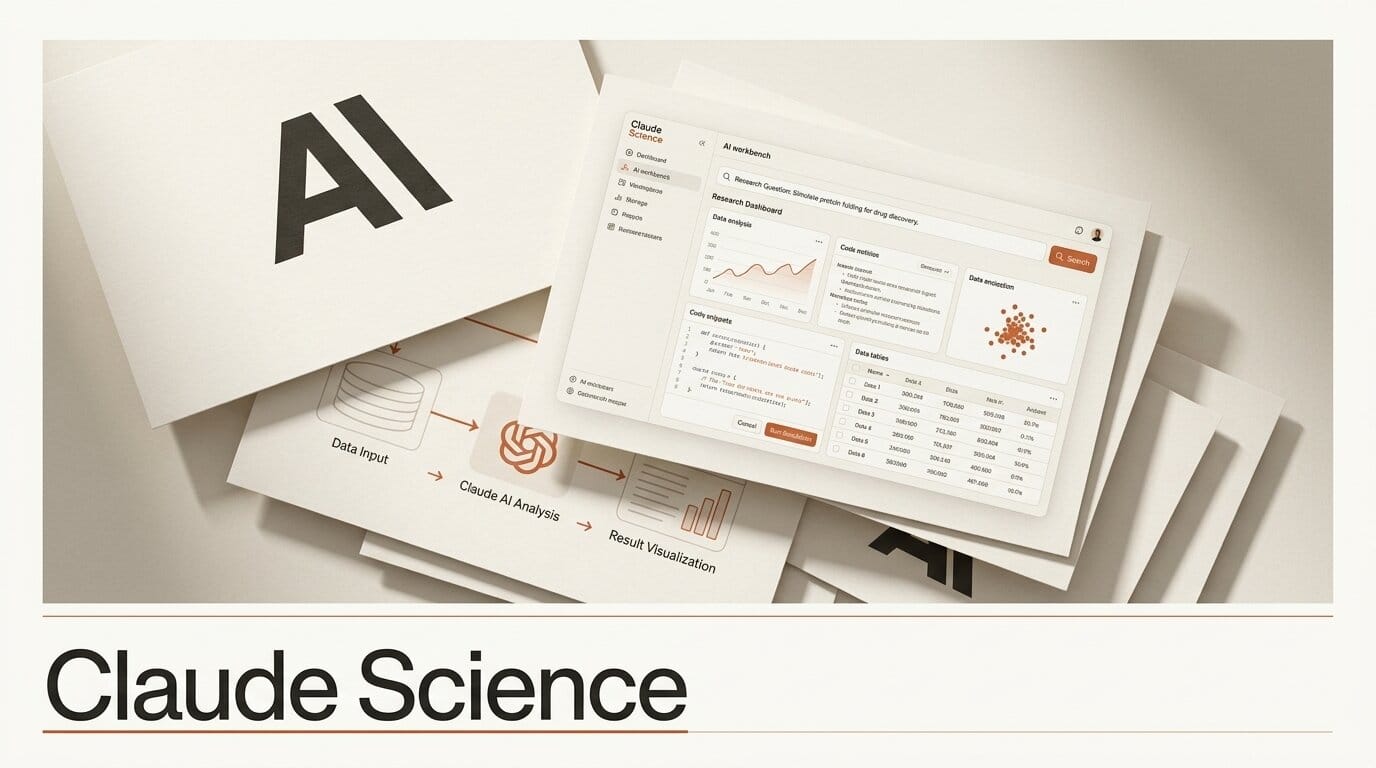
Anthropic launched Claude Science on June 30, 2026, a beta AI workbench that pulls a researcher's scattered tools into a single agentic environment. It runs the same Claude models already on sale, including Opus 4.8, and is the company's clearest bet yet that the workflow layer, not a new model, is where agentic apps win. TechCrunch framed it as exactly that play.
What Happened
Claude Science is a desktop app, in beta for macOS and Linux, available to Claude Pro, Max, Team, and Enterprise users with no special model access. Instead of shipping a science-specific model, Anthropic wrapped its existing agents in a research workbench that handles literature analysis, multistep execution, figure generation, and compute management in one place. As STAT News reported, the debut leaned on pharma and academic heavyweights to prove the workflow holds up on real research.
Why It Matters
For anyone building with AI, Claude Science is a reference design for a vertical agent. It is the same Claude agent platform creators already use, hardened with domain skills, reproducibility, and reviewer agents that flag bad citations and untraceable numbers. The lesson generalizes: a usable agentic app is mostly connectors, guardrails, and an environment that remembers context, not a bespoke model. The New Stack noted the auditing layer as the real differentiator.
Key Details
- Natively renders 3D protein structures, genome browser tracks, chemical structures, and publication-ready figures, each with the exact code and environment that produced it.
- Manages compute from a single GPU to hundreds across laptops, HPC clusters, and on-demand services like Modal, with persistent Python and R kernels.
- Ships 60-plus curated skills and connects to 60-plus scientific databases including UniProt, PDB, Ensembl, and ChEMBL, plus NVIDIA's BioNeMo Agent Toolkit.
- Reviewer agents check citations and calculations, and every artifact carries full message history for validation months later.
- Anthropic is funding up to 50 AI for Science projects with as much as 30,000 dollars in credits each, per the product page, with applications open through July 15, 2026.
What to Do Next
If you are on a Pro, Max, Team, or Enterprise plan, you can download the macOS or Linux beta today and point it at a real analysis to see how the reproducibility trail behaves. Builders studying agentic app design should treat the skills-and-connectors architecture as a pattern to copy. The launch landed the same day as Claude Sonnet 5, part of a broader push to put Claude agents inside the tools people already work in, much like Claude Tag in Slack.