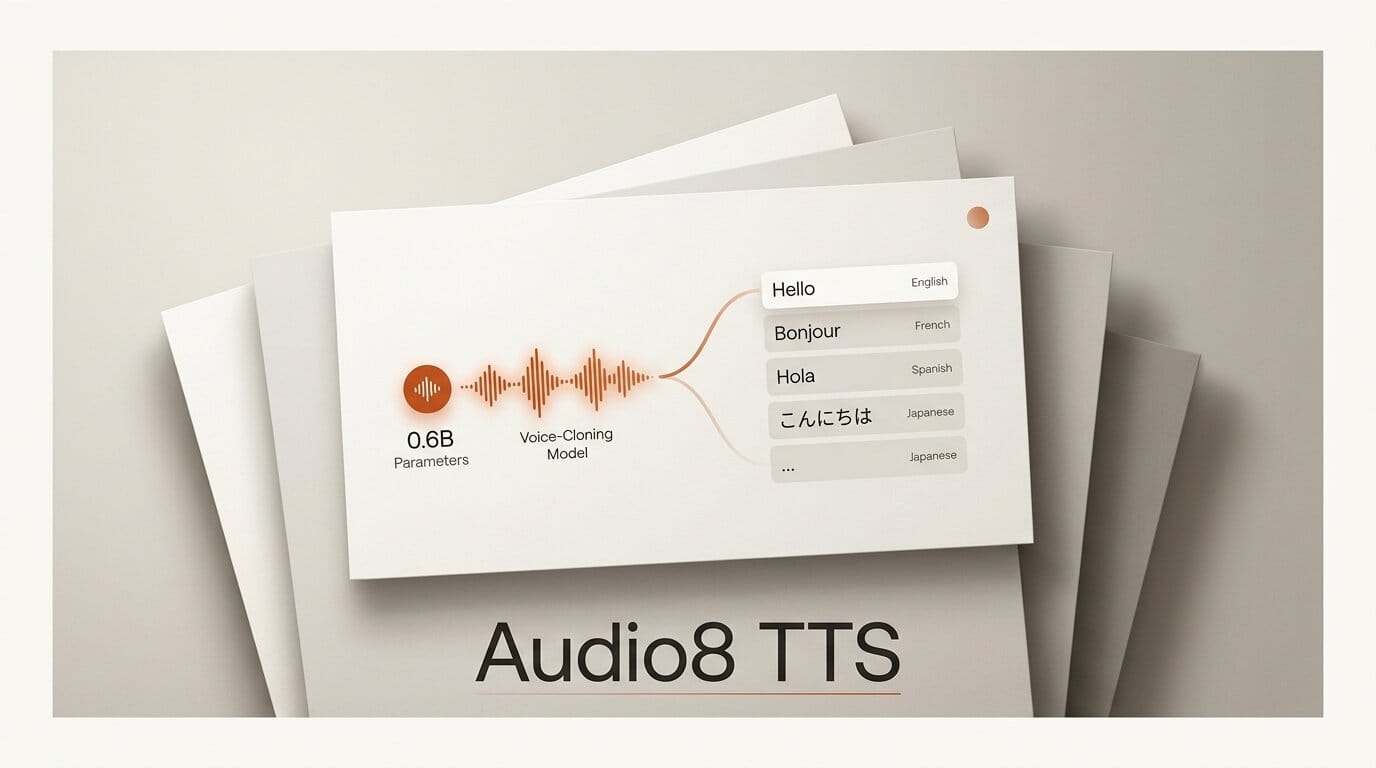
On July 29, 2026, an organization called Audio8 released Audio8 TTS Preview 0.6B, an open-weights text-to-speech model that clones a voice from a few seconds of reference audio and speaks in 11 languages. At just 0.6 billion parameters and under an Apache 2.0 license, it is small enough to run on a laptop and free to use in commercial projects.
Try It: Clone a Voice From One Short Clip
Download the model from Hugging Face, feed it a 5 to 10 second clip of any speaker, and type the text you want spoken in their voice. Because the model is multilingual, you can supply an English reference and have it read Japanese, French, or Korean while keeping the speaker's timbre. For creators that is a fast path to consistent narration across a video series, localized voiceovers without re-recording, or a personal reading voice for long-form text, all generated on your own machine with no per-character fee. Few open cloning models ship this small, and you can browse the field in the Hugging Face text-to-speech catalog.
Why It Matters
The zero-shot voice cloning space has been dominated by hosted APIs that meter usage and closed weights that cannot be inspected or fine-tuned. A 0.6B open model changes the math for independent creators: it is cheap to run, private by default, and legal to embed in a commercial pipeline. Multilingual coverage across Cantonese, Chinese, Dutch, English, French, German, Italian, Japanese, Korean, Polish, and Spanish means one model can handle a global content slate. You can test where it lands against incumbents on the community TTS Arena leaderboard before committing it to production.
Key Details
Audio8 TTS Preview uses a DualAR design, the same slow-plus-fast transformer approach popularized by Fish Speech, which pairs a large autoregressive backbone with a lightweight decoder for faster synthesis. The weights ship as safetensors with custom inference code, and the Apache 2.0 license permits commercial use, modification, and redistribution. In its first two days on Hugging Face the preview drew roughly 96 likes and 225 downloads, early but real traction for a brand-new release. As a preview build, expect rough edges: prosody and stability on longer passages are the usual weak points for models this size, so audition output before you ship it. For a fully on-device setup, see our guide to running TTS locally with audio.cpp.
What to Do Next
Clone the model, run a side-by-side test against your current TTS on three sample scripts, one per target language, and compare naturalness and speaker match. If it holds up, wire it into your narration or localization workflow to cut recurring API costs. If you need studio-grade fidelity today, our breakdown of Fish Audio S2.1 Pro covers a more mature free cloning option to weigh against this preview.