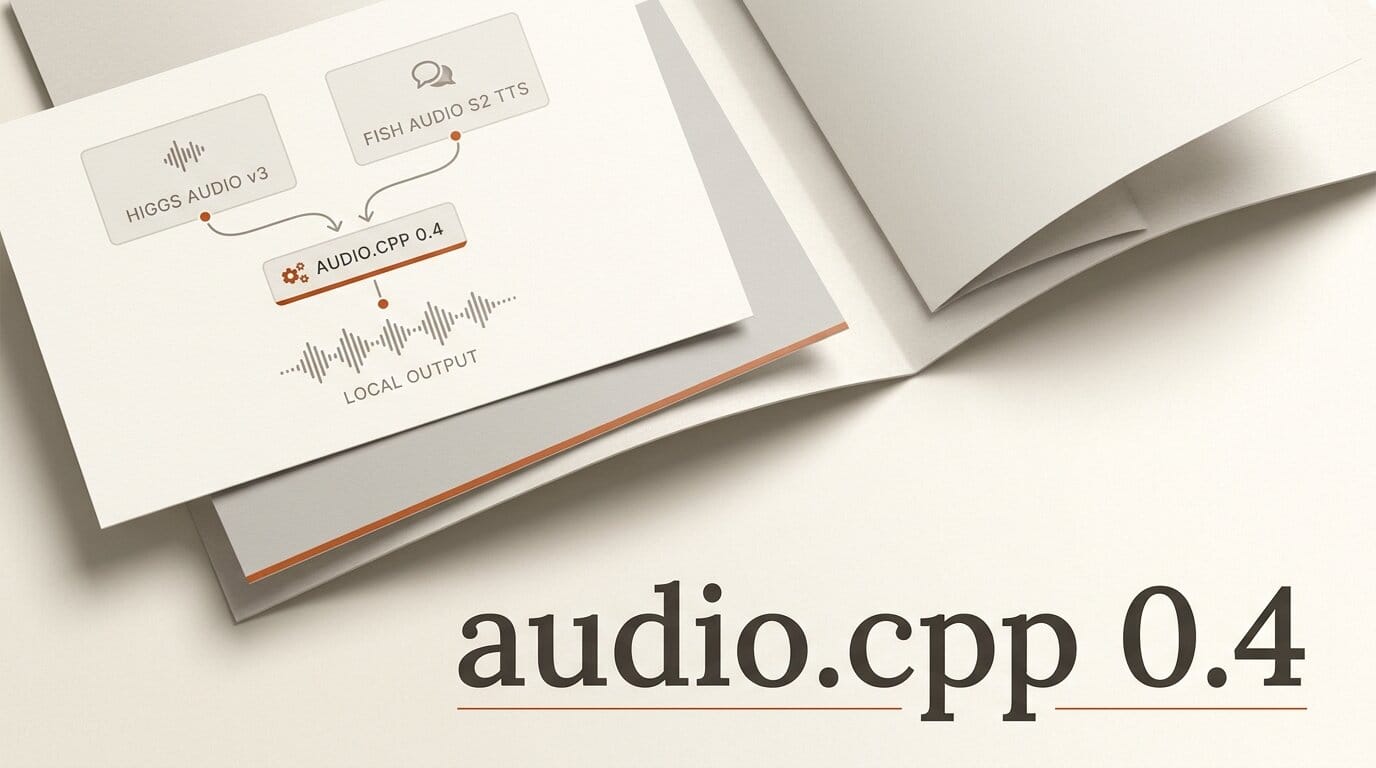
audio.cpp, the pure C++/ggml engine for running audio models without Python, shipped version 0.4 on July 24, 2026. The release adds three of the most talked-about recent speech models, Higgs Audio v3 TTS 4B, Fish Audio S2 Pro, and Voxtral Realtime ASR, and pushes the engine past 35 supported model families, all running locally on CUDA with GGUF weights.
Try It: Run Flagship TTS Locally
If you generate voiceovers, narration, or character dialogue, 0.4 lets you swap a paid cloud TTS API for a local binary. Build the engine with the platform script (build_linux.sh, build_windows.ps1, or build_metal.sh), pull a quantized model from the audio.cpp GGUF collection, and run one CLI command: audiocpp_cli --task tts --model <path> --backend cuda --text "your script". A Gradio WebUI and a server mode ship in the same 0.4 release if you would rather point a browser at it than type commands.
Why It Matters for Creators
The headline addition is Higgs Audio v3, Boson AI's 4B expressive TTS model, which audio.cpp clocks at roughly 8.8x to 10.1x faster than real time in Q8_0. That means a minute of narration renders in a few seconds on a single consumer GPU, with no per-character billing and no audio leaving your machine. For anyone producing a steady volume of voice content, that combination of speed, cost, and privacy is the whole pitch.
Version 0.4 also lands only ten days after audio.cpp 0.3 added the Supertonic models, a cadence that shows how fast the local-audio stack is closing the gap with hosted services.
Key Details
New models. Higgs Audio v3 TTS 4B, Fish Audio S2 Pro (about 3.1x to 3.4x real time), and Voxtral Realtime ASR (offline and streaming, around 15.7x real time in Q8_0 GGUF). Community models OuteTTS and VieNeu-TTS join the ecosystem.
Efficiency. Q8 quantization cuts peak VRAM by up to about 37 percent, and the GGUF-first path was validated on CUDA for this release.
Scope. Beyond TTS, the engine now covers ASR, voice cloning, voice conversion, diarization, source separation, music generation, and sound effects. Fish Audio S2 Pro also has a dedicated s2.cpp port for teams that only need that model.
What to Do Next
Clone the audio.cpp repository, build for your platform, and benchmark Higgs Audio v3 against whatever cloud TTS you pay for now. If the quality holds for your use case, moving a recurring narration or dialogue workload local removes both the API bill and the upload step from your pipeline.