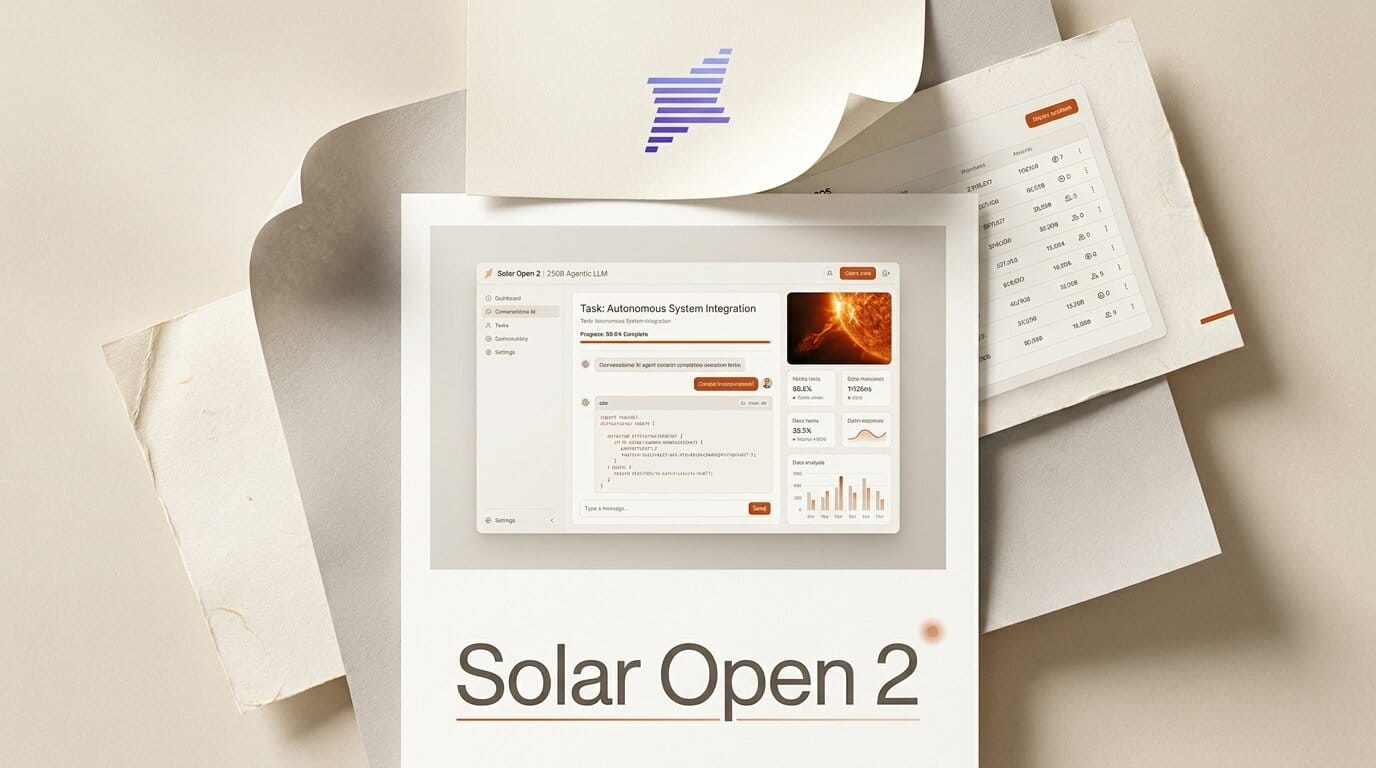
Upstage has released Solar Open 2, a 250-billion-parameter open-weight language model built specifically for long-horizon agentic work: search, tool calling, coding with test loops, and document-heavy office tasks. Only 15 billion parameters activate per token, the context window runs to 1 million tokens, and the Upstage Solar License permits commercial deployment, fine-tuning, and distillation. For builders who want a self-hostable agent brain that is not metered per API call, this is one of the strongest open releases of July 2026.
What Upstage Shipped
Solar Open 2 is a Mixture-of-Experts model: 250B total parameters, 15B active per token, spread across 320 routed experts plus one shared expert, with 8 experts selected per token. The architecture uses hybrid attention that combines grouped-query softmax attention with linear attention, and roughly 75 percent of its 48 layers run the cheaper linear variant. That design is what keeps a 250B model runnable on a small GPU cluster instead of a data center.
The headline numbers, drawn from Upstage's technical report, lean toward agentic and coding tasks: 92.4 on LiveCodeBench, 70.4 on SWE-Bench Verified, 86.2 on MMLU-Pro, and 58.2 on MCP-Atlas for tool calling. The model was announced at Upstage's "Solar Open Weight Day" and, as Korea Times reported, is explicitly positioned for autonomous, multi-step tasks rather than single-turn chat. It supports English, Korean, and Japanese, with a Korean tokenizer that is 50 to 80 percent more token-efficient than global models on Korean text.

How Solar Open 2 Compares to Open-Weight Rivals
The interesting question is not whether Solar Open 2 beats a closed frontier model, but where it sits among the open-weight agent and coding models a builder can actually download and self-host today. The table below lines it up against the current open field. A caveat on methodology: these labs publish different benchmark suites (SWE-Bench Verified is not the same test as SWE-Bench Pro), so treat the coding column as directional, not a like-for-like leaderboard.
| Model | Total / active params | Context | Weights available now | Commercial license | Rough hardware floor |
|---|---|---|---|---|---|
| Solar Open 2 | 250B / 15B (MoE) | 1M | Yes | Yes (Solar License) | 2x H200 (quantized) |
| Laguna S 2.1 | 118B / 8B (MoE) | 1M | Yes | Yes (OpenMDW-1.1) | Single DGX Spark |
| Kimi K3 | 2.8T (MoE) | Long | Weights ~Jul 27 | Open | Multi-GPU server |
| DeepSeek V4 | 1.6T / 49B (MoE) | Long | Stable ~Jul 24 | Open | Multi-GPU server |
Two things stand out. First, Solar Open 2 sits in a practical middle: heavier than a phone-sized model but far lighter to activate than the trillion-parameter releases, so it runs on a two-GPU box rather than a rack. Second, it ships with weights and a permissive license on day one, where Kimi K3 and DeepSeek V4 were announced ahead of their actual weight drops. If you need something to wire into an agent this week, availability matters as much as the benchmark.

What You Can Build With It
Solar Open 2 is tuned for the parts of agent work that break lighter models. The 1M-token context means you can load an entire codebase, a long specification, or a stack of contracts into a single prompt without chunking. The tool-calling score points at reliable multi-step execution: search, call an API, read the result, decide the next step, repeat. Upstage highlights office-document workflows specifically, including spreadsheet and presentation generation, which are exactly the long, structured tasks that trip up 8B-class models.
For a working builder, the concrete play is to run Solar Open 2 as a local endpoint through vLLM and point a coding agent at it, keeping heavy agentic loops off metered cloud APIs. Because the license allows distillation, you can also use it as a teacher to fine-tune a smaller model for a narrow task, then deploy that cheaper student in production. If your work is Korean- or Japanese-language heavy, the tokenizer efficiency alone can cut inference cost meaningfully versus routing the same text through a global model. For agent-heavy coding specifically, it slots next to open frontier coders like Cognition's SWE-1.7 as a self-hosted alternative.

How to Run It
The weights are on Hugging Face now and load through Transformers, vLLM, and compatible frameworks. Upstage lists a hardware floor of four NVIDIA H200 GPUs for full BF16 precision, dropping to two H200s with quantization. A hosted playground is open through July 31, 2026 if you want to test the model's behavior before committing GPU budget to a local deployment. Start there, validate that the tool-calling and long-context behavior fit your agent, then move to self-hosting once you have confirmed the model earns its footprint.
Frequently Asked Questions
Is Solar Open 2 really open-weight?
Yes. The full weights are downloadable from Hugging Face today under the Upstage Solar License, which permits commercial use, fine-tuning, and distillation. Derivative models must carry "Solar" in the name and a "Built with Solar" attribution.
How big is it and how much hardware do I need?
It is a 250B-parameter Mixture-of-Experts model that activates 15B parameters per token. Upstage lists four H200 GPUs for full precision or two H200s with quantization.
What is it best at?
Long-horizon agentic tasks: coding with test loops, tool and API calling, search, and document-heavy office work. Its 1M-token context suits whole-codebase or whole-document prompts.
How does it compare to Kimi K3 and DeepSeek V4?
Those are larger trillion-parameter models, but their weights arrive later in July. Solar Open 2 is smaller to activate, ships weights now, and runs on a two-GPU box, which makes it the more practical self-host option this week.
Can I use it commercially?
Yes, the Solar License allows commercial deployment. You must follow the naming and attribution requirements for any derivative models you release.
Where can I try it without a GPU?
Upstage is running a hosted playground for the model through July 31, 2026, so you can evaluate its behavior before setting up a local deployment.