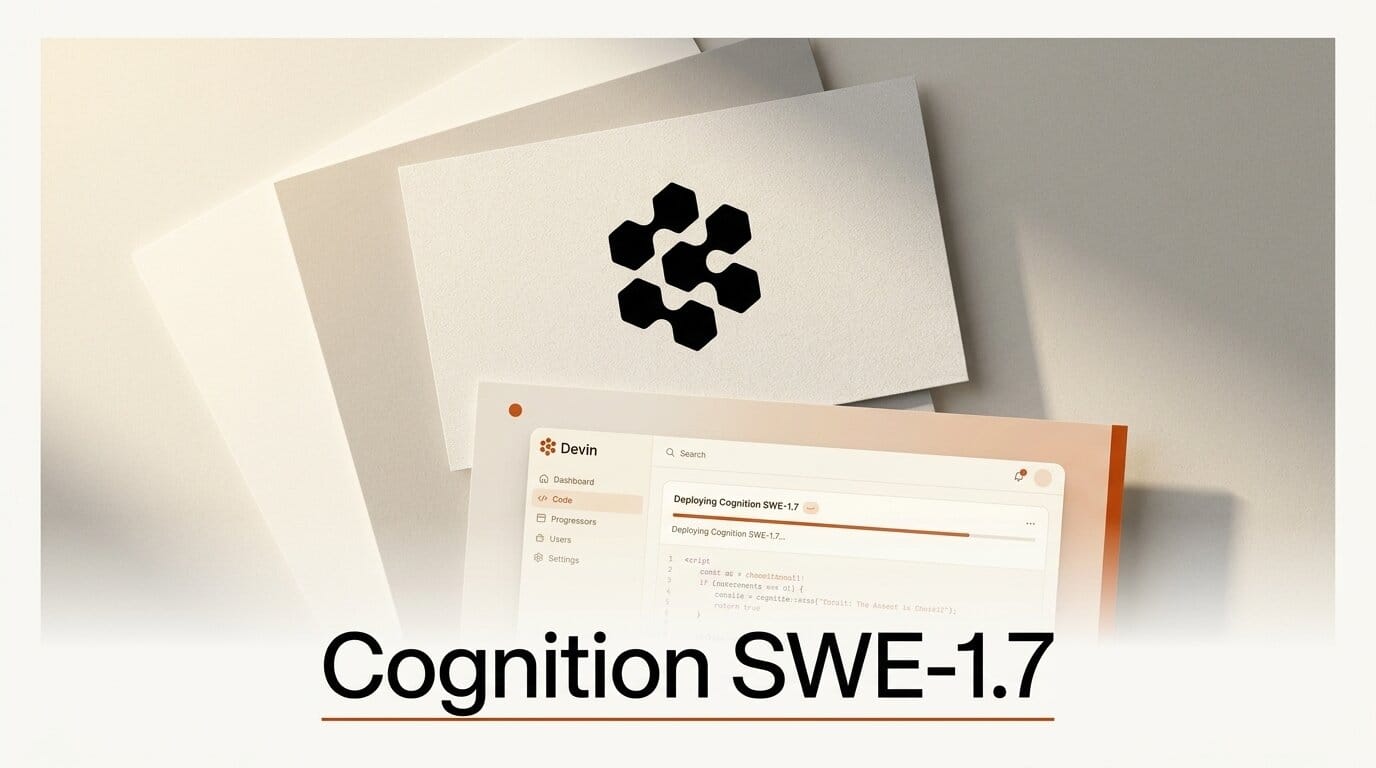
Cognition released SWE-1.7 on July 8, 2026, and the pitch is blunt: near-frontier coding intelligence at a fraction of the price. The model scores 42.3% on Cognition's FrontierCode 1.1 benchmark, sitting just behind GPT-5.5 at 43.0% and Claude Opus 4.8 at 46.5%. It is live inside Devin today, free for paid users for the next month, and runs at 1000 tokens per second on Cerebras hardware. For anyone building software with an AI agent, the headline is not that SWE-1.7 wins the benchmark race. It is that a model this close to the top now costs meaningfully less to run.
What Cognition Actually Shipped
SWE-1.7 is Cognition's most capable model to date and the direct successor to SWE-1.6. It is tuned for software engineering, with a specific focus on longer-horizon asynchronous tasks: the kind of multi-step work where an agent has to plan, edit across many files, run commands, and recover from its own mistakes without a human babysitting every step.
The model is available in Devin across web (app.devin.ai), the desktop app, and the CLI. Cognition is serving it through Cerebras at 1000 tokens per second, which is the part creators will feel first. Agentic coding is bottlenecked by iteration speed as much as by raw intelligence, and a model that streams a thousand tokens a second turns a slow plan-edit-test loop into something closer to real time. Cognition frames the release as advancing the cost-performance Pareto curve rather than topping any single leaderboard.

Reading the Benchmarks
Here is how SWE-1.7 stacks up against the two frontier models it is chasing, plus its own predecessor. Every number below comes from Cognition's published results.
| Benchmark | SWE-1.7 | GPT-5.5 | Claude Opus 4.8 | SWE-1.6 |
|---|---|---|---|---|
| FrontierCode 1.1 | 42.3% | 43.0% | 46.5% | 9.4% |
| Terminal-Bench 2.1 | 81.5% | 84.2% | 86.9% | 39.7% |
| SWE-Bench Multilingual | 77.8% | 76.8% | 84.4% | 58.3% |
Two things stand out. First, SWE-1.7 actually edges out GPT-5.5 on SWE-Bench Multilingual, 77.8% to 76.8%, so this is not a model that is uniformly behind the frontier. Second, the gap to Claude Opus 4.8 is real but narrow: a few points on FrontierCode and Terminal-Bench, a wider spread on multilingual. Third-party trackers like BenchLM put the same story in numbers you can compare against other releases. The value proposition rests on that gap being small enough that the cost savings win for most everyday coding work.
From SWE-1.6 to SWE-1.7: A Big Jump
The most striking column in that table is the last one. SWE-1.6 scored 9.4% on FrontierCode 1.1; SWE-1.7 scores 42.3%. That is not an incremental bump, it is a different class of model. Terminal-Bench more than doubled, from 39.7% to 81.5%, and multilingual coding climbed from 58.3% to 77.8%.
Cognition attributes the leap to broad improvements across its reinforcement learning pipeline: better training infrastructure, more stable training runs, higher-quality data, and new techniques for long-horizon tasks. When we covered SWE-1.6 shipping as a free coding agent, the story was speed and access. This time the story is that the underlying model got dramatically smarter while keeping the same low-cost, high-throughput profile.

Built on a Kimi K2.7 Base
One detail deserves more attention than the benchmark chart. SWE-1.7 was trained from a Kimi K2.7 base, an open-weight model that had already gone through extensive reinforcement learning post-training. Cognition then layered its own RL on top and still extracted large additional gains. The company argues this challenges the idea of a "post-training ceiling," the assumption that a model already heavily post-trained has little room left to improve.
That matters beyond this one release. If a lab can take a strong open base like Kimi K2.7 and push it several points closer to the frontier with focused RL, the moat around closed frontier models gets thinner. As outlets covering the launch noted, SWE-1.7 is a proof point that specialized post-training on open weights can rival purpose-built frontier systems on real coding work.

What This Enables for Builders
The practical takeaway is a cheaper default model for agentic coding that you do not have to feel bad about running on long, iterative tasks. Fast, low-cost, near-frontier is exactly the profile you want for the work that eats the most tokens: large refactors, test-writing sweeps, dependency upgrades, and multi-file feature builds where the agent loops many times.
Here is a simple way to put SWE-1.7 to work this month while it is free for Devin paid users:
- Sign in to Devin on web at app.devin.ai, or open the desktop app or CLI, and select SWE-1.7 as your model.
- Start with a well-scoped, self-contained task: "add input validation to every endpoint in this service and write tests," rather than an open-ended "improve the codebase."
- Let it run the full plan-edit-test loop. Because it streams at 1000 tokens per second, you can watch it iterate instead of waiting on long silent pauses.
- Reserve a frontier model like Opus 4.8 for the genuinely hard reasoning tasks, and route the high-volume, repetitive work to SWE-1.7 to control cost. Our guide to routing tasks across coding models walks through when to escalate.
- Compare the diff quality against your current default on one real task before switching your whole workflow over.
The point of a model like this is not to replace the top of the leaderboard. It is to let you spend frontier-model budget only where it earns its keep.
Frequently Asked Questions
Is SWE-1.7 free to use?
It is free for Devin paid users for one month following the July 8, 2026 launch. After that window, it runs as a standard model inside Devin. Cognition has not published a per-token public price.
How does SWE-1.7 compare to Claude Opus 4.8?
Opus 4.8 leads on every benchmark Cognition published: 46.5% versus 42.3% on FrontierCode 1.1, 86.9% versus 81.5% on Terminal-Bench 2.1, and 84.4% versus 77.8% on SWE-Bench Multilingual. The gap is a few points on most tests. SWE-1.7's argument is that it delivers most of that capability at a much lower cost and higher speed.
Does SWE-1.7 beat GPT-5.5?
On SWE-Bench Multilingual, yes: 77.8% to 76.8%. On FrontierCode 1.1 and Terminal-Bench 2.1, GPT-5.5 is slightly ahead. The two are closely matched overall.
What is SWE-1.7 built on?
It was trained from a Kimi K2.7 base that had already undergone heavy reinforcement learning, with Cognition's own RL pipeline applied on top. The large gains from that additional training are what Cognition points to as evidence against a "post-training ceiling."
Where can I run SWE-1.7?
Inside Devin on web at app.devin.ai, the desktop app, and the CLI. It is served via Cerebras at 1000 tokens per second.
Is 1000 tokens per second actually useful?
For agentic coding, yes. Agents spend most of their time in a loop of reading, editing, and running code. Faster token generation shortens every iteration, which compounds over the dozens of steps a long task requires.