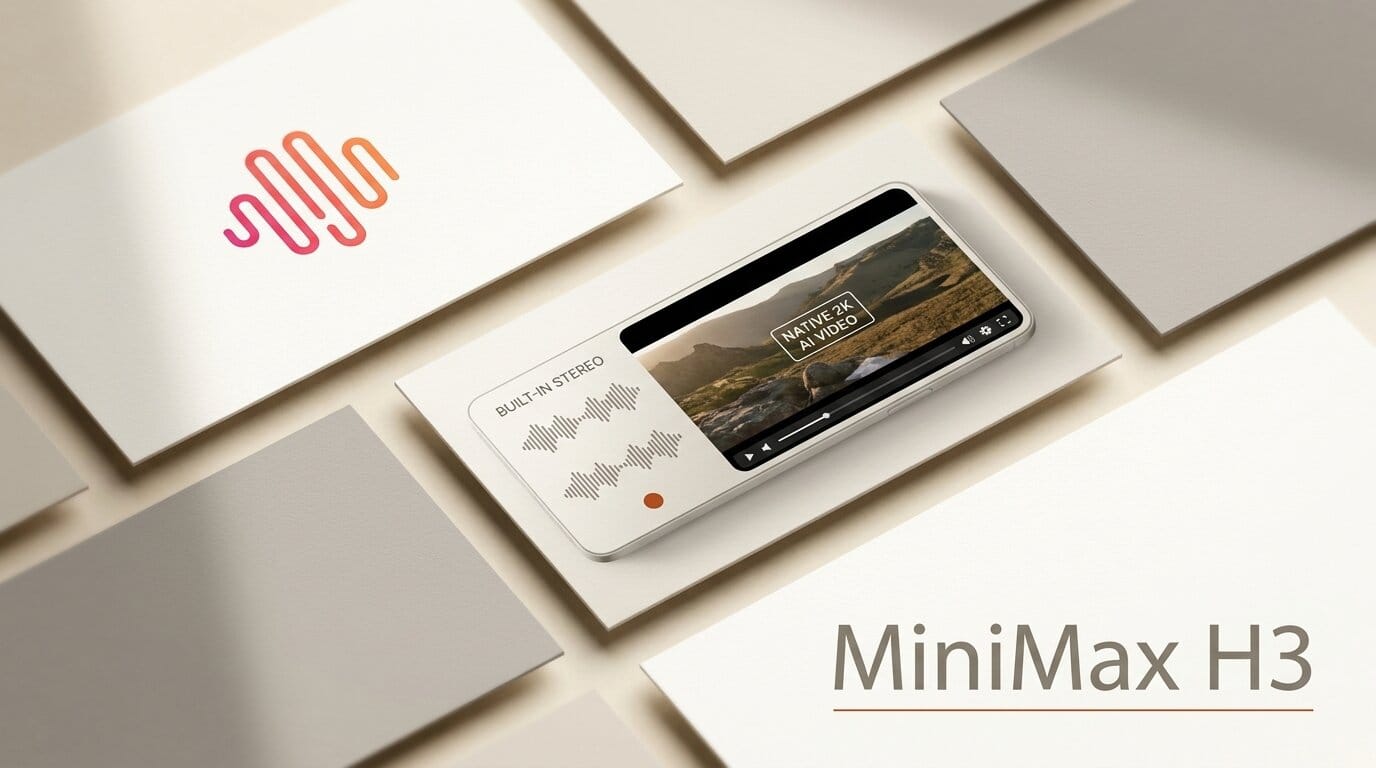
MiniMax released its H3 video model on July 31, 2026, and the pitch is aggressive: native 2K video with built-in stereo sound, an all-modal input system that reads text, images, video, and audio in one pass, and a price MiniMax says runs at less than one third of mainstream rivals. The model is live now in the Hailuo app and through the MiniMax API, and the company says it plans to publish the weights within days under a community license. For creators choosing a video generator, H3 reshapes the cost math more than the capability ceiling.
What MiniMax H3 Ships
H3 is the successor to the Hailuo family and the first MiniMax video model built around an all-modal architecture. It accepts text, images, video, and audio clips as input and generates clips of 5 to 15 seconds at 24 frames per second in native 2K, extendable to roughly 30 seconds, across aspect ratios from 21:9 down to 9:16. The headline capability is native audio: H3 produces dialogue, sound effects, and ambient atmosphere timed to the on-screen action in the same generation pass, which removes the separate audio step most video pipelines still require.
The control layer is where H3 pushes hardest. Its Omni-Reference system accepts up to nine reference images, three video clips, and three audio clips at once to hold style, character identity, motion, and voice consistent across a shot. Instruction-based editing lets you swap a character, alter an object, adjust sound, or re-pace a clip with a text description instead of regenerating from scratch. According to independent breakdowns of the release, that editing focus is what set H3 apart on early rankings.
How H3 Compares to Kling, Veo, and Seedance
H3 lands in a crowded top tier. It competes directly with Kuaishou's Kling 3.0, Google's Veo 3.1, and ByteDance's Seedance 2.0, the model behind recent high-profile AI short films. On the Artificial Analysis rankings published alongside launch, H3 took the number one spot in video editing and placed in the top three for both text-to-video and image-to-video. It does not yet carry an established arena score as a brand-new model, so those positions will move as more head-to-head data lands.
| Model | Max resolution | Native audio | Weights | Relative cost |
|---|---|---|---|---|
| MiniMax H3 | 2K, 24fps | Yes (dialogue + SFX) | Planned, community license | ~1/3 of rivals |
| Kling 3.0 | Native 4K | Limited | Closed | Higher |
| Google Veo 3.1 | Up to 4K | 48kHz synced dialogue | Closed | Higher |
| ByteDance Seedance 2.0 | 2K+ | Yes | Closed | Higher |
The tradeoff is clear. Kling 3.0 still leads on raw resolution with native 4K, and Veo 3.1 holds an edge on high-fidelity synchronized dialogue. H3 counters with the lowest cost in the tier and the only credible open-weights path, which matters more to production teams generating hundreds of clips than a single hero shot does.
Running MiniMax H3 in ComfyUI: Step by Step
ComfyUI added H3 on the same day the weights went public. The path from install to first clip is short if you follow the sequence below.
- Update ComfyUI to version 0.30.0. The H3 nodes require the current release. Older builds will not load the new model type. This mirrors past node drops such as the ComfyUI v0.29.0 model nodes update, where each new model family arrived tied to a specific version.
- Grab the workflow templates. Pull the I2V, R2V, or T2V graph from the Comfy-Org workflow templates repository, or load them from the built-in template browser once you are on 0.30.0.
- Download the models. From the Comfy-Org repository, fetch the diffusion model, the Qwen3-VL text encoder, the video VAE, and the audio VAE, then place each file in its matching ComfyUI directory.
- Choose your variant. Pick bf16 for maximum quality or an int8 or pruned int8 build if you are tight on VRAM.
- Enter your prompt and references, then run. Add a text prompt, and for image-to-video or reference-to-video attach your source frame or clip. Execute the graph and H3 returns the video with its stereo track already muxed in.
Hardware and the Quantized Variants
Native audio and 2K output are not free in memory terms, and this is where the ComfyUI packaging earns its keep. At full bf16 precision the diffusion weights are heavy, but the Comfy-Org repo ships int8 and pruned int8 conversions. According to the ComfyUI post, the smallest pruned build drops the footprint to roughly 42.5 GB from about 123.6 GB at full precision, a reduction that brings H3 within reach of high-end single-GPU setups rather than multi-card rigs. There is also an NVFP4 AWQ text encoder for further savings on the Qwen3-VL component. As with any quantized model, expect a small quality tradeoff at the lowest precisions, so test bf16 first if your hardware allows and step down only if you hit memory limits.
The Local Mac Runners Compared
The three Apple Silicon projects take different engineering routes to the same goal. h3.c is a hand-written Metal engine in C; the MLX ports lean on Apple's array framework for a more Python-native workflow.
| Project | Approach | License | Notable feature |
|---|---|---|---|
| antirez/h3.c | Native Metal in C | MIT | Int8 MLP engine default on M5, interactive session mode |
| appautomaton/mlx-h3 | Pure MLX | Open source | Text-to-video-and-audio in a Python workflow |
| PipeNetwork/minimax-h3-mlx | MLX port | Open source | AdaLN precompute drops 13B of compute at inference |
h3.c is the most complete today. It supports prompt-to-video and audio, first and last frame conditioning (FL2VA), ordered image, video, and audio references (Ref2VA), and text encoding through a Qwen3-VL vision tower. It also ships an interactive session mode that keeps prompt conditioning persistent between generations.
Apple Silicon: Hardware and Speed
This is where expectations need calibrating. Running a 33B diffusion model locally is possible, but it is not fast on today's hardware.
| Setup | Task | Result |
|---|---|---|
| M5 Max, 128 GB | End-to-end video plus audio | ~74 to 77 seconds, ~40 GB peak memory |
| M5 Pro, 64 GB | 9-second 480x864 clip, 20 steps | A bit over an hour (community report) |
| M3 Max | Metal block parity target | Supported, slower than M5 |
The README's headline number, roughly 75 seconds on an M5 Max, reflects a short clip at a modest resolution. As commenters on the Hacker News thread pointed out, wall-clock time swings hard with resolution, duration, and step count. antirez himself framed the release as a fast Metal implementation and invited others to reuse the code, as he noted in his announcement post. Peak memory stayed near 40 GB with zero swap in his tests, which is the more reassuring figure for anyone with 64 GB or more.
How to Run MiniMax H3 on Your Mac
The h3.c workflow is deliberately minimal. Here is the shape of it:
- Check your hardware. You want an Apple Silicon Mac with substantial unified memory. 64 GB is a practical floor for short clips; 128 GB gives headroom for longer or higher-resolution output.
- Install FFmpeg. Both FFmpeg and FFprobe must be on your PATH. Grab them from the FFmpeg project or via Homebrew.
- Download the weights. Pull the MiniMax-H3 weights from Hugging Face into a local directory.
- Build the engine. Clone h3.c and compile with
make -j8. - Generate. Run
./h3 -d ./MiniMax-H3with your prompt and options. Keep canvas dimensions to multiples of 32, with width times height at or under 768 by 1344 pixels. Start at 512x512 to validate, then scale up. - Iterate in session mode. Use the interactive mode to hold conditioning steady while you refine prompts, rather than reloading the model each time.
Frame counts align upward to a 5 plus 17n pattern at 24 fps, so a request lands on clean durations like roughly 0.9 seconds for 22 frames or about 10 seconds for 243 frames.
What This Enables for Creators
The practical unlock is volume. At MiniMax's stated $0.13 per second of 2K video, a 15-second clip costs under $2, and the native audio means you skip a separate sound pass entirely. For an ad team iterating on ten variations of a product spot, or a short-form creator testing hooks, that price and that single-pass workflow change what is economically sensible to generate. You can afford to throw away nine takes to get one.
The Omni-Reference system is the piece to build a workflow around. Feed it a locked character sheet, a motion reference, and a voice sample, and H3 will hold that identity across a sequence of shots, which is the exact consistency problem that breaks most multi-clip AI video projects. Pair it with instruction-based editing and you can revise a single element without re-rolling the whole scene, closer to how a real edit works. If you already run a comparison-driven pipeline, our breakdown of real-time AI video editing tools is a useful frame for where H3 fits.

The Open-Weights Angle
The strategically loaded line in the announcement is the weights. MiniMax said it plans to release H3's weights within days under the MiniMax Community License, which would make it the leading open-weights video model by a wide margin. That extends the open-weights approach Chinese labs have driven in text and image generation into video, a category where nearly every top model stays proprietary. H3 was also engineered to run on Chinese-made semiconductors, part of MiniMax's broader push to decouple from restricted hardware. This is a plan, not a shipped download yet, so treat the open-weights claim as announced intent until the repository is live.
Pricing and Availability
H3 is available today. You can generate in the Hailuo app or call it through the MiniMax API, with full parameters in the video generation docs. MiniMax lists pricing at roughly $0.13 per second of 2K output, about $7.80 per minute, which the company frames as under a third of comparable commercial models. The model targets advertising, e-commerce, product design, and gaming use cases where cost per clip compounds fast.
Frequently asked questions
What is MiniMax H3?
H3 is MiniMax's all-modal video generation model released July 31, 2026. It generates 5 to 15 second clips at 24fps in native 2K resolution with built-in stereo audio, and accepts text, image, video, and audio as input.
How much does MiniMax H3 cost?
MiniMax lists H3 at about $0.13 per second of 2K video, roughly $7.80 per minute, which it says is less than one third the price of mainstream rival video models. It is available in the Hailuo app and via the MiniMax API.
Is MiniMax H3 open source?
MiniMax announced plans to release H3's weights within days under the MiniMax Community License, which would make it the strongest open-weights video model available. As of launch the weights are announced but not yet published, so it is best described as a planned open-weights release.
How does H3 compare to Kling 3.0 and Veo 3.1?
Kling 3.0 leads on native 4K resolution and Veo 3.1 offers higher-fidelity synchronized dialogue, but H3 undercuts both on price and is the only one of the three with a planned open-weights release. Artificial Analysis ranked H3 first in video editing and top three in text-to-video and image-to-video at launch.
What is the Omni-Reference system?
Omni-Reference lets H3 accept up to nine reference images, three video clips, and three audio clips simultaneously to keep style, character identity, motion, and voice consistent across generations. It is designed to solve the character-consistency problem that breaks most multi-clip AI video projects.
Can H3 generate audio with video?
Yes. H3 produces dialogue, sound effects, and ambient atmosphere timed to the on-screen action in the same generation pass, removing the separate audio workflow that most video models still require.