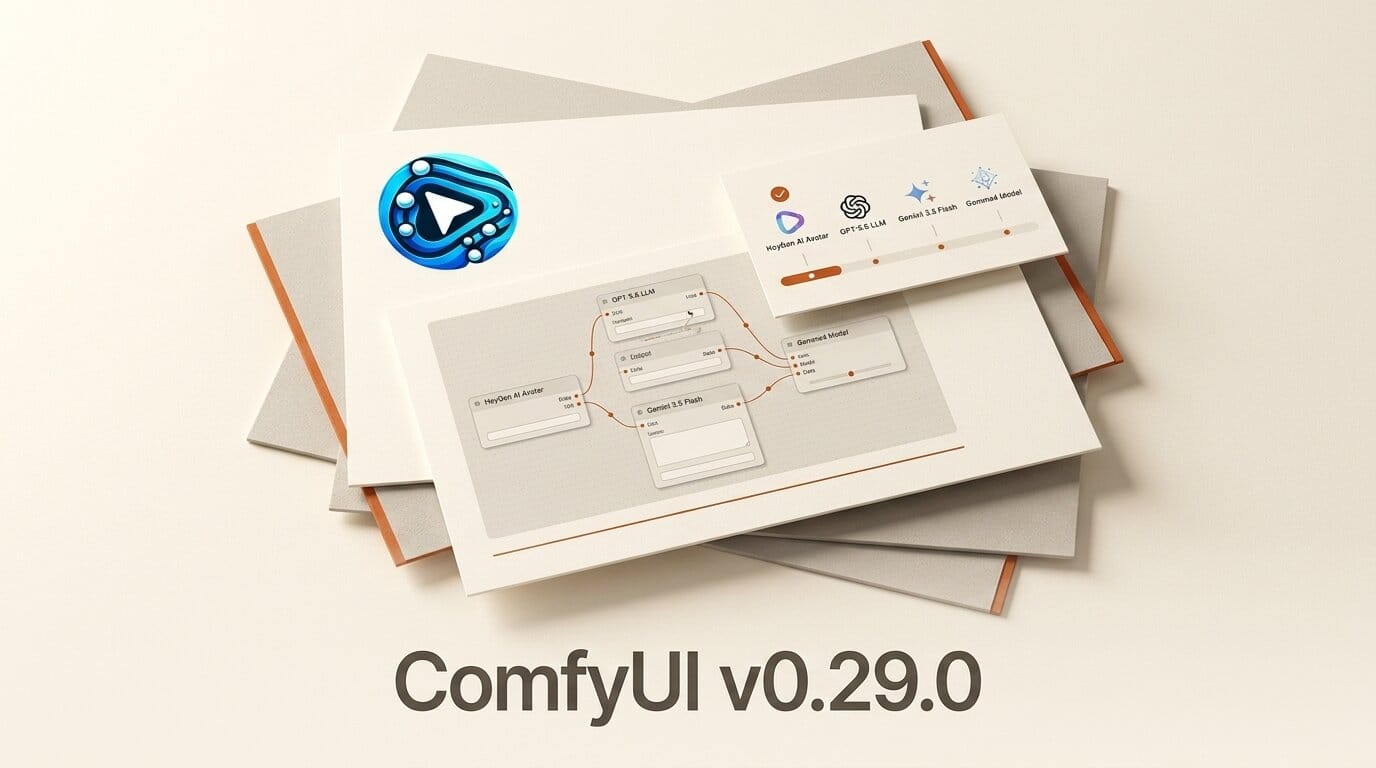
ComfyUI tagged v0.29.0 on July 28, 2026, and the headline is not one marquee feature but the sheer breadth of new model support landing in a single version. This release wires in HeyGen avatar and voice nodes, OpenAI GPT-5.6, Google Gemini 3.5 Flash, Gemma4 12B, ByteDance's multilingual seed-audio model, and a new JoyImageEdit image editor, alongside video training nodes and a round of int8 performance work. For anyone who runs their generative stack inside ComfyUI, one update quietly adds a half-dozen new pipelines you can build on today.
What Shipped in ComfyUI v0.29.0
ComfyUI is the open-source, node-based runtime that a large share of creators use to chain image, video, and audio models into a single visual workflow. Rather than shipping a headline model of its own, the project ships integrations: each release folds new partner APIs and open-weights models into nodes you drag onto the canvas. v0.29.0 is one of the largest such bundles this year, spanning 53 commits since v0.28.3 and bumping the bundled comfyui-frontend-package to 1.47.10.
The pattern matters more than any single node. A creator no longer has to leave the graph to reach a new avatar service, a new frontier LLM, or a new audio voice: the node is already there, sharing the same latents, conditioning, and batch controls as the rest of the pipeline. Here is what the release adds, grouped by what a creator would actually build with it.

| Category | New in v0.29.0 | What you can build |
|---|---|---|
| Image editing | JoyImageEdit native support, Krea 2 reference images and identity-edit ref LoRAs | Instruction-based edits and consistent-character reference workflows |
| Avatar and video | HeyGen Avatar, Talking Photo, Create Avatar, Video Translate, and TTS nodes; Uni3C ControlNet for Wan models | Talking-head avatars, dubbing, and camera-controlled video generation |
| LLM partner nodes | OpenAI GPT-5.6, Google Gemini 3.5 Flash, new Anthropic models, new OpenRouter models | Prompt expansion, captioning, and agentic steps inside a graph |
| Open weights | Gemma4 12B support | Local text conditioning without a paid API |
| Audio | ByteDance seed-audio-1.0-multilingual node | Multilingual voice and audio generation in-graph |
| Training and video | Video processing nodes, image-processing video support, trainer video support | Dataset prep and fine-tuning on video inside ComfyUI |
The New Model Nodes, Grouped by Job
On the image side, JoyImageEdit brings instruction-driven editing directly into the graph, while the Krea 2 additions add reference-image conditioning and identity-edit reference LoRAs, the building blocks for keeping a character consistent across a series of renders. Both slot into existing sampler and conditioning chains rather than living in a separate app.
The avatar and video additions are the most visible. A full set of HeyGen nodes now covers avatar creation, talking photos, video translation, and text-to-speech, which means a creator can script, voice, and animate a presenter without leaving ComfyUI. Uni3C ControlNet support for Wan video models adds native camera and 3D control, and fixes to Anima's lightweight control models plus a model-agnostic FreSca pass tighten up animation control.

For text steps, the release adds partner nodes for OpenAI GPT-5.6 and Google Gemini 3.5 Flash, plus refreshed Anthropic and OpenRouter model lists, so prompt rewriting, captioning, or agentic decision steps can run against a current frontier model mid-graph. Gemma4 12B lands as an open-weights option for anyone who would rather keep that step local. On audio, a ByteDance seed-audio-1.0-multilingual node adds multilingual voice generation. The project also deprecated the older Runway Gen3a node, a reminder that the integration list is curated, not just additive.
Why It Matters for Creators
The strategic point of a release like this is consolidation. Instead of stitching together a browser tab for HeyGen, a script for an LLM call, and a separate audio tool, a creator can keep the entire pipeline in one runtime where every stage passes data to the next. That is the same thesis behind purpose-built ComfyUI front ends such as Mix Studio, and it is why open image and video models like FLUX 3 increasingly ship with ComfyUI nodes on day one.
The breadth also lowers the cost of experimenting. Because these are nodes, not installs, trying GPT-5.6 for prompt expansion or swapping in Gemma4 12B to keep a step local is a matter of dragging a different block onto the canvas. The friction of evaluating a new model drops close to zero, which is exactly what a working creator wants when a new tool lands every week.
How to Update and Try the New Nodes
Updating is the same routine as any ComfyUI point release, and the new nodes appear in the node search the moment you restart.
1. Update the core. In the ComfyUI Manager, use Update All, or pull the v0.29.0 tag from Git and reinstall requirements. Portable and desktop builds can update from the app itself.
2. Restart and confirm the version. Relaunch, then check the version indicator to confirm 0.29.0 and the 1.47.10 frontend. Consult the ComfyUI documentation if a partner node needs an API key configured.
3. Add API keys for partner nodes. HeyGen, GPT-5.6, Gemini, Anthropic, OpenRouter, and ByteDance nodes call hosted services, so add each provider key in settings before wiring them in.
4. Build one new pipeline. Start small: feed an image into a JoyImageEdit node, or send a script through a HeyGen Talking Photo node, and connect the output to your existing preview and save nodes.

Performance and Memory Changes
v0.29.0 is not only about new nodes. A round of comfy-kitchen int8 optimizations speeds up several model families, video transcoding now streams instead of buffering every frame in RAM, the latent upsampler moved to dynamic VRAM handling, and the memory clamp was raised to 128GB for high-end rigs. Several image and video models were rewired to use the optimized RMS rope functions. For creators on constrained GPUs, the streaming-transcode and dynamic-VRAM changes are the quiet wins that keep long video jobs from falling over.
Frequently Asked Questions
Is ComfyUI v0.29.0 stable or a preview?
v0.29.0 is tagged as a standard versioned release on the main ComfyUI repository, following the v0.28.x series. As with any point release, back up custom workflows before updating in case a third-party custom node needs its own update.
Do the new HeyGen, GPT-5.6, and Gemini nodes cost money?
Those are partner nodes that call hosted services, so usage is billed by each provider under your own API key. Gemma4 12B is the open-weights option in this release if you want to keep a text step local and free.
What is the difference between JoyImageEdit and existing edit nodes?
JoyImageEdit adds native instruction-based image editing to the graph. Combined with the new Krea 2 reference-image and identity-edit LoRA support, it targets consistent-character and reference-guided editing workflows.
Can I generate talking-avatar video entirely inside ComfyUI now?
The new HeyGen nodes cover avatar creation, talking photos, text-to-speech, and video translation, so a script-to-avatar pipeline can run in one graph. Uni3C ControlNet adds camera control for Wan video models in the same workflow.
Will this update break my existing workflows?
Core graphs generally carry over, but the release deprecated the Runway Gen3a node, so any workflow relying on it will need a swap. Custom nodes from third parties should be updated alongside core to avoid mismatches.
Where can I see the full changelog?
The complete list of changes is on the v0.29.0 release tag and in the compare view against v0.28.3 on the ComfyUI GitHub repository.